
 Neet Rank Predictor
 NEET UG Predictor
 MDS Predictor
 INI CET Predictor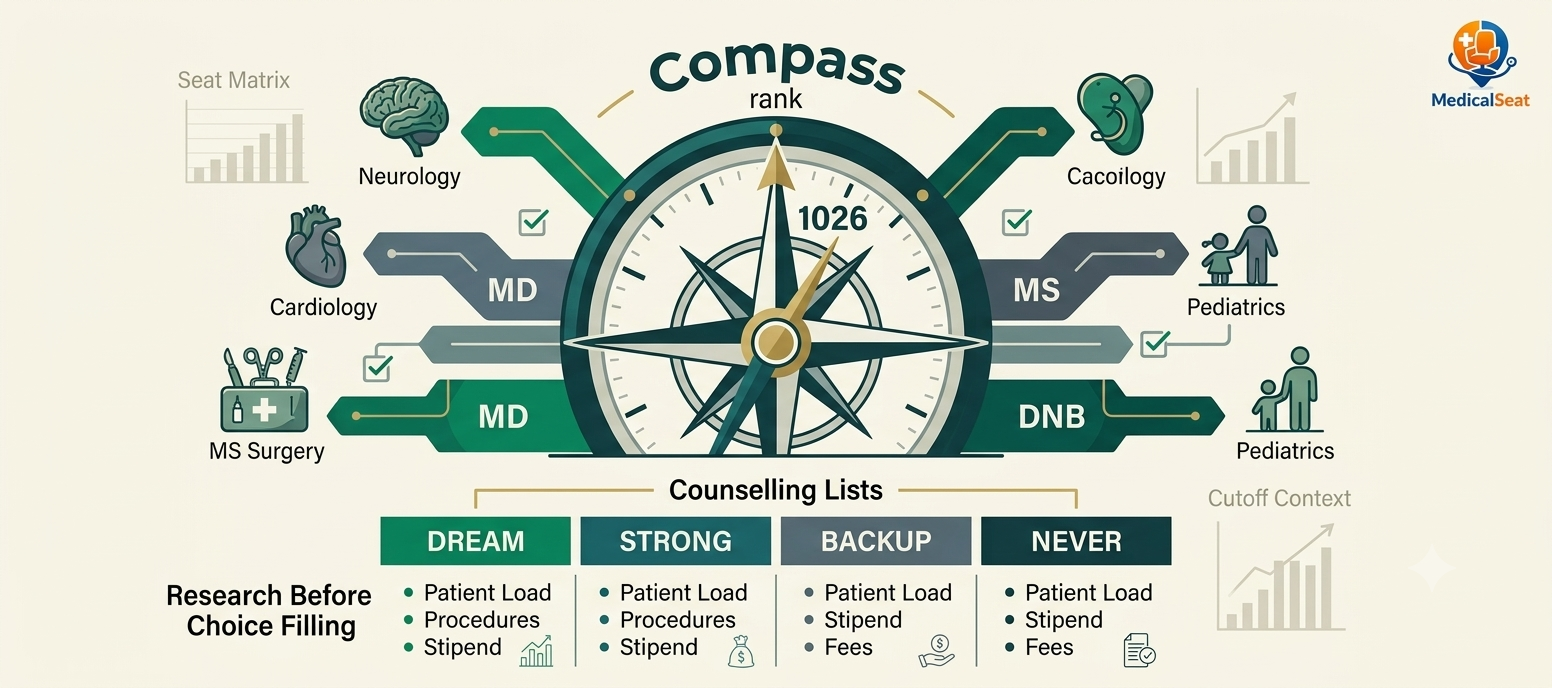
NEET PG 2026 Rank Is Not Your Branch
The NEET PG 2026 result has arrived. And within hours, the internet has already started doing what it does best. Turning thousands of individual careers into cutoff numbers. One candidate wants to know whether they can get MD Medicine. Another is searching for the latest NEET PG cutoff 2026. Someone is comparing their rank with a closing rank from 2024. Someone else has opened a NEET PG college predictor. And somewhere in a WhatsApp group, somebody has confidently declared that a particular branch is “wasted” at a particular rank. This is the part of the NEET PG journey where you need to slow down.
Your NEET PG 2026 rank matters.
A lot.
But your rank does not automatically tell you which specialty you should choose, which college is best for you or whether MD, MS or DNB is the right postgraduate path.
The result tells you where you stand.
Counselling decides what you do with that position.
And that decision deserves considerably more thought than a screenshot of last year's cutoff.
The Rank Is Only One Variable
The easiest way to misunderstand your NEET PG rank 2026 is to treat it as a direct college allocation number.
It is not.
Your possible options depend on several factors.
Rank
Category
Quota
Domicile
Specialty
College
Seat availability
Counselling round
Choice order
Counselling authority
This is why two candidates with similar ranks can have completely different counselling outcomes.
One may be willing to move anywhere in India.
Another may have a strong state preference.
One may consider DNB.
Another may want only MD or MS.
One may have a flexible budget.
Another may have a strict financial limit.
Their ranks may look similar.
Their counselling strategies should not.
Stop Asking What Rank Gets
The question “What can I get with my rank?” is understandable.
It is also incomplete.
A better question is:
What are all the realistic options available at my rank?
Then ask:
Which of those options would I actually choose?
That second question is where proper counselling strategy begins.
A NEET PG rank wise college list can show possible options.
It cannot decide your priorities.
You may discover that your rank gives you access to a specialty you had not considered.
You may also discover that a branch you assumed was impossible is actually worth researching through another counselling route.
This is why candidates should avoid reducing their entire counselling strategy to one predicted college.
Your Cutoff Search Needs Context
The next few weeks will be full of searches for:
NEET PG cutoff 2026
NEET PG closing rank 2026
NEET PG college wise cutoff
NEET PG branch wise cutoff
NEET PG rank wise college
These are useful searches.
But the numbers need context.
A closing rank without its surrounding information can be almost meaningless.
When looking at historical NEET PG cutoffs, always identify:
Year
Round
College
Specialty
Category
Quota
Course
For example, an AIQ closing rank for General category MD Medicine cannot automatically be used to predict a state quota seat for another category.
The number may be accurate.
The conclusion can still be completely wrong.
2025 Data Cannot Predict Everything
Previous year data should absolutely be part of your research.
But it should not become your crystal ball.
The NEET PG 2026 counselling landscape has its own seat availability and candidate preferences.
NMC published the postgraduate seat matrix for the 2026 to 27 academic year on September 29, 2026.
That means candidates should combine historical counselling trends with the latest NEET PG 2026 seat matrix rather than copying an old college list.
A new seat can change the competitive landscape.
A changed intake can affect availability.
A different choice pattern can affect closing ranks.
A later counselling round can produce a different outcome from Round 1.
Historical data gives you direction.
It does not give you a guarantee.
The Seat Matrix Changes Your Strategy
The current seat matrix deserves serious attention before choice filling begins.
You need to understand where the postgraduate seats actually exist.
Look for:
MD seats
MS seats
DNB seats
PG Diploma seats where applicable
Government medical college seats
Private medical college seats
Deemed university seats
Specialty wise availability
Category wise availability
The relevant availability depends on the counselling authority and eligibility conditions.
This is why the latest official seat matrix should sit beside your previous year cutoff research.
One tells you what happened.
The other tells you what is available now.
Do Not Pick A Branch Blindly
Here is the uncomfortable part.
Your rank may make you eligible for a specialty you never wanted.
And everyone around you may tell you to take it.
Why?
Because it is competitive.
Because it has a high cutoff.
Because someone says it has better income.
Because the branch is “in demand.”
Because your rank is supposedly too good to “waste.”
None of those reasons tells you whether you will enjoy the actual work.
Before choosing a specialty, ask yourself:
Do I enjoy this kind of patient care?
Do I like the procedures involved?
Can I handle the workload?
Do I like emergency work?
Do I prefer long term patient management?
Do I enjoy diagnostic decision making?
Do I want surgical training?
Do I prefer outpatient based practice?
Would I actually want to practise this specialty after residency?
These questions are more important than a cutoff screenshot.
Your Residency Will Not Be Instagram
The branch may look attractive on Instagram.
Residency is different.
A specialty is not a three letter abbreviation.
It is your daily work.
It means patients.
Night duties.
Emergencies.
Procedures.
Rounds.
Cases.
Documentation.
Academics.
Examinations.
Thesis work.
And thousands of hours spent inside a department.
Before choosing a specialty, try to understand what residents actually do.
Ask current residents where possible.
Look at the patient volume.
Understand the procedures.
Understand the emergency workload.
Understand the academic schedule.
Understand the department culture.
Your NEET PG specialty choice should survive contact with reality.
College Name Does Not Guarantee Training
The same mistake happens with colleges.
Candidates see a famous name and assume the training must automatically be superior.
Sometimes it is.
Sometimes the reality is more complicated.
For postgraduate training, the relevant department matters enormously.
When comparing NEET PG colleges, look at:
Factor | What To Check |
Patient load | OPD, IPD and emergency volume |
Case mix | Variety and complexity |
Procedures | Resident exposure |
Surgery | OT volume and participation |
Faculty | Department strength |
Academics | Teaching and journal clubs |
Infrastructure | ICU, OT and diagnostics |
Research | Thesis and research opportunities |
Workload | Duty pattern |
Stipend | Current payment |
Fees | Total programme cost |
Location | Living expenses and accessibility |
The best known college is not automatically the best option for every specialty.
Compare MD MS DNB Properly
The MD vs MS vs DNB debate will probably become louder now.
Try not to fall into the trap of turning it into a simple hierarchy.
MD, MS and DNB represent different postgraduate pathways and specialities.
The better question is:
Which actual programme gives me the training I want?
Compare the hospital.
Compare the patient volume.
Compare the department.
Compare procedures.
Compare faculty.
Compare academics.
Compare fees.
Compare stipend.
Compare workload.
Compare location.
A strong DNB programme can be an excellent option.
A strong MD or MS programme can be an excellent option.
The qualification name alone does not tell you everything about the residency experience.
Government College Is Not Automatically Best
Government medical colleges are often highly attractive because of their fees, patient volume and reputation.
But that does not mean every government seat is automatically the best choice for every candidate.
You still need to examine:
Specialty
Department
Clinical exposure
Patient load
Location
Infrastructure
Academics
Stipend
A government seat in a specialty you do not want may not be a better personal choice than a different postgraduate option that matches your career goals.
The same logic applies to private and deemed medical colleges.
Private Fees Need Serious Calculation
This is where dreams meet mathematics.
A candidate may shortlist a private or deemed medical college because the specialty is attractive.
Then they see the total cost.
The actual financial commitment can include:
Tuition
Hostel
Mess
Security deposit
Examination fees
Other institutional charges
Living expenses
Travel
And other compulsory costs
Do not compare colleges using tuition fees alone.
Calculate the approximate cost of the entire programme.
If the financial burden is too high, the seat may not be a realistic choice even if it looks excellent academically.
DNB Deserves A Fresh Look
Some candidates remove DNB from their list before researching it.
That can unnecessarily reduce their options.
DNB training takes place through accredited hospitals and institutions, and the actual experience can vary considerably between programmes.
Instead of asking:
“Is DNB good?”
Ask:
“Is this DNB programme good for the specialty I want?”
Check the hospital.
Check patient volume.
Check procedures.
Check emergency exposure.
Check academics.
Check faculty.
Check stipend.
Check workload.
Check location.
Then compare that programme against the MD or MS alternatives available at your rank.
That is a much more useful comparison.
MCC And State Counselling Matter
Your NEET PG counselling 2026 strategy may involve more than one counselling route.
MCC conducts its designated postgraduate counselling process, including 50% All India Quota seats and other specified categories.
State counselling authorities manage admissions under their respective jurisdictions.
Depending on your eligibility, you may therefore need to track both central and state counselling updates.
Keep an eye on:
Registration dates
Seat matrix
Eligibility rules
Choice filling
Allotment results
Reporting dates
Upgrade rules
Resignation rules
Do not assume that one registration covers every opportunity available to you.
Your Domicile Can Matter
A candidate looking only at AIQ possibilities may underestimate their options.
State counselling can create additional possibilities depending on domicile and eligibility.
That is why your NEET PG college predictor should ideally be used alongside information about your counselling routes.
Your rank is not the only input.
Your eligibility determines which parts of the postgraduate seat pool you can actually compete for.
Before rejecting an option, check whether you are looking at the correct quota and counselling route.
Build Four Counselling Lists
Instead of immediately creating one giant preference list, make four.
List One: Dream Options
These are your highest priority choices.
Competition may be intense.
That is okay.
List Two: Strong Options
You would be genuinely happy with these choices.
List Three: Backup Options
You would accept these if your preferred choices are unavailable.
List Four: Never Choices
You would not join these seats.
This final list is extremely important.
If you know you would never join a specialty or institution, do not place it in your preference list just because the cutoff makes it look attractive.
Your Choice Order Actually Matters
Imagine you have four options.
A: Favourite specialty, average college.
B: Second favourite specialty, excellent college.
C: Favourite specialty, excellent college.
D: Good specialty, much lower fees.
There is no universal ranking.
Your priorities determine the order.
If specialty matters most, A may rank above B.
If college matters most, B may rank higher.
If C combines your top priorities, it may go first.
If finances dominate, D may move up.
This is why NEET PG choice filling should be done after you have decided what matters to you.
Not before.
Use Predictors Before Making Choices
A NEET PG college predictor 2026 can make the research process much faster.
Instead of manually checking hundreds of institutions, you can use your rank and relevant admission information to identify possible options.
MedicalSeat's NEET PG Predictor 2026 can help candidates explore potential MD, MS and DNB options using factors such as rank, category, domicile, quota and counselling trends.
This is useful for discovery.
But remember the difference between:
Possible
and
Preferred
A predictor helps you find the first.
Your research determines the second.
What To Research Before Choice Filling
Before you finalise your NEET PG choice filling 2026, research every serious option on your list.
At minimum, check:
Specialty
College
Hospital
Patient load
Clinical exposure
Procedures
Faculty
Academics
Fees
Stipend
Hostel
Location
Previous closing trends
Current seat availability
You do not need to know everything about every college in India.
You do need to know enough about the options you are actually prepared to join.
Your Choice List Should Be Honest
This is where counselling becomes personal.
Suppose your family wants a particular college.
Your friends want a particular specialty.
Your seniors recommend another branch.
Social media says something else.
At the end of the day, you are the person who will spend three years in residency.
Your choice list should reflect your priorities.
Not someone else's.
If you genuinely prefer a particular specialty in a less famous college, that preference is valid.
If you prioritise location because of family responsibilities, that is valid.
If affordability is a major consideration, that is valid.
If you want a specific clinical environment, that is valid.
Counselling is not a popularity contest.
Do Not Panic About Round One
Round 1 can create enormous anxiety.
Candidates see their allotment and immediately think everything is final.
But counselling processes have multiple rounds and specific rules governing reporting, participation, upgrades and subsequent choices.
The exact rules depend on the counselling authority and the current year.
Read the official instructions before making decisions about an allotted seat.
Do not rely on:
“Everyone is saying…”
“My senior told me…”
“This Telegram group says…”
Counselling rules are published by the relevant authorities.
Follow those.
Keep Your Documents Ready Now
Do not wait for registration to begin.
Keep your important documents organised.
These can include:
NEET PG 2026 scorecard
NEET PG admit card
MBBS degree or provisional certificate
MBBS marksheets
Internship completion certificate
Medical registration certificate
Identity proof
Category certificate
EWS certificate where applicable
Domicile certificate where applicable
PwBD documents where applicable
NRI documents where applicable
The exact document requirements can vary.
Check the latest instructions for the counselling authority you are applying through.
Avoid These NEET PG Mistakes
Chasing The Highest Cutoff
A high cutoff does not automatically mean the specialty is right for you.
Copying Another Candidate
Their rank and priorities are different.
Ignoring DNB
You may unnecessarily eliminate good postgraduate options.
Using Old Seat Data
Always check the current 2026 seat matrix.
Looking Only At College Names
The department and hospital determine much of your training experience.
Ignoring Financial Reality
A seat you cannot realistically afford is not a useful preference.
Filling Random Choices
Only include seats you would genuinely consider joining.
Waiting Until Choice Filling
Research before the portal opens.
Your Next Seven Days Matter
You do not need to solve your entire career tonight.
But you should start.
Day One: Understand Your Rank
Confirm your scorecard, rank, category and eligibility.
Day Two: Shortlist Specialties
Separate preferred, possible and unwanted specialties.
Day Three: Check Seat Matrix
Review the latest NEET PG 2026 seat matrix.
Day Four: Research Cutoffs
Study previous year closing ranks with full context.
Day Five: Research Colleges
Compare departments, hospitals, fees and clinical exposure.
Day Six: Check Counselling
Track MCC and applicable state counselling updates.
Day Seven: Build Preferences
Create your dream, strong, backup and never choice lists.
You do not need a perfect strategy.
You need a researched one.
Your NEET PG Result Starts Decisions
The exam is over.
The rank is out.
The waiting is changing into decision making.
This is where your NEET PG 2026 rank becomes useful.
Not because it tells you exactly what you will get.
But because it gives you the starting point for building a realistic set of options.
Use the NEET PG cutoff 2026 data carefully.
Use the current NEET PG seat matrix 2026.
Research MD, MS and DNB.
Compare government, private and deemed colleges.
Track MCC and state counselling.
Use a NEET PG college predictor to identify possibilities.
Then build your choice list around what you actually want.
Because the biggest mistake after NEET PG is not having a bad rank.
It is having a good enough rank and making a bad decision with it.
Your result tells you where you are.
Your counselling strategy determines where you go next.
MedicalSeat NEET PG 2026 Resources
The NEET PG 2026 result gives you the number.
Now you need to build the strategy around it.
MedicalSeat's NEET PG Predictor 2026 can help you explore possible MD, MS and DNB colleges based on your rank and relevant admission factors.
The NEET PG Counselling 2026 resource can help you track counselling information, college options, choice filling and postgraduate admission planning.
Use the predictor to discover options.
Use the seat matrix to understand availability.
Use previous closing ranks to understand competition.
Use college research to understand training.
And use your own priorities to decide what belongs at the top.
Because after months of preparing for NEET PG, your next challenge is not another exam.
It is making sure you do not waste the rank you worked so hard to earn.