
 Neet Rank Predictor
 NEET UG Predictor
 MDS Predictor
 INI CET Predictor
Blog & Knowledge Hub
Expert guides, Counselling updates, and medical education insights

Why Deemed Universities Fill Faster Than You Think
Every counselling season, a familiar story repeats itself: a candidate treats deemed university seats as a comfortable fallback — something to think about "if government doesn't work out" — and by the time they seriously look at the deemed university seat matrix, the realistic options have already thinned out dramatically. This isn't bad luck. It's the predictable result of how deemed university admissions are structurally built to move faster than government or state quota counselling.

Documents Required for Foreign Students Seeking MBBS Admission in India
For foreign students pursuing MBBS in India, the biggest obstacle is rarely NEET rank — it's paperwork. A single missing AIU equivalence certificate, a name spelled inconsistently across a passport and a marksheet, or an FRRO registration completed a day too late can stall or derail an admission that was otherwise fully earned. This guide organizes every document a foreign student typically needs, stage by stage, from academic equivalence checks all the way through to post-arrival compliance in India.

Can International Students Participate in MCC Counselling?
Yes, international students can participate in MCC counselling — but "international student" isn't one single eligibility category, and the rules differ sharply depending on whether you're an OCI cardholder, an NRI-sponsored candidate, or a foreign national with no Indian citizenship connection at all. Getting this distinction wrong is one of the most common and most costly mistakes families make during NEET UG counselling.
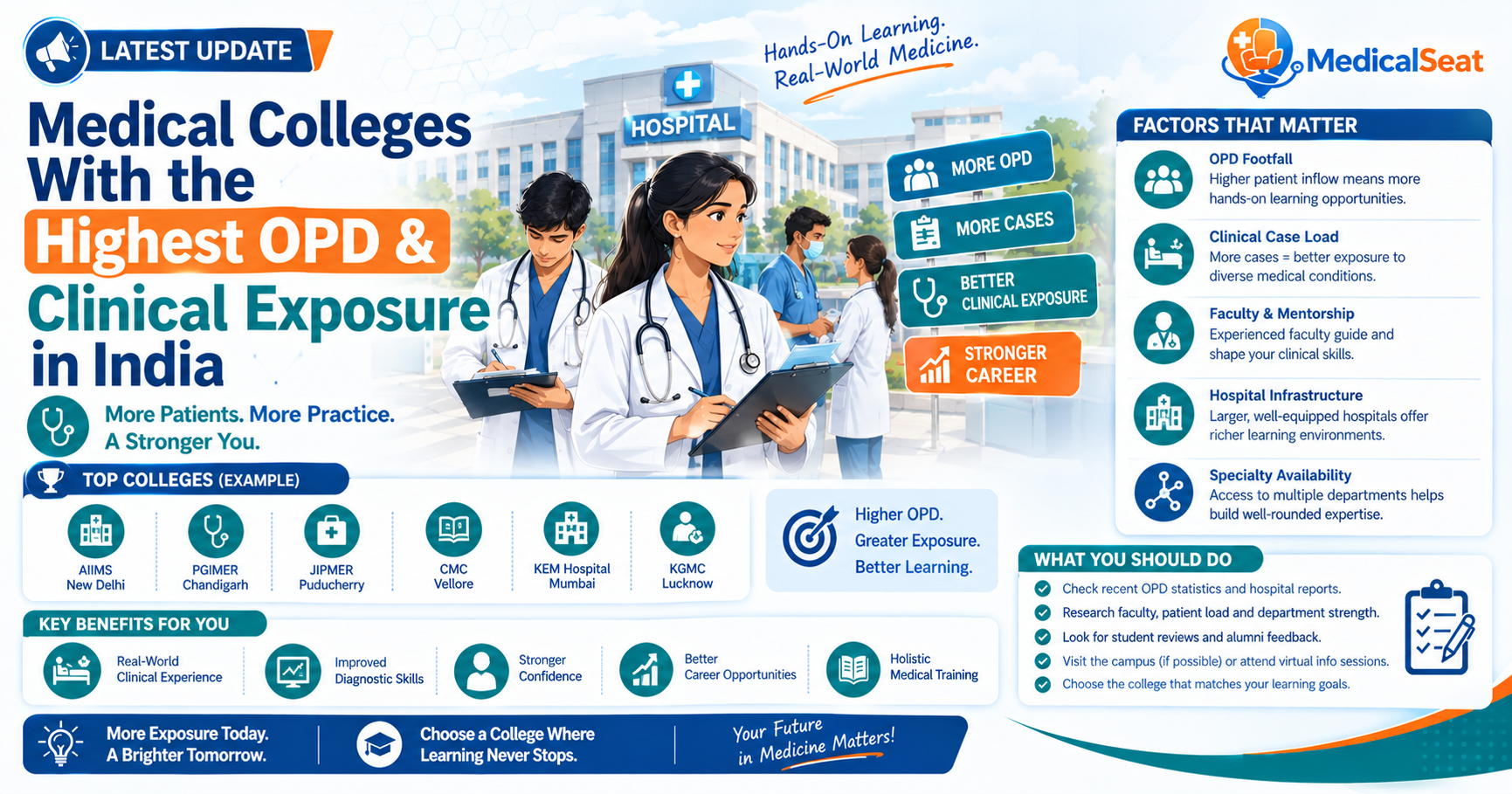
Medical Colleges With the Highest OPD & Clinical Exposure in India
Ask any senior doctor which factor shaped their clinical confidence most during MBBS, and very few will say "my college's NIRF rank." Most will point to something else entirely: how many real patients they examined, how varied the cases were, and how much hands-on responsibility they were trusted with early on.

Best Government Medical Colleges in India by Hospital Patient Load
When aspirants compare medical colleges, they usually start with NIRF rank, fee structure, or location. One factor that gets far less attention — despite mattering enormously for actual clinical training — is patient load: how many real patients pass through a college's attached hospital every day.

How to Choose an MBBS College Beyond Rankings
Every counselling season, families pull up NIRF rankings, decide a "Top 20" college is automatically the right choice, and skip past everything else. Rankings are a useful starting filter — but they weren't designed to answer the questions that actually shape your five and a half years of MBBS: How many patients will you actually examine? How experienced are your professors? Will you get a fair shot at a good NEET PG rank?

Why Your Friend With a Worse Rank Might Get a Better College
It happens every counselling season. Two friends prepare together, sit the same exam, and one gets a rank 15,000 places worse than the other — yet somehow ends up with the better college. It feels unfair, even broken. It isn't. NEET rank determines your position in a merit list, but it is only one input into a much larger allotment system that also factors in category, domicile, quota type, round timing, and strategy. Understanding these mechanics doesn't just explain your friend's result — it can meaningfully improve your own.
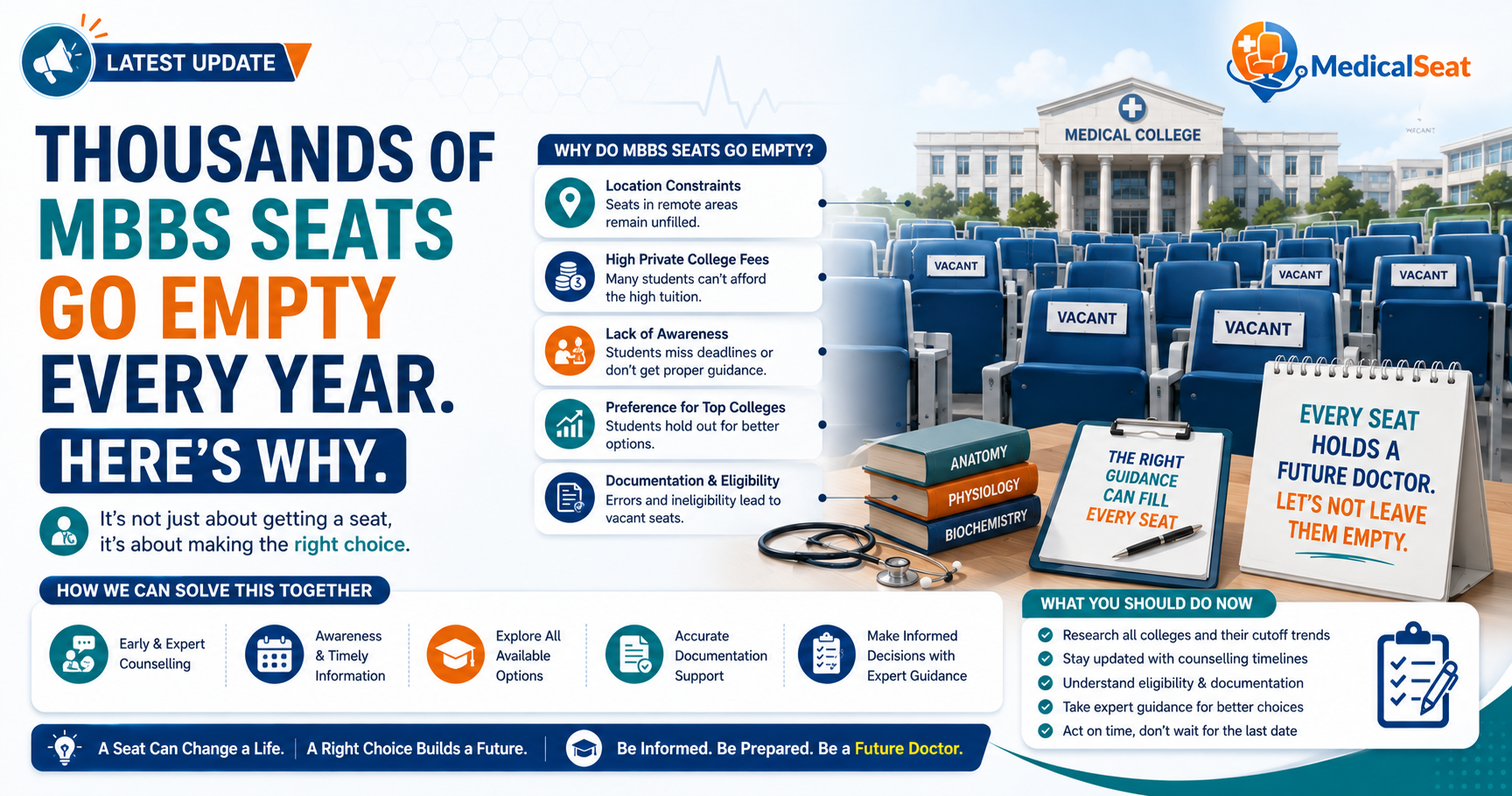
Thousands of MBBS Seats Go Empty Every Year. Here's Why.
It sounds like a contradiction: NEET UG draws over 20 lakh applicants competing for roughly 1.1 lakh MBBS seats, cutoffs climb every year, and yet, by the time the final counselling round closes, thousands of MBBS seats are still sitting empty. Government data placed before Parliament has repeatedly confirmed this — including a figure of more than 2,800 vacant undergraduate medical seats in a recent year, despite a 39% jump in total MBBS seats over the previous few years.

No, AIR 50,000 Doesn't Mean You're Out of the MBBS Race
If your NEET UG rank landed around AIR 50,000, you've probably already heard some version of "that's basically out of the MBBS race." It isn't true — and repeating it to yourself (or hearing it from well-meaning relatives) does more harm than good. AIR 50,000 is a real inflection point, not a dead end. It changes which pathway is realistic, not whether a medical career is possible. This guide lays out exactly what options exist at this rank, honestly, with no false hope and no unnecessary despair.

New Reservation Rules in AIQ 2027: What Has Changed?
Every counselling season, a wave of confusion spreads about whether reservation rules have changed. For NEET UG 2027, the honest answer is nuanced: the reservation percentages themselves have not changed, but how strictly certificates are being verified has changed significantly. Authorities have repeatedly warned that even top-ranked candidates have lost seats in past cycles due to certificate errors — and this year, document scrutiny is tighter than ever.

Your Parents Want Government. You Want MBBS. Here's How to Decide Rationally.
Every counselling season, thousands of families sit at the same kitchen table having the same argument. Parents want the safety, prestige, and low fees of a government medical college — even if it means a lower-ranked one, a distant state, or another year of dropping and re-attempting NEET. Students want to start MBBS now, even if that means a private or deemed college with a much higher fee. Both sides usually have valid reasons. The problem is the decision rarely gets made rationally — it gets made emotionally, under deadline pressure, in the middle of a counselling round. This guide gives you a structured way to make that call, using real trade-offs instead of gut feeling or family pressure alone.
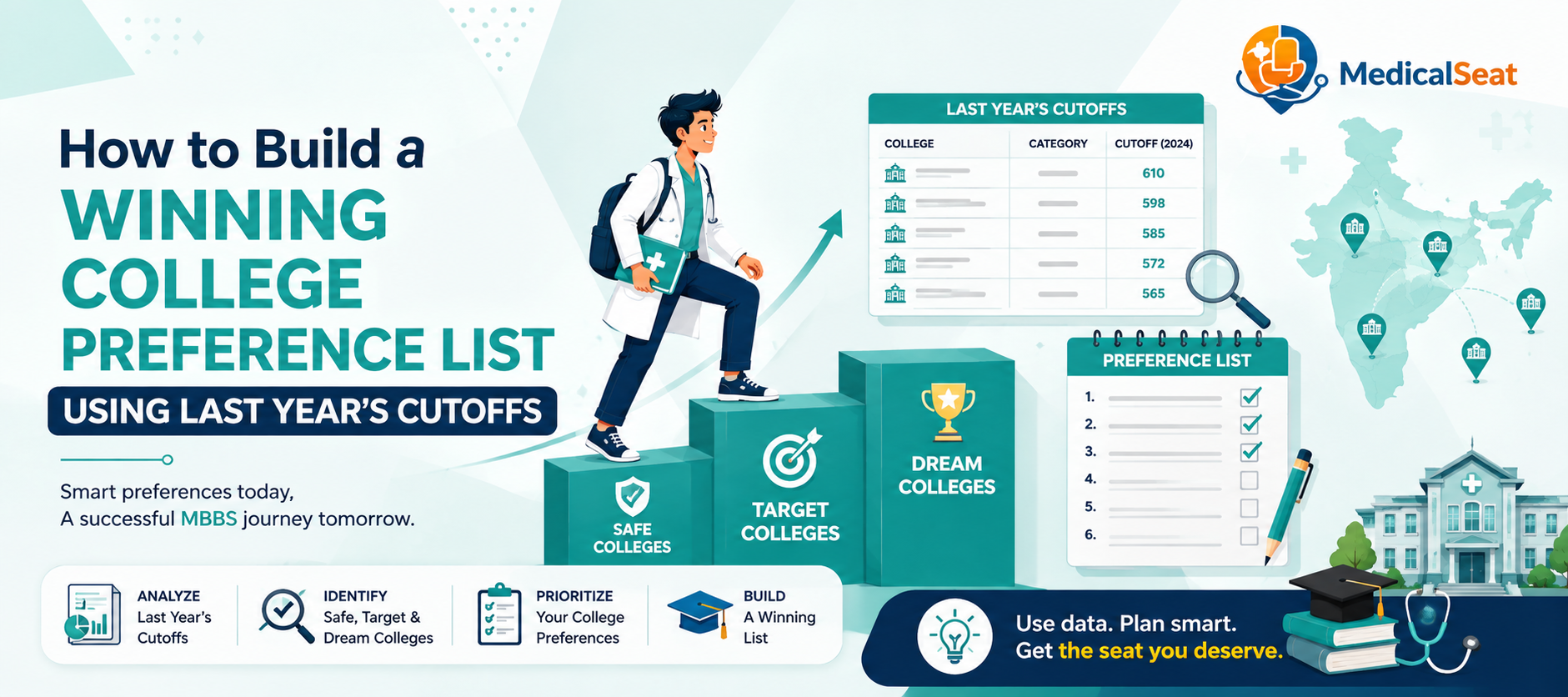
How to Build a Winning College Preference List Using Last Year's Cutoffs
Every year, thousands of NEET-qualified students lose a good seat not because their rank was low, but because their preference list was wrong. A single mistake in ordering choices can push a student out of a college they were genuinely eligible for. Your preference list is not a formality. It is a strategic document that decides whether you study medicine in the state and college you actually want, or end up scrambling for a lower option in later rounds. This guide explains, step by step, how to use last year's cutoffs to build a preference list that maximizes your chances of getting the best possible seat in the very first round.