
 Neet Rank Predictor
 NEET UG Predictor
 MDS Predictor
 INI CET Predictor
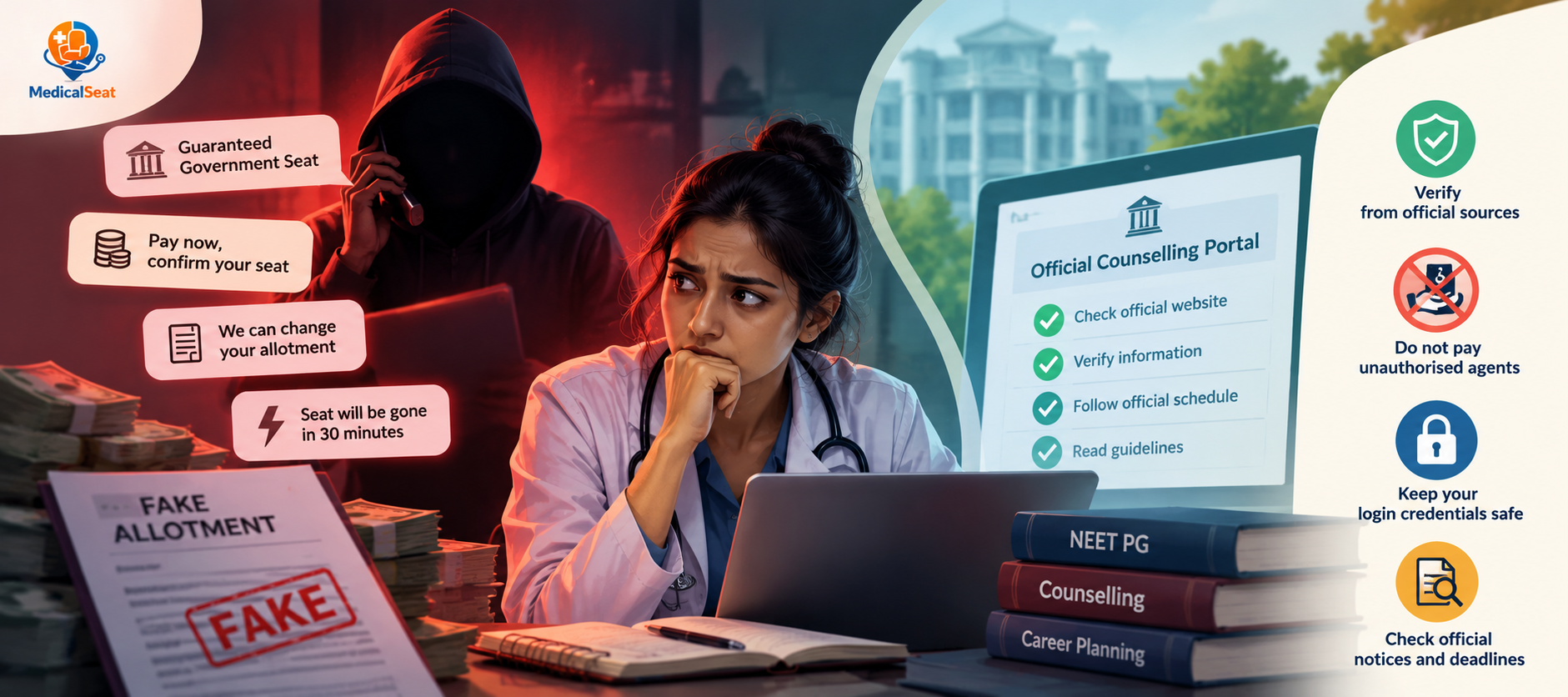
NEET PG 2026 Counselling Scams: If Someone Promises You a Guaranteed Seat, Run Faster Than Your Cutoff Anxiety
Your NEET PG rank is out. Counselling is moving. Every group chat has someone who knows someone who supposedly knows someone inside the system. Suddenly, a stranger claims they can get you a government college. An agent promises a better branch for a fee. Someone forwards an allotment screenshot and says a seat is available if you act today. Another person asks for your login credentials to “handle everything” on your behalf. And because your postgraduate medical seat could shape the next several years of your life, the offer starts to sound tempting.
Stop. A person claiming to have insider access is not proof that they can influence an official allotment.
NEET PG counselling involves real deadlines, complex rules, substantial financial commitments, and difficult decisions. That combination can make candidates vulnerable to misleading promises, impersonation, unauthorised payments, and attempts to obtain sensitive documents or account access.
The safest strategy is not to panic, trust every message, or assume every adviser is dishonest. It is to know what legitimate counselling looks like, identify warning signs, and verify important information through official channels.
Why NEET PG Counselling Is a Target for Misleading Offers
Candidates are often making decisions under pressure. They may be comparing colleges, trying to understand closing ranks, arranging documents, managing fees, and waiting for allotment results.
In that environment, a confident promise can feel more reassuring than an official notice full of conditions.
People making misleading offers may exploit several common concerns:
Fear of losing a seat because of a deadline.
Anxiety about a rank that appears close to a previous year's cutoff.
Confusion about MCC and state counselling procedures.
Uncertainty about deemed, private, government, or DNB options.
Pressure to arrange money quickly.
Lack of clarity about registration, choice filling, reporting, or resignation.
The hope that someone can secure a preferred college through a shortcut.
Not every counselling consultant is fraudulent, and professional guidance can help candidates understand complex processes. The important distinction is between legitimate assistance and a promise to bypass or manipulate the official admission system.
Red Flag No. 1: “Pay Us and We Guarantee Your Seat”
This is one of the most important warning signs to recognise.
A person claims they can guarantee admission to a specific government medical college, obtain a preferred specialty regardless of the normal process, or secure a seat that is supposedly unavailable through regular counselling.
They may demand an advance payment, a “booking amount,” a processing charge, or a fee to speak to an alleged insider.
Be cautious.
Postgraduate medical seat allotments are governed by the applicable eligibility criteria, seat availability, candidate preferences, merit and allocation rules, and official counselling procedures. An individual's claim that they can bypass those processes is not proof of a legitimate admission route.
What to do instead
Ask for the official basis of the claimed admission route.
Verify the institution, course, and seat through the relevant official authority.
Do not pay a person merely because they claim to have access to an insider.
Check whether the payment is an authorised institutional or counselling fee and how it must be paid.
Keep written records of any legitimate professional service you choose to use.
A genuine seat should be traceable through the authorised admission process. A verbal promise is not an allotment letter.
Red Flag No. 2: Someone Claims They Can Change Your Official Allotment
Imagine receiving a message that says your current allotment can be upgraded privately if you pay someone who knows the right officials.
Or perhaps someone claims they can change your specialty, alter your category, influence your rank, or insert your name into a college's admission list.
Do not treat these claims as credible simply because the sender uses official-looking terminology.
A counselling result should be verified through the relevant authorised portal and official documentation. A screenshot, forwarded PDF, edited image, or message containing a candidate's name is not sufficient proof that an allotment is genuine.
How to verify an allotment
Access the official counselling portal directly rather than through a suspicious forwarded link.
Log in using the authorised process.
Check the result and allotment details available to you.
Confirm the institution, course, and category.
Read the reporting instructions and deadlines in the official notice.
Contact the relevant counselling authority if information conflicts.
For MCC counselling, use the official MCC PG Medical Counselling portal.
Do not pay anyone who claims that an unofficial screenshot is the only way to access a seat.
Red Flag No. 3: “Your Seat Will Disappear in 30 Minutes”
Urgency is a powerful pressure tactic.
A caller may tell you that a seat has become available but will be transferred to another candidate unless you pay immediately. Another may claim that you must share your login credentials within minutes or risk losing your allotment.
Real counselling schedules can have strict deadlines, but that does not mean every urgent message is genuine.
How to distinguish a real deadline from a pressure tactic
Situation | Safer response |
An official notice announces a deadline | Verify it on the authorised portal and act within the stated period |
A stranger claims you have minutes to pay for a seat | Do not pay based solely on the message |
Someone sends a shortened or unfamiliar link | Navigate to the official website independently |
A caller says they can extend a deadline privately | Confirm any extension through an official notice |
An agent demands your password or one-time password | Do not share your credentials |
A message threatens cancellation unless you pay an unofficial fee | Verify the claim with the relevant authority |
Never ignore a genuine official deadline. But never let an unverified stranger manufacture urgency to make you act without checking.
Red Flag No. 4: Fake Counselling Websites and Lookalike Links
A website may copy the colours, terminology, or layout of an official portal. A message may use a logo and formal language to look authentic. A link may contain familiar words while leading to an unrelated domain.
The goal may be to obtain login credentials, personal documents, payment information, or other sensitive data.
Check the website before entering information
Look carefully at the domain name. A familiar logo does not establish that the website is official.
Open the portal independently. Type the known official address into your browser or use a trusted bookmark instead of relying on a forwarded link.
Check the page's purpose. Registration, payment, allotment, and reporting instructions should correspond to the process described by the relevant authority.
Be cautious with unexpected downloads. Do not install an unknown application or open a suspicious file simply because someone claims it is necessary for counselling.
Do not assume a secure connection proves legitimacy. A website using HTTPS can still be fraudulent.
For MCC updates, begin with the official PG Medical Counselling portal. Use the official state counselling website for state quota processes.
Red Flag No. 5: Requests for Your Password, OTP, or Remote Access
Some candidates seek help with registration, choice filling, or understanding counselling instructions. That is different from giving an unknown person control over their account.
A person who obtains your password, one-time password, email access, or remote access to your device may be able to view sensitive information or perform actions in your name.
Keep these details private
Passwords and login credentials.
One-time passwords and authentication codes.
Email account credentials.
Banking passwords, card security codes, and payment authentication details.
Remote-access permissions that allow a stranger to control your device.
Do not share an OTP with someone who claims they need it to verify your counselling eligibility or unlock a seat.
If you choose to use a legitimate adviser for guidance, you should remain in control of your own account and personally review any choices or submissions before they are finalised.
If you suspect that someone has accessed your account, change the relevant passwords from a trusted device, secure your associated email account, and contact the appropriate official support channel.
Red Flag No. 6: A Fake Allotment Letter or Payment Receipt
An allotment letter can look convincing even when it has been altered or fabricated. The same applies to payment receipts, college admission letters, and screenshots of supposed seat matrices.
A document should not be treated as genuine merely because it contains a logo, a candidate's name, a registration number, or a signature image.
Verify the document through the official process
Check whether the document is available through your authorised login or issued by the relevant institution or counselling authority. Confirm the course, institution, category, reporting instructions, and payment details.
If the document instructs you to pay an individual, transfer money to an unrelated account, or contact an unofficial number to secure admission, stop and verify the instructions independently.
Do not use a phone number supplied only in a suspicious message to confirm that the message is genuine.
Red Flag No. 7: “This College Has a Secret Seat Nobody Knows About”
Candidates sometimes hear claims about hidden vacancies, reserved seats that can supposedly be released privately, or seats that can be obtained outside the authorised admission process.
Seat availability can change during counselling, and official authorities may publish revised matrices or notices. That is precisely why candidates should check current official information rather than depend on rumours.
A claim about a secret seat is not evidence that an authorised seat exists.
What legitimate seat verification looks like
Check the current seat matrix published by the relevant authority.
Confirm the course and institution details.
Read official notices concerning additions, withdrawals, eligibility, or allocation.
Follow the prescribed registration, choice filling, allotment, and reporting procedure.
Ask the authority to clarify any discrepancy.
For MCC-related updates, consult the current PG counselling events and seat matrix information. For state quota seats, use the relevant state's official counselling portal.
Red Flag No. 8: An Agent Tells You to Ignore the Official Rules
A person may claim that you can skip a prescribed step, pay a fee outside the official process, submit altered documents, or ignore an eligibility requirement because they will “manage it.”
This is not a harmless shortcut.
Providing false information, submitting altered documents, or attempting to bypass applicable admission rules can put your admission and eligibility at risk. The precise consequences depend on the rules and circumstances, so verify requirements before acting.
If an adviser tells you to do something that contradicts an official notice, do not proceed merely because they sound experienced.
Ask for the relevant official instruction. If the conflict remains unresolved, contact the counselling authority or institution through an independently verified channel.
The Financial Trap: How to Verify a Counselling Payment
Not every payment associated with admission is suspicious. Counselling registration fees, security deposits, tuition fees, and other authorised charges may apply depending on the process and institution.
The issue is whether the payment is legitimate, properly documented, and made through the prescribed channel.
Before transferring money, confirm:
What to check | Why it matters |
Who is collecting the payment? | Establish whether the recipient is the authorised authority or institution |
What is the payment for? | Confirm the fee type and the basis for charging it |
Where must payment be made? | Use the official portal or payment method specified in the instructions |
Is the amount documented? | Compare it with the applicable official fee notice |
Will you receive an official receipt? | Keep evidence of the transaction |
What are the refund conditions? | Understand the financial consequences before paying |
Does the payment match your allotted seat? | Ensure that the institution and course details are correct |
Do not transfer money to a personal account merely because the recipient claims to represent a college or counselling authority. Verify the payment instructions independently before proceeding.
What If You Have Already Paid a Suspicious Person?
If you think you have been misled or scammed, act promptly. Do not wait for the person to respond, promise a refund, or provide another explanation.
Step 1: Contact your bank or payment provider
Report the transaction immediately and ask whether it can be stopped, disputed, or otherwise addressed under the provider's procedures. Recovery is not guaranteed, but prompt reporting may matter.
Step 2: Preserve the evidence
Keep payment receipts, transaction references, messages, emails, phone numbers, website addresses, screenshots, and any documents you received.
Do not delete the conversation simply because you feel embarrassed or worried.
Step 3: Report suspected cybercrime
In India, you can report suspected cybercrime through the official National Cyber Crime Reporting Portal. For financial cyber fraud, call 1930 as soon as possible to report the incident and seek guidance on the available response process.
Use the official portal or verified government channels. Do not pay someone who claims they can recover your money for an advance fee.
Step 4: Secure your accounts
If you shared credentials or authentication codes, change your passwords, secure your email account, review account access, and contact the relevant service provider.
If banking information was exposed, notify your bank and follow its security instructions.
Step 5: Protect your admission position
Contact the relevant counselling authority through its official channels if the incident affects your registration, documents, payment, or allotment. Explain the situation and retain the complaint reference and supporting evidence.
Do not assume that reporting a scam automatically extends a counselling deadline or restores a seat. Ask the authority what steps are available under the applicable rules.
How to Get Counselling Help Without Handing Over Control
You do not have to navigate every counselling decision alone. You can seek help understanding rank data, college options, fee structures, choice strategies, and official instructions without surrendering control of your accounts or decisions.
Use a clear division of responsibility.
Official authorities establish the rules. MCC and the relevant state counselling bodies publish their own notices, schedules, seat matrices, and instructions.
Institutions confirm their own authorised admission and fee requirements. Verify the course, reporting process, and charges directly through legitimate institutional channels.
Advisers can help you understand information. They may assist with comparing colleges, interpreting historical data, or organising your preferences, but their advice does not override official rules.
You remain responsible for reviewing important actions. Check the choices being submitted, understand the consequences, retain your records, and confirm that your actions follow the applicable instructions.
If you want help exploring possible colleges, the MedicalSeat NEET PG Predictor can help you shortlist potential options based on your rank and available information. For counselling-related guidance, visit MedicalSeat NEET PG Counselling.
Use these resources to inform your planning, and verify final decisions against current official notices.
Your NEET PG 2026 Anti-Scam Checklist
Before you trust a message, share a document, or make a payment, run through this list.
I checked the information on the relevant official counselling portal.
I verified the website domain independently.
I confirmed that the course and seat details match official information.
I know exactly what the payment is for and who is authorised to collect it.
I have not shared my password, OTP, or authentication codes.
I have not accepted a verbal promise as proof of an allotment.
I understand the official deadline and reporting requirements.
I have saved receipts, allotment documents, and relevant official notices.
I have checked any conflicting advice before acting on it.
I know where to report suspected fraud if something goes wrong.
The objective is not to become suspicious of every person offering help. It is to ensure that no one can exploit your anxiety to make you surrender your money, data, or admission prospects.