
 Neet Rank Predictor
 NEET UG Predictor
 MDS Predictor
 INI CET Predictor
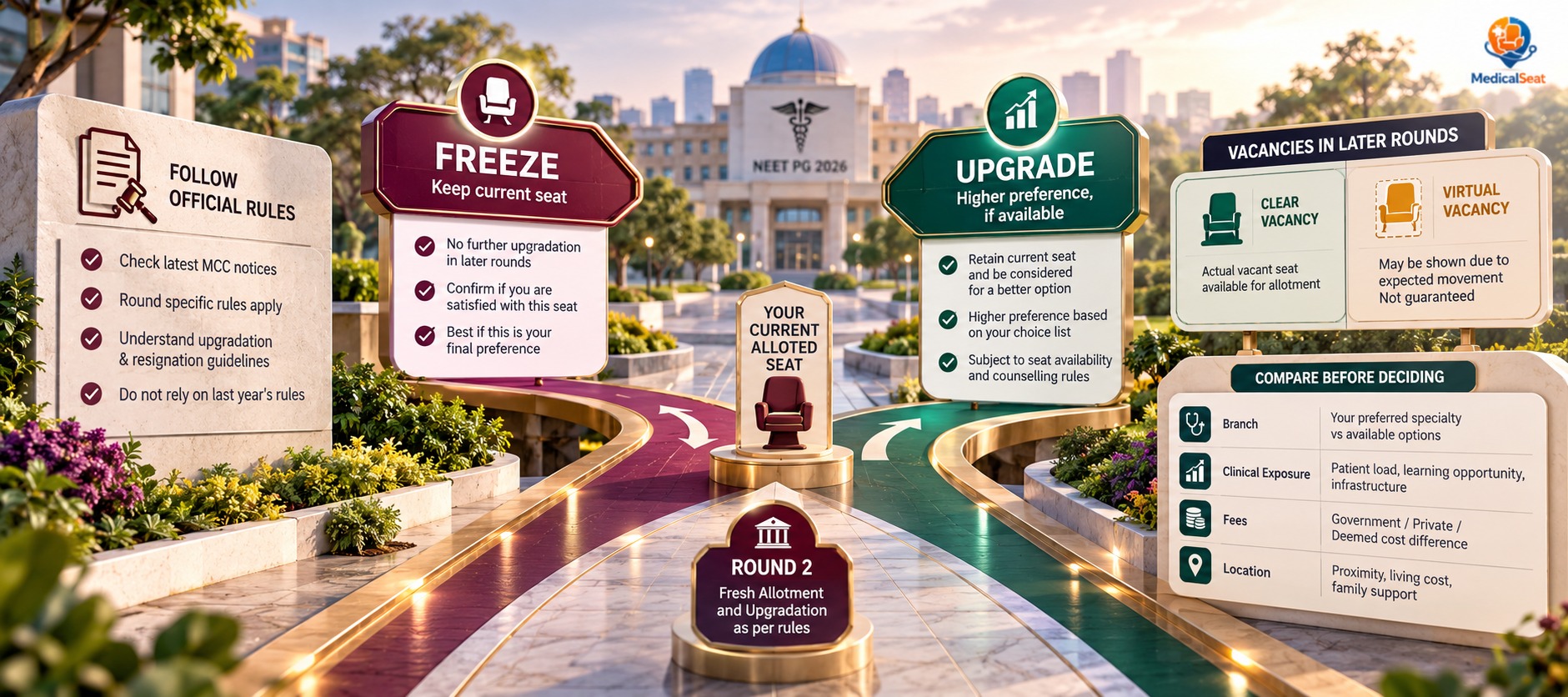
NEET PG 2026 Upgrade Rules Are Wild
You finally got a NEET PG 2026 seat. Congratulations. Then someone tells you: “Just float it.” Another person says: “Freeze it. You can always resign.” Someone else says: “Take the seat and upgrade later.” And suddenly you have five WhatsApp messages, three YouTube videos and absolutely no idea what you are supposed to do. Welcome to the most confusing part of NEET PG counselling 2026.
Upgrade. Freeze. Float. Resign. Round 2.
These words sound simple until your actual medical seat is attached to them.
And that is when a small misunderstanding can become a very serious counselling problem.
MCC is already publishing round specific PG notices for the 2026 session, including a specific notice for Round 2 upgradation and separate notices concerning resignation of Round 1 seats.
So no, you should not simply follow what someone did last year.
The exact rules applicable to your counselling round matter.
Here is how to think about NEET PG 2026 upgrade rules without losing your mind.
Your First Seat Is Not Your Final Seat
Getting a seat in Round 1 does not necessarily mean you have to stop looking.
You may have received:
Your preferred specialty at a lower preferred college.
A preferred college in a less preferred specialty.
A DNB seat.
A private seat.
A deemed university seat.
A seat you are willing to join but would like to improve.
That is where upgradation becomes relevant.
The basic idea is simple.
You have one seat.
You want to be considered for something higher in your preference list.
But the actual consequences of choosing upgrade related options depend on the rules and mechanism of the particular counselling round.
That is why you need to understand the terminology before clicking anything.
What Does Upgradation Actually Mean
In simple terms, upgradation means being considered for a seat that ranks higher in your submitted preferences if one becomes available and you meet the applicable conditions.
Imagine your choices were:
MD Medicine College A
MD Medicine College B
MD Medicine College C
DNB Medicine Hospital D
You receive College C.
You would obviously prefer A or B.
If the counselling process permits you to participate for an upgrade and a higher preference becomes available, your allotment can potentially move upward.
But there is an important catch.
Potentially is doing a lot of work here.
An upgrade is never a guarantee.
Upgrade Does Not Mean You Choose Later
This is where candidates misunderstand the process.
You do not generally get your seat and then sit around waiting for someone to offer you three alternatives.
The allotment process works against the choices and rules applicable to that round.
Your preference order matters.
Your eligibility matters.
Seat availability matters.
Candidate movement matters.
The applicable upgrade mechanism matters.
So if you want a particular college and specialty, it needs to be positioned correctly in your choice list before the relevant locking stage.
The Choice List Comes Back Again
You thought choice filling was over.
It isn't.
Your upgrade possibilities are directly connected to the choices you submitted.
If your desired College A Medicine was never included in your list, you should not expect the system to magically upgrade you into it.
If College A was placed below College C, that ordering also matters.
This is why NEET PG choice filling 2026 is not a clerical exercise.
Your choice list is effectively the map for future allotments.
What Is Freeze
The word freeze generally means you are satisfied with the allotted seat and do not want to be considered for further upgradation under the applicable process.
Think:
“I am happy here.”
If your seat is genuinely your final preference, freezing can make sense.
But do not select freeze simply because someone told you that freezing is safer.
First ask:
Would I actually prefer another seat?
If yes, understand the current upgrade mechanism before making the decision.
What Is Float
Float generally indicates that you are willing to retain your current allotment while being considered for an upgrade to a higher preference, subject to the applicable counselling rules.
Think:
“I will take this seat, but I still want something higher on my list.”
That is fundamentally different from:
“I am done.”
The exact consequences of the float or upgrade option must be checked against the current MCC instructions for the relevant round.
MCC's current 2026 PG counselling material includes a specific Round 2 upgradation notice, showing that upgradation is being handled through round specific instructions rather than one universal rule that candidates can apply blindly.
Freeze Versus Float Matters
Imagine you get:
MS Surgery at College B
You are happy with it.
But your first choice was:
MS Surgery at College A
If you choose the applicable upgrade pathway, you may remain in contention for the higher preference according to the rules.
If you freeze, you are effectively saying:
“This is good enough. I do not want the upgrade route.”
The correct choice depends entirely on what you actually want.
Do Not Float Just Because You Can
This is another counselling trap.
Candidates assume:
“Higher preference is always better.”
Not necessarily.
Suppose you receive:
MS Surgery at a hospital with excellent surgical workload, strong clinical exposure and affordable fees.
Your higher preference is:
MS Surgery at a famous college where the department may be less attractive to you personally.
The fact that it was ranked higher does not automatically mean it is better for your career.
Before pursuing an upgrade, compare the actual seats.
Upgrade Means Your Preferences Matter
Suppose your original list was:
College A Medicine
College B Medicine
College C Medicine
College D Medicine
You receive College D.
If you participate in the upgrade process, the system does not ask:
“Which random better college should we give this candidate?”
It works with your submitted preference structure and applicable allotment rules.
This is why candidates should not casually throw colleges into their choice list.
Your choices can continue to matter after the first allotment.
What If You Get Upgraded
This is where you need to pay attention.
If you receive an upgraded seat, carefully read the applicable reporting and joining instructions.
Do not assume:
“I already joined Round 1, so I don't need to do anything.”
A new allotment can create new procedural requirements.
Check the current MCC notice and the allotted institution's instructions.
Keep records of:
Allotment letter
Joining documents
Fee receipts
Reporting confirmation
Previous seat details
Current seat details
Any acknowledgement generated by the counselling system
The Old Seat Is Not A Casual Backup
One dangerous assumption is:
“I have my old seat anyway.”
Do not make that assumption.
The consequences of an upgrade can depend on the specific round and rules.
Once you are allotted an upgraded seat, understand what happens to the previous seat.
Do not rely on what happened to a friend in a different counselling year.
Do not rely on a 2023 YouTube video.
Do not rely on a Telegram message saying:
“Bro nothing happens.”
Your PG seat is worth more than that.
Round 2 Is Where Things Get Interesting
Round 2 can change the picture considerably.
Candidates move.
Seats can become available.
Some candidates upgrade.
Some seats can be added or removed.
The vacancy position can change.
The preference distribution changes.
MCC's PG archive has historically included notices dealing with seat additions, seat removals, resignation, choice filling and Round 2 scheduling.
That is why your Round 2 strategy should not simply be:
Copy Round 1.
Instead:
Recalculate.
Round 2 Needs A New Reality Check
Before Round 2, ask yourself:
What did I get?
What did I actually like about it?
What did I hate?
Which higher choices remain realistic?
Did new seats appear?
Did any seats disappear?
Did the fee situation change?
Did your preferred specialty become more or less realistic?
Did you discover that DNB is actually a good option?
Your Round 2 choice list should be based on what you learned.
Newly Added Seats Can Change Things
This is one of the most important reasons to monitor official updates.
MCC has historically published separate notices for newly added seats during counselling rounds. The PG archive also contains records of additions and removals of seats.
A new seat can create a new possibility.
But do not assume:
“New seat = easy seat.”
Other candidates can see it too.
Demand can still be extremely high.
Withdrawn Seats Can Destroy Plans
The reverse is also possible.
A seat you thought existed may no longer be available for a particular round.
This is why old spreadsheets can become dangerous.
Your:
“Perfect 200 choice list”
may contain seats that are no longer part of the current availability.
Always check the latest official information before locking choices.
Virtual Vacancy Gets Confusing
Now we enter the part that makes counselling spreadsheets look like conspiracy boards.
Virtual vacancy.
A virtual vacancy is not simply:
“Empty seat. Take it.”
It can reflect a seat that may become available because the candidate currently holding it could move through an upgrade.
That means the seat is potentially available depending on what happens during allotment.
So if you see:
Virtual Vacancy: MD Medicine
do not celebrate prematurely.
It is an opportunity.
It is not a guarantee.
Clear Vacancy Is More Direct
A clear vacancy generally represents a seat actually available in the relevant vacancy position.
That makes it more immediately actionable than a virtual vacancy.
But even a clear vacancy does not mean:
“Your rank will definitely get this.”
You still have to clear the relevant eligibility and allotment conditions.
Why Candidate Movement Matters
Imagine:
Candidate A has College X Medicine.
Candidate A upgrades to College Y Medicine.
College X can then become available.
Another candidate may move into College X.
That candidate may vacate another seat.
And another candidate may then move.
This creates a chain reaction.
That is one reason later rounds can behave differently from what candidates expect.
The seat you want may become available because of movement several levels above you.
Do Not Assume Round Two Will Be Better
This needs to be said loudly.
Round 2 is not automatically an upgrade.
You can potentially move to a better preference.
But you can also remain where you are.
Your desired seat may never open.
Another candidate may outrank you for it.
A seat may disappear.
Your choices may not be broad enough.
So do not reject a good Round 1 seat simply because:
“Round 2 will definitely be better.”
That is gambling.
When Should You Pursue Upgrade
Upgrade makes the most sense when:
You genuinely prefer higher choices.
Your current seat is acceptable.
Your preferred higher options are realistic.
You understand the applicable rules.
You have considered the financial difference.
You have considered specialty and college quality.
You are comfortable with the possibility of the allotment changing.
The decision should be strategic.
Not emotional.
When Should You Stay Put
Staying with your current seat can make sense when:
You love the specialty.
The college is strong.
The fees work.
The location works.
The clinical exposure is good.
You would not genuinely prefer the higher choices.
The upgrade could move you into a less suitable environment.
Remember:
A higher preference number does not automatically mean a better seat.
The Specialty Should Come First Sometimes
Suppose you receive:
MD Paediatrics at a strong institution.
Your higher preference is:
MS Surgery at a more famous institution.
Should you upgrade?
Not if you fundamentally want Paediatrics.
This is where candidates get trapped by college reputation.
Your specialty can influence your entire career.
Do not exchange the branch you actually want for a bigger college name unless you have thought it through properly.
The College Should Matter Sometimes Too
The opposite can also happen.
You may have:
A less preferred specialty at a weak institution.
And a highly preferred institution with a specialty you are genuinely willing to pursue.
Then the college could reasonably matter more.
There is no magic formula.
The important thing is deciding your hierarchy before counselling.
DNB Can Complicate Upgrades
Suppose you receive:
DNB Medicine at Hospital A.
Your higher choice is:
MD Medicine College B.
Do not assume MD automatically wins.
Compare the actual programs.
Look at:
Patient load
Case diversity
Procedural exposure
Faculty
Academic structure
Workload
Stipend
Location
Career plans
The letters after the degree name are not enough to make the decision.
Private And Deemed Upgrades Need Money
An upgrade can look attractive until you calculate the fee.
Suppose your current seat costs substantially less.
Your higher preference is a private or deemed seat costing several times more.
That is not merely an academic upgrade.
It is a financial decision.
Before pursuing it, calculate:
Total tuition
Hostel
Living expenses
Stipend
Travel
Other institutional charges
Potential borrowing
Family contribution
Expected financial pressure
A seat that looks better on paper may not be better for your actual life.
What About Resignation
This is where you need to be extremely careful.
MCC has issued a specific Notice for Resignation of R1 Seat for the 2026 session. It has also published a separate 2026 notice related to Round 1 resignation.
The existence of these notices itself should tell you something important:
Resignation is a formal counselling process.
It is not:
“I don't like my seat, so I will just leave.”
Before resigning, check the current notice for:
Eligibility
Deadline
Procedure
Participation consequences
Fee implications
Refund implications
Any restrictions
Do not resign because someone in a group chat told you that you can always come back.
Do Not Use Resignation As Strategy
A common thought is:
“I'll take this seat now and resign if I get something better.”
That can be dangerous.
You should understand the rules first.
The fact that MCC publishes specific resignation notices for particular rounds means resignation should be treated as a defined process with defined conditions.
Your strategy should be:
Choose carefully.
Not:
Take everything and figure it out later.
What If You Want To Leave After Upgrade
If you receive an upgrade, do not automatically treat your previous seat as something you can freely return to.
The consequences of upgradation and resignation are governed by the applicable counselling instructions.
Read the current notice.
Then act.
This is particularly important because the rules can differ by round and counselling year.
Do Not Trust Old Counselling Rules Blindly
This is probably the most important warning in the entire article.
You will find hundreds of:
“NEET PG upgrade rules explained”
videos and posts online.
Some are excellent.
Some are outdated.
Some mix MCC rules with state counselling rules.
Some refer to undergraduate counselling.
Some discuss a completely different year.
And some confidently explain a rule that no longer applies.
For NEET PG 2026 counselling, use current official MCC instructions for the relevant round.
MCC's current PG portal is specifically publishing 2026 session updates and notices, including current counselling related information.
Freeze Or Float Checklist
Before making the decision, ask yourself:
Do I genuinely want a higher preference?
Would I be happy if I stayed in my current seat?
Can I afford the higher preference?
Have I researched the higher college?
Have I researched the department?
Do I understand the current round's upgrade rules?
Have I checked the latest seat availability?
Would I regret freezing?
Would I regret upgrading?
If you cannot answer these questions, stop.
Research first.
The Four Question Test
Here is a simpler version.
Ask:
Do I like my current seat?
Do I genuinely want something higher?
Can I afford the higher option?
Do I understand what happens if I upgrade?
If the first answer is yes and the second is no, staying may be sensible.
If the first is yes and the second is also yes, investigate upgrade carefully.
If the first is no, you need to understand your next available options.
Your Rank Still Controls Reality
Upgrade does not magically erase rank.
If the higher preference becomes available but another eligible candidate has a stronger position under the applicable allotment rules, they may receive it.
Your desired seat has to become available and be reachable under the relevant allotment conditions.
So:
“Someone said there are vacancies”
is not enough.
You need:
Vacancy
Eligibility
Preference
Rank position
Applicable rules
Why Social Media Predictions Fail
During counselling, you will see posts like:
“Round 2 will definitely drop.”
“Medicine will fall 2,000 ranks.”
“This college always upgrades.”
“DNB is always better.”
“Don't freeze.”
“Always float.”
“Never take a private seat.”
Most of these statements are oversimplifications.
Counselling is too variable for universal rules.
Use historical data.
Use official notices.
Use your own priorities.
Then make the decision.
Your Current Seat Has Value
Do not underestimate this.
Once you have a seat you genuinely like, that seat has value.
You are no longer deciding between:
Seat and no seat.
You are deciding between:
Current acceptable seat
and
Potentially better seat
That is a completely different risk calculation.
This is why upgrade decisions should become more careful, not more aggressive.
The Worst Upgrade Strategy
Here it is:
“Someone told me the college above mine is better.”
So you upgrade.
Then you discover:
The branch is not what you wanted.
The fees are much higher.
The location is terrible for you.
The workload is worse.
The department is not what you expected.
You gave up a seat you actually liked.
That is how counselling regret happens.
Not because the allotment system failed.
Because the candidate never defined what “better” meant.
Define Better Before Upgrading
For you, better could mean:
Better specialty
Better clinical exposure
Better college
Lower fees
Higher stipend
Better location
Better lifestyle
Better academic environment
Better career prospects
Better research
Better patient volume
Write your priorities down.
Then compare seats against them.
The Upgrade Decision Is Personal
There is no universally correct:
“Best NEET PG college.”
There is no universally correct:
“Best branch.”
There is no universally correct:
“MD is always better.”
There is no universally correct:
“DNB is always better.”
Your decision depends on your career plan.
That is why the smartest counselling strategy is not blindly chasing the most prestigious name.
It is matching your rank with your priorities.
What To Do Before Round Two
If you are eligible for the next round, do these things before choice filling begins.
Check the latest official notices.
Download the latest available vacancy information.
Review your previous choices.
Remove choices you no longer want.
Add genuinely preferred options.
Check new seats.
Check removed seats.
Review DNB.
Review private and deemed options.
Check your budget again.
Then create your final preference order.
Do not wait until the final hour.
MedicalSeat Can Help You Decide
NEET PG 2026 upgradation is not about blindly chasing a higher preference.
It is about deciding whether the potential new seat is actually better than the one already in your hand.
MedicalSeat's NEET PG College Predictor can help you explore possible colleges and specialties based on your rank.
Its NEET PG counselling resources can help you compare colleges, understand choices and make a more informed preference list.
Before you freeze, float or pursue an upgrade, compare:
Branch
College
Clinical exposure
Fees
Stipend
Location
DNB options
Career goals
Then make the decision.
Because the most dangerous sentence in NEET PG counselling is not:
“I didn't get a seat.”
It is:
“I thought I could change it later.”