
 Neet Rank Predictor
 NEET UG Predictor
 MDS Predictor
 INI CET Predictor
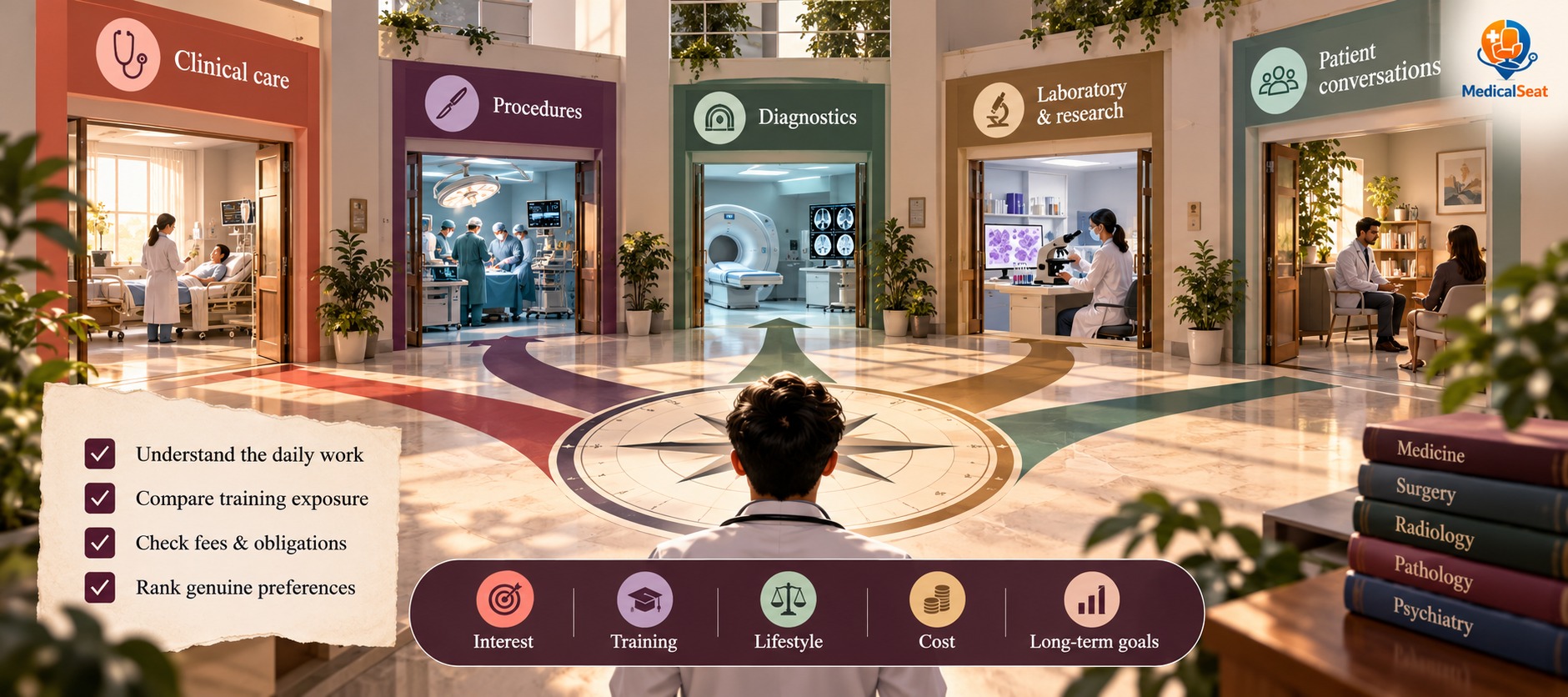
NEET PG 2026: Stop Choosing a Branch Like You're Ordering From a Menu. You'll Be Living This Decision for Years.
Your NEET PG 2026 rank is out. Counselling is underway. Your friends are comparing colleges, family members have their favourites, and somewhere on the internet, a stranger is confidently declaring that one specialty is the only branch worth taking. Meanwhile, you're trying to answer a much bigger question: Which medical specialty should you actually choose? This is where things get complicated. A branch that sounds prestigious may not suit your temperament. A specialty that looks less glamorous on social media might offer the kind of work you genuinely enjoy. A high-demand clinical branch may involve a lifestyle you aren't prepared for, while a less-discussed option could align beautifully with your strengths and long-term plans.
With NEET PG 2026 counselling in progress, candidates need to think beyond the excitement of getting an MD, MS or DNB seat. Your postgraduate specialty influences your training, day-to-day responsibilities, future work environment, opportunities for super-specialisation and, to a significant extent, your professional identity.
The goal isn't to find the universally best branch. It is to find the best fit for you, within the realistic options available at your rank, budget and preferred colleges.
Let's make that decision with something more reliable than peer pressure.
Why Your NEET PG Rank Shouldn't Choose Your Specialty for You
Your rank matters. It determines which seats may be accessible to you during counselling, subject to the applicable eligibility rules, reservation category, quota, seat availability and round.
But rank and career suitability answer two different questions.
Your rank tells you which options may be attainable.
Your preferences tell you which options are worth pursuing.
Your circumstances determine which options are practical.
Confusing these three can lead to a poor choice even when the allotment itself looks impressive.
Imagine two candidates with similar ranks. One wants a highly patient-facing career with frequent clinical decisions. The other prefers analytical work, diagnostic interpretation and a more structured clinical environment. They could reasonably build very different preference lists.
Neither candidate is wrong. The mistake would be selecting the same branch simply because it is considered more prestigious.
Your NEET PG rank should help define your available choices, not dictate your professional personality.
The Specialty Reality Check: What Are You Actually Signing Up For?
Before comparing branches, understand what the work can look like. The descriptions below are broad career considerations, not guarantees of a particular lifestyle, workload or income. These vary significantly by institution, training programme, location and eventual practice setting.
Specialty | What may appeal to you | What you should honestly consider |
MD General Medicine | Broad clinical exposure, complex diagnosis, management of adult medical conditions | Heavy patient loads, complex cases, emergency responsibilities and demanding inpatient work |
MS General Surgery | Operative work, procedural skills, surgical decision-making | Operating-room demands, emergency duties, long procedures and a steep technical learning curve |
MD Paediatrics | Child health, preventive care and managing acute and chronic conditions | Emotional demands, paediatric emergencies and communication with anxious families |
MD Radiodiagnosis | Image interpretation, diagnostic reasoning and technology-led medicine | Sustained concentration, high reporting volumes, responsibility for diagnostic accuracy and changing technology |
MD Dermatology | Skin, hair and nail disorders, medical and procedural practice | Competition for desirable seats, patient expectations and the need to build clinical expertise and trust |
MS Obstetrics and Gynaecology | Women's health, surgery, obstetric care and reproductive health | Unpredictable emergencies, labour-room responsibilities and potentially demanding duty hours |
MD Anaesthesiology | Perioperative care, physiology, procedures and critical-care exposure | High-stakes monitoring, emergency decisions, operating-room schedules and responsibility for patient safety |
MD Emergency Medicine | Acute care, rapid assessment and time-sensitive decisions | Shift work, unpredictable case volume and sustained pressure |
MD Psychiatry | Mental health, longitudinal patient care and therapeutic communication | Emotionally complex consultations, stigma-related challenges and the need for strong communication skills |
MD Pathology | Disease diagnosis through laboratory medicine, tissue and cellular analysis | Laboratory workloads, diagnostic precision and the need to enjoy detailed analytical work |
MD Microbiology | Infectious diseases, laboratory diagnostics and infection control | Laboratory-based responsibilities, quality systems and the importance of precise technical work |
MD Community Medicine | Public health, epidemiology, prevention and population-level healthcare | Research, programme implementation, data analysis and work that may be less focused on individual bedside treatment |
These descriptions are starting points, not substitutes for speaking with residents and practising specialists. The experience of a General Medicine resident at one institution may differ substantially from that of a resident elsewhere.
The question isn't which branch sounds impressive when you introduce yourself. It's whether you can see yourself doing its actual work, repeatedly, including on difficult days.
MD vs MS vs DNB: Choose the Training Path, Not Just the Abbreviation
A common mistake during NEET PG counselling is treating MD, MS and DNB as interchangeable labels attached to a specialty.
They represent different qualifications and training routes, although the appropriate comparison depends on the discipline and institution.
Qualification | Broad orientation | What to examine before choosing |
MD | Postgraduate medical qualification commonly associated with non-surgical clinical and diagnostic specialties | Specialty curriculum, patient exposure, faculty, infrastructure and examination requirements |
MS | Postgraduate surgical qualification | Operative exposure, case mix, hands-on training, supervision and procedural competence |
DNB | Postgraduate qualification awarded through the National Board of Examinations in Medical Sciences | Recognition and eligibility for the specific course, hospital workload, teaching arrangements, case exposure and examination requirements |
DNB is not automatically a weaker choice than MD or MS, nor is every DNB programme automatically superior to a university department. The institution and training environment matter.
When comparing seats, verify the current course recognition, training requirements, eligibility for further qualifications and applicable regulatory rules. Do not rely on an old forum post or a senior's experience from several years ago.
A candidate deciding between an MD seat at one institution and a DNB seat at another should compare the actual programmes, not just the letters after the qualification.
The Five Questions to Ask Before You Put a Branch on Your List
1. Do you enjoy the work, or just the reputation?
Prestige can attract you to a specialty. It cannot sustain your interest through years of training.
If you enjoy solving diagnostic puzzles, investigate specialties that rely heavily on clinical reasoning and interpretation. If you are energised by procedures, explore procedural and surgical disciplines. If long-term conversations with patients appeal to you, consider fields that involve ongoing therapeutic relationships.
You do not need to have one perfect personality type for every branch. You do need a realistic understanding of what the work entails.
2. Can you tolerate the difficult parts of the specialty?
Every branch has a difficult side.
Surgical training can be physically and technically demanding. Emergency medicine can involve unpredictable shifts. Diagnostic work requires sustained concentration and accountability. Psychiatry may involve emotionally complex situations. Clinical medicine can bring heavy workloads and difficult outcomes.
Don't ask only, "Will I enjoy the best parts?"
Ask, "Can I learn to manage the hardest parts without resenting the profession I chose?"
3. What kind of working environment do you want?
Think about your preference for:
Direct patient interaction versus diagnostic or laboratory work.
Procedures and operations versus predominantly medical management.
Acute emergencies versus planned consultations.
Hospital-based practice versus opportunities for outpatient or independent practice.
Individual patient care versus population-level health and research.
These are not rigid categories. Many specialties combine several of these elements. Your task is to identify which working patterns appeal to you most.
4. What are your long-term career plans?
Your first postgraduate qualification is an important step, but it may not be your final professional destination.
Consider whether you may want to pursue a super-specialty qualification, work in a hospital, establish a clinic, enter academic medicine, conduct research, work in public health or explore opportunities outside traditional clinical practice.
For example, a candidate considering General Medicine may wish to investigate potential super-specialty routes. A candidate considering Radiodiagnosis may want to understand diagnostic practice, interventional pathways where applicable, and the role of technology in the field.
These are possibilities, not guaranteed outcomes. Confirm the eligibility requirements and training pathways that apply to your intended career.
5. Does the seat make sense financially and geographically?
Your specialty decision cannot be separated completely from the institution offering it.
A preferred branch at a distant private college may involve substantial tuition, accommodation costs and relocation. A different college may offer stronger training opportunities at a more manageable total cost.
Compare the entire package: course fees, stipend, hostel or rental costs, bond conditions, service obligations and the training environment. Also consider whether you have practical constraints involving location, caregiving responsibilities or family circumstances.
A seat is not a good fit simply because you can technically secure it.
The Lifestyle Question Everyone Asks, but Few Answer Properly
Search for almost any postgraduate specialty and you will find claims about work-life balance. Some branches are described as relaxed; others are portrayed as endless duty.
Take these labels with caution.
Lifestyle depends on several factors:
Institution: Resident strength, patient load, staffing and departmental organisation can influence working conditions.
Training year: Responsibilities and autonomy often change as residents progress.
Location: Work patterns can differ between large referral centres, smaller hospitals and other practice settings.
Career stage: Residency and independent practice are different experiences.
Practice model: Academic medicine, private practice, hospital employment and diagnostic services can involve different schedules.
A specialty known for potentially more predictable work is not necessarily predictable in every institution. Likewise, a demanding residency does not automatically mean an equally demanding career forever.
When researching a branch, speak with residents from more than one institution. Ask specific questions about duty rosters, night shifts, leave, patient volume, hands-on exposure, supervision and the department's working culture.
"Is the branch hectic?" is too vague.
"How many night duties did you have last month, and what happens when the department is understaffed?" is much more useful.
Branch-Wise Career Planning: Think Beyond Your First Job
Choosing a postgraduate specialty is also a decision about the range of careers you may be able to build later.
Career priority | Areas worth investigating | Important reality check |
Broad clinical decision-making | General Medicine, Paediatrics and other clinical disciplines | Workload, patient complexity and career options differ by specialty |
Surgical and procedural practice | General Surgery, Obstetrics and Gynaecology and other procedural fields | Training quality and hands-on opportunities are crucial |
Diagnostic and analytical work | Radiodiagnosis, Pathology and Microbiology | Each has distinct clinical, laboratory and technology-related responsibilities |
Mental healthcare | Psychiatry | Clinical practice requires sustained communication and an understanding of complex patient needs |
Acute and perioperative care | Emergency Medicine and Anaesthesiology | Shift patterns and responsibility can be significant |
Prevention and population health | Community Medicine | Career pathways may involve public health programmes, research, teaching and administration |
This is not a ranking. It is a framework for exploring what each discipline can lead to.
Before finalising your choices, investigate the qualification requirements for further training, the nature of available jobs, the role of location and the kinds of work you would be comfortable doing.
Do not select a specialty based solely on a projected salary, a social media income claim or an anecdote about a doctor who built a successful practice. Individual outcomes vary, and earnings depend on experience, geography, working hours, employment model and other factors.
The Counselling Trap: Don't Put a Branch Above Everything Else Without Thinking
Here is where career planning meets seat allocation.
Suppose your preference list contains these hypothetical options:
General Medicine at College A
General Medicine at College B
Radiodiagnosis at College C
General Medicine at College D
Pathology at College E
Is this the right order? There is no universal answer.
If you genuinely prefer General Medicine over Radiodiagnosis, you may reasonably rank the acceptable General Medicine options first. If College C offers a programme that you prefer over the alternatives, its position may change. The decision depends on your actual priorities.
The critical rule is to order choices according to your genuine preference among acceptable options, while accounting for the counselling system's rules.
Do not place a seat above another merely because you think it is easier to obtain. Do not include a course or college you would refuse to join just because it appears on a prediction list.
Before locking choices, verify:
The course and specialty listed for the seat.
The college and applicable quota.
Your eligibility for that seat.
The official fee and deposit requirements.
Bond and service obligations.
Reporting deadlines and joining requirements.
The consequences of accepting, not joining or resigning from an allotted seat under the current rules.
The official MCC PG Medical Counselling portal publishes counselling schedules, seat matrices, candidate guidance and notices. Read the current documents before acting, as rules and schedules may change.
Your Rank, Your Branch, Your Reality: Build a Practical Preference List
You do not need to decide your entire professional future in one sitting. You do need a structured way to turn a long list of possibilities into a sensible counselling strategy.
Step 1: Create your specialty shortlist
Start with the branches you would genuinely consider pursuing. Include specialties you understand well enough to evaluate, rather than adding a branch simply because it is popular.
For each one, write down why it interests you and what concerns you about it.
Step 2: Separate branch preference from college preference
First, identify your preferred specialties. Then compare the institutions offering those specialties.
This helps you see whether you are choosing a course because you want the work itself or because a particular college name carries weight.
Step 3: Check realistic seat possibilities
Use your NEET PG rank, category, applicable quota, previous allotment trends and current seat availability to assess your options.
The MedicalSeat NEET PG Predictor can help you explore possible college and course options. Treat predictions as estimates, not allotment guarantees. Actual results depend on the live counselling process, candidate preferences, seat availability and applicable rules.
Step 4: Compare institutions properly
Do not evaluate a college using one placement figure, one review or a single senior's opinion. For postgraduate medical training, examine the department's case mix, clinical exposure, faculty availability, infrastructure, supervision, resident experience and official course details.
For a surgical branch, investigate operative exposure. For a diagnostic specialty, examine reporting and practical training opportunities. For a clinical specialty, understand the patient load and responsibilities residents are expected to handle.
Step 5: Check the complete cost and commitment
Review fees, stipend, deposits, hostel expenses, bonds and service obligations before ranking a seat highly.
A specialty that fits your interests may still be impractical at a particular institution. The answer may be to investigate another college offering the same branch rather than abandoning the specialty altogether.
Step 6: Build a preference list you can defend
For every choice, ask yourself three questions:
Would I genuinely be willing to join this course at this college?
Have I understood the financial and training commitments?
Would I still consider this a reasonable decision if my friends received different branches?
If you cannot answer these questions, research the option further before locking it.
For help comparing likely options, the MedicalSeat NEET PG Counselling resources can support your college research and preference-planning process.
What If Your Dream Branch Is Out of Reach?
This is one of the hardest questions to confront after the result.
You may have prepared for months or years with one specialty in mind. Your rank may not support the colleges or courses you expected. Watching peers receive their preferred seats can make the situation feel even worse.
But do not let disappointment force you into an immediate decision.
Consider three separate possibilities.
You want the specialty, but not the available college. Investigate other institutions, training quality, finances and later counselling opportunities under the applicable rules.
You want the college, but are uncertain about the specialty. Ask whether the attraction is the institution's reputation or the work you would actually be doing. A prestigious name cannot compensate for a specialty you strongly dislike.
You are unsure whether to accept an available seat or pursue another attempt. Compare the real alternatives: eligibility and applicable rules, financial costs, the uncertainty of a future rank, the time required to prepare again and your willingness to undertake another attempt.
There is no universally correct answer. A repeat attempt can make sense for some candidates; accepting an available seat can make sense for others. Neither choice should be made solely because of embarrassment, family pressure or the fear of being left behind.
Also, do not assume you can freely leave or upgrade a seat later. Counselling rules on joining, resignation, forfeiture, eligibility and subsequent rounds matter. Verify the current official bulletin before making a decision.
The Red Flags That Should Make You Pause
Before locking your NEET PG 2026 choices, look for these warning signs:
You're choosing a branch because your friends are choosing it. Their interests and circumstances may be completely different from yours.
You're relying on an old closing rank. Previous-year trends are useful context, not a promise about the current round.
You're treating a predicted seat as a confirmed seat. No predictor can guarantee the final allotment.
You've ignored the actual residency experience. Research the department, not just the college's reputation.
You've considered tuition but ignored other costs. Accommodation, deposits, bonds and service obligations can change the decision.
You're ranking a course you would never join. Every preference should reflect a genuine, informed choice.
You're assuming a specialty guarantees a particular income or lifestyle. Career outcomes vary widely.
You're rushing because the deadline is close. Use the time available to verify official details and prioritise the decisions that matter most.
A little uncertainty is normal. Making a major career decision based on assumptions is avoidable.
The Bottom Line: Choose the Work You Want to Learn to Do
NEET PG 2026 counselling is not simply a contest to secure the most impressive seat. It is a process of matching your rank and eligibility with a specialty, institution and training environment you can realistically commit to.
You do not need to predict every detail of your career today. You do need to make an informed decision about the next stage of it.
Understand the specialty. Investigate the institution. Calculate the costs. Read the counselling rules. Build a preference list that reflects what you genuinely want, rather than what other people expect you to want.
Your rank is an important number. It is not your personality, your potential or your entire future.
Choose with your eyes open.
Plan Your NEET PG 2026 Counselling With MedicalSeat
Your next step is to turn your rank into a practical shortlist.
Explore possible colleges and courses: NEET PG Predictor
Review counselling resources and choice-planning support: NEET PG Counselling
Verify official schedules, seat matrices and notices: MCC PG Medical Counselling
Use predictions to explore your options, official information to verify them and your own informed preferences to make the final decision.