
 Neet Rank Predictor
 NEET UG Predictor
 MDS Predictor
 INI CET Predictor
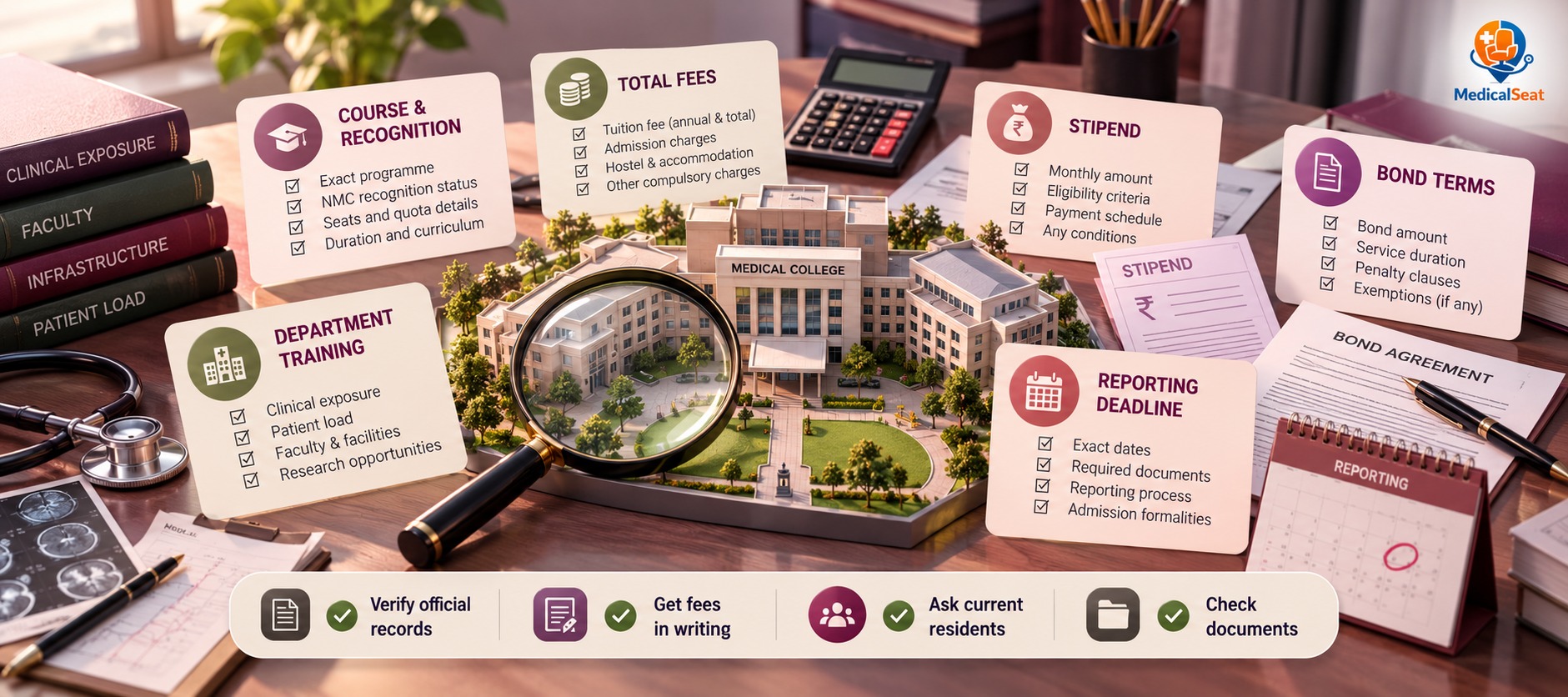
NEET PG 2026: Before You Report to That College, Investigate It Like Your Career Depends on It. Because It Does.
You got an MD/MS seat through NEET PG 2026 counselling. The allotment letter is downloaded, the family group is celebrating, and someone has already started calling you “Doctor” with extra enthusiasm. Then reality arrives.
The college fee is higher than you expected. The stipend information is confusing. Someone says the department has a heavy workload but limited hands-on exposure. Another person claims the bond conditions are different from what you read online. And suddenly, the college that looked perfect on your choice list needs a much closer inspection.
Before reporting to your allotted college, investigate the institution, department, finances and admission conditions—not just the name printed on your allotment letter.
The MCC Round 1 reporting window is scheduled for October 26 to November 2, 2026, according to the published NEET PG 2026 counselling schedule. Candidates should verify the latest instructions on the official MCC PG Medical Counselling portal before making decisions.
This is not about creating unnecessary doubt after you receive a seat. It is about making sure you understand what you are committing to before you complete admission formalities.
NEET PG 2026: What You Must Verify Before Reporting
What to investigate | What you need to establish |
Course and recognition | The exact programme and applicable recognition or approval status |
Department and training | Clinical exposure, patient load, faculty and learning opportunities |
Total cost | Tuition, deposits, hostel, compulsory charges and other expenses |
Stipend | Amount, eligibility, payment schedule and applicable conditions |
Bond and service rules | Bond amount, service duration, penalties and applicable exemptions |
Admission requirements | Original documents, verification, payment methods and reporting deadline |
Hospital environment | Infrastructure, facilities, workload and access to learning resources |
Future options | Career pathways, training outcomes and specialty-specific opportunities |
The information you gather should come from official documents, direct confirmation from the institution and credible department-specific sources wherever possible. Informal reviews can help identify questions, but they should not be treated as verified facts on their own.
1. Investigate the Department, Not Just the College Brand
A well-known medical college can still have departments that differ considerably in their facilities, faculty strength, clinical exposure and academic environment.
The institution's overall reputation is only one part of your decision. You are joining a specific postgraduate programme, and that department will shape much of your day-to-day training.
Questions worth asking
How many patients does the department typically manage?
What clinical exposure do residents receive during training?
Are faculty members available for teaching and supervision?
What academic activities, seminars, case discussions and research opportunities are offered?
What facilities are available for the specialty?
How are duties, rotations and leave managed?
What do current residents say about supervision, workload and learning opportunities?
The answers will vary by specialty. For example, the relevant questions for MD Radiodiagnosis will differ from those for MS General Surgery or MD Paediatrics.
Do not assume that a department has strong training simply because the hospital has a large campus or impressive infrastructure.
How to verify what you hear
Start with the department's official information, published faculty details and available institutional disclosures. Speak to current residents or recent graduates when possible, and ask specific questions rather than simply asking whether the college is “good.”
A useful question is: What do you actually learn and do during a typical month in this department?
Specific answers are generally more informative than sweeping praise or criticism.
2. Calculate the Full Cost of Your NEET PG Seat
A college's advertised tuition fee does not necessarily represent the full financial commitment.
Candidates sometimes compare two colleges using tuition alone, only to discover later that accommodation, deposits, examination charges, equipment, transport and other expenses change the calculation substantially.
Before reporting, prepare a complete cost estimate.
Expense | What to check |
Tuition fee | Annual fee, total course fee and payment schedule |
Admission charges | One-time admission or enrolment fees |
Security deposit | Amount, refund conditions and deductions |
Hostel and accommodation | Compulsory hostel rules, room charges and mess fees |
Examination fees | University and examination-related charges |
Other compulsory charges | Any additional institutional charges specified in writing |
Living expenses | Food, transport, personal expenses and other necessities |
Bond or service obligations | Applicable financial liability and conditions |
Stipend | Amount, payment schedule and eligibility conditions |
Do not assume that every item in this table applies to every college. Use it as a checklist to identify the charges and conditions relevant to your allotted institution.
Ask for written clarification
Before making a payment, confirm:
The amount payable at reporting.
The deadline and permitted payment methods.
The amount payable in subsequent years.
Whether the fee changes during the course.
Which deposits are refundable and under what conditions.
Whether hostel accommodation is compulsory.
Whether any additional charges are mandatory.
Keep copies of the fee schedule, payment receipts and written responses. If an amount differs between two sources, seek clarification from the institution before proceeding.
3. The Stipend Question: What Will You Actually Receive?
A stipend can significantly affect your finances during postgraduate training, but a figure quoted in a student group may not tell the whole story.
Check the official stipend information for your allotted institution and programme. Confirm the amount for each year, the payment schedule, eligibility requirements and any applicable deductions or conditions.
You should also ask whether payments are made regularly and whom residents contact if there is a delay.
Do not treat a stipend figure as guaranteed take-home income until you understand the applicable terms.
A higher stipend may improve your financial position, but it should not automatically outweigh differences in department-level training, course costs or other important factors.
4. The Bond Clause: Read It Before You Sign It
Bond and service obligations can have a substantial impact on your career plans and finances. The applicable conditions may vary by state, institution, course and admission category.
Before reporting, establish whether a bond or service obligation applies to your seat and what the relevant document actually says.
Check:
The bond amount, if applicable.
The duration of any compulsory service.
The circumstances in which the bond can be invoked.
The consequences of leaving the course or not completing the required service.
Any applicable exemptions or special conditions.
The process for obtaining clarification or documentation.
Do not rely on a candidate's experience from a different college or an older admission year. Ask the relevant authority for the current written rules applicable to your allotment.
If a clause is unclear or the potential liability is significant, obtain qualified advice before signing.
5. Verify the Programme and Institutional Details
Before completing admission, confirm that the allotted institution and course match the information in your allotment letter and the applicable official records.
Check the precise course name, duration, institution and relevant recognition or approval details. Where applicable, confirm the current status of the programme through the appropriate official authority.
You should also review the institution's admission instructions, required documents and any programme-specific conditions.
This step is particularly important when an institution offers several postgraduate courses or operates multiple campuses, hospitals or teaching units.
Do not assume that information about one campus or department necessarily applies to another.
6. Investigate the Hospital's Training Environment
Postgraduate medical education involves more than attending lectures and completing examinations. Your clinical environment influences the opportunities available to observe, assess and manage patients under appropriate supervision.
The most useful questions depend on your specialty, but consider the following areas.
Clinical exposure
Find out about the department's patient load, case mix, procedures and learning opportunities. Where relevant, ask how responsibilities develop as residents progress through training.
Faculty and supervision
Check the department's faculty information and ask residents how teaching, supervision and feedback work in practice.
Facilities and resources
Investigate the facilities relevant to your specialty. Depending on the programme, these might include laboratories, operating theatres, intensive care facilities, diagnostic equipment, libraries, research resources or other clinical infrastructure.
Resident workload and welfare
Ask about duty schedules, leave, accommodation, safety, grievance procedures and the availability of support when residents face difficulties.
A demanding workload is not automatically evidence of good training, just as a less intense schedule does not automatically indicate poor training. The important question is whether the environment supports appropriate learning, supervision and patient care.
7. Talk to Current Residents Without Treating Every Review as Fact
Current residents can provide context that official brochures may not capture. However, individual experiences can differ according to specialty, seniority, faculty, batch and personal expectations.
Use conversations to identify questions and verify patterns—not to accept every claim as established truth.
Instead of asking, “Is this college good?”, try asking:
What surprised you most after joining?
Which aspects of the department's training are strongest?
What would you investigate before choosing this department?
Are there differences between the official information and everyday experience?
What should a new resident know about the workload and facilities?
Are there recurring administrative or stipend issues?
What would you want to know before signing the admission documents?
Whenever possible, speak to more than one person. A consistent pattern across independent accounts is more useful than a single dramatic review.
Also remember that online posts can be outdated, anonymous or based on unusual experiences. Verify important claims independently.
8. Do Not Confuse a College's Marketing With Its Actual Training
Institutional websites are useful for finding official details, but promotional language is not a substitute for evidence.
Claims about advanced facilities, excellent academic exposure or extensive clinical opportunities should lead you to ask for relevant details.
For example:
If a college highlights advanced equipment, check whether it is available to the relevant department and how it is used in training.
If it advertises research opportunities, ask about actual departmental projects and resident participation.
If it promotes a large hospital, investigate the case mix and training opportunities for your specialty.
If it highlights faculty strength, review the relevant department's published faculty information.
The aim is not to dismiss institutional claims. It is to understand how those features translate into your postgraduate education.
9. Your Allotment Letter Is Not the Final Admission Checklist
Once you receive an allotment, you must follow the reporting and verification process set out by the counselling authority and the allotted institution.
Prepare the documents specified in the current official instructions. These may include your allotment letter, NEET PG documents, MBBS degree or provisional certificate, mark sheets, internship completion certificate, medical registration certificate, identity proof and applicable category or disability documents.
Additional requirements may apply depending on your circumstances and the institution.
Before leaving for reporting, verify:
The exact reporting location and dates.
Whether original documents are required.
Whether photocopies or additional sets are needed.
Whether the institute requires a particular format or certificate.
The payment amount, method and deadline.
Whether any online or in-person verification steps must be completed.
Use the current MCC instructions and direct institutional communication as your reference. Do not assume that a checklist shared by another candidate is complete for your case.
The published Round 1 reporting window is October 26 to November 2, 2026. Confirm the latest schedule and any applicable changes on the official MCC portal.
10. What If Your Investigation Raises Serious Concerns?
Finding an unexpected fee, unclear bond clause or concerning resident feedback can be unsettling. The next step is to establish the facts and understand your options under the applicable rules.
Use this sequence:
Step 1: Separate verified facts from claims.
Identify what is documented, what has been confirmed directly and what remains an unverified allegation.
Step 2: Request written clarification.
Contact the appropriate college office, department or counselling authority for questions about fees, reporting requirements, course details or admission conditions.
Step 3: Review the relevant official rules.
Understand the obligations attached to your allotment and the consequences of each available option.
Step 4: Assess the concern's significance.
A minor administrative inconvenience is different from an unexplained financial liability, a major discrepancy in programme details or a serious concern about the training environment.
Step 5: Make an informed decision within the deadline.
If you need to consider another option, first verify what the counselling rules permit and what consequences may follow. Do not miss a reporting deadline while waiting indefinitely for informal advice.
Never assume that refusing to report, withdrawing or resigning is consequence-free. The applicable rules depend on the counselling round and your circumstances.
A Practical 30-Minute College Verification Plan
If the reporting window is approaching, start with the most consequential questions rather than trying to research everything at once.
<box> <row align="start" gap={3}> <box background="surface-secondary" radius="lg" padding={2} align="center" justify="center" size="44px"> <icon name="file-check" size="xl" /> </box> <box flex="1" gap={1}> Minutes 0–5: Confirm the allotment
Match the college, course and quota against your official allotment letter. Open the latest reporting instructions.
</box>
</row> <divider color="subtle" /> <row align="start" gap={3}> <box background="surface-secondary" radius="lg" padding={2} align="center" justify="center" size="44px"> <icon name="wallet" size="xl" /> </box> <box flex="1" gap={1}> Minutes 5–12: Check financial obligations
Confirm the tuition fee, amount payable at reporting, deposits, stipend information and bond or service conditions.
</box>
</row> <divider color="subtle" /> <row align="start" gap={3}> <box background="surface-secondary" radius="lg" padding={2} align="center" justify="center" size="44px"> <icon name="hospital" size="xl" /> </box> <box flex="1" gap={1}> Minutes 12–22: Investigate the department
Review official department details and contact current residents or the institution with specific questions about training and facilities.
</box>
</row> <divider color="subtle" /> <row align="start" gap={3}> <box background="surface-secondary" radius="lg" padding={2} align="center" justify="center" size="44px"> <icon name="clipboard-check" size="xl" /> </box> <box flex="1" gap={1}> Minutes 22–30: Prepare the reporting plan
Verify the document checklist, reporting location, payment process and deadline. Write down unresolved questions and contact the relevant office.
</box>
</row> </box>
Thirty minutes is a starting point, not a substitute for due diligence. If you discover a material concern, investigate it properly before making a consequential decision.
How MedicalSeat Can Help You Evaluate Your Options
The period around allotment and reporting is a good time to combine college research with a clear understanding of counselling rules.
MedicalSeat NEET PG Predictor: Explore potential college and specialty options using available information. Treat the output as an estimate, not a guarantee of allotment.
MedicalSeat NEET PG Counselling: Review counselling guidance and organise your decision-making around your preferences and available options.
Official MCC PG Medical Counselling portal: Verify current schedules, counselling instructions, seat matrices and official notices.
For college-specific details, consult the institution directly. MCC's published information bulletin advises candidates to verify details such as fees, stipend, bond amounts, service requirements and other institutional conditions with the relevant college or hospital.
Final Takeaway: Do Your Homework Before You Commit
An NEET PG allotment is an important achievement, but choosing where to train deserves more than a quick search and a few reassuring messages from strangers.
Investigate the department. Calculate the actual cost. Understand the stipend and bond conditions. Verify the programme details. Ask current residents specific questions. Read the reporting instructions.
You do not need to find a perfect college. You need to understand the institution you are joining, the obligations you are accepting and the training environment you can realistically expect.
The best decision is not necessarily the college with the biggest name. It is the option that fits your specialty goals, financial circumstances and training priorities—and whose conditions you have verified before committing.