
 Neet Rank Predictor
 NEET UG Predictor
 MDS Predictor
 INI CET Predictor
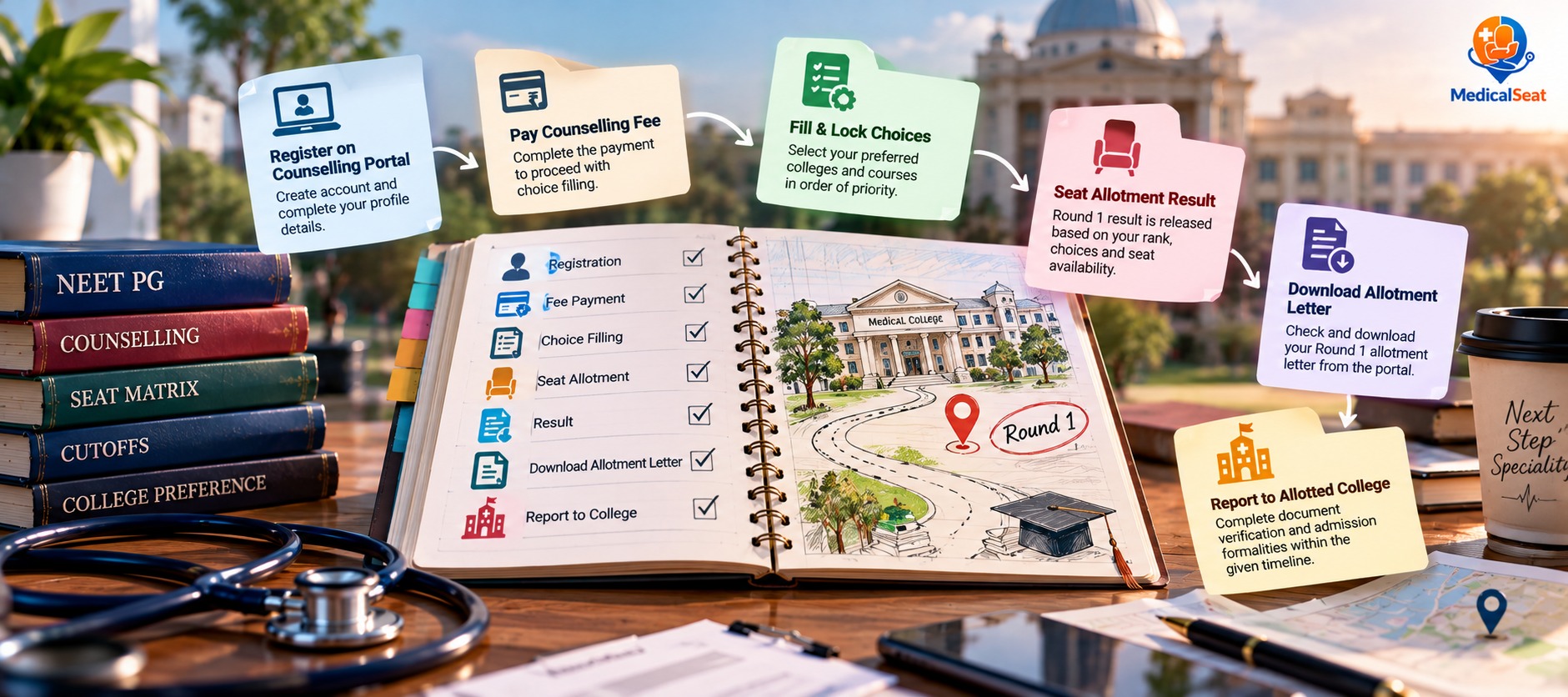
NEET PG 2026 Round One Explained Clearly
The NEET PG 2026 result is out. You know your rank. You have probably checked your expected colleges at least twenty times. Now comes the part that can actually turn your rank into an admission. NEET PG counselling 2026 Round 1. For many candidates, this is where the confusion starts. Where do you register? When do you pay? How does NEET PG choice filling work? How many colleges should you select? What does choice locking mean? What happens after locking? What if you get your first choice? What if you get your tenth choice? What if you get nothing? And perhaps the biggest question: What happens after the Round 1 result? Here is the entire process in simple terms.
What Is NEET PG Round One
NEET PG Round 1 is the first major seat allotment stage of the postgraduate counselling process.
For the central counselling conducted by MCC, eligible candidates register during the notified window, complete the required formalities and submit their preferred colleges and courses.
The system then processes those choices according to the applicable counselling rules.
Your allotment depends on factors including:
NEET PG rank
Category
Applicable quota
Choice order
Seat availability
Eligibility
Reservation rules
This means your rank alone does not determine your college.
Your choice list matters too.
When Will Round One Start
The exact NEET PG Round 1 dates 2026 should be taken from the official MCC schedule once published.
The 2025 cycle is useful for understanding the general timing.
The revised 2025 counselling schedule placed MCC Round 1 between October 17 and November 22, 2025, followed by the applicable reporting period. The overall 2025 counselling process eventually continued into January 2026.
Because the NEET PG 2026 result was declared later than the 2025 result, candidates should expect the 2026 counselling calendar to be shifted accordingly.
A practical planning estimate is:
Round 1 registration: October to November 2026
Choice filling: October to November 2026
Round 1 allotment: November 2026
These are expected planning windows, not confirmed dates.
The official MCC notification will determine the actual schedule.
Who Can Participate In Round One
Eligibility depends on the applicable MCC counselling rules.
Candidates generally need to have:
A valid NEET PG 2026 result
The required eligibility for postgraduate medical admission
Completed registration within the prescribed period
Submitted the required information
Paid the applicable fees
Completed choice filling where required
Candidates must also satisfy any category, quota, document or other requirements applicable to their admission route.
If you are participating through state counselling, the eligibility and registration process can be different.
Do not assume that an MCC rule automatically applies to state counselling.
What Happens Before Registration
Before you even open the registration form, prepare your information.
Keep your:
NEET PG 2026 scorecard
NEET PG application details
MBBS documents
Internship documents
Medical registration details
Category documents
Identity documents
Domicile documents where applicable
Other required certificates
The exact document requirements can vary depending on your category and counselling route.
Also keep your payment method ready.
Registration windows can be short, and waiting until the final day is unnecessary risk.
How NEET PG Registration Works
When MCC opens the Round 1 registration window, candidates need to complete the registration process through the official counselling portal.
You will be required to enter the requested information and complete the applicable payment.
Before submitting anything, check every detail carefully.
Pay particular attention to:
Name
NEET PG details
Category
Date of birth
Contact information
Registration information
Eligibility information
Incorrect information can create problems later.
Do not rush through registration simply because everyone in your WhatsApp group is saying:
“Registration is open.”
What Happens After Registration
Registration does not mean you have entered your college preferences.
That comes next.
The crucial stage is:
NEET PG choice filling.
This is where you tell the counselling system which courses and colleges you want and, more importantly, the order in which you want them.
Suppose you want:
MD Medicine College A
MD Medicine College B
MD Medicine College C
MS Surgery College A
MS Surgery College B
You enter those choices in your preferred order.
The order matters.
If your rank allows you to compete for more than one available choice, your preference order becomes important in determining which option is considered.
How Should You Build Choices
Do not start choice filling by randomly searching for colleges.
Start with your specialty preference.
Ask yourself:
Do I want Medicine?
Do I want Surgery?
Do I want Paediatrics?
Do I want Radiology?
Do I want Dermatology?
Do I want Anaesthesia?
Do I want Psychiatry?
Do I want another specialty?
Then shortlist colleges offering those specialties.
After that, compare:
Clinical exposure
Patient load
Fees
Stipend
Location
Infrastructure
Department reputation
Hospital workload
Academic environment
Previous closing trends
This gives you a much stronger NEET PG college preference list.
Should You Fill Many Choices
A common question is:
“How many choices should I fill?”
There is no magic number.
A better question is:
How many choices would I genuinely accept?
If there are 200 colleges and you would happily join 120 of them, you can consider all relevant options.
But if you would only consider 25, adding another 175 random choices does not automatically improve your strategy.
Do not put a college above another simply because someone told you its previous cutoff was better.
Your list should represent your actual preference.
What Are Dream Target Choices
One useful way to structure your list is:
Dream
Target
Safe
Dream choices are the colleges and specialties you would most like to get.
Target choices are realistic options where your rank has a reasonable chance based on available data.
Safe choices are options where your chances may be stronger.
But remember:
A safe choice is not necessarily a choice you must accept.
If you would never join a particular specialty or college, do not put it in your list just because you think you need a safety option.
Why Previous Cutoffs Matter
Previous year closing ranks are useful.
But they are not guarantees.
Suppose a college closed at rank 8,000 in the previous counselling cycle.
That does not mean rank 8,100 cannot get it this year.
It also does not mean rank 7,900 is guaranteed to get it.
Closing ranks can move because of:
Seat additions
Seat reductions
Changes in preferences
Category movement
New colleges
Changes in specialty demand
Fee differences
Choice filling patterns
Candidate behaviour
This is why NEET PG cutoff 2026 should be treated as a range or trend rather than a guaranteed number.
Why The 2026 Seat Matrix Matters
The NEET PG seat matrix 2026 is one of the most important documents for choice filling.
A previous year college list may show you what existed in 2025.
The current seat matrix tells you what is available for the 2026 admission cycle.
There may be:
New seats
New courses
Changed intake
Updated college details
Seat category changes
Changes in available postgraduate specialties
So do not build your 2026 choice list entirely from a 2025 spreadsheet.
The current seat matrix should be your starting point.
What Is Choice Locking
Once you have entered your choices, you may need to lock them within the prescribed time.
Choice locking means confirming your submitted preferences for processing.
This is extremely important.
Do not assume that simply entering choices means they will automatically be considered forever.
Follow the official instructions for the relevant round.
Check the deadline.
Check whether your choices have actually been locked or submitted.
Take screenshots or retain confirmation details where appropriate.
And never wait until the final few minutes if you can avoid it.
What Happens After Locking
After the choice filling and locking period ends, the counselling authority processes the allotment.
You do not manually choose a seat after the deadline.
The allotment is processed based on the applicable counselling mechanism.
Then the NEET PG Round 1 allotment result is published.
This is the moment candidates have been waiting for.
And this is also where your next decision begins.
What If You Get Your First Choice
Congratulations.
But do not stop reading the instructions.
Getting your preferred seat means you now need to understand the reporting and joining requirements.
Check:
Reporting deadline
Reporting location
Required documents
Fee requirements
Medical examination requirements where applicable
College instructions
MCC instructions
Failure to complete the required process within the prescribed timeline can have consequences.
Your allotment is not the same thing as completing admission.
What If You Get Your Fifth Choice
This is where things become more interesting.
Suppose your choices were:
MD Medicine A
MD Medicine B
MD Medicine C
MD Medicine D
MD Medicine E
You receive College E.
Now you need to decide whether you are satisfied with the seat or whether you want to participate in the next applicable round for an upgrade.
Do not make this decision emotionally.
Ask:
Would I be happy completing residency here?
If yes, the seat may be worth retaining while exploring your options under the applicable upgrade rules.
If no, understand exactly what your next options are before taking action.
Can You Upgrade Your Round One Seat
Candidates may be able to participate in subsequent rounds for an upgrade, subject to the current counselling rules.
This is why you should not blindly reject a reasonable Round 1 seat just because it is not your first preference.
But you also need to understand what happens if an upgrade is allotted.
Your current seat and the upgraded seat are not two independent purchases.
The applicable counselling rules determine how the movement works.
Always read the instructions for the specific round.
What If You Get No Seat
This is probably the second biggest Round 1 fear.
You log in.
You check the result.
Nothing.
No college.
No specialty.
No allotment.
Do not immediately assume that your NEET PG rank is useless.
Later rounds can have different seat availability.
Candidates move.
Seats become vacant.
New seats may be added.
Some candidates do not join.
Others upgrade.
The counselling landscape can change significantly.
Your next move should be to reassess your choices rather than panic.
Should You Change Your Choices
If you receive no seat, review your list.
Ask:
Did I choose too few colleges?
Was my specialty preference too narrow?
Did I exclude DNB?
Did I exclude colleges I would actually consider?
Did I ignore private or deemed options that are financially possible?
Did I rely too heavily on one previous year's cutoff?
Did the current seat matrix change?
This is where a NEET PG college predictor can be useful as a planning tool.
But a predictor should help you explore possibilities, not replace your own decision making.
What Happens If You Change Preference
Your preference can change as you learn more.
Perhaps you originally wanted only MD Medicine.
After researching colleges, you may decide that DNB Medicine is also worth considering.
Perhaps you initially rejected a particular city.
Later you realise the hospital offers excellent clinical exposure.
Perhaps your budget changes your private college options.
That is why counselling should be treated as a decision process, not a single spreadsheet.
What About DNB Choices
Do not automatically exclude DNB while preparing your choices.
For some candidates, DNB vs MD MS becomes one of the biggest decisions after the NEET PG result.
The right choice depends on the hospital, specialty, training environment, workload, academic exposure, future plans and the individual candidate.
A DNB seat in a strong hospital may be worth considering alongside MD or MS options.
The correct decision is not simply:
“MD is always better.”
Or:
“DNB is always better.”
Compare the actual programs.
What About Private Colleges
Private medical colleges can significantly expand the number of postgraduate options available to candidates.
But the biggest factor is often cost.
Before placing a private MD or MS seat high on your list, check:
Tuition fee
Hostel fee
Other charges
Stipend
Bond requirements where applicable
Refund rules
Payment schedule
The most dangerous choice is one you receive and then discover you cannot realistically afford.
What About Deemed Universities
Deemed universities are another important category in postgraduate counselling.
Candidates should research them separately because their fee structures can be substantially different from many government options.
If you are considering a deemed university, calculate the total financial commitment before putting it into your final choices.
Do not look only at the annual tuition number.
Consider the entire residency period.
What Happens After Round One
Round 1 is only the beginning of the broader counselling process.
Depending on your result and the applicable rules, your journey may continue into:
Round 2
Round 3
Stray Vacancy
The exact rules can change between rounds.
This is why you should save the official counselling notifications and read the instructions whenever a new round begins.
Do not rely on a screenshot from last year's counselling.
Round One Mistakes To Avoid
Several mistakes appear again and again.
Filling Choices Without Research
Do not copy somebody else's list.
Ignoring Fees
A seat is useful only if you can realistically take it.
Choosing By Cutoff Alone
Closing rank does not tell you everything about a residency program.
Adding Unwanted Specialties
Never fill a choice simply because you are scared of getting nothing.
Ignoring DNB
DNB can be a meaningful option for some candidates.
Ignoring The Current Seat Matrix
2025 availability is not the same as 2026 availability.
Waiting Until Deadline
Technical problems become much more stressful when the deadline is minutes away.
Not Reading Round Rules
Round specific rules can differ.
A Better Round One Strategy
A simple workflow can make the process much easier.
First, identify your realistic specialties.
Second, identify your preferred colleges.
Third, check the current NEET PG 2026 seat matrix.
Fourth, compare fees and clinical exposure.
Fifth, review previous closing ranks.
Sixth, create your dream, target and safe groups.
Seventh, arrange everything according to your genuine preference.
Eighth, verify every choice.
Ninth, lock or submit according to the official instructions.
Finally, save the confirmation.
That is far safer than building your list at midnight while scrolling through Telegram messages.
Your Rank Starts The Process
Your NEET PG 2026 rank gets you into the competition.
It does not choose your college.
Your choices do.
The seat matrix tells you what exists.
Previous closing ranks show you what has happened before.
Your preferences tell the counselling system what you want.
And the allotment process brings all of those factors together.
So do not treat Round 1 as a formality.
It is the stage where your preparation becomes an actual admission possibility.
MedicalSeat Can Help Build Choices
The difficult part of NEET PG counselling 2026 is not simply finding colleges.
It is deciding which colleges belong above the others in your personal choice list.
MedicalSeat's NEET PG College Predictor can help you explore possible MD, MS and DNB options based on your rank and preferences.
The NEET PG counselling platform can also help candidates compare options, understand counselling developments and prepare for choice filling.
Use your rank as the starting point.
Use the current seat matrix to understand availability.
Use previous closing ranks as reference points.
Then build a choice list based on where you would genuinely want to train.
Because when NEET PG Round 1 opens, you should not be figuring out what you want.
You should already know.