
 Neet Rank Predictor
 NEET UG Predictor
 MDS Predictor
 INI CET Predictor
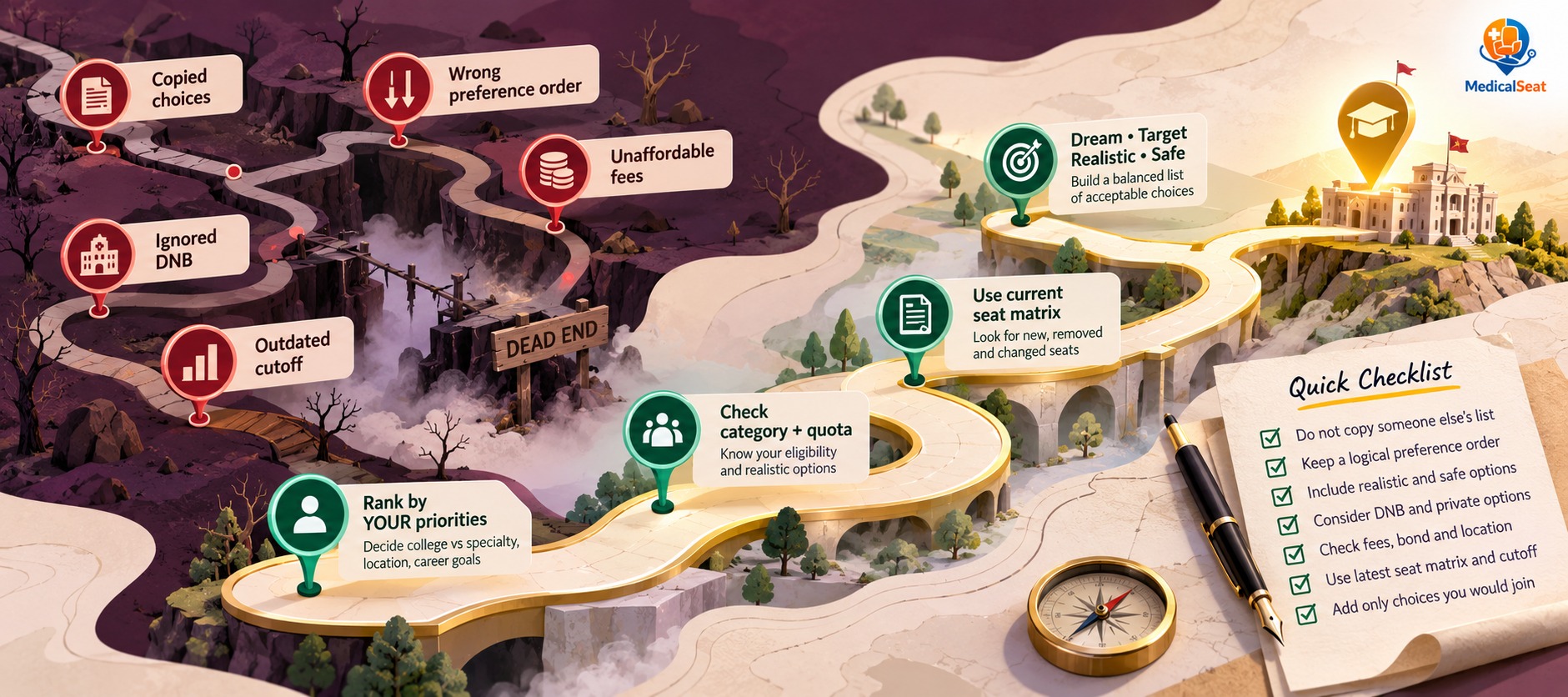
NEET PG 2026 Choice Filling Mistakes Ruin Everything
You can have a decent NEET PG 2026 rank, enough seats in the matrix and several realistic colleges in front of you. And still get a terrible allotment. Why? Because NEET PG choice filling is where candidates turn good options into bad outcomes. Some put colleges in the wrong order. Some copy somebody else's choice list. Some add 400 choices without knowing what they actually want. Some refuse DNB because it is not MD or MS. Some add private colleges they cannot afford. Some trust last year's cutoff blindly. Some leave realistic options out because they look “too low.” And some put a college above another one simply because somebody on Telegram called it better. Then the allotment comes. And suddenly the counselling system is blamed for a choice list that was never properly built. For NEET PG counselling 2026, your choice list needs to be treated like an actual decision. Not a formality.
Choice Filling Is Your Real Strategy
Your rank does not directly select your college.
Your choices interact with your rank, category, quota and available seats.
That means two candidates with similar ranks can receive completely different outcomes.
Candidate A builds a broad, carefully ordered list.
Candidate B selects only a handful of famous colleges.
Candidate A gets an acceptable seat.
Candidate B gets nothing.
The difference may not be rank.
It may simply be choice filling strategy.
Never Copy Someone Else's Choices
This is probably the most common mistake.
A senior sends you a choice list.
A Telegram group posts a “top 100 colleges” list.
A YouTube video gives you the “best preference order.”
You copy it.
The problem?
That list belongs to someone else.
Their:
Rank
Category
Budget
Specialty preference
Location preference
Career plan
Family situation
Risk tolerance
may be completely different from yours.
There is no universal NEET PG choice filling order.
There is only an order that makes sense for you.
College And Specialty Come First
Before ranking colleges, decide how you actually value specialties.
Suppose you have:
MD Pediatrics at College A
and
MD General Medicine at College B
Which comes first?
There is no universal answer.
If you strongly prefer General Medicine, College B may come first.
If you specifically want Pediatrics, College A may be the better choice.
The correct order comes from your priorities.
Not from someone else's ranking.
Do Not Chase Brand Names Blindly
A famous medical college can be excellent.
That does not automatically make it the right choice for every candidate.
You need to consider:
Specialty
Clinical exposure
Patient load
Faculty
Infrastructure
Location
Fees
Bond
Stipend
Work environment
Career goals
A famous college in a specialty you do not want is not necessarily better than a less famous college offering your preferred specialty.
The name is one factor.
It is not the entire decision.
Your Dream List Needs Realism
You should absolutely include ambitious choices.
That is what dream choices are for.
But if your entire list contains only extremely competitive options, you are effectively betting your entire counselling season on an unlikely outcome.
For example, a candidate with a rank of 40,000 cannot sensibly create a list containing only the most competitive government clinical specialties.
Add ambitious choices.
Then add realistic ones.
Then add safe choices.
That is how you protect the result.
Safe Does Not Mean Unwanted
This mistake is everywhere.
Candidates think:
“I need safe choices, so I will put some random college at the bottom.”
No.
Your safe choices should be colleges you would actually join.
If you would reject the seat immediately, it is not a safe choice.
It is a bad choice.
The purpose of a safe option is to give you a realistic admission path that you are comfortable accepting.
The Order Actually Matters
This is the part candidates underestimate.
The system does not look at your choices as a random list.
Your preference order matters.
If you put:
College A
College B
College C
you are telling the allotment system that College A is preferred over College B, and College B over College C.
So do not arrange choices alphabetically.
Do not arrange them according to a friend's list.
Do not arrange them according to Google search results.
Arrange them according to your actual preference.
More Choices Can Be Better
Generally, having more acceptable choices can increase the number of opportunities available to you.
But there is an important condition.
The additional choices must be choices you would genuinely accept.
Adding hundreds of random colleges simply to make the list long is not strategy.
A long bad list is still bad.
A long, carefully ranked list can be powerful.
Fewer Choices Can Be Dangerous
Suppose you have a rank that could realistically secure several colleges.
But you select only five.
All five are highly competitive.
You receive no seat.
Another candidate with the same rank selected 100 acceptable options and received one.
The difference was not luck alone.
The second candidate gave the allotment system more acceptable opportunities to work with.
That is why overly short choice lists can be risky.
Use The Current Seat Matrix
Your NEET PG 2026 seat matrix should be one of the first things you check.
Do not create your list entirely from previous years.
The current matrix can reveal:
New seats
Changed seat numbers
Available specialties
College additions
Category changes
Vacancies
Virtual vacancies
Clear vacancies
The NMC published the PG seat matrix for the 2026 to 27 academic session on September 29, 2026. The applicable MCC counselling matrix and vacancy information should be checked for the specific round in which you are participating. (nmc.org.in)
Your 2026 choice list should therefore be built around 2026 information.
Previous Cutoffs Need Context
Last year's NEET PG cutoff is useful.
It is not your destiny.
Suppose a specialty closed at rank 20,000 last year.
You have rank 23,000.
Do not immediately delete it.
Check:
Current seat count
Current vacancies
Round
Category
Quota
Specialty
New seats
Previous movement
The same college can behave differently this year.
Use historical cutoffs to estimate probability.
Do not use them as hard walls.
Build Four Choice Groups
A practical choice list can be divided into four groups.
Dream Choices
Highly preferred options that may be difficult to secure.
Target Choices
Options that match your rank reasonably well.
Realistic Choices
Options where your chances are stronger based on available data.
Safe Choices
Options you are comfortable accepting and are more likely to obtain.
You need all four where appropriate.
A list with only dream choices is fragile.
A list with only safe choices may waste your rank.
Do Not Put Random Choices Between Them
Suppose your actual preference is:
College A
College C
College B
But you insert College B between A and C because you heard it has a better “brand.”
You have changed your own preference.
If College B is genuinely your second choice, fine.
If it is not, remove it.
Every position in the list should have a reason.
Specialty Preference Must Be Honest
This is especially important when choosing between clinical specialties.
Do not select a specialty because:
Everyone says it has money
It has the highest cutoff
Your friend selected it
Instagram doctors are talking about it
It sounds prestigious
Postgraduate training lasts years.
Your day to day work matters.
Think about:
Patient interaction
Procedures
Emergency workload
Lifestyle
Academic interest
Long term career
Fellowship plans
Private practice possibilities
Research interest
Your NEET PG choice list should reflect the career you actually want.
DNB Should Not Be Automatically Rejected
One of the biggest missed opportunities is ignoring DNB after NEET PG.
Candidates sometimes see DNB and immediately delete it.
That can be a mistake.
A strong DNB programme in a major hospital can offer substantial clinical exposure.
But not every DNB programme is automatically better than every MD or MS seat.
Compare the actual institution.
Look at:
Patient volume
Specialty exposure
Faculty
Academics
Workload
Infrastructure
Stipend
Fees
Location
Career goals
Evaluate the programme.
Do not evaluate the label.
Private Colleges Need A Budget Filter
Never add a private college before checking the total financial commitment.
The tuition figure shown in a discussion may not represent everything.
Check:
Annual tuition
Total course fees
Hostel
Security deposit
Examination charges
Other compulsory fees
Stipend
Bond
Refund rules
If the total cost is outside your budget, remove the choice.
Do not wait for allotment day to discover that.
Deemed Universities Need Extra Research
Deemed universities can provide additional opportunities in NEET PG counselling 2026.
But they can also carry significantly different fee structures.
A candidate should compare:
Specialty + college + clinical exposure + fees + location + career value
rather than simply asking:
“Can I get this seat?”
Getting a seat and wanting the seat are two different questions.
Check The Quota Carefully
A college can have multiple seat categories and counselling pathways.
Do not assume every seat listed under a college is available to you.
Check:
Quota
Category
Seat type
Eligibility
Counselling authority
A choice is useful only if you can actually compete for that seat.
Virtual Vacancies Need Care
Virtual vacancies can create potential opportunities during upgrade based counselling.
But they should not be treated as guaranteed vacant seats.
If a candidate currently holding the seat upgrades, it may become available.
If they remain in place, it may not.
Therefore, virtual vacancies belong in your analysis.
They should not become the foundation of your entire strategy.
Clear Vacancies Deserve Attention
Clear vacancies are more straightforward.
They represent seats available for allotment in the relevant vacancy information.
If you have a realistic rank and the specialty is acceptable, these seats can be particularly important.
But again, check whether the seat actually fits your:
Category
Quota
Specialty
Budget
College preference
A vacancy is not automatically a good choice.
Do Not Ignore New Seats
New seats are one of the biggest reasons to rebuild your choice list.
If a college adds seats in a specialty you want, that can change your probability.
The same applies if a new postgraduate programme or additional approved seats appear in the applicable matrix.
Candidates who rely exclusively on last year's data can miss these changes.
Always check the current official matrix.
Read Every Important MCC Notice
The MCC counselling portal can publish notices that affect practical decisions around choice filling, upgradation, resignation and vacancies.
The current 2026 PG counselling information includes specific notices concerning Round Two upgradation and resignation related processes. (mcc.nic.in)
This is why old counselling videos can become dangerous.
A video explaining NEET PG counselling 2024 may describe a process that is no longer applicable.
Use old material for background.
Use current MCC notices for rules.
Never Make Choices Under Pressure
Choice filling often happens under ridiculous time pressure.
Someone messages:
“Lock this college now.”
Another says:
“This branch will definitely close.”
Someone else says:
“Don't take DNB.”
You panic.
Then you submit a list you did not actually think through.
Stop.
Your choice list should not be based on somebody else's urgency.
Use the available time to check the data.
Then lock.
Do Not Change Everything At Midnight
Another common mistake is endless editing.
You have a solid list.
Then at 1:30 AM someone posts a new cutoff prediction.
You change 20 choices.
At 2:15 AM someone posts another prediction.
You change them again.
Eventually your list no longer represents what you actually want.
Make your decisions based on reliable information.
Once your order is logically correct, stop chasing noise.
Check Your Final Preference Order
Before locking, read the list from top to bottom.
Do not look at it as a spreadsheet.
Read it as a future.
Ask:
“If I receive my highest available choice, will I be happy?”
Then move down.
“Would I prefer this over everything below it?”
Continue.
If the answer is no, change the order.
This is one of the simplest ways to catch badly ordered choices.
Your Choice List Needs A Reality Check
Run these questions before locking.
Would I actually join this college?
Would I actually join this specialty?
Can I afford it?
Have I checked the current seat matrix?
Have I checked the category and quota?
Have I compared recent closing ranks?
Have I included realistic options?
Have I considered DNB?
Have I checked private and deemed fees?
Have I considered location?
Have I checked the latest MCC notice?
If you cannot answer these, keep working.
MedicalSeat Can Simplify The Process
Building a NEET PG 2026 choice list manually can become overwhelming.
MedicalSeat's NEET PG Predictor can help organise possible colleges and specialties according to rank and preferences.
The MedicalSeat NEET PG counselling platform also provides counselling information, choice filling resources, updates and guidance.
Use prediction to narrow the universe.
Then use your own priorities to create the final order.
The official seat matrix and counselling rules remain the final reference.
The Best Choice List Is Yours
There is no magical 500 choice list.
There is no universal college ranking that can solve your counselling.
There is no Telegram message that knows your priorities better than you do.
A strong NEET PG choice filling strategy is personal.
It uses:
Your rank
Your category
Your specialty preference
Your college preference
Your budget
Your location preference
Your career goals
The current seat matrix
Recent cutoff movement
Current vacancies
Official counselling rules
Put all of that together.
Then rank the choices honestly.
Because once you lock the list, the system does not know what you meant.
It only knows what you submitted.