
 Neet Rank Predictor
 NEET UG Predictor
 MDS Predictor
 INI CET Predictor
NEET PG 2026 Round 1 Is Here: Your Rank Won't Save You From a Missed Deadline
You survived NEET PG 2026. You checked your result. You calculated your rank. You compared specialties, stalked college websites, questioned every career decision you have ever made and probably asked at least five people what they would do in your position. Now Round 1 counselling has arrived. And suddenly, a different kind of anxiety begins. Did you register correctly? Are your documents ready? Is your preferred college actually available? Should you fill more choices? What happens if you miss the locking deadline? And why does every person on the internet seem convinced they know exactly which college you will get?
Welcome to NEET PG counselling 2026, where a strong rank is useful, but preparation, accurate information and timely decisions matter just as much.
The Medical Counselling Committee has started the Round 1 registration process for the 2026 postgraduate medical admission cycle. Candidates can check the latest registration instructions, seat matrices, counselling schedule and candidate user guide through the official MCC PG Medical Counselling portal.
This is no longer the stage to collect predictions indefinitely.
It is time to prepare your application, understand your options and make sure avoidable mistakes do not get in the way of your admission.
NEET PG 2026 Round 1: What Actually Happens Now?
The first counselling round moves candidates from result analysis to the formal admission process.
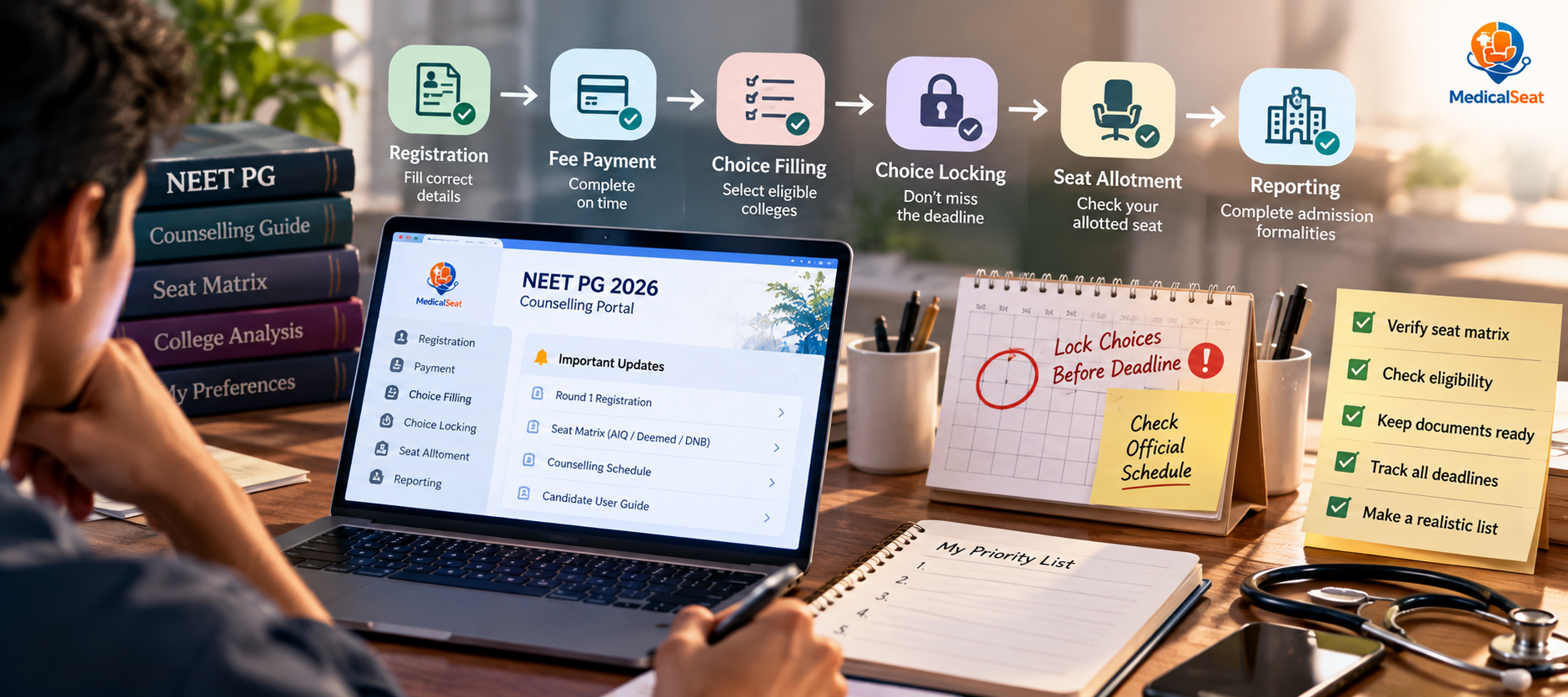
The main steps generally include registration, payment of applicable fees, choice filling, choice locking, seat allotment and reporting to the allotted institution.
Candidates must follow the current schedule and instructions for their applicable counselling route.
Here is what you should focus on at each stage.
Stage | What You Need to Do |
Registration | Complete the application using the correct candidate details |
Fee payment | Pay the applicable registration fee and security deposit |
Choice filling | Select eligible colleges and specialties in your preferred order |
Choice locking | Finalise choices according to the portal instructions |
Seat allotment | Check the official allotment result and allotted course |
Reporting | Complete admission formalities within the specified period |
These stages are connected, but completing one does not automatically mean every subsequent requirement has been fulfilled.
Keep your own checklist and verify each step on the relevant official portal.
The Biggest Round 1 Mistake? Treating Registration Like a Formality
Registration can feel like the least important part of counselling because the real decisions seem to happen during choice filling.
That assumption can be costly.
Incorrect details, incomplete documentation, payment problems or failure to complete the required registration steps can create unnecessary complications.
Before submitting your application, check your name, NEET PG details, category, applicable eligibility information and other requested particulars.
Keep your application credentials secure and retain the confirmation or acknowledgement generated by the portal.
If something appears incorrect, consult the official instructions and available correction procedures rather than assuming it will be fixed automatically later.
A counselling strategy is useful only if you successfully complete the process required to participate.
Your Rank Is Known. Now Stop Guessing and Start Verifying.
By this point, most candidates have a rough idea of the colleges and specialties they want.
The problem is that a rough idea is not the same as a verified shortlist.
You may have seen a college mentioned in a previous year's cutoff list. You may have heard that a particular specialty is available at a hospital. You may even have received a screenshot claiming that someone with your rank secured the seat last year.
None of these establishes that the same option is available to you in the current counselling round.
Before adding an option to your list, verify:
Whether the college and course appear in the applicable seat matrix.
Whether you meet the eligibility requirements for that seat.
Which quota and category apply.
Whether the current fee structure is financially manageable.
Whether the programme matches your specialty preference.
Whether the institution's admission conditions are acceptable to you.
Historical data can help you estimate possibilities. Current official information determines what you should investigate now.
The NEET PG 2026 Seat Matrix Deserves Your Attention
The seat matrix is one of the most important documents in your Round 1 preparation.
MCC's official PG counselling portal lists the 2026 matrices for All India Quota MD/MS seats, central internal quota seats, deemed university MD/MS seats and DNB postgraduate seats.
These are distinct categories within the counselling process. You should examine the matrix relevant to the options you intend to pursue.
Do not simply search for your favourite college and assume every postgraduate specialty is available.
Check the exact course, institution and applicable seat category.
Also watch for subsequent official notices that may add, withdraw or correct seats.
A college can be excellent for your preferred specialty, but that does not help if the relevant seat is not available through the counselling route you are using.
MD, MS or DNB? Make Your Decision Before the Deadline Panic Begins
The closer choice filling gets to its deadline, the easier it becomes to select options based on urgency rather than suitability.
This is particularly true when candidates compare MD, MS and DNB programmes.
MD broadly covers medical and related postgraduate specialties. MS primarily covers surgical specialties. DNB is a postgraduate qualification offered through the NBEMS framework at accredited hospitals and institutions.
The right option depends on the specialty and the specific programme.
Before making your list, investigate the hospital, department, clinical exposure, procedures, faculty, academic environment, fees and resident responsibilities.
For surgical specialties, pay particular attention to operative exposure and supervised participation. For medical specialties, look at inpatient admissions, emergency work, ICU exposure and case diversity. For diagnostic specialties, investigate the workload, reporting experience, equipment and available subspecialty services.
Do not automatically reject a DNB programme because of its qualification label. Equally, do not assume that every DNB programme is equivalent to every MD or MS programme.
Compare actual training opportunities.
College Reputation Is Not a Substitute for Department Research
A prestigious institution can be attractive for good reasons. But your postgraduate experience will depend heavily on the department you join.
Before ranking a college highly, look beyond its name.
Factor | What to Investigate |
Patient load | OPD, IPD and emergency workload |
Clinical exposure | Variety and complexity of cases |
Procedures | Resident participation and supervision |
Faculty | Availability and teaching support |
Academics | Seminars, journal clubs and teaching sessions |
Infrastructure | Specialty facilities, ICU, OT and diagnostics |
Research | Thesis support and research opportunities |
Duty pattern | Working hours, responsibilities and workload |
Stipend | Current amount and payment conditions |
Accommodation | Hostel availability and living expenses |
Fees | Total cost of the postgraduate programme |
Speak to current residents wherever possible. Their experiences can help you understand aspects of training that an institutional brochure may not explain.
The objective is not to find a flawless college.
It is to identify a programme whose strengths and limitations you understand before committing to it.
Do Not Let One Cutoff Screenshot Dictate Your Entire Future
Every counselling season brings a familiar phenomenon.
Someone shares a closing rank. Another person interprets it as a guarantee. A third person creates a prediction around it. By the end of the day, a historical data point has somehow become a promise.
Do not fall for it.
A previous year's closing rank represents an outcome under the conditions of that particular counselling process. It does not guarantee that the same rank will secure the same seat in 2026.
Closing ranks can vary according to the round, category, quota, course, institution, seat availability and candidate preferences.
If you use historical data, record the context alongside the number.
A closing rank without its category, quota, round and specialty can be misleading.
Use past trends to build a shortlist, not to eliminate every option that looks uncertain.
How to Build a Round 1 Preference List That Actually Makes Sense
Start with the options you genuinely want.
Then organise them according to your priorities, rather than arranging them according to what other candidates consider prestigious.
Your First Group: Preferred Options
These are the college and specialty combinations you would be happiest to receive, even if competition is intense.
Your Second Group: Realistic Alternatives
These are options that fit your preferences and deserve serious consideration based on your rank, eligibility, historical data and current seat availability.
Your Third Group: Acceptable Backups
These are alternatives you would genuinely join if your higher preferences were unavailable.
The word acceptable matters.
Do not add a specialty you dislike simply because you are worried about not receiving a seat. Do not add an expensive institution without checking whether you can manage the fees.
A broad list is useful when it expands your real opportunities. It is not useful when it contains choices you would regret accepting.
Should You Fill Every Available Choice?
Not automatically.
The number of choices is less important than the quality and order of those choices.
If you would happily join several eligible programmes, including them in your preference list may help you explore more opportunities within the applicable counselling rules.
However, every option should be evaluated before you include it.
Ask yourself:
Would I actually join this college and specialty?
Can I afford the programme?
Does the department offer the training I want?
Would I be comfortable relocating there?
Do I understand the relevant admission conditions?
If you cannot answer these questions, research the option before placing it in your list.
The goal is to make your preferences reflect your priorities, not simply to create the longest possible list.
Choice Locking: Do Not Leave This Until the Last Five Minutes
You can research colleges for weeks and still create a problem by mishandling the final submission.
Before locking your choices, verify the complete list.
Check that the college names, specialties and preference order are correct. Make sure you have not accidentally excluded an important option or included one you would never accept.
Then follow the official portal's instructions for saving, submitting and locking your preferences.
Do not assume that a saved list is necessarily a locked list.
Do not assume that an unfinished application will automatically be considered.
And do not rely on a friend to remind you when the deadline is approaching.
Set your own reminders and check the official schedule.
What If Your Dream College Is Not Realistic?
This is where counselling requires some uncomfortable honesty.
You may have a preferred institution that appears difficult to secure at your rank. That does not mean you must immediately abandon it.
It means you should distinguish between a preferred option and a complete admission strategy.
Include ambitious choices where appropriate, but also research realistic alternatives that offer a specialty and training environment you would genuinely accept.
Consider institutions beyond the names that dominate social media discussions.
Look at departments, clinical exposure, fees and location. A less widely discussed institution may offer a suitable programme that deserves serious consideration.
The point is not to lower your expectations blindly.
It is to make sure your entire strategy does not depend on one uncertain outcome.
Government vs Private vs Deemed vs DNB: Compare the Actual Options
There is no single institutional category that is automatically best for every candidate.
Government medical colleges may offer comparatively lower tuition fees, but competition for certain specialties can be intense.
Private medical colleges may provide additional opportunities, although costs vary substantially.
Deemed universities have their own applicable fee and admission conditions within the relevant counselling framework.
DNB programmes offer another postgraduate route through accredited institutions and hospitals.
Compare the specific college and specialty combination rather than relying on a universal ranking of these categories.
Consider the quality of training, available facilities, fees, stipend, patient exposure and your long-term career goals.
A seat is not a good deal simply because it is available. It becomes a serious option when its benefits and limitations make sense for you.
Your Budget Can Change Your Entire Counselling Strategy
This is a conversation every candidate should have before finalising preferences.
Two programmes may appear similarly attractive until you compare their total costs.
Calculate tuition fees, hostel expenses, deposits, examination charges, living costs and other compulsory payments. Review the current stipend and any applicable bond or service conditions.
Do not rely on fee information copied from an older admission cycle.
Use the latest official fee notification or prospectus.
If a programme requires a financial commitment that is not realistic for you, decide that before you rank it highly.
A rushed decision can leave you choosing between a seat you cannot comfortably afford and an opportunity you did not properly investigate.
MCC and State Counselling: Keep Both on Your Radar
MCC counselling is not the only route that may matter to you.
MCC handles its designated postgraduate counselling categories, including 50% All India Quota seats and other categories covered by its process. State counselling authorities administer their respective admission processes.
Eligibility requirements, domicile conditions, seat categories, deadlines and admission rules may differ.
If you qualify for multiple routes, maintain separate schedules and check each authority's official announcements.
Do not assume that completing registration with one authority automatically covers another.
A suitable college is of little practical value if you overlook the process required to compete for its seats.
PwBD and NRI Candidates: Check the Details Before Submitting
Candidates applying under special categories should pay particular attention to the latest documentation and eligibility instructions.
MCC has published guidelines relating to Persons with Benchmark Disabilities for postgraduate medical admissions and information about assessment boards for the current counselling cycle.
Candidates applying under the NRI category should also review the latest applicable instructions. MCC's current portal lists a corrigendum concerning NRI documents dated October 14, 2026.
The documents and procedures required depend on the applicable category and counselling rules.
Do not rely on an old checklist without confirming that it remains valid for the current admission cycle.
What Happens After Round 1 Allotment?
Once the Round 1 result is published, candidates must review their allotment and follow the instructions applicable to their situation.
If you receive a seat, check the allotted college, specialty, reporting deadline, required documents and admission conditions.
If you do not receive a preferred seat, review the options available in subsequent rounds and determine whether you remain eligible to participate.
If you receive a seat but hope to upgrade, read the applicable rules before deciding how to proceed.
Do not resign, surrender or abandon an allotted seat based on assumptions about a future round.
The consequences of accepting, upgrading or leaving a seat depend on the current counselling scheme and applicable notices. Read those rules carefully before taking action.
Use a NEET PG College Predictor Before Finalising Your Choices
MedicalSeat's NEET PG Predictor 2026 can help candidates explore possible MD, MS and DNB college options using factors such as rank, category, domicile, quota and counselling trends.
Use it to develop a shortlist and identify programmes that deserve closer investigation.
Then verify the current seat matrix, eligibility, fees and admission requirements through official sources.
A predictor estimates possible outcomes. It cannot guarantee an allotment or determine whether a particular residency is right for you.
The strongest approach combines prediction with programme research and a preference list built around your actual priorities.
Your Round 1 Checklist Before the Deadline
Before you complete the process, make sure you have covered the essentials.
Checked the latest official counselling schedule.
Completed registration and required fee payments.
Verified your candidate and category details.
Reviewed the applicable seat matrix.
Researched your preferred colleges and specialties.
Compared fees, stipend and other financial commitments.
Checked the relevant eligibility and documentation rules.
Arranged your choices according to your priorities.
Confirmed the choice-locking deadline and submission procedure.
Saved the relevant confirmations and kept documents ready.
Use the checklist alongside the official instructions for your counselling route. It is a planning aid, not a substitute for the applicable rules.
NEET PG 2026 Round 1: The Decisions You Make Now Deserve More Than Panic
Your result has given you a rank. It has not made your admission decisions for you.
Round 1 is an opportunity to turn your research into a practical plan, identify the options available to you and submit preferences that reflect what you genuinely want.
You do not need to chase every college name circulating online. You do not need to copy someone else's list. And you certainly do not need to make a rushed decision because another candidate claims to know exactly how counselling will unfold.
Check the official information. Compare the actual programmes. Understand the costs. Follow the deadlines. Keep realistic alternatives.
Most importantly, remember that the objective is not merely to secure a postgraduate medical seat. It is to secure an opportunity you are prepared to pursue.
Your rank got you to counselling.
Your decisions will determine how well you use it.
MedicalSeat Resources for NEET PG 2026
Round 1 counselling is the time to turn your rank into a practical admission strategy.
MedicalSeat's NEET PG Predictor 2026 helps candidates explore possible MD, MS and DNB college options based on rank, category, domicile, quota and counselling trends.
The NEET PG Counselling 2026 resource brings together counselling information, college prediction, choice-filling support and admission guidance.
Use these resources to develop your shortlist, compare possible options and prepare for the counselling process. Verify all current deadlines, seat availability, fees and eligibility requirements against the relevant official notices.
The difference between a rushed preference list and a well-researched one is not how many colleges it contains.
It is how well those choices match your goals, your circumstances and the kind of doctor you want to become.