
 Neet Rank Predictor
 NEET UG Predictor
 MDS Predictor
 INI CET Predictor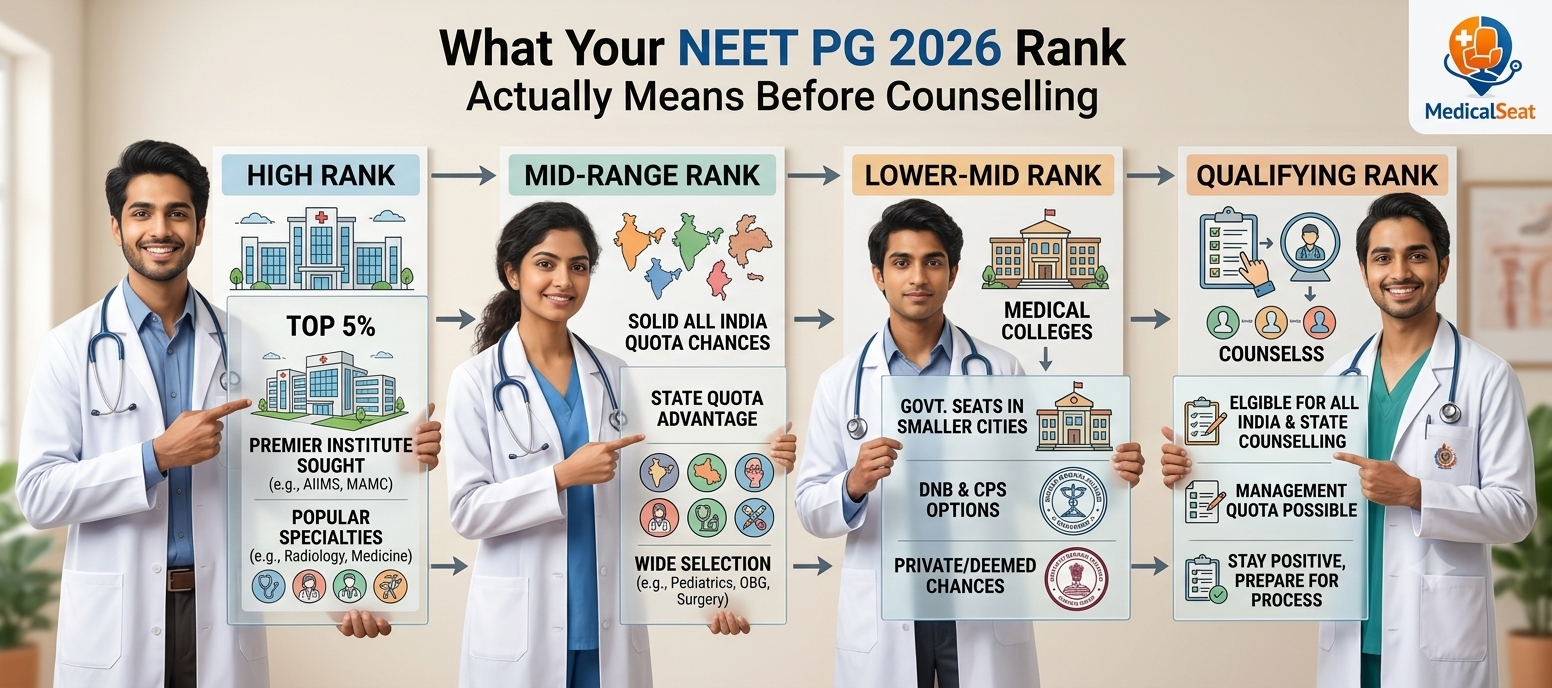
What Your NEET PG 2026 Rank Actually Means Before Counselling
The NEET PG 2026 result is out. The marks are visible. The rank is real. The screenshots are circulating. The WhatsApp groups are full of cutoff predictions. And somewhere, someone has already announced that a particular rank will “definitely” get a particular branch. This is also the point where the real NEET PG battle begins. Because your NEET PG rank tells you where you stand. It does not tell you what you should choose. The NEET PG 2026 result was declared by the National Board of Examinations in Medical Sciences on September 24, 2026. NBEMS subsequently listed the individual scorecard and answer key on October 1, giving candidates access to their detailed result information. Now the focus shifts from examination preparation to NEET PG counselling 2026, specialty selection, college research, seat matrix analysis and choice filling. And this phase can be just as important as the exam itself.
Your NEET PG Rank Is a Starting Point, Not a Career Plan
Getting your result can create a strange situation.
You spend months thinking about one number.
Then the number arrives.
And suddenly you have hundreds of possible questions.
Can I get MD Medicine?
Can I get Radiology?
Should I take DNB?
Should I wait for Round 2?
Should I choose a government college over a private college?
What if I get a better branch in a less famous college?
What if I get my preferred college but not my preferred specialty?
These are not questions that can be answered by rank alone.
Your options depend on your NEET PG rank, category, quota, domicile, specialty preference, college preference, seat availability, counselling round and choice filling strategy.
MCC conducts online counselling for 50% of All India Quota postgraduate medical seats and other categories covered under its counselling process. State counselling authorities conduct their respective state level admissions.
That means the same NEET PG rank can lead to very different outcomes for two candidates.
The difference is often not the rank.
It is the strategy.
First Things First: Download and Check Your NEET PG Documents
Before spending hours looking at colleges, make sure your official documents are in order.
Keep copies of:
NEET PG 2026 result
NEET PG 2026 scorecard
NEET PG 2026 answer key
NEET PG admit card
MBBS degree or provisional degree certificate
MBBS marksheets
Internship completion certificate
Medical registration certificate
Category certificate, where applicable
PwBD documents, where applicable
NRI documents, where applicable
NBEMS has listed the Scorecard and Answer Key of NEET PG 2026 on its official notice board.
Check your name, application details, marks and rank carefully.
Do not rely on screenshots shared by other candidates when your own official result is available.
NEET PG 2026 Cutoff and College Closing Rank Are Not the Same Thing
This distinction becomes extremely important after the result.
The NEET PG qualifying cutoff determines whether you are eligible to participate in counselling.
The college closing rank tells you how far competition extended for a particular specialty, college, category, quota and counselling round.
These are completely different numbers.
A candidate may qualify for NEET PG counselling but still not be competitive for the specialty or college they want.
This is why searches for NEET PG cutoff 2026 can sometimes create confusion.
If you are researching a previous year's closing rank, always record:
Year
Round
Specialty
College
Category
Quota
Without that context, a cutoff number is almost meaningless.
The Biggest Mistake You Can Make After NEET PG 2026
Do not start with:
“Which college can I get?”
Start with:
“What do I want to train in?”
This sounds obvious.
It is not.
Once results are declared, candidates naturally start chasing the most competitive branches their rank appears to permit.
A candidate who wanted Paediatrics may suddenly start considering another specialty because its cutoff is higher.
Someone interested in surgery may start looking at non surgical options because a particular college is considered prestigious.
Someone may reject DNB without researching the actual hospital.
Someone else may accept a branch they dislike simply because the seat is difficult to obtain.
Your rank should determine which options you can investigate.
It should not automatically determine which career you choose.
Make Three Specialty Lists
Before building your final preference list, divide specialties into three groups.
Group One: I Actually Want This
These are specialties you can realistically imagine training in and practising.
Think about the work itself.
Do you like medicine?
Do you like surgery?
Do you enjoy procedures?
Do you prefer diagnostics?
Do you want long term patient management?
Do you enjoy emergency medicine?
Do you want a specialty with substantial outpatient work?
Do you enjoy laboratory or pathology based medicine?
Your answers matter more than an Instagram ranking.
Group Two: I Could Consider This
These are specialties you are not completely sure about.
Research them properly.
Look at the actual residency workload, clinical exposure, patient population, procedures, academic requirements and future training options.
Group Three: I Do Not Want This
This list is equally important.
If you already know that you do not want a particular specialty, do not place it high in your preference list simply because its cutoff is competitive.
A difficult seat is not automatically the right seat.
MD, MS and DNB Should Be Compared Properly
The MD vs MS vs DNB debate will become louder as counselling approaches.
But these are different postgraduate pathways and should not be reduced to a simple ranking.
MD broadly covers medical and related specialties.
MS is associated primarily with surgical specialties.
DNB is a postgraduate qualification conducted through NBEMS accredited institutions and hospitals.
The relevant comparison is therefore not simply:
MD > DNB
or
DNB > MD
Instead ask:
How does this specific MD programme compare with this specific DNB programme in the specialty I want?
Look at the hospital.
Look at the department.
Look at the patient load.
Look at procedures.
Look at faculty.
Look at academics.
Look at fees.
Look at the training environment.
The qualification name is only one part of the decision.
The College Name Is Not the Whole Story
Medical PG candidates sometimes spend too much time comparing college names and too little time comparing departments.
A postgraduate resident spends three years inside a particular specialty.
That department matters.
When comparing two options, investigate:
Factor | What to Check |
Patient load | OPD, IPD and emergency volume |
Case mix | Variety and complexity of cases |
Procedures | Resident exposure and supervision |
Surgery | Operation volume for surgical specialties |
Faculty | Department strength and availability |
Academics | Seminars, teaching and journal clubs |
Infrastructure | ICU, OT, diagnostics and specialty facilities |
Research | Thesis and research opportunities |
Duty pattern | Residency workload and schedules |
Accommodation | Hostel and living arrangements |
Fees | Complete financial commitment |
Stipend | Current stipend and payment terms |
A college with a famous name is not automatically the best training environment for every specialty.
Clinical Exposure Should Be One of Your Biggest Checks
If you are choosing between medical colleges, ask what you will actually see and do during residency.
For a medical specialty, examine:
OPD volume
Inpatient admissions
Emergency workload
ICU exposure
Referral patterns
Specialty clinics
Procedures
Case diversity
For a surgical specialty, look closely at:
Number of operations
Variety of procedures
Emergency surgeries
Elective surgeries
Resident participation
Operation theatre availability
Supervision
Postoperative care exposure
For diagnostic and laboratory specialties, examine:
Sample volume
Diagnostic workload
Equipment
Reporting exposure
Subspecialty services
Research opportunities
Clinical exposure is not simply about having a large hospital.
It is about the kind of training residents actually receive.
Now Look at the 2026 Seat Matrix
The NEET PG 2026 seat matrix is one of the most important documents candidates should monitor before finalising choices.
MCC's current PG counselling page is the official source for its counselling process and current notices. It currently lists the 2026 PwD assessment notice and the final PwBD guidelines received from NMC.
Recent reporting has also indicated that the 2026 postgraduate seat matrix includes MD, MS, DNB and PG Diploma seats and that the number of available postgraduate seats has increased.
This matters because the 2026 counselling landscape should not simply be treated as a copy of 2025.
New seats, changed intake and revised availability can affect competition.
That does not mean every new seat will dramatically change the cutoff.
It means candidates should use the current seat matrix alongside historical counselling data.
Do Not Copy Last Year's Preference List
This deserves its own warning.
A 2025 preference list is not a 2026 strategy.
The seat matrix can change.
The candidate pool changes.
Specialty preferences change.
Counselling choices change.
Some institutions may have different seat availability.
Some candidates upgrade in later rounds.
Some candidates withdraw.
Some seats move between categories or become available through subsequent rounds.
Historical data is useful.
But it should be treated as historical evidence, not a guarantee.
Your NEET PG Rank Can Have More Than One Meaning
Consider two candidates with similar ranks.
Candidate A wants MD Medicine and is willing to move anywhere in India.
Candidate B wants MS Orthopaedics and strongly prefers a particular state.
Their counselling strategies can be completely different.
Now add category and quota.
The possibilities change again.
Now add DNB.
Then private medical colleges.
Then deemed universities.
Then state counselling.
Suddenly, “What can I get with my rank?” is no longer a single question.
It becomes a map.
That is why a good NEET PG college predictor should be used as a starting point for research rather than as an automatic final decision.
Use a NEET PG College Predictor, But Do Not Let It Choose Your Career
MedicalSeat's NEET PG Predictor 2026 is designed to help candidates explore possible MD, MS, DNB and other postgraduate medical college options using factors such as rank, score, category, domicile, quota and counselling trends.
The platform covers government colleges, private colleges, deemed universities, DNB institutes and state medical college options. It also provides filters around fees, states, courses and categories.
Use a predictor to answer:
What are my possible options?
Then use college research to answer:
Which of those options do I actually want?
That second question is yours.
Government vs Private vs Deemed vs DNB
Once your specialty list is ready, start comparing institution types.
Government medical colleges can offer lower tuition costs but may also have intense competition for popular specialties.
Private medical colleges can offer additional seats but may involve significantly different fee structures.
Deemed universities operate under their own applicable fee and counselling structures.
DNB provides another postgraduate pathway through accredited hospitals and institutions.
There is no universal hierarchy that works for every candidate.
Instead, compare:
Specialty + Institution + Fees + Clinical Exposure + Training Environment
That combination tells you far more than the institution category alone.
Fees Can Completely Change Your Preference List
This is where some counselling strategies fall apart.
A candidate may identify ten possible colleges and only later discover that the financial commitment differs dramatically between them.
Before adding an option to your final preference list, check:
Tuition fees
Hostel fees
Security deposits
Examination charges
Other compulsory charges
Living expenses
Stipend
Payment schedule
Do not look only at the advertised tuition fee.
Calculate the approximate total cost of completing the programme.
Your NEET PG choice should be academically suitable and financially realistic.
State Counselling Is a Separate Game
Another common mistake is treating MCC counselling as the entire NEET PG admission process.
It is not.
MCC conducts its designated postgraduate counselling process, including 50% AIQ seats and other specified categories.
State authorities conduct their own counselling for seats under their jurisdiction.
That means candidates may need to monitor both.
A candidate who only follows MCC updates could miss an important state counselling deadline.
A candidate who only follows their state portal could miss an AIQ opportunity.
Keep both calendars in front of you.
What PwD Candidates Need to Watch Right Now
For candidates applying under the PwBD category, the post result phase has an additional requirement.
MCC has issued a Notice for PwD assessment for PG Round 1 2026 and published final guidelines relating to Persons with Benchmark Disabilities for postgraduate medical courses.
Candidates in this category should follow the latest MCC and NMC instructions carefully.
Do not rely on old counselling timelines or screenshots from previous years.
The applicable 2026 instructions are what matter.
Build Your Preference List Like a Strategy, Not a Wish List
Once you have researched your specialties and colleges, divide your choices into three broad groups.
Dream Choices
These are highly preferred options where the competition may be intense.
Realistic Choices
These are options that appear achievable based on your rank, category, historical trends and current seat availability.
Backup Choices
These are options you would genuinely accept if your preferred choices are unavailable.
The most important rule is simple:
Do not put a seat in your preference list if you already know you would not join it.
A long choice list is useful only when the choices are meaningful.
Your Choice Order Matters
Imagine you have these four options:
College A: Preferred specialty, average institutional preference
College B: Less preferred specialty, excellent institution
College C: Preferred specialty, excellent institution
College D: Another acceptable specialty, lower fee
There is no universally correct order.
Your ranking depends on what matters most to you.
If specialty is your priority, College A may come before College B.
If institution is your priority, College B could move up.
If affordability is critical, College D may become much more important.
This is why NEET PG choice filling should happen only after you have decided what your priorities actually are.
Five Questions to Ask Before Locking Your Choices
Before submitting your final preference list, ask:
1. Would I actually train in this specialty?
Not “Would I take it because it is prestigious?”
Would I actually want to spend three years doing this work?
2. Would I join this college?
If the college were allotted tomorrow, would you report?
3. Can I afford it?
Calculate the total financial commitment, not just the tuition fee.
4. Does the department provide the training I want?
Look at patient load, procedures, academics and infrastructure.
5. Would I still choose this if nobody knew where I studied?
This is a surprisingly useful test.
Remove the prestige.
Remove the social media posts.
Remove what your friends think.
Would you still want the specialty?
If yes, it deserves serious consideration.
What Not to Do After NEET PG 2026 Result
The post result period creates a lot of noise.
Avoid making decisions based solely on:
Instagram rankings
Telegram predictions
WhatsApp cutoff screenshots
One senior's opinion
One year's closing rank
Expected salary
College reputation alone
A branch being “trending”
Fear of losing a seat
Pressure from relatives
Talk to seniors.
Research departments.
Check official counselling notices.
Compare actual options.
Then make your own decision.
The Real Question Is Not “What Can I Get?”
It is:
“What should I choose from what I can get?”
That is the question that separates rank prediction from counselling strategy.
Your NEET PG result has already given you one thing.
A position.
Now you have to build the rest.
The specialty.
The college.
The counselling route.
The financial plan.
The preference list.
The backup plan.
And eventually, the residency you will actually spend the next three years completing.
The exam is over.
The career decision is not.