
 Neet Rank Predictor
 NEET UG Predictor
 MDS Predictor
 INI CET Predictor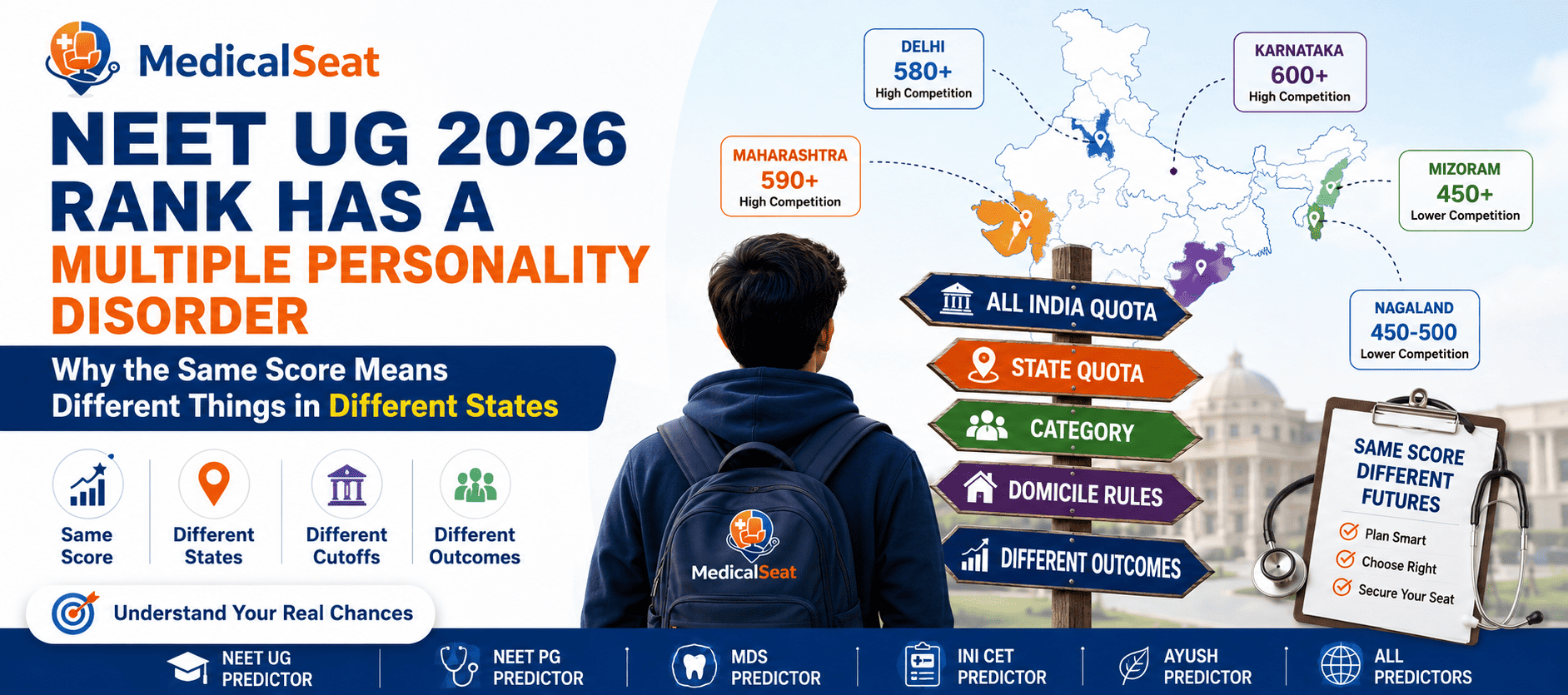
Your NEET UG 2026 Rank Has a Multiple Personality Disorder
A NEET UG 2026 score does not have the same value everywhere. Learn how state quotas, domicile rules, reservation categories, and counselling processes can make the same score lead to completely different admission outcomes across India.
Why the Same Score Means Five Different Things in Five States
Comfort often hides in numbers. Though a ranking seems absolute, fixed across places, its meaning shifts quietly. Spend seven days within NEET Counselling India, then doubt begins. That figure on the result sheet does not stand whole. Rather, it moves like someone holding multiple documents - each entry stamp changing how they are seen.
This reality requires no symbolic interpretation. In actual operation, the mechanism functions exactly in this manner.
The Quiet Architecture Behind a Single Score
Many learners begin NEET prep thinking their score marks the goal. Yet behind that number lies a complex process governed by regional policies, reserved categories, local quotas, and administrative preferences unique to each territory. By mid-2026, India offered about 1,28,976 MBBS positions nationwide; how these spots get allocated forms the hidden structure determining why equal ranks lead to unequal results in that year’s admission rounds.
One in seven spots at each public medical school belongs to a national category, available to applicants regardless of home state, whereas the rest go toward local admissions processes. That one policy choice, set long ago, shapes how your position shifts meaningfully depending on context. Across borders, hopefuls chase identical openings within the central allocation, yet inside individual regions, residency determines access to most opportunities. The ranking you hold behaves differently based on these dividing rules.
Consider what truly happens here. When ranked within the national group, you are among top performers from Kerala, Delhi, Bihar, Tamil Nadu - each region contributing its strongest. Yet shift that position into your state’s selection circle, and the level of challenge drops fast. Identical standing. Entirely different surroundings shape the outcome.
The Mathematics of Belonging
Across the country, competition pushes All India Quota thresholds upward. In contrast, limits under state quotas shift depending on local residency criteria alongside seat supply in each region. Fifty to sixty points below those national levels often defines the range seen for General category applicants applying through state channels. This gap emerges mainly due to participation being limited only to students from within individual states.
A span of fifty to sixty points. Let that settle briefly. When each point alters standing by hundreds - sometimes thousands - the gap defines outcomes: one path erases ambition, another opens doors to numerous public and private medical institutions nationwide.
Geographically, picture this scenario unfolding. For a General category applicant seeking an MBBS position under state reservation in Delhi, Maharashtra, or Karnataka, scores near 580 to 630 typically mark the threshold - competition runs high here. In contrast, similar seats within Mizoram or Nagaland may settle much lower, somewhere around 450 to 500. The variation reveals regional imbalances quietly shaping access.
This marks no minor shift. What separates them is not slight - it splits two completely distinct outcomes, even though each person took identical tests at the same time under the same conditions.
The Identity Crisis of a Single Number
Irony shapes the disorder here, nearly laughable. Picture two learners, each holding 580 scores, both within the General bracket, judged by impartial onlookers as just alike - equal effort, equal merit. Yet one resides in a region thick with rivals. The other lives where applicants are fewer, though openings stretch wider in comparison.
A single candidate, eyeing a secure government MBBS position under the All India Quota - typically demanding scores between 610 and 680 - may hover near uncertainty while state-level thresholds dip slightly, often set from 550 to 620. Through successive phases of NEET UG/PG Counseling 2026, tension lingers; placement could shift with just one delayed update appearing halfway into the process.
A different student, also scoring 580, could now be at ease - admission to public universities in their home state likely secured. Despite the same number, outcomes diverge based on location alone. One remains anxious; another moves forward without delay.
One figure. Identical preparation. The testing room is unchanged, perhaps the calendar identical too, down to the morning or afternoon session. Still, outcomes split apart - not due to skill, but because borders drawn on a map decide advantage through residence proof alone.
Category as the Sixth Personality
Should residence create confusion, classification introduces further layers. When considering OBC status within the All India Quota, scores typically fall between 590 and 610. In contrast, applicants from SC or ST backgrounds often see thresholds drop to a span of 520 up to 550 for identical allocation. Moving toward state-level distribution, different numbers emerge - OBC results tend to rest from 550 through 590. Meanwhile, those representing SC or ST communities might encounter minimums beginning near 420 and reaching only to about 490.
Effectively, this setup does not produce just five rankings. The number could rise to ten, fifteen, or even higher, shaped by eligibility across various states and classifications. Rather than facing uniform standards, General category applicants often see thresholds set well above those for OBC contenders, sometimes by thirty to forty points. For SC and ST aspirants, the gap widens further - differences reaching up to 180 marks in specific regions. These shifts do more than tweak outcomes. They redefine the value of a given result, fully dependent on context. Meaning transforms - not gradually - but completely.
The Quiet Tragedy of Misreading Your Own Number
What makes this situation risky is not complicatedness. When people grasp intricate details, those turn into useful plans. Risk grows where learners assume their position has just one universal definition, yet build pivotal choices upon that narrow, partial insight. Authority often seems tied to digits. Such figures come listed on formal reports, shaped by countrywide tests, making it understandable for someone young, worn down after long study periods, to view that digit as decisive for what comes next.
A closing remark: this is not. Rather, an initial note - fragile, incomplete - in a dialogue stretching far beyond first impressions. Dwellings documented, categories defined, regional seating mapped out step by step; these shape what follows. Weeks pass while placement procedures move slowly, shaped by unseen conditions. One may observe a figure next to their name, interpret it as failure across all public institutions, then retreat without further attempt. Unseen: that identical mark could hold value locally, protected under personal eligibility tiers. That quiet surrender often goes unnoticed - not flagged as error, but mistaken for resolution. Stillness arrives, a quiet acceptance settling in. Yet beneath lies a version too narrow, one missing full shape of what stands present. Though calm appears, perception remains half-formed, shaped by gaps more than clarity. Reality holds more edges unseen, ignored through selective sight. What seems complete proves partial, filtered through limited view.
Picture this unfolding step by step. While reviewing results, a General category applicant views an overall national list - only to find their mark far beneath the threshold for any All India Quota public medical seat. Faced with that sight, thoughts drift toward paying for education at a private institute - or even stepping away from medicine completely, turning instead to unrelated fields. Hidden from view, simply due to lack of guidance, is another path: applying filters like regional quotas, reserved categories, and local admission patterns could reveal that identical score qualifying for a solid government college back home. The disappointment felt genuine. Yet the conclusion drawn from it missed its foundation.
Yet the belief that high marks ensure admission everywhere may collapse when All India Quota rounds begin. Such miscalculation carries consequences just as severe, though stemming from optimism rather than doubt. Despite strong results in state-level assessments, one might presume similar standing nationwide without verifying broader trends. Still, the national list combines applicants from all regions at once, turning what seemed like solid ranking into something far less certain. When thousands more enter the frame, earlier assumptions about placement tend to weaken quickly. That shift in perception - usually emerging halfway through seat allocation - affects decisions shaped by outdated expectations.
Confusion among students regarding NEET Counseling 2026 often stems from differing seat allocation methods, fluctuating cutoff patterns, alongside varying reservation frameworks across states. Unlike Tamil Nadu, Uttar Pradesh applies separate guidelines for its NEET counseling procedure. While domicile criteria differ, so do the allocated quotas - round counts shift, just as procedures for listing unfilled positions between phases change. Subtle contrasts appear here; dramatic ones emerge there. Preparation ignoring such local conditions becomes misaligned, almost like studying for an exam that does not exist.
Confusion here does not signal lack of ability. Instead, it reflects how systems grow - slowly, unevenly, influenced by legal decisions, shifting guidelines, and local agreements over time. Each change layered on earlier ones, rarely removing complexity. Difficulty understanding does not stem from weakness; the process was never meant to be straightforward. Priorities shaped its design: fairness across regions, legacy obligations, conflicting demands - all placed ahead of clear guidance for applicants. Understanding remains hard because simplicity was not part of the original plan. What stands now emerged from compromise, not clarity.
This moment shows why careful help with MBBS admissions holds weight. Help here involves more than picking a college name. A precise view of one's rank unfolds when seen through multiple angles - home region, applicant group, nationwide seats, plus colleges run privately or by special status. Value of a mark appears only after asking: valuable for which path, for which body, within which framework.
A single layer of insight missing, then a high mark seems low, while a small result appears locked away - though really it unlocks many paths. Headlines never carry this story. Silent, the loss grows: few speak of the many students yearly who misunderstand their place, stop too soon or rush forward blind. This unnoticed error, echoing through countless dreams each season, sits among the easiest mistakes to avoid within admissions, yet causes deep strain and sorrow. What seems difficult often just needs clarity. Viewed differently, the figure shifts - not fixed, but shaped by context. Where it appears matters. So does who looks. Meaning adjusts, quietly, based on position and perspective. Numbers speak only when surroundings give them voice.
Reading the Number for What It Actually Is
To understand your NEET UG 2026 rank clearly, begin by shifting focus - from its general significance to its context. Within your state's public medical colleges, what position does this score offer? When viewed under national allocation rules, how does access change? Your eligibility group affects both scenarios differently. With those factors combined - instead of examined alone - the realistic, possible, and stretch choices take shape.
One reason the final threshold shifts lies in how many applicants join state-level admissions. Depending on the exam's complexity, scores may spread differently across test takers. Another influence appears when participation rates change unexpectedly. As results unfold, patterns shift subtly. Even inside one region, adjustments persist until the process ends completely.
A single figure on your report may seem fixed, yet beneath lies a network of outcomes. Different conditions - location, group, limits - trigger separate results. This insight does not deepen confusion during study. Instead, perception shifts: the ranking appears sharp, unblurred by worry's usual distortion.
Should personal score patterns interest you among varying identity categories, tools found at MedicalSeat.com - the NEET UG 2026 Rank Predictor along with its NEET College Predictor counterpart - trace such shifts carefully. These models turn scattered outcomes into a single clear narrative, revealing how rank transforms under distinct conditions.