
 Neet Rank Predictor
 NEET UG Predictor
 MDS Predictor
 INI CET Predictor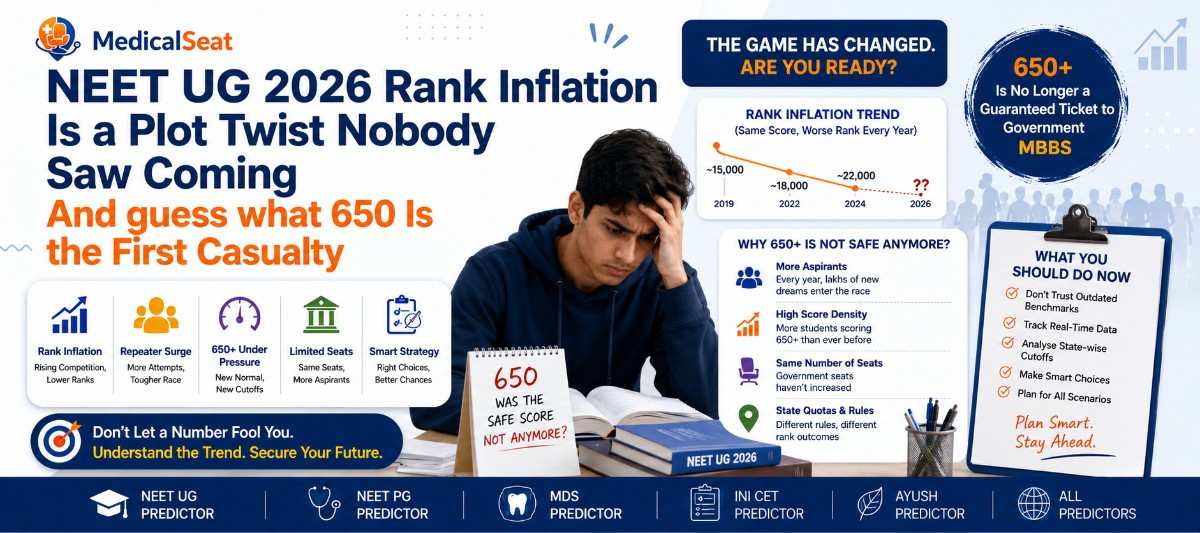
NEET UG 2026 Rank Inflation Is a Plot Twist Nobody Saw Coming And guess what 650 Is the First Casualty
NEET UG 2026 rank inflation is real. A 650+ no longer guarantees a seat. Here's why the safe score just got a lot less safe, and what it means for you.
It is possible. It has occurred before and yet that is what makes this belief particularly dangerous. Hope is not always optimism. Sometimes hope is just an outdated truth you forgot to fact-check.
Gone are the days when tricks like getting 650+ in NEET UG was considered a safe range category. While year-wide panic brings a ray of hope in the form of the myth that the 650 to 700 range accounts for a secure seat in a government MBBS institution. Rooting for selective study students and from the coaching centres, aspirant-parents Whatsapp groups and share button movers for social media content creator teachers, this blog breaks the 650+ myth.
When a NEET aspirant aspires to get 650 (a safe score in his/her opinion), he/she tends to overlook the fact that the seat matrix remains stagnant and repetitive each year. They think their rank will fall in a historically predictable range like in 2023-24.
None of these assumptions are fundamentally right or relevant in 2026. Marks, ranks and admissions are three entirely separate variables which are mutually exclusive of one another. In the NEET UG 2026 they seemingly drift even more apart than ever before. Most importantly, they all have different value deciding factors.
Marks are fixed. NEET closing ranks are determined by the level of aspirants all over. And admissions follow a complete counseling process including state quotas, domicile rules, round-wise seat movement and strategic choice filling behaviour of tens of thousands of other applicants all at the same time.
In 2026, score projection could be worse still. Marks or student preparation did not change. However, the rank changed because the competitive density around the score changed drastically.
The False Ceiling
A score of 650 in 2019 might have comfortably placed a general category student within AIR 15,000. The same score in 2024 may have placed them closer to AIR 22,000 or beyond. In 2026, with the factors currently at play, the projection could be worse still. The marks did not change. The student's preparation did not change. The NEET UG paper difficulty did not change dramatically. But the rank changed and that too drastically because the competitive density around that score changed.
This is the core of what makes safe score thinking not just inaccurate but actively harmful. It gives students a false ceiling. A student who believes 650 is safe will stop pushing at 648. They will feel psychologically secure at 655. They will walk into the counseling season with a confidence that the data does not support, and they will make choices both in preparation and in strategy that reflect a reality that existed five years ago and not the one they are actually entering.
The most cruel part of this myth is that it is backed by success stories. Every year, students do get government MBBS seats with scores in the 640–660 range. Those narratives circulate. Those students become the evidence that the benchmark holds.
What does not circulate as loudly are the thousands of students who scored 648 and did not get a seat they had anticipated, who are now in their second or third drop year, who assumed the benchmark was safe and discovered it too late that it had silently shifted beneath them.
In 2026, with the conditions that have unfolded over the past three years, the 650 myth is not just outdated. It is a trap. And the students most vulnerable to it are often those the most sincere. The ones who worked hard, hit their target, and trusted a number that the system is no longer honouring.
What Is Rank Inflation
Why It Hits Hardest in the 620–700 Zone
Picture a highway that hasn't changed, same lanes, same speed limit. But suddenly, three times the vehicles are fighting for the same stretch. You didn't slow down. The road didn't get worse. The vehicles crowding around you did.
Rank inflation is what happens when the same score produces a worse rank than it did in previous years, because more students are now scoring at or above that level. Your NEET 2026 closing rank is not calculated from your marks alone, it is calculated from your position relative to every other candidate. So when the number of students scoring 640 or above increases from, say, 40,000 to 70,000 over three years, every student at or below 640 automatically ranks lower and that too without the paper changing, without their preparation declining, and without a single additional mark being added or removed. The score stays fixed. The rank shifts. That shift, compounding silently year after year, is called rank inflation.
That is exactly what is happening in this score zone, and three forces are driving it simultaneously.
The result? Five marks now separates thousands of ranks.
A student who scored 645 in 2022 and a student who scored 645 today are not living the same reality. Same marks. Completely different fate.
The Repeater Explosion
Drop-Year Culture Is Quietly Destroying Everyone's Rank
NEET aspirant system was not designed to absorb and it shows. Taking a drop year was once a considered, somewhat reluctant decision if not just a taboo. Today it has become almost a default response to a score below expectation. The repeater NEET 2026 aspirant population has grown to a scale that its consequences are now visible in rank data every single year.
Here is the problem nobody talks about plainly. A dropper does not re-enter the exam at the same level of preparation. Their practice and experience makes them return better. Who sits in the exam hall is a sharper, more practiced, more strategically prepared version of the NEET aspirant. A student who scored 610 in their first attempt is more likely to score 635 or 645 in their second, moving directly into the most competitive zone of the exam, joining fresh aspirants who worked just as hard, arrived there first but did not have enough. The zone is not very cooperating to accommodate them. The ranks simply compress even further.
Top Score Clustering
Scoring 705 Still Leaves You Shocked at Your Rank
There was a time when crossing 700 in NEET UG felt like crossing into safe, uncrowded territory. Thanks to top score clustering, that time seems to have passed.
The number of aspirants have grown enough that no range is any longer comfortable for buffers like it once was represented psychologically. More importantly, the clustering happening just below - between 670 and 700 which is extraordinarily dense.
Students scoring 705 walk into admission counseling expecting some certainty. The rank they receive introduces them to a different one entirely.
The score feels like an achievement. The rank feels like a punishment. Both are accurate. That is the painstaking cruelty of top score clustering.
2026 Re-Exam Controversy
Reshaping Counselling Behaviour
Exam controversy travels downstream fumbling into counselling halls, tapping on choice-filling portals, and leading to the anxious calculations of families sitting around kitchen tables at midnight.
The 2026 re-exam situation introduced something that cannot be fully captured through data: psychological uncertainty at scale. When NEET aspirants and parents are unsure about the legitimacy of a process, they do not just wait and watch. They react and more often than not defensively, sometimes irrationally, and almost always in a way that distorts usual counselling patterns.
What this looks like in practice is significant. Aspirants who would normally take calculated risks on their preferred college applications start locking safer seats earlier. Families that would have waited for mop-up rounds now refuse to do so. Choice-filling becomes conservative across the board, leading to paradoxical tightening of closing ranks at institutions that historically would have remained accessible later into the counselling process.
This is the hidden cost of controversy. It does not just shake confidence. It shifts behaviour - and behaviour, ultimately, is what determines closing ranks.
Your Post-NEET Action Plan
Rank Prediction to College Shortlisting Before Round 1 Opens
The exam is done. The real work has just begun.
Most NEET aspirants spend the weeks between result and counselling either celebrating too early or grieving too long. The aspirants who turn good scores into great seats spend that same window doing something entirely different, they get precise about their time and reality, fast.
Here is what that looks like in practice.
The first thing you drop is hope without reality. And then proceed to come to a rank. A rank closest to your most probable rank, calculated not on last year’s data or your coaching centre's most optimistic estimate but on current competitive trends, repeater density and mathematical score clustering patterns of NEET UG counselling 2026 specifically. Without this number your counselling decision research or preparation is just ambitious guesswork and dressed up strategy.
The second thing you require is a realistic college mapping resembling less to a wishlist.
Answering to - Which institutions fall within your probable rank range across AIQ and state quota? Which categories apply to you? Where have closing ranks moved over the last three rounds historically, and how might controversy-driven behaviour shift them this year?
This is not night cramming before choice-filling opens.
And fortunately, you do not have to build any of this from scratch. This is where MedicalSeat comes in handy.
MedicalSeat's NEET UG 2026 Rank Predictor gives you a data-backed probable rank based on 2026-specific competitive patterns and not outdated benchmarks. And the NEET UG 2026 College Predictor maps that rank against real closing data across AIQ, state quota, and category, so that you walk into counseling with a shortlist, and not just a prayer.
The window between result and Round 1 is shorter than you can imagine. The students who use it well are the ones who come out the other side with a seat.
Start with your rank. Everything else follows the blueprint of your action plan from there.