
 Neet Rank Predictor
 NEET UG Predictor
 MDS Predictor
 INI CET Predictor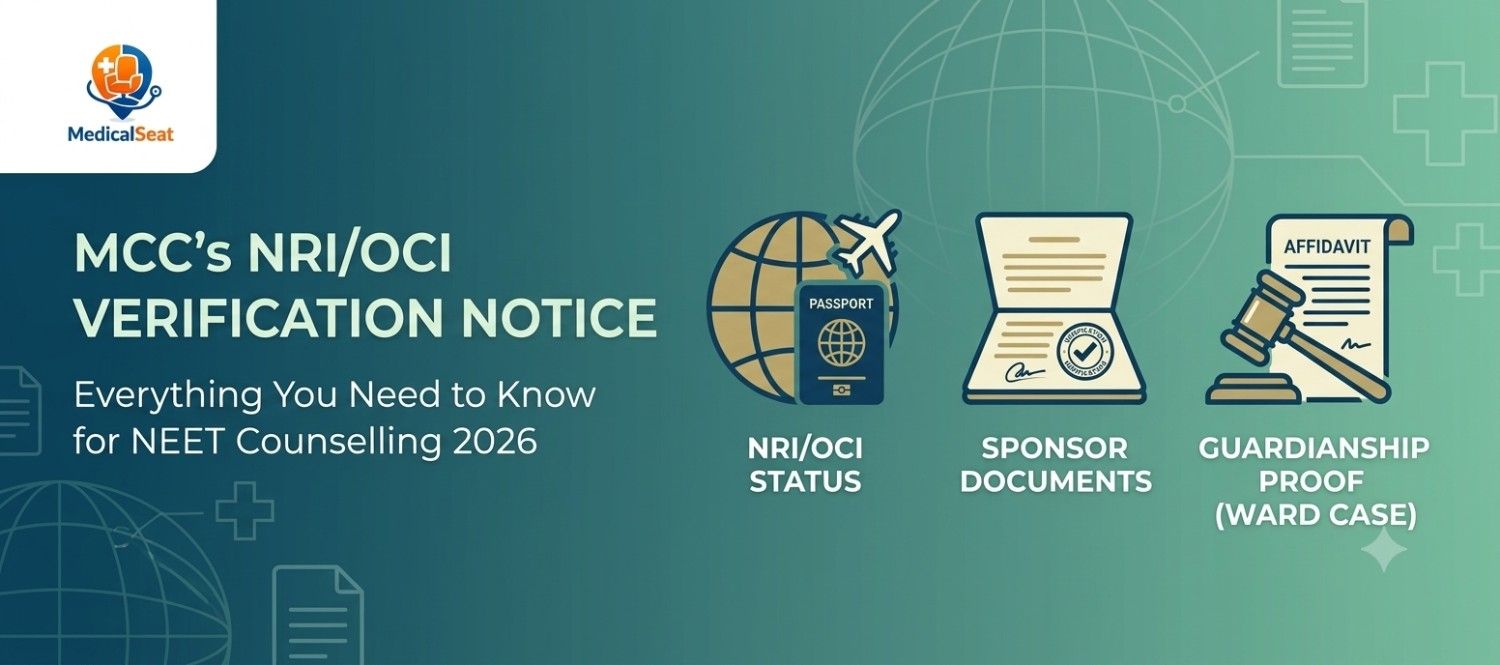
MCC's NRI/OCI Verification Notice for NEET Counselling 2026: Everything You Need to Know
MCC has made document verification mandatory for NRI and OCI candidates before they can view NRI quota seats in NEET UG Counselling 2026. Here is what the notice means, who qualifies under the Anshul Tomar criteria, which documents are required, and what to expect in future counselling rounds
On August 6, 2026, the Medical Counselling Committee (MCC), which functions under the Directorate General of Health Services, Government of India, issued a fresh notice titled "Verification of OCI/NRI Candidates for NRI Eligibility." It's a short document, just a page long, but it affects a very specific and often confused group of NEET UG 2026 aspirants: those applying under the NRI quota.
If you're an NRI, an OCI cardholder, or an Indian student being sponsored by a relative abroad, this notice directly changes how you'll experience choice filling in this year's counselling. Here's the complete picture, what the notice actually says, where this requirement comes from, who it affects, what documents are involved, what's gone wrong in the past with this quota, and what to expect going forward.
What the August 6 Notice Actually Says
The notice is addressed to all Overseas Citizens of India (OCI) and NRI candidates participating in MCC counselling. In plain terms, it says three things.
First, before you can even see NRI seats in the choice filling list, your documents must be verified by MCC's dedicated NRI Document Verification Team. This applies wherever the NRI category is relevant to your application.
Second, once that verification is complete and your eligibility is confirmed, you get access to both NRI seats and Indian Unreserved (UR) seats when you fill your choices. In other words, verified NRI/OCI candidates aren't restricted to NRI seats alone; they can also compete for general UR seats if they choose to.
Third, and this is the practical instruction most candidates will actually need to act on, you must select "YES" to the question "Whether you want to apply for NRI Quota seats" at the time of registration. Answering yes triggers the verification workflow. MCC has explicitly asked candidates to get this verification done early, well before the choice filling window opens, to avoid last minute problems.
This notice fits into a broader pattern. It's dated barely a day after MCC's separate notice for Puducherry domicile candidates, and it lands right in the middle of the 2026 UG counselling registration period, with round 1 choice filling having already been pushed to open on August 8, 2026. In short, MCC is trying to get all the eligibility housekeeping done before candidates start locking in college preferences.
Why This Verification Requirement Exists at All
To understand why MCC is being this careful, it helps to know what the NRI quota is and why it has historically been a magnet for disputes.
The NRI quota is a reserved category of medical seats, typically capped around 15 percent of total seats in private medical colleges and deemed universities, and available in a more limited way in a handful of government colleges depending on the state. It exists to give genuine Non-Resident Indians, Persons of Indian Origin, and Overseas Citizens of India a route into Indian medical colleges without having to compete directly against the massive general applicant pool inside India, which regularly exceeds twenty lakh NEET UG candidates.
The problem, over roughly the last two decades, has been misuse. Because NRI quota seats often carry different, and sometimes more flexible, fee structures, and because "who counts as NRI" was historically interpreted quite loosely, families with no genuine connection abroad began using distant or even fabricated relatives as "sponsors" purely to access these seats. Colleges, in some cases, were accused of quietly encouraging this because NRI quota fees, usually collected in US dollars or an equivalent INR amount, are often significantly higher than regular management or government fees.
This is exactly the situation the Supreme Court of India stepped in to address.
The Legal Backbone: Anshul Tomar vs. State of Madhya Pradesh
The eligibility framework MCC is enforcing traces directly back to a 2008 judgment, Anshul Tomar vs. State of M.P., decided by the Madhya Pradesh High Court following earlier Supreme Court directions on the subject dating back to 2006. This case, along with related Supreme Court rulings including P.A. Inamdar vs. State of Maharashtra, laid out who can legitimately be considered a "sponsor" for NRI quota purposes, precisely to close the loophole of vague or manufactured family connections.
MCC has referenced this same judgment repeatedly through 2026, first in a detailed notice dated May 27, 2026, and now again in the August 6 verification notice. The eligibility criteria set out under this framework fall into three broad categories.
Category one: parent as NRI. If either the candidate's mother or father is an NRI and ordinarily resides abroad, the candidate is straightforwardly eligible. This is the simplest and most common scenario.
Category two: first degree relations. If neither parent qualifies as NRI, the candidate may still be eligible if a first degree relative, specifically a real brother or sister, is an NRI residing abroad. The court's language here is deliberately narrow; it does not extend to half-siblings or cousins at this level.
Category three: nearest blood relations acting as guardian (ward or "palya" cases). This is the most restrictive and most heavily scrutinized category. If a candidate is being sponsored by a broader family member acting in a guardian capacity, only the following relations qualify, and only if they are themselves NRIs ordinarily residing abroad: a real paternal uncle or aunt, a real maternal uncle or aunt, a paternal or maternal grandparent, or a first degree paternal or maternal cousin. Crucially, for this category, the sponsor must also be recognized as the candidate's bona fide legal guardian under the Guardians and Wards Act, 1890, backed by an evidential affidavit. A relative who is simply willing to "sponsor" a student on paper, without this legal guardianship status, no longer qualifies.
This third category is where MCC's tightened verification process really bites. In earlier years, families sometimes used a distant relative as a sponsor with minimal documentation. That is no longer sufficient. Candidates relying on category three must now produce legal, evidential proof of guardianship, not just a relationship certificate.
The Documents Candidates Typically Need
While exact document checklists can vary slightly by counselling round and by whether you're applying at the UG or PG level, the core paperwork that MCC's NRI Document Verification Team generally expects includes the following.
An Embassy Certificate or an equivalent document issued by the Indian Diplomatic Mission or the Ministry of External Affairs, confirming the NRI status of the relevant parent, sibling, or guardian. Passport copies and visa or residency proof for the NRI sponsor, establishing that they are indeed "ordinarily residing abroad" and not just holding NRI status on paper. Proof of relationship, such as birth certificates or family registers, connecting the candidate to the sponsor. For OCI applicants specifically, a valid OCI card, and where relevant, confirmation of whether an older PIO card has been converted to OCI, since PIO cards are being phased out. And for category three (guardian) cases, the legal guardianship documentation and affidavit described above.
MCC has been explicit, in this notice and in earlier ones through 2026, that submitting incomplete, incorrect, or fake documents can lead to outright cancellation of candidature. This isn't a new warning; MCC issued similar cautions in the 2025 counselling cycle too, stating plainly that documents found to be fake would result in rejection, with copies of submitted proofs forwarded to the relevant embassy or mission for cross verification at the reporting stage.
How the Verification Process Actually Works, Step by Step
Based on the current notice and MCC's broader 2026 counselling framework, here's how the process plays out for an NRI or OCI candidate.
During registration for UG counselling, you'll be asked whether you want to apply for NRI quota seats. Answering "YES" flags your application for NRI processing. Your documents then go to MCC's dedicated NRI Document Verification Team, which checks them against the Anshul Tomar criteria described above. If everything checks out and your eligibility is confirmed, your choice filling screen unlocks both NRI category seats and Indian UR (unreserved) seats, meaning you get a wider set of options than a candidate who applies for NRI seats alone.
If your documents are incomplete or your relationship doesn't fit cleanly into one of the three recognized categories, your NRI eligibility may be rejected, and depending on your category status otherwise, you would then need to compete only through the regular quota you're eligible for. This is exactly why MCC keeps repeating, across multiple notices this year, that candidates should complete verification well before the choice filling window opens rather than waiting until the last moment and risking a scramble.
It's also worth noting that document verification here happens twice in the wider process. Initial screening happens before choice filling so you know what you can even select. A second, deeper verification typically happens again at the college reporting stage, where the allotted college physically checks your original documents and forwards copies to MCC, which in turn may verify with the concerned embassy or mission. A candidate who slips through the first check with weak documentation can still lose their seat at the reporting stage if the second check fails.
Who Exactly Does This Affect
This notice is relevant to a fairly specific slice of the overall NEET UG applicant pool, but within that slice, it touches almost everyone.
It affects candidates who are themselves NRIs or OCI cardholders and are directly applying under that status. It affects Indian resident students whose parent qualifies as NRI and who want to use that route rather than compete purely in the general or state quota. It affects students being sponsored by an NRI sibling, uncle, aunt, grandparent, or cousin, particularly those relying on the more scrutinized guardian category. And it affects candidates who were originally registered with Indian nationality status but now want to convert to NRI status for this counselling cycle, since MCC's May 2026 notice specifically addressed this "nationality conversion" scenario as well, alongside the routine NRI verification covered in the August notice.
It does not affect general category, state quota, or all India quota candidates who have no NRI or OCI connection at all; their counselling path is unaffected by this particular notice.
Where NRI Quota Seats Actually Exist
It's worth understanding that the NRI quota isn't uniformly available everywhere in India, which is part of why this eligibility screening matters so much for candidates weighing their options.
NRI quota seats are most commonly found in private medical colleges and deemed universities across the country, where the quota typically runs around 15 percent of total seats per course. A smaller number of government medical colleges in specific states, historically including Rajasthan, Haryana, Punjab, Himachal Pradesh, Goa, Chandigarh, and Puducherry, also carry an NRI quota, though this varies by state policy and can change year to year. Kerala's private medical, dental, and AYUSH colleges have historically carried a sizeable NRI quota as well, while some states, such as Tamil Nadu, don't offer NRI quota in government colleges but do allow it at select private institutions like CMC Vellore.
Because availability is so state and institution specific, an eligible NRI candidate's real options depend heavily on which state and which type of college (government, private, or deemed) they're targeting, which is exactly why MCC's decision to also unlock Indian UR seats for verified NRI candidates is significant. It broadens the realistic seat pool for candidates who complete verification successfully, rather than confining them to a narrower and geographically uneven NRI seat list.
Fees: What NRI Quota Actually Costs
One thing prospective NRI quota candidates and their families should walk in understanding clearly is cost. NRI quota MBBS fees are generally substantially higher than government or even standard private seats, commonly ranging anywhere from roughly 12 lakh to 45 lakh rupees per year depending on the college and state, often payable in US dollars or an equivalent INR amount. This is the trade-off for the separate, less competitive admission pathway. Families considering this route should factor total course cost, not just the first year's fee, into their planning well before choice filling begins.
The History of Misuse and Why Scrutiny Has Increased
This isn't the first time MCC has tightened NRI quota rules, and it likely won't be the last. Over the past several counselling cycles, MCC and various state authorities have repeatedly flagged instances of candidates submitting fabricated sponsor documents, exaggerating distant family connections, or claiming guardian status without any real, ongoing relationship with the sponsoring relative. The 2025 counselling cycle saw MCC issue explicit warnings that documents found to be fake would lead to cancellation of candidature, with verification sent through embassies and missions abroad. The 2026 cycle has continued and arguably intensified that scrutiny, first through the May 27 notice laying out the precise Anshul Tomar categories and demanding Guardians and Wards Act documentation for guardian sponsored cases, and now through the August 6 notice formalizing a dedicated verification team and process before choice filling even opens.
The direction of travel is clear. What used to be a comparatively loosely policed category, where a distant relative abroad was often enough to unlock an NRI seat, has become a category with defined legal categories, mandatory affidavits for guardian cases, and a two stage verification process. Genuine NRI, OCI, and sponsored candidates aren't disadvantaged by this shift, if anything it protects legitimate applicants from a system where seats were previously being taken by candidates who didn't meet the actual criteria. But it does mean the margin for incomplete paperwork has shrunk considerably.
What Happens Next: The Road Ahead in This Counselling Cycle
With round 1 choice filling for NEET UG Counselling 2026 opened on August 8, 2026, candidates who intend to use the NRI quota are working against a tight, immediate timeline. MCC's clear message across this notice is to complete document verification now, not after choice filling opens, since unverified candidates simply won't be able to see NRI seats when the window is live.
Looking further ahead, this verification requirement is not a one-time, one-round event. Because MCC counselling runs across multiple rounds, typically round 1, round 2, a mop-up round, and sometimes a stray vacancy round, candidates whose NRI status wasn't finalized in round 1, or who are converting their nationality status partway through the process, should expect the same verification gate to apply before later rounds too. MCC's own guidance notes that nationality conversion opportunities are typically offered before each round, which also implies verification checkpoints recur at each stage.
For future admission cycles beyond 2026, the pattern strongly suggests this stricter, document heavy verification approach is now the standard, not a temporary measure. Families planning ahead for younger children who may apply in 2027 or later should assume the same Anshul Tomar based categories, the same Guardians and Wards Act requirement for guardian sponsored cases, and a similarly early, embassy backed verification process will remain in place, possibly with even tighter enforcement given the direction MCC has taken over the past two cycles.
Practical Takeaways for Candidates and Families
If you're planning to use the NRI quota this year, treat document collection as urgent, not a task to handle after your NEET result excitement settles. Confirm which of the three eligibility categories genuinely applies to your situation before assuming you qualify; a well meaning but legally unrecognized "sponsor" will not pass verification. If you fall into the guardian sponsored category, start the Guardians and Wards Act documentation and affidavit process immediately, since this tends to take the longest to arrange, particularly if it involves coordination with a relative abroad across time zones. Keep both digital and physical copies of every document, since verification happens at least twice, once before choice filling and again at college reporting. And register your intent correctly by answering "YES" to the NRI quota question at registration, since this is what actually triggers MCC's verification workflow in the first place.