
 Neet Rank Predictor
 NEET UG Predictor
 MDS Predictor
 INI CET Predictor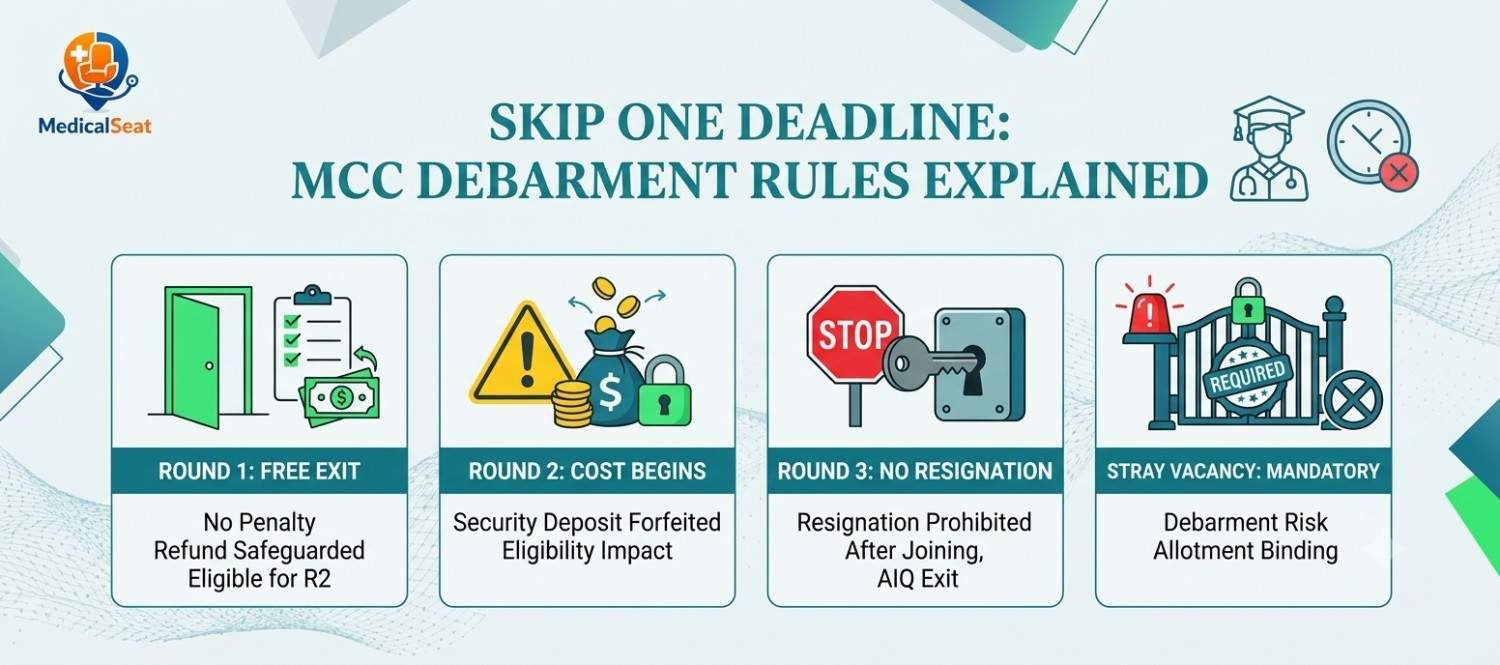
Skip One Deadline and MCC Could Debar You From Next Year's NEET: What Not Joining Really Costs You
What really happens if you don't join after NEET AIQ seat allotment — round-by-round penalties, security deposit rules, and the join-and-resign trick.
Getting allotted a seat feels like the hard part is over. It isn't quite. What you do in the days immediately after allotment, join, resign, or simply not show up, carries consequences that range from mildly inconvenient to genuinely severe, and the rules are not the same in every round. This is one of the least explained parts of NEET counseling, mostly because most NEET Counselling India guides only cover the happy path of joining on time.
Here's exactly what happens at each stage of All India Quota (AIQ) counselling if you don't join, plus where state counselling rules diverge from MCC's. Think of this as the missing chapter in every NEET counseling guide that only covers what to do, never what happens if you don't.
Round 1: The One Genuinely Free Exit
If you're allotted a seat in AIQ Round 1 and decide not to join, this is the one point in the entire process with essentially no penalty. Your security deposit stays safe, you face no disqualification, and you remain eligible to participate directly in Round 2. MCC refers to this as a free exit, and it exists precisely because Round 1 allotments are based on your very first choice list, before you've had any real information about how the rest of the process is playing out.
This doesn't mean Round 1 decisions don't matter, they absolutely shape your NEET rank vs college trajectory for the rest of counselling, but it does mean you're not locked into a bad Round 1 outcome the way you are in later rounds.
Round 2: This Is Where It Starts Costing You
Skip joining an allotted seat in Round 2, and the consequences change meaningfully. Your refundable security deposit, commonly cited around ten thousand rupees for general and EWS candidates and around five thousand for SC, ST, OBC, and PwD candidates, though exact figures should always be confirmed against the current year's information bulletin, is forfeited. Some accounts also note reduced eligibility for later rounds if you don't join in Round 2, so this is genuinely the round where indecision starts to cost real money, not just opportunity.
If you did join a Round 2 seat but want to try for something better, MCC generally allows you to express willingness to upgrade into Round 3, though you'll need formal relieving from your Round 2 seat first, and once upgraded you typically lose any further upgrade or resignation option. This is a one-way door, so it's worth being certain before you use it, especially given how far apart government and private MBBS fees India figures can sit for the same rank band.
Round 3: No More Resignations for AIQ
Round 3 tightens further. For AIQ, Deemed University, and Central University seats specifically, resignation is generally not permitted once you've joined. If you're allotted a seat in Round 3 and simply don't join at all, the typical consequence is that you exit AIQ counselling entirely, with fees forfeited and no path into later rounds through this track. Fresh registration is usually required for Round 3 only if you'd skipped both earlier rounds or previously resigned, so this round has a genuinely different rule set from Round 1 and 2, not just a stricter version of the same rules.
Stray Vacancy Round: Joining Is Mandatory
This is the round where the stakes are highest, and it's also the round where sources genuinely disagree on exact penalty severity, which is itself useful information: treat any claim about stray vacancy consequences as something to verify against the current year's official MCC bulletin rather than take at face value from any single source, including this one. What's consistently reported is that joining an allotted stray vacancy seat is mandatory, there's no free exit option here, your security deposit is forfeited if you don't join, and in some formulations the consequence extends to debarment from participating in NEET UG counselling for a period afterward. Given how serious that potential outcome is, if you're entering the stray vacancy round, go in with a firm intention to join whatever you're allotted, not as a casual long shot.
The "Join and Resign" Strategy
There's a middle path worth knowing about if you're genuinely unsure whether to accept a seat: physically report and join within the deadline, then formally resign before MCC's resignation cut-off, rather than simply not showing up. This keeps your security deposit intact in a way that silent non-joining doesn't, and it preserves your eligibility to participate in the Mop-Up round afterward. The key distinction is procedural: MCC and most state authorities treat a formal, on-time resignation very differently from an unexplained no-show, even when the practical outcome, not attending that particular college, looks identical from the student's side.
This is a genuinely useful piece of MBBS admission guidance for anyone torn between a safe seat in hand and a better seat they're hoping to reach in a later round, and it's the kind of MBBS admission guidance most students only learn about after they've already lost a deposit the hard way.
State Counselling Rules Are Not Identical to MCC's
Everything above describes AIQ specifically. NEET UG/PG Counseling 2026 at the state level runs on separate rules set by each state's own counselling authority, and they genuinely differ. Some states allow you to continue participating in subsequent rounds if you pay a penalty fee for missing a deadline; others impose a full bar for that admission year with no exceptions. If your shortlist spans both a government AIQ seat and a state quota seat in, say, bihar, tamilnadu, jharkhand, or maharastra, don't assume the exit and resignation rules you've read for MCC apply identically to your state portal. Check your specific state's counselling brochure directly, since this is exactly the kind of detail that's genuinely state-specific rather than uniform across government & private medical colleges counselling nationally. The same caution applies whether you're comparing medical colleges in India broadly or narrowing in on one state's government & private medical colleges list specifically.
Why This Matters More in a Re-Exam Year
This year's re-conducted exam has already shifted NEET closing ranks compared to a normal cycle, which means more candidates than usual are likely to be genuinely uncertain about whether to hold or float a given allotment, precisely the situation where knowing the exit rules in advance prevents a costly mistake. MedicalSeat's breakdown of the NEET UG 2026 result statistics and their analysis of rank inflation around the 650 score band both explain why this year's numbers need fresh context rather than a direct comparison to prior years.
Deciding whether to hold a Round 1 seat or gamble on Round 2 comes down to a realistic read of your upgrade chances against this year's shifted NEET closing ranks, which is exactly where a NEET rank predictor helps, whether you're navigating NEET UG/PG Counseling 2026 for the first time or upgrading from an earlier attempt. Running your score through a NEET college predictor calibrated for this year's re-exam pattern before you make any join, float, or resign decision gives you an actual probability picture rather than a guess, and treating it as one input from a broader medical college predictor India view, not the only input, keeps you from overreacting to a single number. MedicalSeat.com's predictor covers MBBS, MDS, INI CET, and AYUSH counselling in one place, with a dedicated MDS predictor and INI CET predictor if postgraduate seats are part of your decision too. Their explainer on how a free rank and college predictor actually works is worth reading before you lean on any predictor for a decision with real financial consequences attached.
If cost is part of what's driving your hesitation between holding a seat and gambling on an upgrade, especially with MBBS fees India ranging so widely between government and private tiers, MedicalSeat's budget focused resource and their rank to college reference across roughly 5,000 institutions are both useful before you make a call you can't undo. It's also worth checking their list of upcoming medical colleges, since a newly approved college entering the matrix mid-cycle can occasionally change what's realistically available in later rounds.
A Practical Checklist Before You Decide
The core lesson across every version of NEET Counselling India rules, AIQ or state, is the same: silence is expensive and formal action is cheap. Before you decide:
Know which round you're in, the rules genuinely change round to round, not just get stricter
If you're unsure about a seat, report and formally resign rather than silently not joining, this protects your security deposit
Never treat the stray vacancy round as a casual backup; joining is typically mandatory once allotted
Check your specific state's exit rules separately from MCC's; they are not the same, whether you're in bihar, tamilnadu, jharkhand, maharastra, or elsewhere
Run a fresh NEET rank vs college check before deciding to float past a seat you already hold, especially this year, using a NEET rank predictor and a NEET college predictor together rather than relying on either alone
If you're weighing whether to hold what you have or gamble on the next round, get a real number behind that decision instead of guessing. This is the kind of decision no generic NEET counseling guide can make for you, since it depends entirely on your specific rank, category, and the medical colleges in India actually within reach for both. Run your score through MedicalSeat.com's predictor, or talk to their counselling desk directly at +91 97517 95765 or support@medicalseat.com if you want to think through a specific join-or-float decision with a person before the deadline closes. A quick pass through any solid medical college predictor India tool costs you five minutes; a wrong guess here can cost you a full year.