
 Neet Rank Predictor
 NEET UG Predictor
 MDS Predictor
 INI CET Predictor
MBBS Colleges With The Best Internship Experience In India
Where you get admission matters, but where you intern shapes the doctor you actually become. Here is a look at which MBBS colleges in India genuinely deliver strong internship exposure, what factors separate a great internship year from a weak one, and how to pair that research with a real NEET Rank Predictor 2026 and NEET College Predictor before you finalise your shortlist.
Most students spend years obsessing over which college they will get into, and almost no time thinking about the one year that actually turns them into a doctor, the internship. It is the single most hands on, high stakes, character forming stretch of the entire MBBS journey, and yet it barely factors into how most aspirants build their NEET College Predictor shortlist. That needs to change, because where you intern shapes your clinical confidence far more than where you sat for first year anatomy lectures.
If you are working through NEET UG/PG Counseling 2026 right now, this is the piece that asks the question almost nobody else does. Not which college looks best on paper, but which college will actually hand you a scalpel, a stethoscope and real responsibility during your internship year.
What The Internship Year Actually Involves
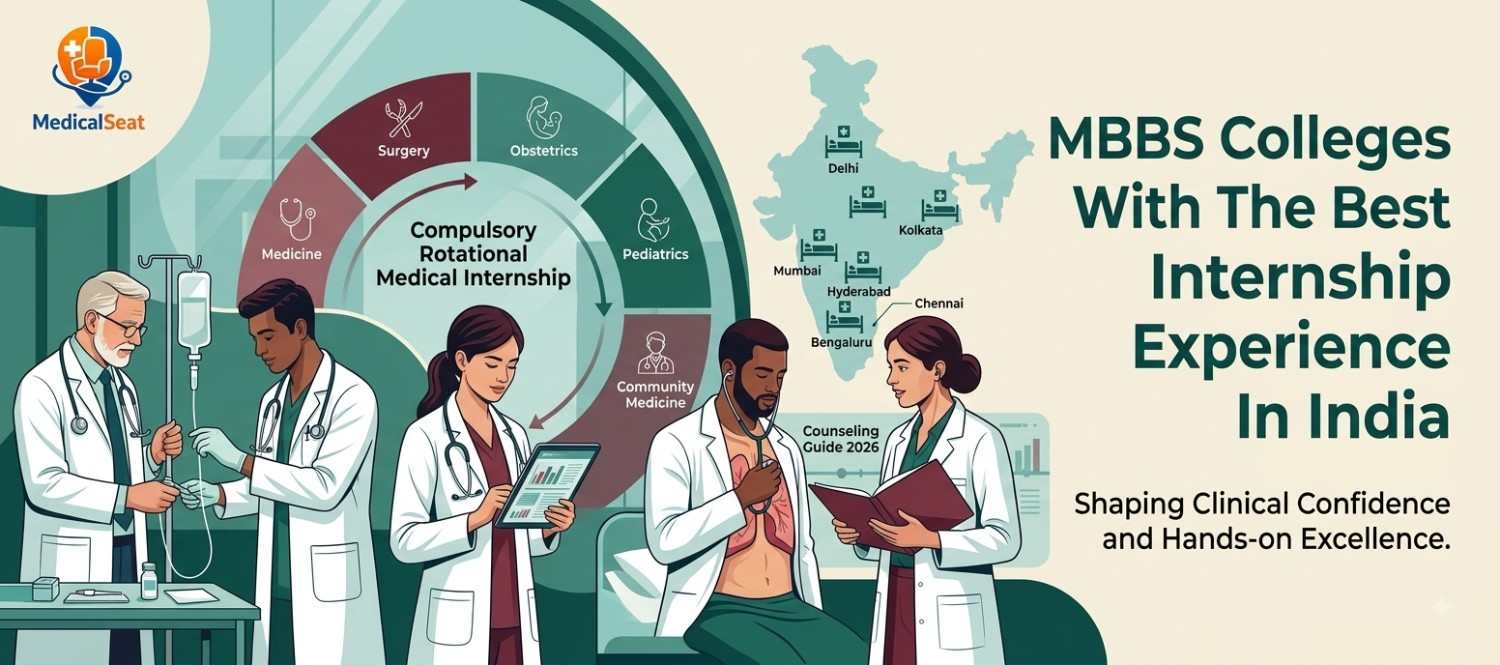
The MBBS internship in India is formally known as the Compulsory Rotational Medical Internship, and it is regulated directly by the National Medical Commission. It lasts twelve months and is distributed proportionately across core medical and surgical rotations, giving graduates well rounded patient exposure while they work alongside senior doctors in multiple departments. Each individual rotation typically runs four to eight weeks, moving interns through medicine, surgery, obstetrics and gynaecology, paediatrics, orthopaedics and community medicine, ensuring exposure to a genuinely diverse range of patients and clinical scenarios.
This is not a passive observation period. Interns follow a demanding daily schedule, typically starting around six to six thirty in the morning and reaching the hospital by seven thirty or eight, performing both clinical and administrative duties throughout the day. Stipends during this period differ meaningfully between government and private colleges, reflecting differences in institutional funding, which is another reason MBBS fees India wide and internship quality should be researched together, not separately.
Why Internship Quality Varies So Much Between Colleges
Not every college delivers this year the same way, and the difference comes down to a handful of measurable factors. Higher outpatient department footfall, multispecialty hospital infrastructure and early exposure to clinical rotations give interns a genuine advantage, both for building competence and for postgraduate entrance preparation afterward. Colleges attached to smaller, lower footfall hospitals simply cannot replicate this, regardless of how strong their classroom teaching is.
City choice compounds this effect. Delhi, Mumbai, Chennai, Bengaluru, Kolkata and Hyderabad are consistently identified as the strongest cities for MBBS internship exposure, each offering maximum patient volume, structured clinical rotations and strict compliance with National Medical Commission guidelines that together shape confident, competent doctors. Students are generally advised to prioritise Tier 1 or Tier 2 cities with large patient inflow, varied medical cases and strong government hospital infrastructure, since the city where an internship happens has an outsized influence on the rest of a medical career.
This is exactly why a purely rank driven medical college predictor India search misses something important if it stops at admission cutoffs. A NEET College Predictor tells you where you can get in. It takes a second layer of research, specifically around internship structure and city, to know where you should actually want to go.
Institutions Known For Strong Internship Exposure
Some names come up repeatedly in internship focused research, each for slightly different reasons.
AIIMS institutions are frequently cited for the sheer scale of patient volume interns encounter. Interns undergo a mandatory rotating internship at the AIIMS hospital network, which handles millions of outpatients annually, giving them hands on experience with complex cases that are rarely seen at other medical institutions.
Christian Medical College, Vellore takes a distinctly different, and arguably more holistic, approach. Its internship structure includes mandatory clinical rotations within CMC's high volume tertiary care units, alongside a unique rural internship placement at its Community Health and Development unit and Low Cost Effective Care Unit, giving interns exposure to both high complexity tertiary cases and grassroots rural healthcare delivery in the same year. For students who want their internship year to build both hospital based and community based clinical judgment, this dual exposure model is genuinely distinctive.
Bihar's established government colleges, including Patna Medical College, are also worth highlighting for aspirants focused on bihar. Medical colleges in Patna and across Bihar affiliated with national regulatory bodies enforce strict internship protocols, and high patient volumes in Patna's government hospitals accelerate pattern recognition for common regional conditions such as tuberculosis, dengue and diabetic complications, while community medicine rotations expose interns directly to rural healthcare delivery challenges including vaccination coverage gaps and maternal health factors. This kind of regionally relevant clinical exposure is exactly what a generic national ranking will never capture.
Reading Between The Lines: What "Best Clinical Exposure" Actually Signals
When a college is described as offering strong clinical exposure, it almost always maps back to the same underlying factors, patient inflow, hospital scale, faculty engagement and how early students are pushed into real rotations rather than purely observational postings. Institutions with strong hospital affiliations, experienced faculty and active community health programs are consistently the ones prioritised by students focused specifically on clinical exposure quality. This is worth cross checking against the raw bed strength data covered separately for colleges you are shortlisting, since patient volume and bed count tend to move together.
Once you have this qualitative picture, pairing it with actual admission data is what turns research into a workable strategy. Running your real score through the NEET rank and college predictor tells you which of these internship strong colleges are genuinely within reach for your rank, category and state, rather than leaving you to guess.
Why This Matters Even More This Year
The re NEET 2026 re exam pattern has shifted score distributions compared to a standard cycle, which means the college band a given rank could access in a normal year may look different this time around. A NEET Rank Predictor 2026 that has not been recalibrated for this specific pattern risks pointing you toward internship strong colleges that are not actually realistic for your true standing, wasting the time you should be spending researching rotation structure and hospital scale instead. If you want to understand exactly how this year's pattern has reshaped a specific score band, this analysis of NEET UG 2026 rank inflation around the 650 score band is worth reading before you finalise anything.
Government Versus Private: Internship Trade Offs
Government & private medical colleges differ meaningfully on internship experience, not just on fees. Government colleges, particularly older, high patient volume institutions, tend to offer larger raw case numbers and more emergency exposure, simply because they serve larger public patient populations. Private and deemed institutions often counter with more structured rotation scheduling, better documented mentorship, and in some cases stronger stipend support, though this varies significantly by institution.
Neither side is universally superior, which is exactly why internship quality needs to sit alongside NEET rank vs college planning as its own research category, not an assumption based on institution type alone. If budget realism is part of how you are weighing these trade offs, this guide on medical college options within a realistic budget is a useful way to see where strong internship exposure and sustainable fees actually overlap.
Building Internship Awareness Into Your NEET Counseling Guide
A complete NEET counseling guide for this cycle should treat internship quality as a standing research layer, not an afterthought discovered in final year. Confirm your realistic rank using a NEET Rank Predictor 2026 recalibrated for this year's pattern. Generate your reachable list through a proper NEET College Predictor. Then research each shortlisted college's internship city, attached hospital patient volume and rotation structure before ranking your final choices. If your rank sits near the widely searched five thousand mark, this breakdown of how a rank near 5,000 maps to actual colleges is a useful starting point for identifying which of those reachable colleges also carry strong internship reputations.
Total Medical Seats In India: The Scale Behind This Decision
This decision sits inside a genuinely large system. As per the latest National Medical Commission seat matrix for the 2026 27 session, the total number of medical seats in India for MBBS now stands at approximately 1.37 lakh, following a fresh round of seat approvals, up from roughly 1.18 lakh in the previous cycle. The total number of government medical seats in India is roughly 63,000 to 64,000 across more than 450 institutions, while the total number of private medical seats in India, spanning all deemed and private college options, makes up the remainder, estimated between 65,000 and 74,000 seats. Newer institutions entering this pool often need several years to build up the patient volume and rotation infrastructure that older colleges already have, which is worth keeping in mind when reviewing the list of upcoming medical colleges for internship potential rather than just seat availability.
This Extends Beyond MBBS Too
Internship and clinical training structure matters just as much for other tracks. MDS candidates should research attached dental hospital patient volume and rotation structure the same way MBBS aspirants research general hospital internship exposure, and a dedicated MDS predictor helps narrow that search to realistic options. Candidates aiming for Institutes of National Importance through INI CET are, by definition, targeting some of the highest volume training environments in the country, and the dedicated INI CET predictor reflects that reality more accurately than a generic tool. AYUSH aspirants should apply the same lens to their own attached hospital and clinical training networks when shortlisting.
Do Not Let Internship Quality Be An Afterthought
Every guess costs you a round, and picking a college purely on admission prestige while ignoring internship quality is a guess that shows up years later, in the operating theatre, not in a counseling hall. Before you finalise your choice list, run your real score through a rank and college predictor genuinely calibrated for this year's pattern, covering MBBS, MDS, INI CET and AYUSH all in one place, at MedicalSeat.com. If you want to talk through how a specific college's internship structure stacks up against your rank and goals with an actual counseling expert, call 8448997528 or email support@medicalseat.com. It is free to start, and already trusted by over 50,000 NEET aspirants building smarter, more complete shortlists.