 Neet Rank Predictor
 NEET UG Predictor
 MDS Predictor
 INI CET Predictor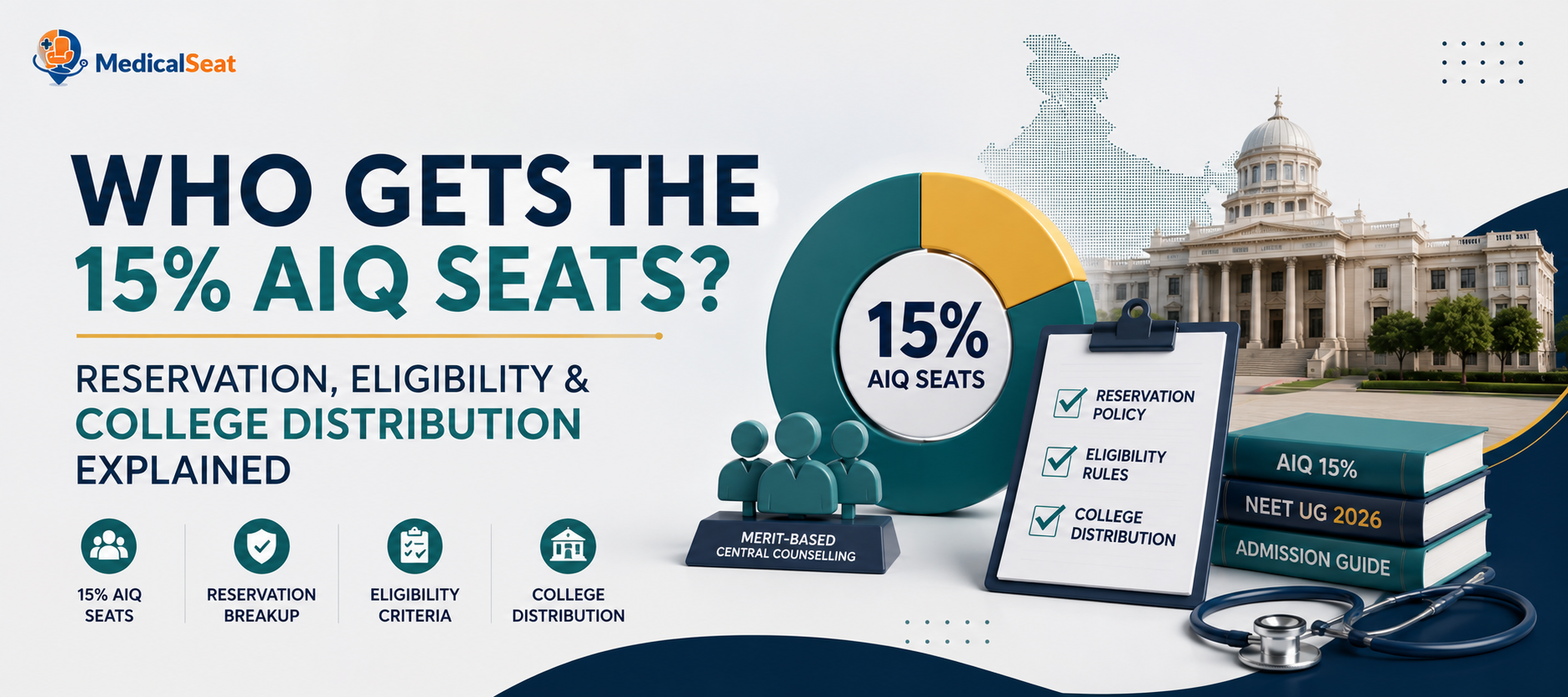
Who Gets the 15% AIQ Seats? Reservation, Eligibility & College Distribution Explained
Who actually qualifies for NEET UG's 15% AIQ seats? Full breakdown of reservation percentages, eligibility rules, and how seats are distributed by college
Who Gets the 15% AIQ Seats? Reservation, Eligibility & College Distribution Explained
The 15% AIQ pool follows a fixed central reservation matrix: 10% EWS, 15% SC, 7.5% ST, 27% OBC-NCL, and 5% horizontal PwD — leaving roughly 40.5% as Unreserved/General.
These percentages are uniform nationwide and cannot be changed by individual states for AIQ seats, even though the same state may apply different rules to its own 85% quota.
OBC candidates need a certificate valid under the Central OBC-NCL list — a state-only OBC certificate is not accepted for AIQ counselling.
Institutions like AIIMS and JIPMER don't participate in the 85%/15% split at all — 100% of their seats go through AIQ.
The exact seat-wise breakdown for each college is published by MCC as an official AIQ seat matrix, first as a provisional version and then finalized just before counselling.
Introduction
The 15% AIQ pool isn't a single undivided block of seats waiting to be claimed by rank alone. It's split further by a fixed reservation formula, layered eligibility rules for each category, and a college-by-college seat matrix that MCC publishes every year. Many NEET UG aspirants only discover these layers midway through counselling — often after assuming a category certificate that works for state quota will also work for AIQ.
This guide answers the practical question aspirants actually have: who gets the 15% AIQ seats, how the reservation matrix works, what makes a candidate eligible under each category, and how these seats are distributed across colleges.
Direct Answer
The 15% AIQ pool is split by a fixed central formula — 10% EWS, 15% SC, 7.5% ST, 27% OBC-NCL, and 5% horizontal PwD — with the remaining share going to the Unreserved category. These percentages apply uniformly nationwide to every government medical college's AIQ share, plus 100% of seats at AIIMS, JIPMER, central universities, ESIC colleges, and deemed universities, with exact seat counts per college published in MCC's official AIQ seat matrix.
Table of Contents
The AIQ Reservation Matrix, Explained
Who Is Eligible Under Each Category
Quick Facts: AIQ Reservation at a Glance
Which Colleges Contribute to the 15% AIQ Pool
Institutions With 100% AIQ (No State Quota at All)
How the AIQ Seat Matrix Document Works
Documents Required by Category
Common Certificate Mistakes That Cost a Seat
Latest Updates for NEET UG 2026
Benefits of the Reservation Structure
Challenges Candidates Commonly Face
Comparison Table: AIQ Reservation vs Typical State Reservation
Eligibility Checklist by Category
Seat Matrix Release Timeline
Expert Tips
FAQs
Conclusion
1. The AIQ Reservation Matrix, Explained
Every government medical college's 15% AIQ contribution is split using a reservation formula fixed by the Government of India, applied identically across the entire country:
10% — Economically Weaker Sections (EWS)
15% — Scheduled Caste (SC)
7.5% — Scheduled Tribe (ST)
27% — Other Backward Classes – Non-Creamy Layer (OBC-NCL)
5% — Persons with Benchmark Disabilities (PwBD/PwD), applied horizontally across all the above categories, not as a separate vertical block
Once these are added, roughly 40.5% of AIQ seats remain Unreserved (General/Open), for which any candidate — including high-ranking reserved-category candidates — can compete purely on merit.
Featured Snippet: What Is the AIQ Reservation Breakdown?
The 15% AIQ pool in every government medical college follows a fixed national reservation formula: 10% for EWS, 15% for SC, 7.5% for ST, 27% for OBC-NCL, and 5% horizontal reservation for PwD candidates across all categories. The remaining roughly 40.5% is Unreserved, open to any candidate on pure merit. These percentages apply uniformly across the country and cannot be modified by individual states for AIQ seats.
2. Who Is Eligible Under Each Category
EWS (Economically Weaker Sections): Open to candidates from the General category who fall below the prescribed income and asset threshold. Eligibility must be established with a valid income and asset certificate issued for the current admission cycle — an expired or previous year's certificate is not accepted.
SC (Scheduled Caste): Candidates must hold a valid caste certificate confirming SC status, issued by a competent authority, matching the candidate's declared category at NEET UG registration.
ST (Scheduled Tribe): Similar to SC, requiring a valid tribe certificate from a competent authority, consistent with the candidate's registration details.
OBC-NCL (Other Backward Classes – Non-Creamy Layer): The candidate must be listed in the Central OBC-NCL list — a certificate valid only for state purposes is not accepted for AIQ. Candidates falling under the creamy layer are treated as General category regardless of their community, and the certificate must be current, not carried over from a previous year.
PwBD/PwD (Persons with Benchmark Disabilities): Requires a disability certificate issued from a designated disability certification center, confirming a benchmark disability percentage as defined under applicable law. This reservation is horizontal, meaning a PwD candidate is also counted within their applicable social category (General, EWS, SC, ST, or OBC-NCL).
3. Quick Facts: AIQ Reservation at a Glance
Category | AIQ Reservation | Certificate Type Required |
|---|---|---|
EWS | 10% | Current-cycle income & asset certificate |
SC | 15% | Valid SC caste certificate |
ST | 7.5% | Valid ST tribe certificate |
OBC-NCL | 27% | Certificate valid under the Central OBC-NCL list |
PwBD/PwD | 5% (horizontal) | Disability certificate from a designated center |
Unreserved/General | ~40.5% | Not applicable — open merit |
4. Which Colleges Contribute to the 15% AIQ Pool
Every state government medical college contributes 15% of its total MBBS/BDS seats to the AIQ pool, while retaining 85% for its own state quota counselling. For example, Delhi's state-run and DU-affiliated colleges — such as Maulana Azad Medical College, Lady Hardinge Medical College, and UCMS — each carve out their 15% share for AIQ, while the remaining 85% is filled through Delhi's own state or university-level counselling process.
This pattern repeats across every state: a fixed 15% slice from each government medical college feeds into the same national AIQ pool, which is then allotted purely by AIR and category rank, regardless of which state the seat originally belonged to.
Note: Jammu & Kashmir's medical colleges are generally excluded from mandatory AIQ contribution, though candidates from J&K may still choose to participate in AIQ counselling separately.
5. Institutions With 100% AIQ (No State Quota at All)
Some institutions don't participate in the 15%/85% split at all — every seat they offer goes through AIQ:
AIIMS (all campuses) — India's AIIMS network offers thousands of MBBS seats nationally, entirely through 100% AIQ via MCC, with no state quota component. AIIMS New Delhi additionally carries a small number of separate seats reserved for foreign nationals, outside the regular AIQ count.
JIPMER Puducherry — 100% AIQ, following the same central reservation matrix
Central Universities such as BHU, AMU, and JMI — seats filled entirely by MCC
ESIC Medical Colleges — 100% AIQ
Deemed Universities — 100% of seats filled by MCC, though many deemed universities also apply their own institutional fee and reservation structures within that framework
6. How the AIQ Seat Matrix Document Works
MCC releases an official document each counselling cycle called the AIQ seat matrix — a comprehensive, college-wise, category-wise breakdown of every seat available under AIQ. This document is released in two stages:
Provisional Seat Matrix — an initial version released for review, allowing colleges and authorities to flag corrections
Final Seat Matrix — the confirmed version released just before counselling begins, which is the only version candidates should rely on for choice-filling
The seat matrix shows, college by college, exactly how many seats fall under General, EWS, SC, ST, OBC-NCL, and PwD within that college's AIQ share — making it the single most reliable source for understanding real seat availability, rather than estimates from third-party sites.
7. Documents Required by Category
All candidates: NEET UG admit card, scorecard, Class 10 and 12 certificates, passport photographs, valid photo ID
EWS: Income and asset certificate issued for the current financial year/admission cycle by a competent authority
SC/ST: Caste or tribe certificate issued by a competent authority, matching the category declared at NEET UG registration
OBC-NCL: Certificate confirming inclusion in the Central OBC-NCL list, explicitly stating non-creamy layer status, issued within the validity period specified by MCC
PwBD/PwD: Disability certificate from a designated disability certification center, stating the benchmark disability percentage
8. Common Certificate Mistakes That Cost a Seat
Submitting a state-issued OBC certificate for AIQ counselling, when only the Central OBC-NCL list is accepted
Using an EWS certificate from a previous admission cycle instead of a current one
Declaring a category at NEET UG registration that doesn't match the certificate later submitted during counselling
Assuming creamy layer status doesn't apply, when it in fact converts the candidate to General category for reservation purposes
Obtaining a disability certificate from a center not authorized to issue it for medical admission purposes
Any of these mistakes can lead to category rejection during document verification — even for a candidate with an otherwise strong NEET UG score.
9. Latest Updates for NEET UG 2026
MCC continues to apply the same central reservation matrix (10% EWS, 15% SC, 7.5% ST, 27% OBC-NCL, 5% horizontal PwD) for AIQ seats in the 2026 cycle
The provisional AIQ seat matrix for 2026 is released ahead of counselling, followed by a final version closer to Round 1
Total MBBS seats for 2026-27 are estimated at over 1.29 lakh across all colleges, with the AIQ pool drawing from the 15% share of every government college plus 100% AIQ institutions like AIIMS and JIPMER
AIIMS institutes collectively offer thousands of MBBS seats nationwide, entirely under 100% AIQ, category-distributed as per the central formula
10. Benefits of the Reservation Structure
Provides consistent, predictable reservation percentages nationwide, regardless of which state's college a candidate is competing for
Gives reserved-category candidates a fair, transparent share of seats at premier institutions like AIIMS and JIPMER
The horizontal PwD reservation ensures disability-based access exists within every social category, not as a separate isolated pool
A published, official seat matrix reduces reliance on guesswork or unofficial estimates
11. Challenges Candidates Commonly Face
Confusion between state-specific and central category certificates, especially for OBC-NCL
Provisional seat matrix numbers sometimes shifting before the final version is released
EWS and OBC-NCL certificates needing to be reissued each cycle, which candidates sometimes overlook until late in the process
Candidates from small states may be unfamiliar with AIQ rules since their day-to-day exposure is mostly to state counselling
12. Comparison Table: AIQ Reservation vs Typical State Reservation
Factor | AIQ (Central) | Typical State Quota |
|---|---|---|
Reservation percentages | Fixed nationwide (10/15/7.5/27/5) | Varies by state |
OBC certificate validity | Central OBC-NCL list only | State-issued OBC certificate |
EWS certificate | Central income/asset format | May follow state-specific format |
Applicability | Uniform across all states | Set independently by each state government |
Seats covered | 15% of govt. colleges + 100% AIQ institutions | 85% of govt. colleges + private colleges |
13. Eligibility Checklist by Category
Category declared at NEET UG registration matches the certificate to be submitted
EWS candidates: current-cycle income and asset certificate ready
SC/ST candidates: valid caste/tribe certificate from a competent authority
OBC-NCL candidates: certificate confirms Central OBC-NCL, non-creamy layer status
PwBD candidates: certificate from a MCC-recognized disability certification center
Final AIQ seat matrix checked before choice-filling, not just the provisional version
14. Seat Matrix Release Timeline
Stage | Approximate Timing |
|---|---|
NEET UG Result Declared | July |
Provisional AIQ Seat Matrix Released | Shortly after result, before Round 1 registration |
Choice Filling Window Opens | Following provisional matrix release |
Final AIQ Seat Matrix Released | Just before Round 1 seat allotment |
Round-wise Seat Matrix Updates | Before each subsequent round (Round 2, Mop-Up, Stray Vacancy) |
15. Expert Tips
Always cross-check your reservation category against the final seat matrix, not the provisional one, before filling choices
If you're OBC, confirm your certificate explicitly states Central OBC-NCL status — a state-only certificate can invalidate your reservation at verification
Renew EWS and OBC-NCL certificates for the current cycle even if you had a valid one last year
Remember that AIIMS and JIPMER seats are 100% AIQ — factor their entire seat count into your AIQ strategy, not just the 15% carve-out from state colleges
Conclusion
Understanding who actually qualifies for the 15% AIQ seats comes down to two layers working together: a fixed national reservation matrix that applies the same way in every state, and category-specific eligibility rules that hinge on having the right certificate, issued in the right format, for the current admission cycle. Institutions like AIIMS and JIPMER add another dimension, since their entire seat count runs through AIQ rather than the usual 15% carve-out. For NEET UG aspirants, checking the official AIQ seat matrix and verifying certificate validity early is what turns a strong rank into an actual, uncontested seat.
MedicalSeat CTA: Unsure which reservation category applies to you across AIQ and state quota? Speak with MedicalSeat's admission counsellors to verify your eligibility and build a realistic AIQ college shortlist.