 Neet Rank Predictor
 NEET UG Predictor
 MDS Predictor
 INI CET Predictor
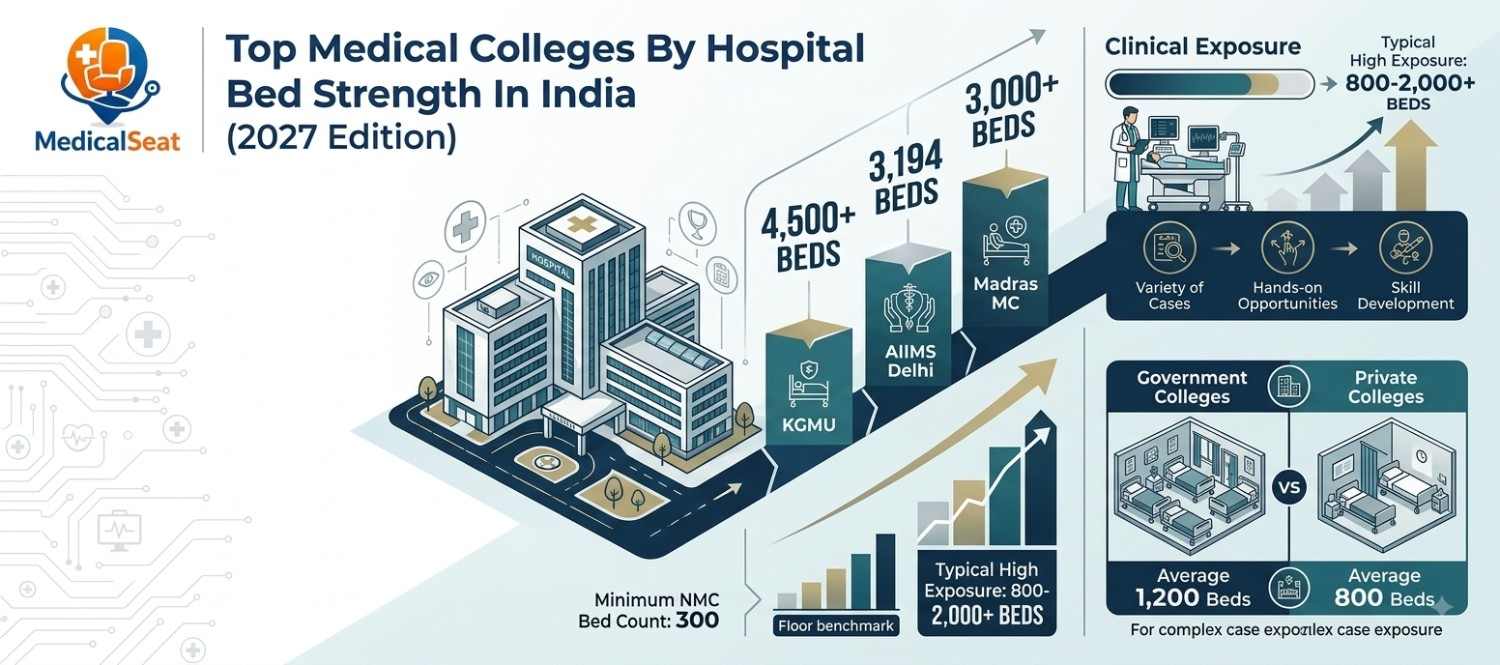
Top Medical Colleges By Hospital Bed Strength In India (2027 Edition)
Bed strength is the clinical exposure metric most NEET aspirants ignore until it is too late. Here is a ranked look at the medical colleges in India with the largest attached hospitals, why the National Medical Commission treats bed count as a real quality benchmark, and how to combine that data with a proper NEET College Predictor before you finalise your shortlist.
Nobody chooses a medical college because of its bed count until the day they actually start their clinical postings and realize how much it matters. A college attached to a 300 bed hospital and a college attached to a 3,000 bed hospital can carry the exact same name recognition on paper and still produce a completely different quality of hands on training. This is the metric almost no rank based ranking talks about, and it deserves far more attention in NEET Counseling decisions than it currently gets.
If you are building your shortlist for NEET UG/PG Counseling 2026 and only looking at NIRF rankings or fee brackets, you are missing one of the most practically important numbers in the entire decision, how many beds the attached teaching hospital actually has.
Why Hospital Bed Strength Actually Matters For MBBS Training
Clinical exposure during MBBS is built almost entirely around patient volume. More beds generally means more patients, more case variety, and more hands on opportunities during ward rounds, outpatient duty and casualty postings. Guidance aimed at aspirants consistently frames a 200 bed hospital as offering inadequate exposure, and recommends prioritising colleges with 500 or more beds for government institutions and 600 or more for private ones, since a smaller hospital gives inadequate exposure, and colleges with 500 or more beds for government institutions and 600 or more for private ones are generally preferred.
Other expert guidance goes further, noting that the National Medical Commission sets a regulatory floor and that the strongest institutions go well beyond it. The NMC requires a minimum of 300 beds for MBBS colleges, while the best medical colleges in the country typically maintain between 800 and 2,000 beds, since a higher bed count translates directly into greater patient exposure and stronger practical skill development. This is exactly the kind of detail a serious NEET counseling guide should be walking you through before you rank your choices, not something you discover mid semester.
There is also a documented gap between government and private institutions on this specific metric. Government institutions average around 1,200 beds, giving students exposure to roughly three times more complex cases than the average private college, which typically operates closer to 800 beds. That single statistic alone should reshape how you weigh Government & private medical colleges against each other when fees look comparable after scholarships or loans.
The Colleges With The Largest Attached Hospitals In India
Based on recent hospital sector data, a handful of Indian teaching hospitals stand well above the rest in raw bed capacity.
King George's Medical University, Lucknow tops most national comparisons, with a bed count of 4,500, making it the largest hospital in India by bed size.
AIIMS, New Delhi remains one of the most recognised names in Indian medical education, and on the infrastructure side it backs that reputation with scale, supporting 3,194 beds, making it one of the most prestigious medical institutions in the country.
Madras Medical College and the attached Rajiv Gandhi Government General Hospital, Chennai is another giant, with 3,000 beds serving as a cornerstone of Tamil Nadu's healthcare system, addressing a vast range of medical conditions, making it a serious option for anyone building a NEET rank vs college shortlist focused on tamilnadu.
Grant Medical College and the Sir JJ Group of Hospitals, Mumbai functions as a critical healthcare hub in Maharashtra with 2,844 beds, playing a vital role in both routine and emergency care, and represents exactly the kind of scale worth targeting for aspirants focused on maharastra.
IPGMER, Kolkata rounds out the top tier with 2,500 beds, functioning as a significant player in West Bengal's healthcare system and providing specialised services to a large patient base.
Further down the list but still firmly in the high exposure category, GS Medical College and KEM Hospital, Mumbai operates with 2,250 beds, contributing substantially to the healthcare infrastructure of Mumbai, while JIPMER, Puducherry carries 2,231 beds and stands as a major medical education and research institution. Government Medical College and Hospital, Nagpur provides essential regional coverage with 1,886 beds serving the central region of India, and Patna Medical College, a key reference point for aspirants targeting bihar, operates with 1,748 beds delivering a wide range of medical services. SGPGIMS, Lucknow closes out this tier with 1,609 beds supporting specialised medical care in Uttar Pradesh.
On the private and deemed side, Kasturba Medical College, Manipal, one of India's oldest and most established private institutions, draws on a network described as offering more than 2,700 beds across its affiliated hospitals, ensuring students handle a diverse range of cases, putting it comfortably ahead of most other private options on this specific metric. Maulana Azad Medical College, Delhi, attached to Lok Nayak Hospital, offers a 1,900 bed facility along with a dedicated burns unit and an organ transplant wing, backed by a significant annual infrastructure budget that keeps its clinical facilities current.
What This Means For Your Shortlist
None of this data is meant to replace rank based planning, it is meant to sharpen it. A NEET College Predictor tells you which colleges are statistically within reach for your rank, category and state. Bed strength tells you which of those reachable colleges will actually give you the clinical hours that make the difference between a confident final year and an anxious one. Combining both is what a genuinely useful medical college predictor India approach looks like, and running your real score through the NEET rank and college predictor is the fastest way to generate that reachable list before you start layering in infrastructure research.
This matters even more this year, given how the re NEET 2026 re exam pattern has shifted score distributions compared to a standard cycle. A NEET Rank Predictor 2026 that has not been rebuilt for this specific pattern can point you toward a college band that is not actually realistic, which wastes the research time you should be spending on comparing hospital infrastructure instead. If you want to understand exactly how this year's pattern has moved the numbers, this breakdown of NEET UG 2026 rank inflation around the 650 score band is worth reading before you finalise any shortlist.
Bed Strength And Fees Do Not Always Move Together
One of the more counterintuitive findings in this space is that high fees do not automatically mean high bed strength. Some all deemed and private college institutions charge premium fees while operating with far smaller attached hospitals than long established government colleges. A useful comparison point comes from a smaller private deemed institution, whose hospital operates with 330 beds, four advanced operation theatres, and round the clock lab services, a fraction of the capacity offered by the large government hospitals listed above, despite carrying private tuition costs. This is exactly why MBBS fees India wide should never be evaluated in isolation from infrastructure data. For a realistic sense of what fits within a sensible budget without sacrificing clinical exposure, this guide on medical college options within a realistic budget is a genuinely useful cross check.
Total Medical Seats In India: The Backdrop To This Comparison
Understanding where these large hospital colleges sit within the national picture requires knowing the overall seat landscape. As per the latest National Medical Commission seat matrix for the 2026 27 session, the total number of medical seats in India for MBBS now stands at approximately 1.37 lakh, following a fresh round of seat approvals, up from roughly 1.18 lakh in the previous cycle. Within that, the total number of government medical seats in India sits at roughly 63,000 to 64,000 across more than 450 institutions, while the total number of private medical seats in India, spanning all deemed and private college options, makes up the remainder, estimated between 65,000 and 74,000 seats. For a running view of new capacity entering the system, the list of upcoming medical colleges is worth checking, since newer colleges frequently start with smaller attached hospitals that grow bed capacity over subsequent years.
State Focus: Where Large Hospital Colleges Concentrate
Tamil Nadu stands out clearly here, anchored by Madras Medical College's massive attached hospital and a broader network of well established government institutions across the state, making it one of the strongest states in the country on this specific infrastructure metric.
Maharashtra, through institutions like Grant Medical College and KEM Hospital in Mumbai, similarly punches well above average, though bed strength varies significantly once you move beyond the major metro colleges into smaller regional institutions.
Bihar, anchored by Patna Medical College's substantial capacity, offers a genuine high exposure option within the state, even though the state's overall government seat base remains comparatively smaller than states like Maharashtra or Tamil Nadu.
Jharkhand, with a smaller and newer medical college network overall, generally offers lower average bed strength than these more established states, which makes cross state research, not just in state options, especially valuable for Jharkhand domiciled aspirants prioritising clinical exposure.
Building A Bed Strength Aware NEET Counseling Guide
A complete NEET counseling guide for this cycle should treat bed strength as a standing filter, not an afterthought. Confirm your realistic rank using a NEET Rank Predictor 2026 recalibrated for this year's pattern. Generate your reachable college list through a proper NEET College Predictor. Then filter that list against attached hospital bed strength, prioritising options above the commonly recommended 500 bed threshold for government colleges and 600 bed threshold for private ones wherever your rank allows it. If your rank sits near the widely searched five thousand mark, this breakdown of how a rank near 5,000 maps to actual colleges is a useful way to see how much genuine choice exists at that level, including several strong bed strength options.
This Applies Beyond MBBS Too
Clinical exposure through attached hospital infrastructure matters just as much for postgraduate tracks. Candidates targeting MDS seats should weigh attached dental hospital patient volume the same way MBBS aspirants weigh general hospital bed strength, and a dedicated MDS predictor helps narrow that search realistically. Candidates aiming for Institutes of National Importance through INI CET are, by definition, already targeting some of the country's highest bed strength institutions, and the dedicated INI CET predictor reflects that competition level accurately. AYUSH aspirants should apply the same infrastructure lens to their own attached hospital and clinic networks rather than assuming it does not apply outside allopathic medicine.
Make Infrastructure Part Of Your Strategy, Not An Afterthought
Every guess costs you a round, and choosing a college purely on name recognition while ignoring attached hospital bed strength is exactly the kind of guess that shows up years later, during internship, as a genuine training gap. Before you finalise your choice list, run your real score through a rank and college predictor genuinely calibrated for this year's pattern, covering MBBS, MDS, INI CET and AYUSH all in one place, at MedicalSeat.com. If you want to talk through how a specific college's infrastructure stacks up against your rank and budget with an actual counseling expert, call 8448997528 or email support@medicalseat.com. It is free to start, and already trusted by over 50,000 NEET aspirants building smarter, data backed shortlists.