
 Neet Rank Predictor
 NEET UG Predictor
 MDS Predictor
 INI CET Predictor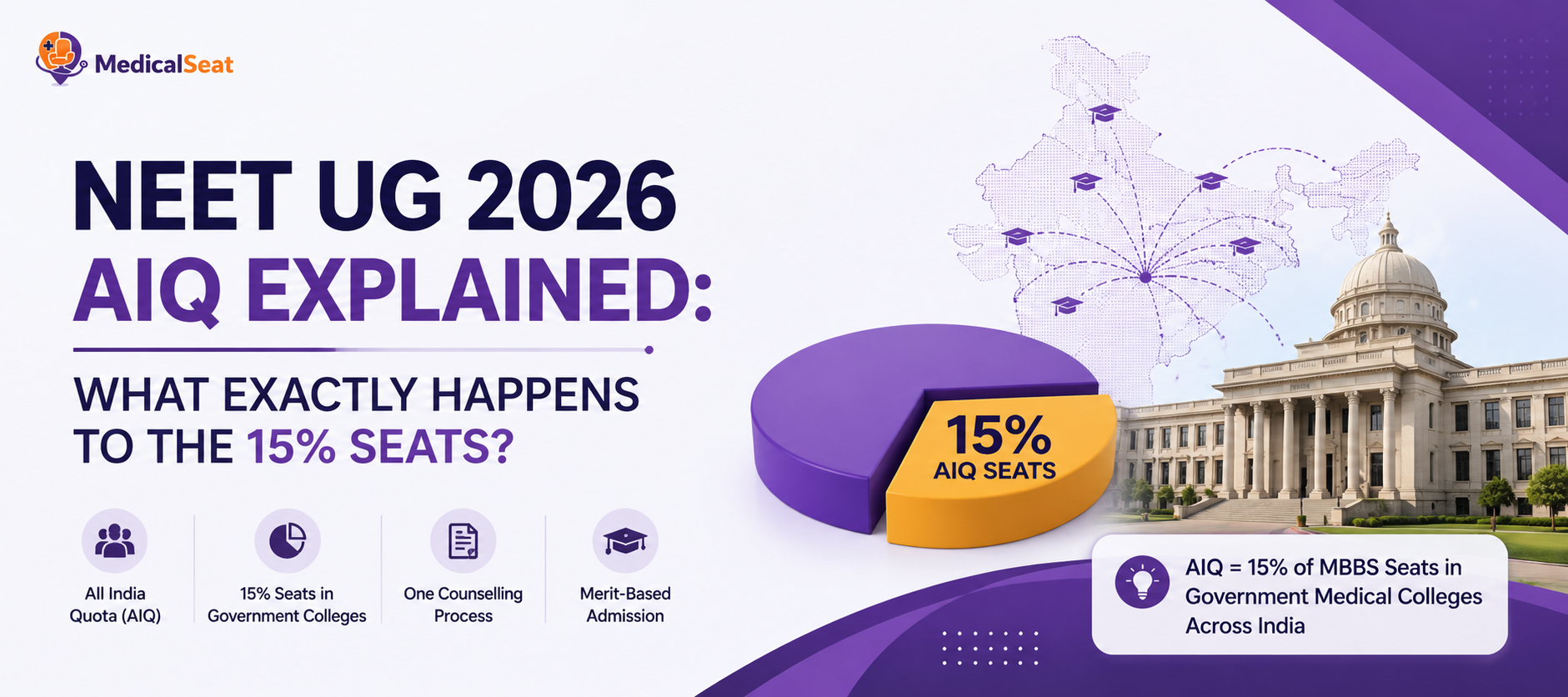
NEET UG 2026 AIQ Explained: What Exactly Happens to the 15% Seats?
Confused about NEET UG 2026 AIQ? Here's exactly how the 15% All India Quota seats work, who's eligible, and how MCC counselling allots them.
NEET UG 2026 AIQ Explained: What Exactly Happens to the 15% Seats?
AIQ (All India Quota) carves out 15% of MBBS/BDS seats from every government medical college in the country, before the remaining 85% goes to that state's own counselling.
AIQ is conducted entirely by the Medical Counselling Committee (MCC), based purely on NEET UG all-India rank, with no domicile restriction.
Beyond the 15% carve-out, MCC also separately handles 100% of seats at AIIMS, JIPMER, central universities (BHU, AMU, JMI, DU/IPU), ESIC colleges, and all deemed universities.
AIQ counselling runs in Round 1, Round 2, a mop-up round, and a stray vacancy round.
Candidates must register separately for AIQ (MCC) and state quota counselling — qualifying for one does not affect eligibility for the other.
Introduction
Once NEET UG results are out, most students hear the phrase "15% All India Quota" for the first time and assume it's simply one more counselling round to register for. In reality, AIQ is a distinct seat-allotment mechanism that decides whether a student from Kerala can land a government MBBS seat in Maharashtra, or whether a Delhi-based aspirant can compete for a seat in Rajasthan — something state quota counselling does not allow.
This guide explains NEET UG 2026 AIQ in plain terms: how the 15% seats are created, who can apply, how MCC allots them, and where this quota fits alongside AIIMS, JIPMER, and deemed university admissions.
Direct Answer
NEET UG 2026 AIQ (All India Quota) is a central pool made up of 15% of MBBS/BDS seats from every government medical college, filled by the Medical Counselling Committee (MCC) purely on NEET UG rank, with no state domicile requirement. MCC also separately fills 100% of seats at AIIMS, JIPMER, central universities, ESIC colleges, and deemed universities, making it the route for any student targeting these institutions nationwide.
Table of Contents
What Is the NEET UG AIQ (15% Quota)?
AIQ vs State Quota: Key Differences
Who Handles Which Seats (Quick Facts Table)
Eligibility for AIQ Counselling
Reservation Structure Within AIQ
AIQ Registration Process (Step-by-Step)
Documents Required
Choice-Filling Strategy for AIQ
Counselling Rounds Explained
Latest Updates for NEET UG 2026
Common Mistakes Students Make
Benefits of the AIQ System
Challenges and Limitations
Pros and Cons: AIQ vs State Quota
AIQ Registration Checklist
Counselling Timeline
Expert Tips
FAQs
Conclusion
1. What Is the NEET UG AIQ (15% Quota)?
The All India Quota was introduced so that a student's home state doesn't limit access to good government medical colleges elsewhere in the country. Under this system, every state government medical college contributes 15% of its MBBS and BDS seats to a central pool. This pool is filled on the basis of NEET UG all-India merit rank by the Medical Counselling Committee (MCC), functioning under the Directorate General of Health Services (DGHS).
The remaining 85% of seats in that same college stay with the state and are filled through the state's own counselling process, usually with domicile-based eligibility.
Featured Snippet: What Happens to the 15% AIQ Seats?
Every government medical college in India sets aside 15% of its MBBS/BDS seats for the All India Quota. These seats are pooled centrally and allotted by MCC purely on NEET UG rank, open to candidates from any state, with no domicile restriction. The remaining 85% of seats stay within that state and are filled through the respective state counselling authority under domicile-based rules.
2. AIQ vs State Quota: Key Differences
Factor | AIQ (15%) | State Quota (85%) |
Conducted by | MCC (central) | Respective state authority |
Domicile requirement | None — open to all states | Usually mandatory |
Seats covered | 15% of govt. college seats + 100% AIIMS/JIPMER/central/deemed | 85% of govt. college seats + private colleges |
Reservation policy | Central reservation norms | State-specific reservation norms |
Registration | Separate registration on mcc.nic.in | Separate registration on state portal |
Both processes run in parallel. Registering for AIQ does not affect a candidate's state quota participation, and vice versa — candidates are expected to register for both if they want to maximize their options.
3. Who Handles Which Seats (Quick Facts Table)
Seat Category | Share | Conducting Authority |
Government college seats (AIQ carve-out) | 15% | MCC |
Government college seats (state pool) | 85% | State counselling authority |
AIIMS (all campuses) | 100% | MCC |
JIPMER | 100% | MCC |
Central Universities (BHU, AMU, JMI, DU/IPU) | 100% | MCC |
ESIC Medical Colleges | 100% | MCC |
Deemed Universities | 100% | MCC |
Private Medical Colleges | 100% | State counselling authority |
As per MCC's own classification, AIQ counselling handled roughly 26,500 seats in a recent cycle — close to a fifth of all MBBS seats nationally — once the 15% carve-out is combined with AIIMS, JIPMER, central, and deemed university seats.
4. Eligibility for AIQ Counselling
Must have qualified NEET UG 2026 at or above the minimum qualifying percentile for the applicable category
No domicile or home-state requirement — open to NEET-qualified candidates from anywhere in India
Minimum age of 17 years as of December 31 of the admission year
Must complete separate online registration on the MCC portal (mcc.nic.in)
Qualifying NEET UG does not guarantee an AIQ seat — final allotment depends on rank, category, choices filled, and seat availability in each round.
5. Reservation Structure Within AIQ
AIQ seats follow the central government's reservation policy, applied uniformly regardless of the candidate's home state:
10% for Economically Weaker Section (EWS)
15% for Scheduled Caste (SC)
7.5% for Scheduled Tribe (ST)
27% for Other Backward Classes — Non-Creamy Layer (OBC-NCL)
Additional horizontal reservation for persons with disabilities (PwD), as per applicable norms
Because this is a central reservation list, a candidate's category certificate must be valid for central purposes; a state-issued category certificate that isn't recognized centrally may not apply within AIQ, even if it's valid for state quota.
6. AIQ Registration Process (Step-by-Step)
Visit the MCC portal at mcc.nic.in and create an account
Log in using NEET roll number, application number, and name exactly as per the NEET UG scorecard
Pay the counselling fee — typically a non-refundable registration fee plus a refundable security deposit
Fill choices from the list of AIQ-eligible colleges and courses
Lock choices before the deadline — MCC auto-locks unlocked choices, but locking manually is safer
Seat allotment is published based on rank, category, and choice order
Report to the allotted institute for document verification and admission, or choose to upgrade in a later round if eligible
According to the MCC's process for 2026, candidates should keep a valid, active bank account ready, since the refundable security deposit is returned only after counselling concludes.
7. Documents Required
NEET UG 2026 admit card and rank/scorecard
Class 10 and Class 12 mark sheets and certificates
Category certificate valid for central government purposes (if applicable)
Passport-size photographs
Valid government photo ID (Aadhaar or equivalent)
Provisional AIQ seat allotment letter
Medical fitness certificate
Migration certificate (where applicable)
8. Choice-Filling Strategy for AIQ
Research previous years' AIQ closing ranks for target colleges, keeping in mind ranks shift year to year
Fill a realistic spread of choices — don't list only AIIMS Delhi or top metro colleges if your rank doesn't support it
Include a mix of high-ROI government colleges across different states, since AIQ removes domicile restrictions
Check state-specific bond conditions before locking a choice — some states attach service bonds or penalty clauses to seats
Avoid leaving choices unlocked; lock them yourself instead of relying on auto-lock
9. Counselling Rounds Explained
AIQ counselling for NEET UG runs across multiple structured rounds:
Round 1: Initial seat allotment based on rank and choices
Round 2: Candidates who didn't get a seat, or wish to upgrade, participate again
Mop-Up Round: Fills seats still vacant after Round 2, sometimes open to fresh registrants
Stray Vacancy Round: Final round to fill any remaining vacant seats before the admission cycle closes
Rules on withdrawal, seat retention, and "free exit" can change between rounds and between years — MCC's official information bulletin for each specific round remains the only authoritative source, so candidates should verify current rules there before making a decision.
10. Latest Updates for NEET UG 2026
NEET UG 2026 results were declared in July 2026, moving the process into the counselling phase
General category qualifying cutoffs have risen this year, with reported qualifying marks around 213–715 depending on category
MCC has indicated the AIQ counselling schedule will be released shortly on mcc.nic.in, following the usual pattern of registration, choice filling, and Round 1 allotment
As per MCC's seat matrix for 2026-27, government medical colleges collectively offer over 63,000 MBBS seats nationwide, a portion of which flows into the AIQ pool
11. Common Mistakes Students Make
Assuming AIQ and state quota are the same process, or that registering for one covers the other
Filling choices only for the most famous colleges, ignoring their own realistic rank range
Not verifying whether a category certificate is valid centrally before relying on it for AIQ
Leaving choices unlocked and assuming auto-lock will preserve the intended preference order
Ignoring bond or penalty conditions attached to specific state or institutional seats
Missing round-specific deadlines by relying on the previous year's dates instead of the current bulletin
12. Benefits of the AIQ System
Removes domicile barriers, letting meritorious students access top colleges nationwide
Single centralized process for AIIMS, JIPMER, central universities, and deemed universities
Transparent, rank-based allotment with published cutoffs each round
Multiple rounds (including stray vacancy) give candidates more than one chance to secure a seat
13. Challenges and Limitations
Competition is intense since AIQ draws applicants from the entire country, not just one state
Candidates must track two separate counselling timelines (AIQ and state) simultaneously
Category certificates and reservation rules differ between the central AIQ list and state lists, causing confusion
Round-specific rules (like free exit or seat retention) can change year to year, so relying on old information can be costly
14. Pros and Cons: AIQ vs State Quota
Aspect | AIQ | State Quota |
Reach | Nationwide, no domicile limit | Restricted to home state (mostly) |
Seat pool size | Smaller (15% + central institutions) | Larger (85% of govt + all private) |
Competition level | Very high (all-India pool) | Comparatively more predictable within state |
Institutions covered | AIIMS, JIPMER, central & deemed universities | State government and private colleges |
Registration | Separate, via MCC | Separate, via state authority |
15. AIQ Registration Checklist
NEET UG 2026 scorecard and admit card ready
MCC portal account created with correct roll number and application number
Registration fee and security deposit payment completed
Category certificate verified for central/AIQ validity
Shortlist of realistic college choices prepared, spanning multiple states
Choices filled and manually locked before deadline
Bank account active and ready for security deposit refund
16. Counselling Timeline (Typical Pattern)
Stage | Approximate Timing |
NEET UG Result Declaration | July |
AIQ Registration Opens | Following weeks after result |
Round 1 Choice Filling & Allotment | Late July–August |
Round 2 Allotment | August |
Mop-Up Round | September |
Stray Vacancy Round | September–October |
Exact 2026 dates are released progressively by MCC on mcc.nic.in; candidates should rely on the current year's official bulletin rather than assuming last year's schedule repeats exactly.
17. Expert Tips
Register for both AIQ and state quota as soon as both portals open — don't wait to decide which one to prioritize
Keep a realistic range of choices rather than a wishlist of only top-tier colleges
Read each round's official information bulletin before deciding to accept, upgrade, or exit a seat
If your category certificate was issued for state purposes only, check its central validity well before choice-filling begins
Conclusion
NEET UG 2026 AIQ is best understood as a separate, nationwide layer sitting on top of state-level counselling — 15% of every government college's seats, plus 100% of AIIMS, JIPMER, central university, ESIC, and deemed university seats, all allotted by MCC purely on merit. For NEET UG aspirants, understanding this structure early — and registering for both AIQ and state quota without delay — is often the difference between securing a strong government seat and missing out due to confusion over which process covers which seats.
MedicalSeat CTA: Not sure how your NEET UG rank stacks up for AIQ this year? Connect with MedicalSeat's admission counsellors for a personalized college shortlist across AIQ and state quota options.