
 Neet Rank Predictor
 NEET UG Predictor
 MDS Predictor
 INI CET Predictor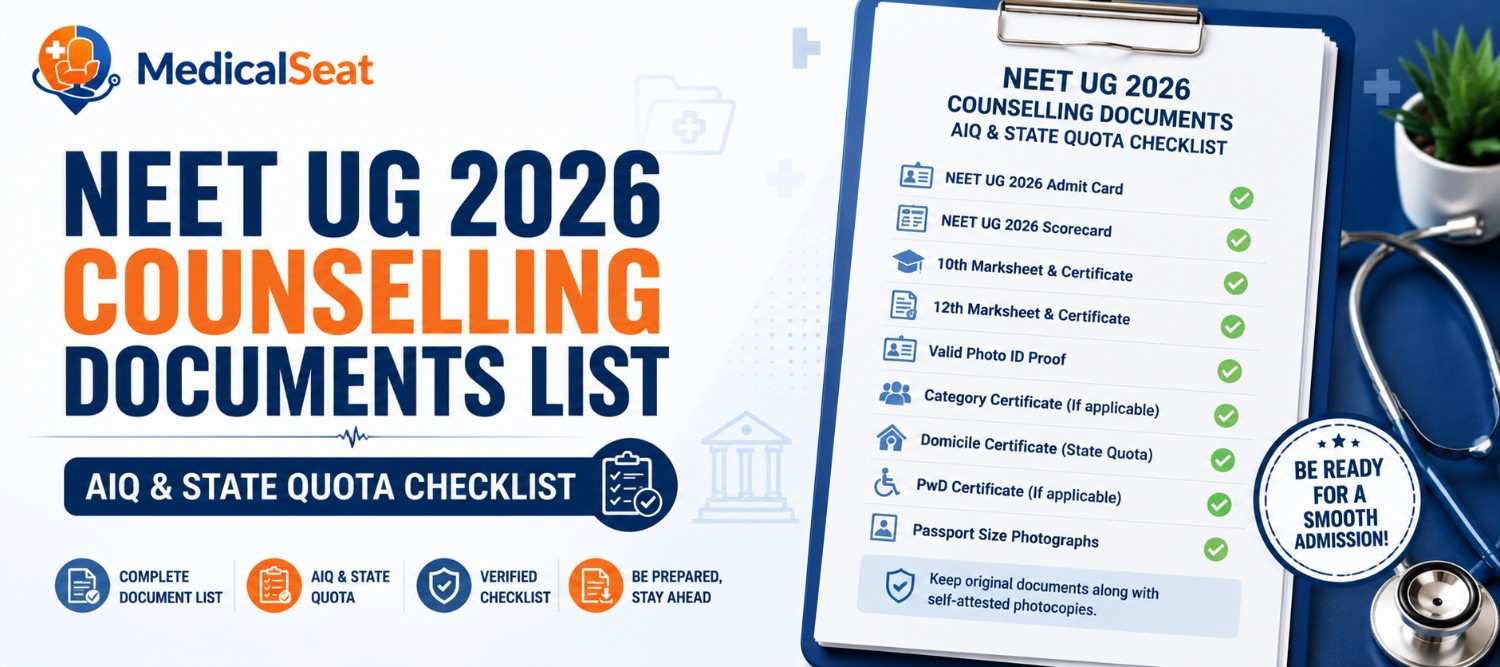
NEET UG 2026 Document Verification Rules: How to Avoid Rejection & Seat Cancellation
Know the exact NEET UG 2026 document verification rules — certificate formats, validity dates, and mistakes that cause rejection or seat cancellation.
NEET UG 2026 Document Verification Rules: How to Avoid Rejection & Seat Cancellation
Document verification happens physically at the college, not just online
Category certificate format and validity dates are the single biggest cause of rejection
OBC-NCL certificates must show the Central List of OBCs and explicitly state "Non-Creamy Layer"
EWS and OBC-NCL certificates are valid for only one financial year and must carry a specific issue date
Name/DOB mismatches across documents can block verification, even with a confirmed allotment
Missing the reporting deadline or exiting outside permitted rounds can forfeit your security deposit
Introduction
A confirmed NEET UG 2026 seat allotment feels like the finish line — but it isn't. The actual finish line is document verification, where colleges physically scrutinize every certificate you carry. In our counselling work at MedicalSeat, this is where we see the most avoidable losses: strong ranks undone by an expired certificate or a name that doesn't match across two documents.
This guide covers the exact rules authorities apply during verification, why rejections happen, and how to make sure your paperwork survives the scrutiny.
Direct Answer: NEET UG 2026 document verification requires original certificates that exactly match your application details, with category certificates in the correct format and validity window. Common rejection triggers include state-format OBC certificates used for AIQ, expired EWS certificates, name mismatches, and missing gap or migration certificates — any of which can lead to seat cancellation even after allotment.
Table of Contents
What is Document Verification in NEET Counselling
Why Verification Rules Matter This Year
Category Certificate Rules: The #1 Rejection Cause
Name, DOB, and Photo Mismatch Rules
Gap Certificate and Migration Certificate Rules
AIQ vs State Format: Where Most Rejections Happen
Step-by-Step: How to Avoid Rejection
Seat Cancellation and Security Deposit Rules
Exit and Resignation Rules
Common Mistakes That Trigger Rejection
Expert Tips from MedicalSeat
Key Takeaways
FAQs
Conclusion
What is Document Verification in NEET Counselling?
Document verification is the physical scrutiny of a candidate's original certificates by the allotted college after seat allotment, confirming eligibility before final admission is granted. Scanned uploads during MCC or state registration are only preliminary — the real check happens in person, where officials examine dates, formats, and watermarks against your application record.
Getting past this stage requires more than having the right documents. It requires having them in the exact format and validity window each authority demands.
Why Verification Rules Matter This Year
According to counselling authorities, missing or incorrect documents can lead to seat cancellation even after a candidate has been formally allotted a seat. This isn't a warning reserved for careless applicants — it applies equally to toppers and average scorers, since verification checks paperwork, not rank.
With NEET UG 2026 following a disrupted exam cycle and a compressed counselling timeline, candidates have less buffer time than usual to fix document issues between allotment and reporting. That makes getting the rules right the first time more important this year than most.
Category Certificate Rules: The #1 Rejection Cause
Category certificate errors are consistently the leading cause of NEET counselling rejections. The rules differ meaningfully by category:
OBC-NCL Certificate
Your caste must appear on the Central List of OBCs to claim AIQ reservation — a state OBC list entry alone is not sufficient
The certificate must explicitly state "Non-Creamy Layer" (NCL) — a certificate without this wording does not qualify
Must be issued on or after April 1 of the year preceding admission, to reflect the current financial status
EWS Certificate
Valid for only one financial year
Must be issued for the relevant financial year based on the correct income assessment period
An EWS certificate from a previous cycle will not be accepted, even if the candidate's financial status hasn't changed
SC/ST Certificate
Must be issued by a competent authority (Tehsildar, District Magistrate, or equivalent)
For AIQ counselling, it must strictly follow the format specified in the MCC information bulletin
Generally does not carry an expiration date, unlike OBC-NCL and EWS certificates
PwBD Certificate
Must be issued by a designated, NMC-authorized medical board
Certificates from non-authorized centers are typically rejected during verification
Name, DOB, and Photo Mismatch Rules
Verification officers cross-check every document against your NEET application form. The most common failure point is inconsistency, not missing paperwork:
Name spelling must match exactly across your Aadhaar, Class 10/12 certificates, admit card, and application form
Date of birth must be identical across all identity and academic documents
Photograph on your ID proof and passport-size photos must match the one uploaded during the NEET application
Even a single-letter difference — a middle name included on one document and dropped on another — can hold up verification and require an on-the-spot affidavit or correction, which isn't always possible during a tight reporting window.
Gap Certificate and Migration Certificate Rules
If you passed Class 12 before the current admission year, you're classified as a "dropper" for counselling purposes and must submit a notarized gap affidavit, typically on stamp paper, declaring that you were not enrolled in any other course during the gap period and were preparing for NEET.
A migration certificate, issued by your previous school or board, is also commonly required — especially when moving from a state or international board to a college in a different state.
AIQ vs State Format: Where Most Rejections Happen
Document | AIQ (MCC) Rule | State Quota Rule |
OBC Certificate | Central List format mandatory; state format not accepted | State-format certificate is often accepted or required |
Domicile Certificate | Not required | Mandatory |
EWS Certificate | Central format, current financial year | May follow state-specific income criteria |
Certificate Issuing Authority | Must match the Central Government-recognized list | Must match state-recognized list |
Featured Snippet Answer: The most common NEET UG 2026 document rejection happens when candidates submit a state-format OBC or EWS certificate for AIQ counselling, since MCC only accepts certificates that follow the Central Government format and are listed under the Central List of OBCs.
Step-by-Step: How to Avoid Rejection
Match every document's name and DOB against your NEET application form before counselling begins
Check certificate issue dates — especially OBC-NCL and EWS certificates, which expire annually
Confirm the certificate format matches AIQ or state requirements, not both interchangeably
Prepare a notarized gap affidavit in advance if you have a break after Class 12
Collect your migration certificate early from your previous school or board
Organize documents in the order specified in your counselling authority's brochure
Carry originals plus 2–3 self-attested photocopies to every reporting stage
Recheck validity dates before each round, not just before your first reporting
Seat Cancellation and Security Deposit Rules
According to MCC counselling guidelines, a seat can be cancelled — and the security deposit forfeited — under specific circumstances:
Admission cancelled due to incorrect information or missing documents
The candidate receives a seat in Round 2 or a later round and fails to join
Candidate exits counselling outside the permitted exit window
This makes document accuracy directly tied to your finances, not just your admission status. A rejected document at verification can cost both the seat and the deposit.
Exit and Resignation Rules
MCC counselling permits seat resignation only within specific windows announced for each cycle. Historically:
Candidates not upgraded in a later round can typically resign an earlier round's seat without forfeiting their security deposit, within the stipulated time
Candidates who joined a seat and later resign outside the permitted window generally forfeit their deposit
Exact exit dates and forfeiture rules are announced each counselling cycle separately, so always confirm the current year's notification on mcc.nic.in rather than relying on a previous year's timeline.
Common Mistakes That Trigger Rejection
Submitting a state-format OBC certificate for AIQ counselling
Using an expired EWS or OBC-NCL certificate
Ignoring the "Non-Creamy Layer" wording requirement on OBC certificates
Name or DOB mismatches between Aadhaar and academic records
Missing a notarized gap affidavit for droppers
Forgetting the migration certificate when moving across states
Carrying only photocopies without originals for verification
Assuming last year's certificate format still applies this year
Expert Tips from MedicalSeat
Current counselling guidance suggests treating document preparation as seriously as exam preparation itself. Our counselling experience shows that candidates who get their OBC-NCL and EWS certificates reissued fresh for the current financial year — rather than reusing an older one — face far fewer rejections at verification. It's also worth getting document copies pre-checked against your specific counselling authority's brochure before reporting day, since format expectations can differ subtly between AIQ and individual states.
Key Takeaways
Category certificate format and validity dates cause the majority of rejections
AIQ and state quota accept different certificate formats — don't assume one works for both
Name, DOB, and photo consistency across documents is non-negotiable
Gap and migration certificates need preparation, not last-minute arrangements
Seat cancellation can also mean forfeiting your security deposit
Conclusion
Passing NEET UG 2026 and receiving an allotment letter is a huge milestone — but document verification is where seats are actually won or lost on paper, not rank. Understanding certificate formats, validity windows, and consistency rules well before reporting day is what protects the seat you've already earned.
Unsure whether your category certificate or gap documentation meets this year's format requirements? MedicalSeat's counselling team can review your document set against current AIQ and state rules before you report. Get in touch with MedicalSeat today.