
 Neet Rank Predictor
 NEET UG Predictor
 MDS Predictor
 INI CET Predictor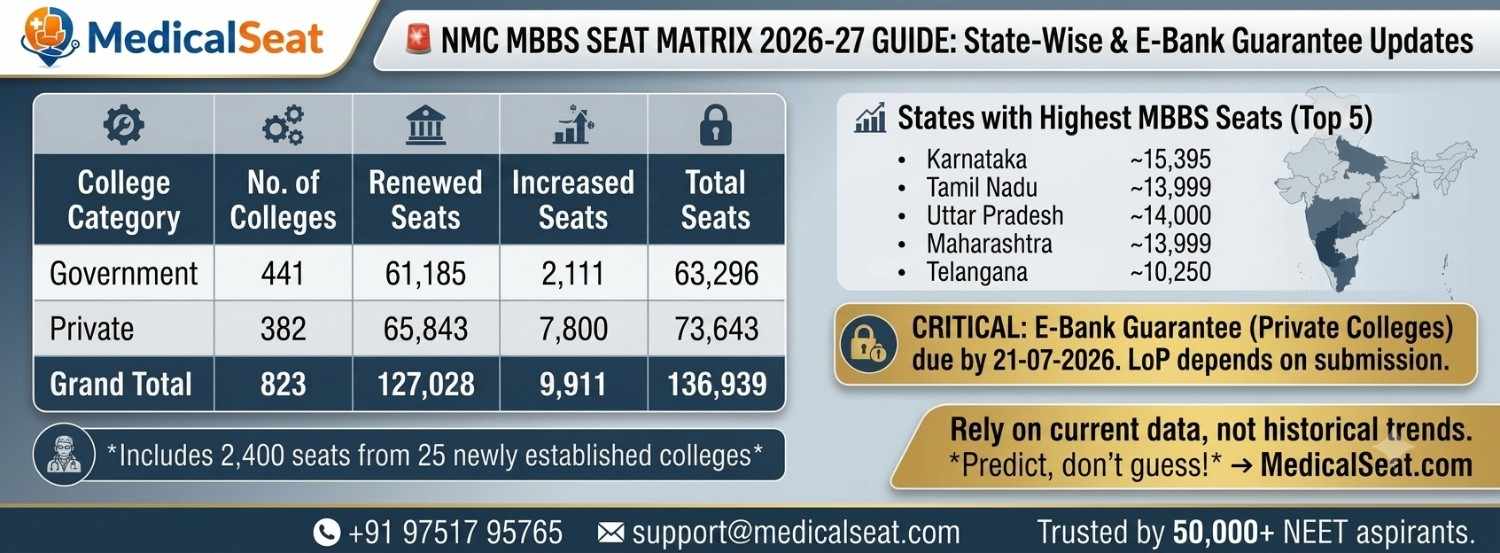
NMC MBBS Seat Matrix 2026–27: Complete State-Wise Guide
Explore the NMC MBBS Seat Matrix 2026-27 with state-wise seat counts, new medical colleges, and E-Bank Guarantee rules for NEET UG counselling this year.
The National Medical Commission (NMC) has finally released the much-awaited Seat Matrix for Undergraduate MBBS Courses for the Academic Year 2026–27, and it is, without exaggeration, one of the most important documents any NEET UG aspirant, parent, or counsellor will read this season. Issued on 14-07-2026 through the Medical Assessment & Rating Board (MARB) under the National Medical Commission Act, 2019, this notification lays down — college by college, state by state — exactly how many MBBS seats are available across India for the upcoming academic session, excluding the seats of Institutes of National Importance (INIs) such as AIIMS and JIPMER.
If you are preparing for NEET UG 2026 counselling, this is not a document you can afford to skim. Every number in this seat matrix determines your odds in a particular round, your college prediction, and ultimately, where you will spend the next five and a half years of your life. In this guide, we break down the entire notification — the numbers, the new colleges, the compliance directions, the legal warnings to private institutions, and what all of it practically means for your MBBS admission journey in 2026.
What Exactly Is the NMC Seat Matrix?
The seat matrix is the official, legally binding record of how many MBBS seats each recognised medical college in India is permitted to fill in a given academic year. It is prepared and published by the Medical Assessment & Rating Board (MARB), the wing of the National Medical Commission responsible for assessing and approving medical colleges, granting Letters of Permission (LoP), and monitoring compliance with NMC regulations.
This particular seat matrix for AY 2026–27 was issued as a follow-up to:
The original Public Notice dated 22.12.2025, which invited applications for establishing new MBBS colleges and increasing intake capacity at existing ones.
A subsequent Addendum dated 06.01.2026.
Both the NMC's Office of the Secretary (Dr. Raghav Langer) and MARB President Dr. M.K. Ramesh have signed off on the covering letters, which were sent to every Director/Principal/Dean of medical colleges that applied under the December notice, as well as to the Medical Counselling Committee (MCC), DGHS, which conducts All-India NEET UG counselling.
The Headline Numbers: Total MBBS Seats for 2026–27
Here is the topline data every aspirant should memorize before counselling begins:
Category | Number of Colleges | Renewed Seats | Increased Seats | Total Seats |
Government Medical Colleges | 441 | 61,185 | 2,111 | 63,296 |
Private Medical Colleges | 382 | 65,843 | 7,800 | 73,643 |
Grand Total (India) | 823 | 127,028 | 9,911 | 136,939 |
That's right — 136,939 MBBS seats across 823 medical colleges in India for the 2026–27 session, excluding INI seats. This is a meaningful jump from previous years, driven largely by seat increases at established colleges and a wave of newly established medical colleges that received approval this cycle.
Notably, the notice specifies that this total includes 2,400 new MBBS seats created through 25 newly established medical colleges — comprising 400 seats across 7 new Government Medical Colleges and 2,000 seats across 18 new Private Medical Colleges. This is a significant expansion of India's medical education capacity in a single admission cycle.
State-Wise MBBS Seat Distribution: Where the Seats Actually Are
Understanding the state-wise seat matrix is critical if you're deciding between All India Quota (AIQ) and state quota counselling, or evaluating your realistic chances based on NEET rank and domicile. Here's how the major states stack up:
States With the Highest Total MBBS Seats
Karnataka — 75 colleges, 15,395 total seats (24 government, 51 private)
Tamil Nadu — 78 colleges, 13,999 total seats (37 government, 41 private)
Uttar Pradesh — 88 colleges, 14,000 total seats (49 government, 39 private)
Maharashtra — 86 colleges, 13,099 total seats (42 government, 44 private)
Telangana — 66 colleges, 10,250 total seats (36 government, 30 private)
Andhra Pradesh — 40 colleges, 7,465 total seats
Gujarat — 42 colleges, 7,750 total seats
Kerala — 36 colleges, 5,454 total seats
Rajasthan — 51 colleges, 8,080 total seats
Madhya Pradesh — 34 colleges, 5,600 total seats
West Bengal — 41 colleges, 7,200 total seats
Bihar — 26 colleges, 3,420 total seats
Smaller States and Union Territories
States and UTs like Sikkim, Mizoram, Nagaland, Arunachal Pradesh, Andaman & Nicobar, Dadar & Nagar Haveli, Chandigarh, Goa, and Meghalaya have far smaller allocations — ranging from just 100 to 250 seats — reflecting their smaller population base and fewer medical colleges. Aspirants from these regions often rely more heavily on All India Quota seats and central pool counselling to secure an MBBS seat, which makes accurate rank estimation even more important.
This kind of state-wise MBBS seat matrix data is exactly why serious NEET UG aspirants don't counsel themselves blind — they cross-check their expected rank against actual seat availability in their preferred states before locking in choice-filling decisions.
New Medical Colleges Approved for 2026–27
One of the most consequential parts of this seat matrix is the list of newly established medical colleges that have received their first-ever seat allocation this year. These institutions previously had zero MBBS seats and now appear with fresh approvals, including:
Alva's Institute of Medical Sciences and Research Centre (Karnataka) — 150 seats
APS Medical College Hospital and Research Institute (Tamil Nadu) — 150 seats
B.S.P. Medical College and Hospital (Maharashtra) — 150 seats
Bharat Vikas Institute of Medical Sciences (Rajasthan) — 150 seats
Buddha Hospital and Research Institute (Bihar) — 100 seats
Chettinad Institute of Medical Education and Research (Karnataka) — 100 seats
Dr. B.S. Tomar Institute of Medical Sciences and Research (Rajasthan) — 150 seats
Fulan Singh Medical College, FS University (Uttar Pradesh) — 100 seats
Maa Padmavati Institute of Medical Sciences (Chhattisgarh) — 100 seats
Mauli Medical College Hospital & Research Center (Maharashtra) — 100 seats
Prince Medical College & Hospital (Rajasthan) — 50 seats
Raja Rajeshwari Institute of Medical Sciences-Girls (Telangana) — 150 seats
Sanskaram School of Medical Sciences (Haryana) — 100 seats
Shrinivas G Educational & Research Institute of Medical Sciences (Bihar) — 100 seats
Sido Kanhu Medical College and Hospital (Jharkhand) — 100 seats
Sikkim Government Medical College (Sikkim) — 100 seats
SKS Medical College (West Bengal) — 150 seats
Viraat Ramayan Institute of Medical Sciences (Bihar) — 100 seats
...along with several new Government Medical Colleges in Chhattisgarh (Dantewada, Janjgir-Champa, Kabeerdham, Manendragarh, and Jashpur-Kunkuri), each adding 50 new government seats.
This is important context for anyone building a college prediction list this year — these institutions won't have historical cutoff data, so aspirants need to be extra cautious and rely on a properly calibrated rank and college predictor rather than guessing based on last year's closing ranks, which simply don't exist for brand-new colleges.
Increased Intake Capacity at Existing Colleges
Beyond new colleges, dozens of already-established institutions have been granted increased seats for 2026–27. A few notable examples:
Government Medical College, Kadapa (AP) — increased from 175 to 250 seats
Government Siddhartha Medical College, Vijaywada (AP) — increased from 175 to 250 seats
Rajendra Institute of Medical Sciences, Ranchi (Jharkhand) — increased from 180 to 250 seats
Balvir Singh Tomar Institute of Medical Sciences (Rajasthan) — increased from 150 to 250 seats
PES University Institute of Medical Sciences, Bangalore (Karnataka) — increased from 150 to 250 seats
Netaji Subhas Medical College & Hospital, Bihta (Bihar) — increased from 150 to 250 seats
These seat increases matter enormously for counselling strategy — a college that historically had a higher closing rank due to limited seats may now have a noticeably different (usually more accessible) cutoff simply because more seats are on offer. Relying on outdated closing-rank data instead of the current seat matrix is one of the most common — and costly — mistakes aspirants make during choice filling.
The E-Bank Guarantee Directive: A Critical Compliance Deadline for Private Colleges
Section 3 of the MARB Public Notice carries a directive that private medical college managements absolutely cannot ignore:
All Private Medical Colleges that have been granted approval for establishing a new MBBS college or increasing intake capacity are directed to furnish the requisite Electronic Bank Guarantee (E-Bank Guarantee) to the Director, MARB, within seven (7) days from the date of issuance of the Public Notice (i.e., by 21-07-2026).
Details of the E-Bank Guarantee must also be emailed to bgugmarb@nmc.org.in and pratap.ram@nic.in. Crucially, the Letter of Permission (LoP) — the document that legally allows a college to admit students against its approved seats — will be issued by MARB only after the E-Bank Guarantee is received and verified.
This has a direct, practical implication for aspirants: if a particular private medical college's management fails to submit its E-Bank Guarantee on time, its LoP could be delayed, which could in turn delay or complicate that college's participation in NEET UG counselling rounds. Keeping an eye on official NMC updates closer to counselling dates is therefore essential if any of your target colleges fall into the "new establishment" or "seat increase" category.
Compliance and Anti-Fraud Warnings for Medical Colleges
The NMC and MARB have been unusually direct in this notification about consequences for non-compliance. Key directions include:
No admissions beyond approved seats. The notice states in bold: "All Medical Colleges shall strictly ensure that admissions are made only against the number of seats approved by the Medical Assessment & Rating Board (MARB) for the Academic Year 2026–27."
Penal action for violations. Any admission made in excess of the approved intake capacity will be treated as a violation of the National Medical Commission Act, 2019 and will attract regulatory and penal action against the defaulting college.
Counselling Committees must flag discrepancies. If any Counselling Committee — Central or State — notices a discrepancy or deviation from the approved seat matrix, the matter must be referred back to MARB for clarification before proceeding.
The matrix remains subject to revision. The notice explicitly states that the seat matrix may still be revised based on decisions of the Appeal Committee or any other competent authority — meaning aspirants should keep checking the official NMC website for updated versions closer to counselling.
This last point is worth repeating: the numbers in this seat matrix are not guaranteed to stay frozen. Appeals, revised approvals, or last-minute corrections are common in the Indian medical admission ecosystem, and every serious aspirant should track the official notifications right up until choice-filling closes.
Government vs. Private MBBS Seats: What the Split Really Means
Out of 136,939 total MBBS seats, 63,296 (about 46%) are in government medical colleges, and 73,643 (about 54%) are in private medical colleges. This split has direct financial and strategic implications:
Government MBBS seats are dramatically cheaper — often a fraction of the fee at private institutions — making them the first preference for the vast majority of NEET UG aspirants.
Private MBBS seats, while costlier, still fall under NMC fee regulation norms for a portion of their intake and remain the only viable pathway for many students whose NEET rank, while good, doesn't clear the cutoff for government colleges in their target state.
Deemed universities and larger private groups (several of which appear repeatedly in this seat matrix — such as multi-campus private trusts with colleges across three or four states) tend to have more seats but also higher fees, so state-quota versus All India Quota (AIQ) planning becomes essential.
Because the gap between a government seat and a private seat in the same state can mean a difference of lakhs of rupees per year, aspirants sitting near a state's average cutoff rank need an especially precise picture of where they stand — which is exactly the kind of clarity a proper rank and college predictor tool is built to provide.
Why This Seat Matrix Matters More Than Ever in a Re-Exam Year
This year's counselling cycle carries an added layer of complexity because of the NEET re-exam pattern, which has shifted rank distributions, cutoff trends, and round-wise seat matrix availability compared to previous years. Historical cutoff data from earlier NEET cycles is a far less reliable guide this year than usual — which is precisely why relying on last year's closing ranks, or worse, guesswork, is a mistake that can cost an aspirant an entire counselling round.
With 823 colleges, 136,939 seats, dozens of newly established institutions with zero historical cutoff data, and a redrawn seat matrix reflecting fresh government approvals — this is not the year to eyeball your chances.
Key Dates and Contacts to Remember
Public Notice issued: 14-07-2026
E-Bank Guarantee submission deadline for private colleges: within 7 days of notice (by ~21-07-2026)
E-Bank Guarantee email contacts: bgugmarb@nmc.org.in, pratap.ram@nic.in
Issuing authority: MARB, National Medical Commission, Sector-8, Dwarka, New Delhi-110077
Signatories: Dr. Raghav Langer (Secretary, NMC) and Dr. M.K. Ramesh (President, MARB)
Circulated to: All Medical Colleges/Institutions, Medical Counselling Committee (MCC) DGHS, State Directorates of Medical Education, and NMC's own IT Division for website and official X (Twitter) handle publication
Download the Official Notification
Want to check the exact seat count, management type (government/private), and the renewed-versus-increased seat breakup for every single one of the 823 colleges listed in this seat matrix? Download the full official NMC MBBS Seat Matrix 2026–27 PDF here and cross-reference it against your own NEET UG target list before counselling begins.
Final Word: Don't Let a Guess Cost You a Round
The 2026–27 NMC seat matrix is now public, the E-Bank Guarantee clock is ticking for private colleges, and MCC counselling will follow soon after based on this very data. With 136,939 seats, 823 colleges, dozens of brand-new institutions, and a re-exam-affected rank distribution, this is the year precision beats optimism.
Before you finalize a single choice-filling decision, know your real rank, your realistic college options, and your category-wise, state-wise standing — not your guess.
Get Your Real Rank and College Match Before Counselling Opens
Every guess costs you a round. Head to MedicalSeat.com and run your score through a rank and college predictor that's actually calibrated for this year's re-exam pattern — MBBS, MDS, INI CET, and AYUSH, all in one place.
Talk to a counselling expert directly: 📞 +91 97517 95765 📧 support@medicalseat.com
Free to start · Trusted by 50,000+ NEET aspirants