
 Neet Rank Predictor
 NEET UG Predictor
 MDS Predictor
 INI CET Predictor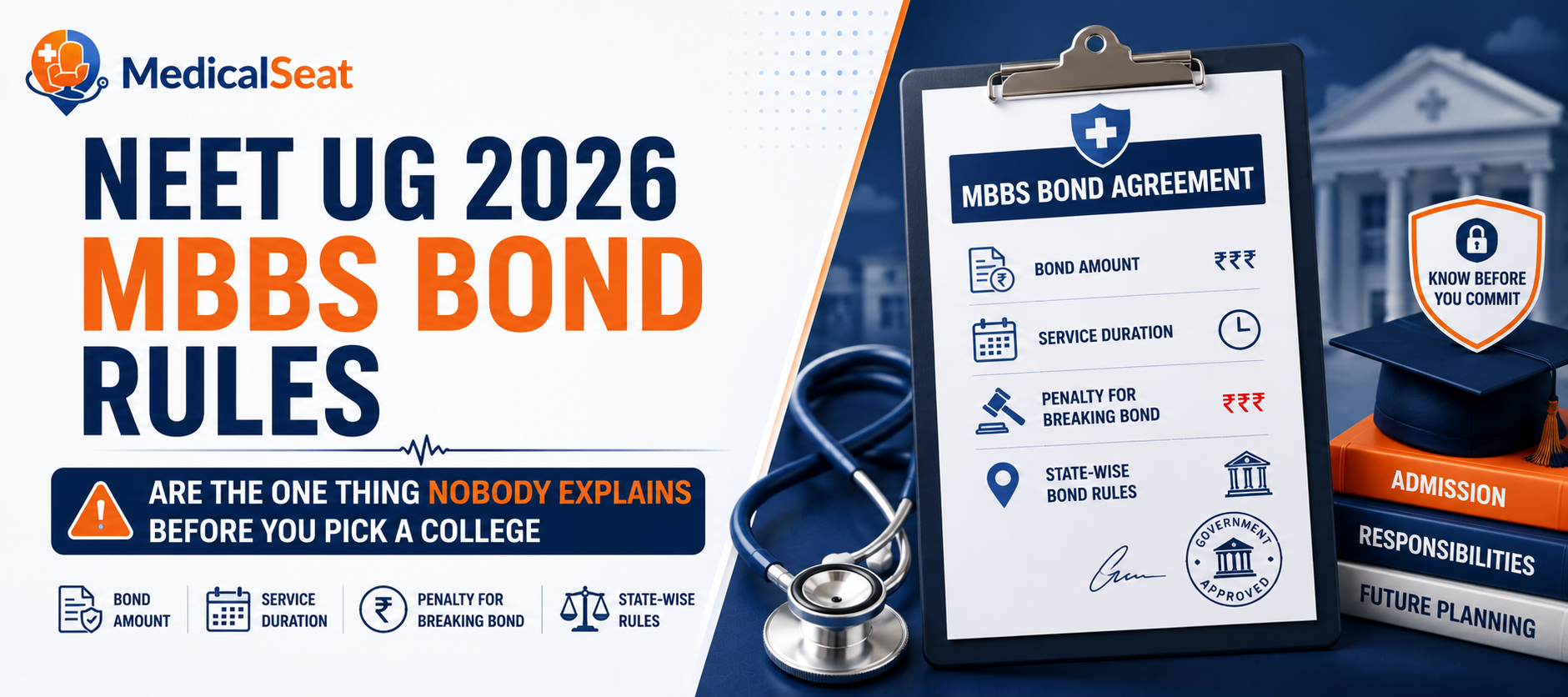
NEET UG 2026 MBBS Bond Rules Are the One Thing Nobody Explains Before You Pick a College
Compare NEET UG 2026 MBBS bond rules by state, government vs private college fees, service bond duration, penalties, and choose the right medical college.
NEET UG 2026 MBBS Bond Rules Are the One Thing Nobody Explains Before You Pick a College
Every year, thousands of NEET UG 2026 aspirants obsess over cutoffs, NEET rank vs college charts, and fee brochures, then sign an admission bond on day one without reading a single line of it. That bond can cost you anywhere from 5 lakhs to 40 lakhs, or five years of your twenties, depending purely on which state you pick during NEET UG/PG Counseling 2026. This is the guide that puts bond rules and fee structures for government, private, and semi-government medical colleges side by side, state by state, so you choose a college with your eyes open, not just your rank.
Before you go further, run your score through MedicalSeat's free NEET Rank Predictor or the dedicated NEET UG 2026 Rank Predictor so the college bands mentioned below actually mean something for your profile. If you're deciding between a low fee government seat with a bond and a bond free private seat, our medical college predictor India tool models both paths against your NEET closing ranks.
Government, Private, and Semi-Government: What Actually Separates Them
Before the state-by-state breakdown, here's the structural difference that most NEET Counseling guides skip over.
Government medical colleges are run directly by state health departments or the central government. Fees are heavily subsidised, often just 20,000 to 1.5 lakh per year, because taxpayers fund most of the real training cost. In exchange, many states attach a compulsory service bond, a legal contract requiring you to serve in a rural or government hospital for a fixed period after your internship, or pay a steep penalty.
Private medical colleges charge full commercial fees, typically 15 to 25 lakh per year, sometimes touching 1 crore over the full course at the most sought after institutes. Because you're not subsidised, there's generally no post course service bond, though a seat leaving penalty still applies if you drop out mid-course.
Semi-government colleges sit in between. This category includes deemed universities operating under management and NRI quotas, ESIC medical colleges, municipal corporation colleges (like Delhi's civic body institutions), and armed forces institutions such as AFMC Pune. Fees here range widely, from near-government levels at ESIC colleges to fully private level fees at deemed universities, and bond policy depends entirely on the specific institution rather than a blanket state rule.
Anyone building a serious NEET counseling guide for themselves needs to map all three categories against their own rank and domicile before choice filling begins, not after.
Total MBBS Seats in India for 2026: The Numbers Behind Every Rank Discussion
Context matters here because bond exposure scales with how many government medical seats versus private medical seats actually exist. As per the latest official NMC seat matrix released for the 2026 to 27 session, India now has 1,36,939 total MBBS seats across 823 colleges, an increase of 9,911 seats over 2025. Of this total number of medical seat in india, government colleges account for 63,296 seats and private colleges account for 73,643 seats, meaning the total number of private medical seat in india now edges past the total number of government medical seat in india for the first time at this scale. These figures exclude central Institutes of National Importance like AIIMS and JIPMER, which run entirely outside state bond jurisdiction.
This shift matters directly for bond planning. More private capacity means more bond free seats are available if you can afford the fee, while government seat growth in states like Rajasthan, Chhattisgarh, Karnataka, Maharashtra, Bihar, and Andhra Pradesh means more low fee, but potentially bonded, options too. Check our upcoming medical colleges page for the newest additions to this matrix before you lock your preference list.
States With Zero MBBS Service Bond: Your Freedom List for 2026
If bond free flexibility after MBBS matters to you as much as MBBS fees India, these state government college systems currently impose no compulsory rural service bond at the undergraduate level: Andhra Pradesh, Bihar, Chandigarh, Delhi (MAMC, VMMC, UCMS), Himachal Pradesh, Jammu & Kashmir, Kerala, Manipur, Meghalaya, Mizoram, Nagaland, Pondicherry (home to JIPMER), Punjab (subject to an ongoing High Court stay on a proposed surety bond), Telangana, Uttarakhand, and West Bengal. All AIIMS campuses, JIPMER, BHU, and AMU are bond free nationwide since they sit under the central Ministry of Health rather than state health departments.
A crucial correction that most NEET Counselling India content gets wrong: sites frequently list Andhra Pradesh, Kerala, and West Bengal with 40 to 50 lakh penalties. Those figures apply strictly to postgraduate MD/MS bonds, not undergraduate MBBS. At the MBBS level, these three states are completely bond free. Bihar specifically has no UG service bond either, despite being cited elsewhere with 25 to 30 lakh figures that actually belong to PG data.
Even in a no bond state, a course discontinuation penalty can still apply if you drop out mid-course after the final counselling round. Uttarakhand, Punjab, Mizoram, J&K, Himachal Pradesh, and Chandigarh currently impose zero discontinuation penalty as well, making them the lowest risk states overall for undecided students.
One Year MBBS Bond States: The Middle Ground
Several states balance subsidised fees with a shorter, one year commitment rather than a multi year lock-in.
Maharashtra requires a 1 year rural PHC or tribal posting after internship, with a 10 lakh penalty for opting out. The state is actively discussing scrapping this bond entirely in 2026 because seat capacity has tripled since 2006, so watch for gazette updates before you finalise choices here.
Karnataka enforces its bond under the Karnataka Compulsory Service Act, posting graduates to district or taluk hospitals for 1 year, again with a 10 lakh penalty for breaking it.
Madhya Pradesh runs a 1 year bond at 10 lakh penalty for general category candidates, with a lower figure for SC/ST candidates, though students under the Medhavi Chhatra Yojana scholarship scheme can see this extend up to 5 years.
Gujarat technically sits in the 1 year bracket but carries one of the highest penalties for that duration, at 20 lakh, making it disproportionately risky if you plan to break the bond.
Goa and Jharkhand both apply a 1 year bond with a 10 lakh penalty structure similar to Maharashtra and Karnataka.
Two Year and Longer Bond States: Plan Your PG Timeline Around These
Uttar Pradesh mandates a 2 year bond in government hospitals or semi-urban PHCs, with a comparatively manageable 10 lakh penalty.
Tamil Nadu requires 2 years of PHC or CHC service, but at just a 5 lakh penalty, one of the lowest per-year penalty ratios in the country, reflecting Tamil Nadu's strong public health network.
Rajasthan also runs a 2 year bond at 5 lakh penalty for undergraduates, though its PG bond mechanics are far more complex, involving a surety bond replaced by a bank guarantee plus a legal bond at admission.
Odisha, Chhattisgarh, and Tripura each apply a 2 year bond with a 10 lakh penalty. Assam steps up to a 3 year commitment at 15 lakh, one of the stricter mid-tier states.
Haryana carries the longest and most talked about UG bond in the country: a full 5 year government service commitment, with a gender-differentiated penalty of 25.77 lakh for male candidates and 23.19 lakh for female candidates if the bond is broken. Haryana MBBS students have actively protested this policy over unclear posting timelines, so this is one to track closely before choice filling.
Dadra & Nagar Haveli, a Union Territory, has the single highest penalty nationwide for its 2 year bond, at 40 lakh, making it worth avoiding unless you are fully committed to the full service period.
What Breaking the Bond Actually Costs You
Ignoring a signed bond isn't a paperwork issue you can walk away from. Four consequences follow in every bonded state: your original certificates and MBBS degree stay with the Dean's office until the bond is served or the penalty is paid, your State Medical Council refuses permanent registration, you're blocked from NEET PG counselling without a No Objection Certificate, and the state can pursue legal recovery from your parents as guarantors. Even going abroad for USMLE or PLAB requires a Good Standing Certificate that stays locked until the bond is resolved. None of this is refundable once paid.
Private Medical College Fees: The Bond Free Trade-Off
Private colleges generally carry no compulsory service bond because you're paying the full, non-subsidised cost of your education, typically 60 lakh to 1 crore over the entire course. This buys immediate freedom to pursue NEET PG or private practice right after internship, but the seat leaving bond still applies if you exit after the counselling cutoff, and it's calculated as tuition for every remaining year. If a private college carries a government quota subsidy on select seats, that state's bond rule can still attach to those specific seats, so always confirm this at the brochure level rather than assuming.
Semi-Government Colleges: Deemed Universities, ESIC, and AFMC
Deemed universities charge full commercial fees through the separate MCC DGHS Deemed counselling stream and don't impose a post-MBBS service bond, since students already pay market rate. What they do enforce strictly is the seat leaving bond: dropping out mid-course can mean paying tuition for all remaining 4.5 years, which can run 60 lakh to 1.2 crore at the top deemed institutions.
ESIC medical colleges and AFMC Pune sit closer to the government fee band while carrying their own separate service obligations tied to employment with ESIC hospitals or the armed forces respectively, rather than a standard state rural bond.
Central institutes like AIIMS, JIPMER, BHU, and AMU remain the cleanest option on both fronts: heavily subsidised fees and zero compulsory bond, since they answer to the central Ministry of Health rather than any state health department.
Bihar, Tamil Nadu, Jharkhand, and Maharashtra: A Quick Side-by-Side
Since these four states come up constantly in NEET UG/PG Counseling 2026 planning, here's the direct comparison. Bihar carries no UG service bond at all, making it one of the most flexible low fee options currently available. Tamil Nadu applies a 2 year bond but at a modest 5 lakh penalty, a favourable ratio given the length. Jharkhand runs a shorter 1 year bond at a 10 lakh penalty. Maharashtra also sits at 1 year and 10 lakh, with an active state discussion around removing the bond altogether in 2026. Across all deemed and private colleges in these four states, expect no compulsory service bond but a meaningful seat leaving penalty if you exit after the counselling deadline.
Why This Matters More in 2026: The Rank Inflation Angle
Government & private medical colleges are getting harder to separate purely on marks this year. As we've covered in our detailed piece on NEET UG 2026 rank inflation, a 650 plus score is no longer the safe benchmark it once was, which means more borderline candidates are weighing a bonded government seat against a bond free private or deemed seat at a similar rank band. Use our free NEET rank and college predictor to see where your score actually lands across all three categories before you commit to a bond you might regret. If you're specifically eyeing dental or postgraduate dental routes, our MDS predictor and for postgraduate medical seats the INI CET predictor apply similar logic to those counselling streams. Aspirants also comparing budget colleges under 30 lakh total cost should check our budget college resource, and those exploring options around the 5,000 AIR mark can reference our rank band college list.
Conclusion
A government MBBS seat isn't automatically the "cheaper" choice once you factor in bond duration and penalty exposure, and a private or deemed seat isn't automatically the "expensive" choice once you factor in the freedom it buys you right after internship. The only way to make this decision properly is to run your own rank, domicile, and budget against the specific state and college type you're targeting, because bond policy in India changes almost every admission cycle through gazette notifications and court orders. Treat this guide as your starting map for NEET UG 2026 Rank Predictor based planning, then verify the final bond clause in your specific college's admission brochure before you sign anything on day one.
For personalised guidance on matching your NEET rank to a bond free or low bond college that fits your budget, reach out to Medical Seat:
Call or WhatsApp: +91 9751795765
Email: support@medicalseat.com
We help you compare government medical seats, private options, and deemed university placements side by side, factoring in bond exposure, so your MBBS Admission Guidance covers the full financial picture, not just the headline fee.