
 Neet Rank Predictor
 NEET UG Predictor
 MDS Predictor
 INI CET Predictor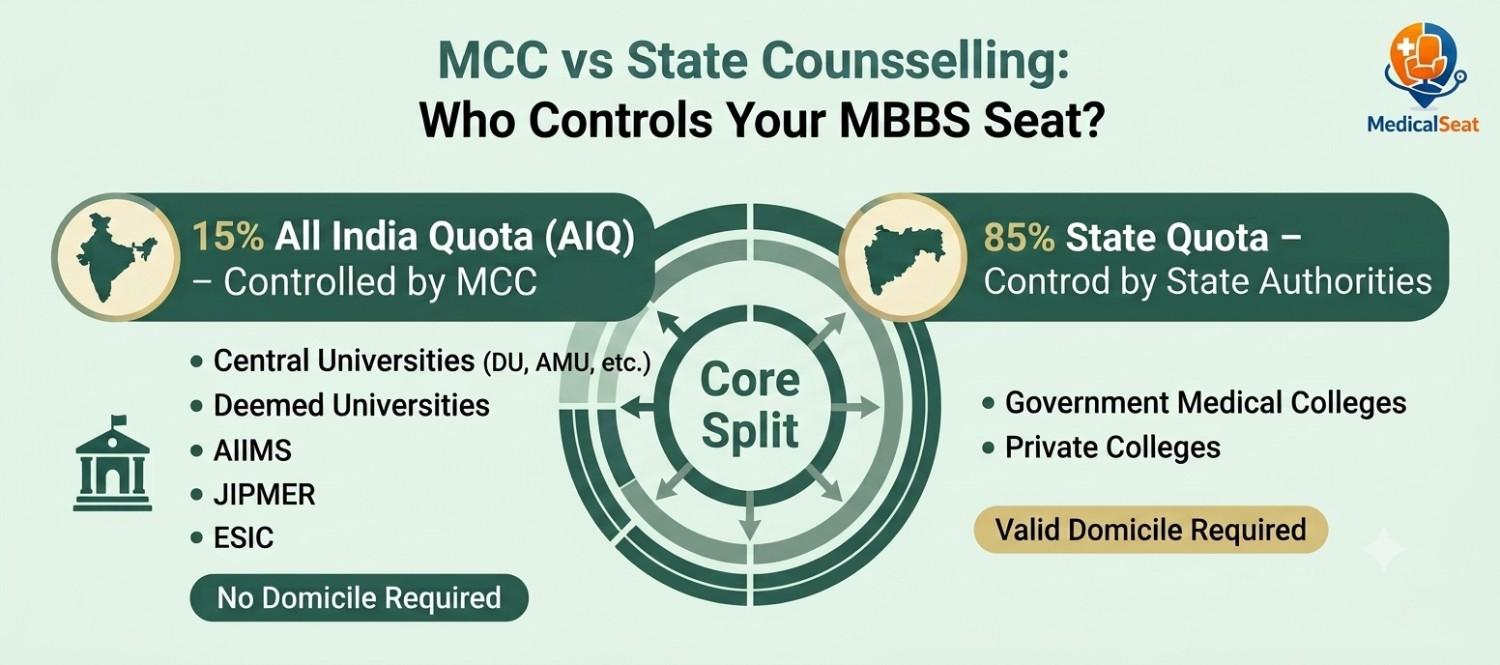
Who Controls Your MBBS Seat? MCC vs State Counselling Explained Without the Confusion
MCC vs state counselling for NEET UG explained clearly — who handles AIQ, deemed universities, and private colleges, plus how to use a rank predictor.
Every year, a huge share of NEET UG aspirants clear the exam and then lose weeks figuring out something nobody explained to them properly: qualifying NEET UG doesn't put you into one admissions process. It puts you into two, running at the same time, filling different pools of seats, under different rules. This is the single biggest source of confusion in NEET counseling, and it's worth untangling properly before you touch a choice list.
This guide walks through exactly what the Medical Counselling Committee (MCC) controls, what your state counselling authority controls, how the two interact, and what that means practically whether you're targeting bihar, tamilnadu, jharkhand, maharastra, or any other state's government & private medical colleges.
The Core Split: 15% AIQ vs 85% State Quota
Every government medical college in India carves out its seats into two pools before your state even sees them:
15% All India Quota (AIQ): filled entirely by MCC, open to any NEET-qualified candidate from any state, no domicile requirement
85% State Quota: filled by your home state's own counselling authority, almost always requiring a valid domicile certificate
On top of that 15% slice, MCC also runs 100 percent of admissions for a separate set of institutions entirely: deemed universities (roughly 88 of them across India), central universities like Delhi University, BHU, AMU and Jamia Millia Islamia, plus every AIIMS and JIPMER campus and the ESIC medical colleges. None of these run any state quota at all, they sit fully under MCC.
Meanwhile, your state authority handles the remaining 85 percent of government seats plus, in most states, 100 percent of the seats at all deemed and private college options that aren't formally deemed universities. This is the part that trips people up most: "private" and "deemed" are not the same category, and they don't go through the same door.
What MCC Actually Controls
If you remember nothing else, remember this list. MCC (under the Directorate General of Health Services) runs:
15% AIQ seats at every government medical college nationally
100% of seats at deemed universities
100% of seats at central universities (DU, BHU, AMU, Jamia Millia Islamia, IP University)
All AIIMS and JIPMER campuses
ESIC medical colleges
AFMC, with its own separate service-bond eligibility criteria
MCC handled roughly 26,500 seats in a recent cycle, close to a fifth of the country's total MBBS capacity. Registration is centralised, choice filling happens on one national portal, and there's no domicile filter anywhere in this pool. A candidate from Kerala can land an AIQ seat in Maharashtra, and the reverse is just as true.
What Your State Counselling Authority Controls
Everything else. Specifically:
The remaining 85% of government seats, restricted to state domicile in almost every state
All private and management quota seats, unless the private college happens to be a deemed university
NRI quota seats where applicable
State-specific reservation categories, which often differ meaningfully from the AIQ reservation list
This is where it gets genuinely state-dependent. A student's category classification under AIQ can literally differ from their classification under their home state's list, because reservation policy isn't uniform. This is one of the most overlooked details in any NEET counseling guide, and it's exactly the kind of detail that costs a candidate a seat they were otherwise eligible for, simply because they assumed one category tag carried over.
Register for Both. Always.
Participating in AIQ counselling does not affect your state quota eligibility, and vice versa. Most successful candidates register on both the MCC portal and their home state's portal simultaneously, then run separate choice lists for each, because they're separate competitions with separate cutoffs.
The mistake to avoid: assuming a single registration or a single scorecard covers everything. It doesn't. Missing a specific portal's registration window is one of the most preventable ways students lose access to seats they had every right to compete for.
Where Private Colleges Actually Sit
This is the part where medical college predictor India tools genuinely earn their keep, because private colleges don't behave uniformly across the country:
In most states, a NMC-recognised private medical college fills its seats entirely through the state counselling authority, split between a lower-fee government quota tier and a much higher-fee management or NRI quota tier
A small number of private colleges are structured as deemed universities, which pulls them out of the state system entirely and into MCC's national pool instead
The practical effect: two private colleges in the same city can have completely different application processes depending on whether one is deemed and the other isn't
If you're building a shortlist across states like bihar, tamilnadu, jharkhand, or maharastra, checking each shortlisted college's exact admission route (state quota versus MCC deemed) before you fill choices saves you from missing a registration deadline for the wrong portal entirely.
The National Numbers, For Context
As of the NMC's most recent 2026-27 seat matrix, India has 1,36,939 total MBBS seats across 823 medical colleges, made up of 63,296 government MBBS seats across 441 government colleges and 73,643 private MBBS seats across 382 private colleges. That's a jump of nearly 9,911 seats over the previous cycle, with the private sector contributing close to four fifths of the new capacity. Of the 25 newly approved medical colleges this year, 7 are government and 18 are private, which tells you where India's medical seat expansion is actually concentrated right now.
Understanding this national split matters even if you only care about one state, because it tells you how much of your competition is actually national (the AIQ and deemed pool) versus local (your state's 85% quota and its private colleges).
Where a Rank and College Predictor Fits In
Because AIQ and state quota are two separate competitions with two separate rank lists, a single flat cutoff number rarely tells the full story. NEET rank vs college planning has to account for both pools separately, and NEET closing ranks from a prior year need extra caution this year given the re-exam pattern shifting score distributions.
Once you have a realistic expected score, running it through an actual NEET UG 2026 rank predictor helps narrow both pools down to a workable shortlist based on your category, domicile, and quota eligibility, rather than guessing off last year's numbers. MedicalSeat.com's predictor is built around this year's revised pattern, and covers MBBS, MDS, INI CET, and AYUSH counselling in one place. There's a dedicated MDS predictor for dental postgraduates and an INI CET predictor for AIIMS and JIPMER PG seats specifically, plus a plain-language explainer on how a free rank and college predictor actually works if you want to understand the mechanics before trusting any output.
For the bigger picture on this year's score to rank mapping, MedicalSeat's analysis of NEET UG 2026 result statistics and their breakdown of rank inflation around the 650 score band both explain why comparing this year directly to 2024 or 2025 closing ranks can mislead you. And if budget is the deciding factor between an AIQ government seat and a private management quota seat, MedicalSeat's budget focused resource and its rank to college reference across roughly 5,000 institutions are both useful before you lock a choice list. Newer colleges also shift the matrix mid-cycle, so it's worth tracking MedicalSeat's list of upcoming medical colleges if your rank sits near the margin.
A Practical Checklist Before Counselling Opens
Register on the MCC portal for AIQ, deemed university, central university, or AIIMS/JIPMER eligibility, whichever applies to you
Register separately on your home state's counselling portal for the 85% state quota and any private colleges in that state
Confirm your category classification separately under both the AIQ list and your state's list, they are not guaranteed to match
Keep your domicile certificate ready well before state counselling opens
Track each shortlisted private college's actual admission route, since deemed-status colleges bypass the state system entirely
Every guess here costs you a round, and rounds don't come back. Running your score through a predictor calibrated for this year's actual pattern is a faster starting point than reconstructing last year's cutoffs from memory. Head to MedicalSeat.com's predictor, or talk to their counselling desk directly at +91 97517 95765 or support@medicalseat.com if you'd rather walk through your specific AIQ and state options with a person.