
 Neet Rank Predictor
 NEET UG Predictor
 MDS Predictor
 INI CET Predictor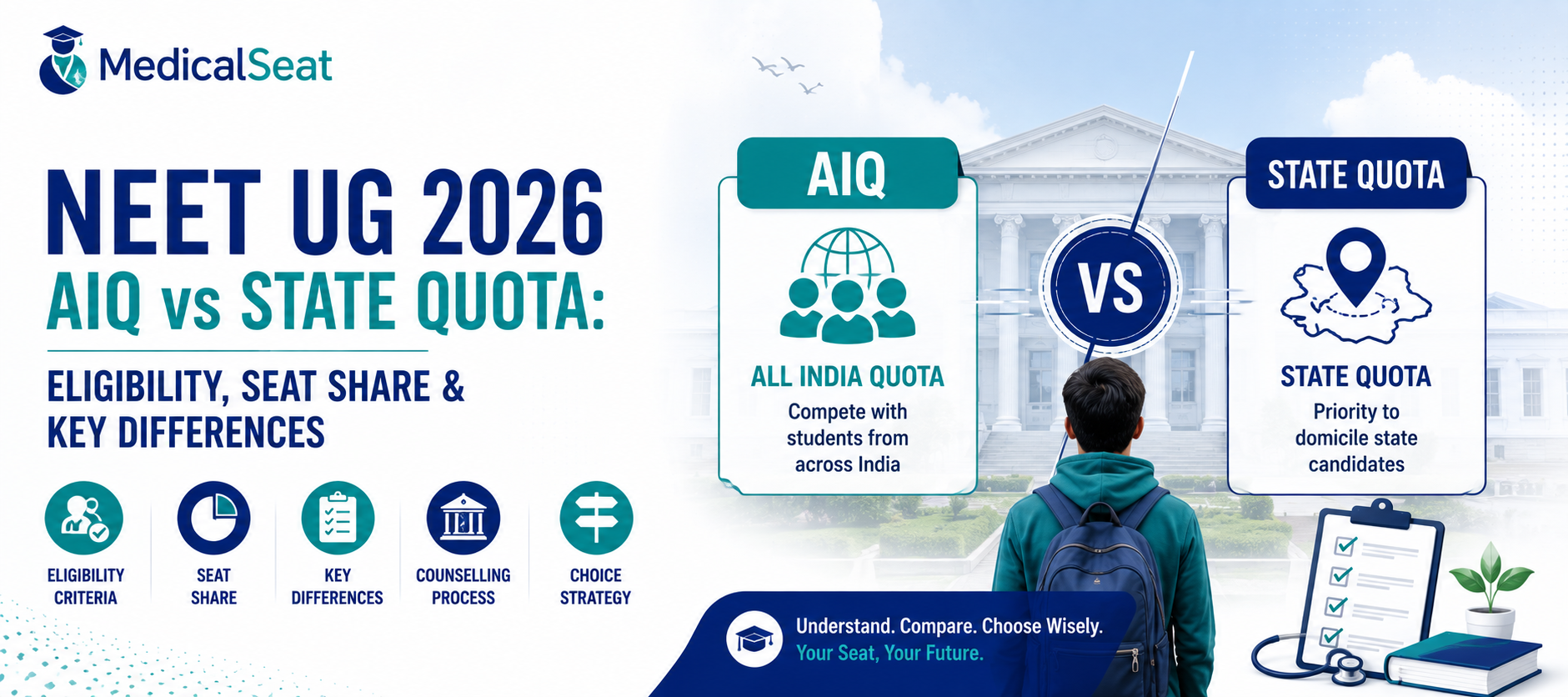
NEET UG 2026 AIQ vs State Quota: Eligibility, Seat Share & Key Differences
NEET UG 2026 AIQ vs State Quota explained — seat share, eligibility, counselling rounds, fees and which quota suits your rank. Read the full guide.
NEET UG 2026 AIQ vs State Quota: Eligibility, Seat Share & Key Differences
All India Quota (AIQ) covers 15% of government MBBS/BDS seats plus 100% of deemed, central university, AIIMS and ESIC seats, counselled centrally by MCC.
State Quota covers the remaining 85% of government seats, counselled by each state's own authority based on domicile.
AIQ has no domicile requirement; State Quota generally does, with exceptions for Union Territories.
NEET UG 2026 (Re-NEET) was held on June 21, 2026, with NTA declaring qualifying cut-offs on July 16, 2026.
Reservation differs slightly between the two — AIQ follows central norms (10% EWS, 27% OBC, 15% SC, 7.5% ST, 5% PwD); states may apply their own local reservation on top of this within their 85% share.
Introduction
Every NEET UG aspirant eventually runs into the same question: should I focus my counselling strategy on the All India Quota, or is the State Quota the safer bet? The answer shapes how you fill your choices, which documents you prepare, and even which state you may need to establish domicile in. For NEET UG 2026 candidates, this decision matters more than usual, since the exam calendar was disrupted by the Re-NEET conducted on June 21, 2026, compressing the counselling timeline that follows.
This guide breaks down NEET UG 2026 AIQ vs State Quota in detail — seat share, eligibility, reservation, fees, counselling rounds, and the practical trade-offs — so you can plan your admission strategy with a clear head rather than guesswork.
Under NEET UG 2026, All India Quota (AIQ) accounts for 15% of seats in government medical and dental colleges, counselled centrally by the Medical Counselling Committee (MCC) with no domicile restriction. State Quota accounts for the remaining 85%, counselled by individual state authorities, largely restricted to domicile candidates of that state. AIQ also includes 100% of seats in deemed universities, central institutes, AIIMS and ESIC colleges.
Table of Contents
What Is All India Quota (AIQ) in NEET UG 2026
What Is State Quota in NEET UG 2026
NEET UG 2026 AIQ vs State Quota: Quick Comparison Table
Eligibility Criteria for AIQ and State Quota
Seat Share Breakdown
Reservation Policy: AIQ vs State Quota
NEET UG 2026 Admission Process
Important Dates for NEET UG 2026 Counselling
Documents Required
Fees Comparison
Top Colleges Under Each Quota
Pros and Cons of AIQ vs State Quota
Common Mistakes Aspirants Make
Expert Tips to Choose the Right Quota
Career Scope and Salary After MBBS
Checklist Before Counselling
Conclusion
FAQs
H2: What Is All India Quota (AIQ) in NEET UG 2026?
All India Quota is the portion of MBBS/BDS seats reserved for centralised, merit-based counselling that any NEET-qualified candidate in the country can apply for, regardless of which state they belong to. It exists so that a topper from a smaller state isn't limited to weaker colleges just because of geography.
Under AIQ, the Medical Counselling Committee (MCC), which functions under the Directorate General of Health Services, Ministry of Health and Family Welfare, conducts the counselling on mcc.nic.in. AIQ covers:
15% of MBBS/BDS seats in every government medical and dental college
100% of seats in deemed universities
100% of seats in central universities such as BHU, AMU, Jamia Millia Islamia and Delhi University
100% of seats in AIIMS and JIPMER campuses
100% of seats in ESIC medical colleges
H3: Who Can Apply for AIQ?
Any candidate who has qualified NEET UG 2026 and meets the NMC eligibility norms can apply, with one long-standing exception: candidates from Jammu & Kashmir are treated separately unless they opt into the general AIQ pool, since J&K runs its own domicile-based reservation structure.
H2: What Is State Quota in NEET UG 2026?
State Quota refers to the 85% share of seats in government medical and dental colleges that each state or Union Territory counsels independently through its own counselling authority — for example, KEA in Karnataka, DME in Tamil Nadu, or the state's Directorate of Medical Education elsewhere.
H3: Domicile Requirement for State Quota
Most states require candidates to prove domicile — typically through a state-issued domicile certificate, a specified number of years of schooling in the state, or a parent's government service record in that state. Rules vary meaningfully from state to state, so it's worth checking your target state's official counselling brochure rather than assuming one state's rule applies elsewhere.
H3: Private and Management Quota Within State Counselling
Private and deemed colleges located within a state also reserve a portion of seats for management quota and NRI quota, regulated by the state's Fee Regulatory Committee. These sit alongside, not inside, the 85% government state quota share.
H2: NEET UG 2026 AIQ vs State Quota: Quick Comparison Table
Parameter | All India Quota (AIQ) | State Quota |
Seat share | 15% of government seats + 100% deemed/central/AIIMS/ESIC | 85% of government seats |
Counselling body | MCC (mcc.nic.in) | State counselling authority |
Domicile required | No | Usually yes (state-specific) |
Competition level | National, very high | State-level, varies by state |
Fee structure | Same as respective college's regular fee | Same as respective college's regular fee |
Reservation | Central norms (10% EWS, 27% OBC, 15% SC, 7.5% ST, 5% PwD) | Central norms plus state-specific local reservation |
Counselling rounds | Round 1, Round 2, Mop-Up, Stray Vacancy | Round 1, Round 2, Mop-Up, Stray Vacancy (varies by state) |
Best suited for | High AIR candidates targeting top government/deemed colleges anywhere in India | Candidates who want to leverage state-level reservation or stay closer to home |
H2: Eligibility Criteria for AIQ and State Quota
The base eligibility for NEET UG 2026 is common to both quotas, since both draw from the same qualified candidate pool.
Nationality: Indian Nationals, NRIs, OCIs, PIOs, and eligible foreign nationals
Age: Minimum 17 years as of December 31, 2026
Academic qualification: Class 12 (or equivalent) with Physics, Chemistry, Biology/Biotechnology and English as core subjects
Minimum marks in PCB: 50% for General category, 45% for General-PwD, 40% for SC/ST/OBC
NEET UG 2026 qualifying score: As declared by NTA on July 16, 2026 — around 213 marks (50th percentile) for UR/EWS and around 177 marks (40th percentile) for OBC/SC/ST, though the admission closing rank at any specific college will be far higher than this minimum qualifying mark
H4: Additional Requirement for State Quota
Beyond the NEET eligibility above, State Quota candidates must additionally satisfy their state's domicile criteria and register separately on that state's counselling portal within its notified window.
H2: Seat Share Breakdown
As per the National Medical Commission's UG seat matrix, India has approximately 1,29,026 MBBS seats across 819-plus NMC-recognised colleges for the current academic cycle. Of this total:
Roughly 20% of all MBBS seats nationally flow through MCC's centralised AIQ counselling (15% carve-out from government colleges plus 100% of deemed/central/AIIMS/ESIC seats)
The remaining seats are distributed across state counselling processes and private management/NRI quota
General category seat allocation within government colleges typically works out to around 40-45% of total government seats, once reservation categories are accounted for — though this varies from state to state depending on local reservation policy.
H2: Reservation Policy: AIQ vs State Quota
Reservation under AIQ follows the central government's uniform framework:
EWS (Economically Weaker Section): 10%
OBC (Other Backward Classes): 27%
SC (Scheduled Caste): 15%
ST (Scheduled Tribe): 7.5%
PwD (Persons with Disability): 5%, applied horizontally across the above categories
State Quota follows the same broad central framework as a floor, but individual states can and do layer additional local reservation on top — for example, reservation for candidates from a specific district, rural service bond categories, or state-specific backward class lists. This is one reason two candidates with an identical NEET AIR can see very different outcomes depending on whether they're counselling through AIQ or their home state.
H2: NEET UG 2026 Admission Process
H3: Step-by-Step AIQ Counselling Process
Qualify NEET UG 2026 with a valid score
Register on mcc.nic.in and pay the counselling fee
Fill and lock your college and course preferences
Participate in seat allotment for Round 1
Report to the allotted college with original documents, or opt for the upgrade/next round if unallotted
Repeat through Round 2, Mop-Up Round and Stray Vacancy Round as applicable
Complete document verification and fee payment at the reporting college
H3: Step-by-Step State Quota Counselling Process
Qualify NEET UG 2026
Register separately on your state's official counselling portal within the notified dates
Submit domicile and category proof for verification
Fill state-specific college and course preferences
Participate in state Round 1, Round 2, Mop-Up and Stray Vacancy rounds
Report to the allotted college and complete admission formalities
H2: Important Dates for NEET UG 2026 Counselling
Event | Date |
NEET UG 2026 application window | February 8 – March 2026 |
Original NEET UG 2026 exam (cancelled) | May 3, 2026 |
Re-NEET UG 2026 exam | June 21, 2026 |
NTA qualifying cut-off declared | July 16, 2026 |
AIQ counselling registration (MCC) | Expected shortly after result declaration — check mcc.nic.in |
State counselling registration | Varies by state — check respective state authority portal |
Note: The original NEET UG 2026 exam scheduled for May 3, 2026 was cancelled following reported irregularities and a question paper leak; NTA conducted the Re-NEET on June 21, 2026 with the same syllabus and marking scheme, and candidates already registered did not need to re-apply. Given this disruption, counselling dates for 2026 are compressed compared to a typical year — candidates should track mcc.nic.in and their state authority's site directly rather than relying on projected dates.
H2: Documents Required for Counselling
NEET UG 2026 admit card and scorecard
Class 10 and Class 12 mark sheets and certificates
Date of birth proof
Category certificate (SC/ST/OBC/EWS/PwD), if applicable
Domicile certificate (for State Quota)
Passport-size photographs matching the application
Aadhaar card or other government ID
Migration certificate and provisional allotment letter (as required by the college)
H2: Fees Comparison
AIQ and State Quota seats at the same government college carry the same fee structure — there is no premium for an AIQ seat versus a state quota seat at an identical institution. The real cost difference in NEET UG 2026 counselling comes from the type of college, not the quota:
Government colleges (AIQ or State Quota): Typically ₹10,000 to ₹1,50,000 per year, depending on the state
Deemed and private colleges (managed under AIQ or state management quota): Can range from ₹8 lakh to over ₹25 lakh per year, depending on the institution
H2: Top Colleges Under Each Quota
AIQ-exclusive institutions: AIIMS Delhi, JIPMER Puducherry, BHU, AMU, and India's deemed medical universities
Strong State Quota options: Government medical colleges in Maharashtra, Tamil Nadu, Karnataka, Uttar Pradesh, and West Bengal, many of which are highly ranked and cost-effective for domicile candidates
H2: Pros and Cons of AIQ vs State Quota
H3: All India Quota — Pros and Cons
Pros:
Access to top institutions like AIIMS and deemed universities
No domicile restriction — apply from anywhere in India
Transparent, centralised process
Cons:
Higher national-level competition
Only 15% of government seats available through this route
H3: State Quota — Pros and Cons
Pros:
Larger seat share (85%)
Local reservation can improve odds for domicile candidates
Often more familiar counselling process and language support
Cons:
Domicile proof required, which can disqualify candidates who moved recently
Rules and reservation vary significantly by state, adding complexity for cross-state planning
H2: Common Mistakes Aspirants Make
Assuming AIQ and State Quota rank are the same — MCC and state counselling run independently, and your standing in one does not affect the other
Missing the separate state registration window because attention is focused only on MCC
Submitting an incomplete or expired domicile certificate
Not preparing for both counselling tracks in parallel, which limits options if one round doesn't work out
Assuming an AIQ government seat costs more than a state quota seat at the same college — it does not
H2: Expert Tips to Choose the Right Quota
Register for both AIQ and your home State Quota simultaneously — they don't conflict with each other
Use your previous year's closing rank data for both tracks to set realistic expectations
If your state has favourable local reservation for your category, weigh that seriously against a marginally better AIQ option
Keep every document — domicile, category and identity — ready before Round 1 opens, since verification windows are short
If deemed universities or AIIMS are your goal, remember these are AIQ-only; state quota counselling will never offer these seats
H2: Career Scope and Salary After MBBS
Whether admission comes through AIQ or State Quota, the degree, curriculum and NMC recognition are identical. Career paths after MBBS include government service, private practice, postgraduate specialisation through NEET PG or INI CET, and further international options through routes like FMGE, USMLE, or PLAB for those considering practice abroad. Entry-level salaries for government medical officers typically start in the range of ₹50,000-₹90,000 per month, rising substantially with postgraduate specialisation and experience.
H2: Checklist Before Counselling
NEET UG 2026 scorecard downloaded
AIQ registration completed on mcc.nic.in
State Quota registration completed on your state's portal
Domicile certificate ready (if applying for State Quota)
Category certificate ready (if applicable)
College and course preference list drafted using previous year's cut-off data
Funds arranged for seat acceptance/counselling fee
H2: Conclusion
Understanding NEET UG 2026 AIQ vs State Quota comes down to one core distinction: AIQ gives you a shot at top institutions nationwide through a smaller 15% seat pool, while State Quota gives you a much larger 85% share, tied to your home state's rules and reservation. The smartest approach for most candidates is not choosing one over the other, but registering for both, preparing documents early, and using last year's closing ranks to set realistic, well-informed preferences for each round.
MedicalSeat CTA: Planning your NEET UG 2026 counselling strategy? Explore verified college options, compare AIQ and State Quota cut-offs, and get personalised guidance for NEET UG, NEET PG, MBBS Abroad, and Global Medical Education pathways on MedicalSeat.