
 Neet Rank Predictor
 NEET UG Predictor
 MDS Predictor
 INI CET Predictor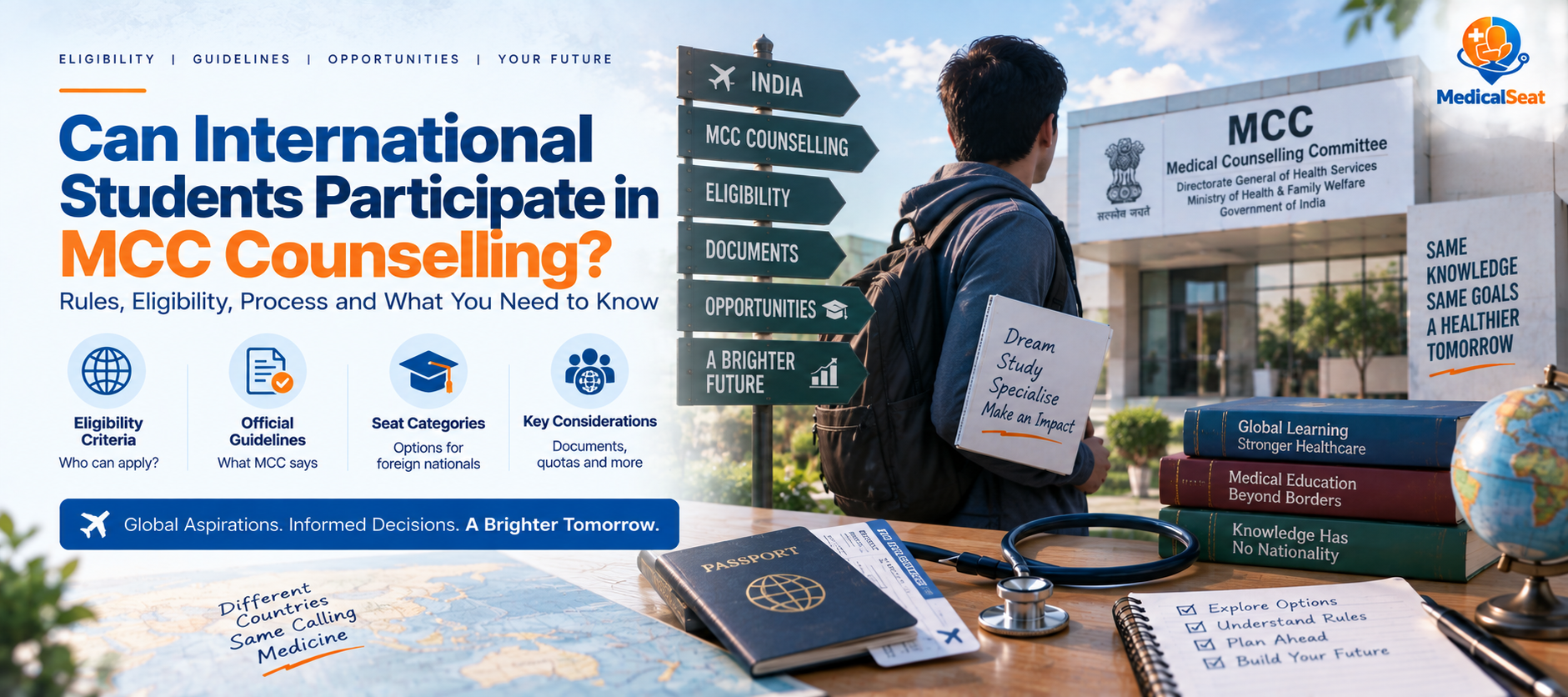
Can International Students Participate in MCC Counselling?
Yes, international students can participate in MCC counselling — but "international student" isn't one single eligibility category, and the rules differ sharply depending on whether you're an OCI cardholder, an NRI-sponsored candidate, or a foreign national with no Indian citizenship connection at all. Getting this distinction wrong is one of the most common and most costly mistakes families make during NEET UG counselling.
Introduction
Yes, international students can participate in MCC counselling — but "international student" isn't one single eligibility category, and the rules differ sharply depending on whether you're an OCI cardholder, an NRI-sponsored candidate, or a foreign national with no Indian citizenship connection at all. Getting this distinction wrong is one of the most common and most costly mistakes families make during NEET UG counselling.
This guide breaks down exactly who qualifies for what, what MCC requires procedurally in 2026, and which doors stay closed even for legitimately eligible international candidates.
Quick Facts Box
Category | Can Compete for UR (General) Seats? | Can Compete for NRI Quota Seats? | Sponsorship Required? |
OCI cardholder | Yes, treated at par with Indian citizens | Yes | Generally not required |
NRI (Indian citizen residing abroad) | Yes | Yes | Yes, from a specified relation |
Foreign national (non-OCI) | No | Yes | Yes, from a specified relation |
PIO cardholder | N/A — merged into OCI category in 2026 | N/A | N/A |
The Short Answer
International students absolutely can join MCC counselling for MBBS/BDS admission in India — provided they qualify NEET UG first. What changes based on their specific status (OCI, NRI, or foreign national) is which seats they're allowed to compete for, and what documentation they must submit before MCC will let them participate in choice filling.
Featured Snippet Answer
Can international students participate in MCC counselling for MBBS admission? Yes. NRI, OCI, and foreign national candidates can all participate in MCC counselling, but must first qualify NEET UG like any other candidate. OCI cardholders are treated at par with Indian citizens and can compete for both Unreserved (General) seats and NRI quota seats. Foreign nationals without OCI status can only compete for NRI quota seats, typically requiring sponsorship from a specified NRI relative and additional documentation verified by MCC before choice filling.
The Three Categories Explained
Comparison Table: NRI vs OCI vs Foreign National
Factor | NRI | OCI | Foreign National (Non-OCI) |
Definition | Indian citizen residing abroad | Person of Indian origin holding an OCI card | No Indian citizenship or origin connection |
Seats accessible | UR (General) + NRI quota | UR (General) + NRI quota | NRI quota only |
Sponsorship required | Yes, from a specified blood relation | Generally not required | Yes, from a specified blood relation |
Fee structure | Higher, NRI fee slab | Slightly lower than NRI slab | NRI fee slab |
Important Update: As of 2026, PIO (Person of Indian Origin) is no longer treated as a separate category for NEET or MBBS admission — the earlier PIO scheme has been merged into the OCI framework. Candidates still holding older PIO documents should confirm and update their current OCI status before registering for NEET or participating in counselling.
Do International Students Still Need to Qualify NEET?
Yes, without exception. NEET UG is mandatory for MBBS admission in India for every category of candidate — Indian, NRI, OCI, or foreign national. There is no exemption route that allows a foreign national to secure an MBBS seat in India without a qualifying NEET score. Beyond NEET, candidates must also meet standard academic eligibility: turning 17 by December 31 of the admission year, completing Physics, Chemistry, Biology/Biotechnology, and English through a recognized Class 12 or equivalent qualification, and meeting applicable minimum marks and practical requirements.
Did You Know? Qualifying NEET does not by itself guarantee an NRI quota seat. It only makes the candidate eligible to enter the admission process — actual seat allotment still depends on rank, approved NRI status, sponsorship documentation, and seat availability in the specific category.
What OCI Candidates Can Access
Following Supreme Court directives, OCI cardholders are treated at par with Indian citizens for admission purposes. This means an eligible, verified OCI candidate can compete for:
UR (Unreserved/General) seats through MCC counselling, on the same merit basis as Indian citizen candidates
NRI quota seats, as an additional option
Expert Tip: Because OCI candidates can access both pools, it's often strategically advantageous to register interest in NRI quota seats even if you expect to compete well on UR merit — this keeps both options open during choice filling rather than narrowing your possibilities upfront.
What Foreign Nationals (Non-OCI) Can Access
Candidates with foreign citizenship and no OCI status are restricted to NRI quota seats only. Historical MCC information bulletins have consistently stated that OCI, PIO (now merged into OCI), and foreign national candidates are eligible only for NRI seats — they cannot compete for UR/General category seats reserved for Indian citizens and OCI cardholders.
Comparison Table: Access Restrictions by Status
Seat Type | OCI Eligible? | Foreign National (Non-OCI) Eligible? |
UR/General AIQ seats | Yes | No |
NRI quota seats (Deemed/private institutions) | Yes | Yes |
State Quota government seats | Generally no (domicile-based) | No |
The NRI Sponsorship Requirement
This is where many international applications stall. To claim NRI category benefits, a candidate typically needs sponsorship from a specific NRI relative — commonly a parent, grandparent (paternal or maternal), an uncle or aunt (sibling of the candidate's parent), or in some interpretations, a first cousin. This isn't a formality; MCC requires documented proof of both the sponsor's NRI status and the exact family relationship, following Supreme Court guidance from cases including P.A. Inamdar vs. State of Maharashtra, Anshul Tomar, and the CODEUNIK judgment.
Checklist: Sponsorship Documentation
Sponsor's passport and visa showing current NRI/overseas residency status
Documented proof of the specific blood relationship between sponsor and candidate
Notarized affidavit from the sponsor confirming they will fund the candidate's entire course fee
Embassy or Consulate certificate confirming the sponsor's status
Candidate's NEET UG scorecard
Important Update: For local guardian-based NRI claims — where the candidate resides in India but is financially supported by an NRI relative — documentation requirements are stricter still, often requiring proof that the sponsor has genuinely acted as the candidate's bona fide guardian, not just a distant financial contributor.
MCC's 2026 Document Verification Process
For NEET UG 2026 counselling, MCC has implemented a specific procedural requirement: NRI and OCI candidates must answer "yes" to the question "Whether you want to apply for NRI Quota seats" during registration, then get their credentials verified by MCC's dedicated NRI Document Verification Team.
Checklist: MCC's 2026 NRI/OCI Process
Answer "yes" to the NRI quota question during MCC registration
Submit all required documents to the NRI Document Verification Team
Wait for successful scrutiny and eligibility confirmation
Only after confirmed eligibility can the candidate view NRI seats and Indian UR seats (if OCI) during choice filling
Common Mistakes to Avoid:
Delaying document submission, assuming verification can happen quickly close to the choice-filling deadline — MCC has explicitly warned this creates real risk of missing the choice-filling window entirely.
Not selecting "yes" on the NRI quota question during registration, which can block access to NRI seat options later.
Submitting incomplete sponsorship documentation, assuming a valid OCI/NRI card alone is sufficient.
Required Documents Checklist
Checklist: Standard Document Set for NRI/OCI Candidates
Valid OCI card (for OCI candidates) or proof of NRI status (for NRI candidates)
NEET UG scorecard
Class 10 and Class 12 mark sheets
Foreign education equivalence certificate from the Association of Indian Universities (AIU), if educated abroad
Certificate from the concerned Indian Diplomatic Mission in the country of residence (required per the NEET UG 2026 bulletin for NRI/OCI applicants)
Sponsorship documentation (for NRI and foreign national candidates specifically — see checklist above)
State-Level Variations Worth Knowing
NRI admission rules aren't fully uniform across India — individual states and even specific government colleges can impose additional conditions:
Comparison Table: Examples of State-Specific NRI Rules
State/Institution | Additional Requirement |
Government Medical College, Chandigarh | Only candidates who studied abroad for at least 3 years and applied under the NRI category in NEET are eligible |
Punjab (government & private colleges) | The candidate or their guardian must be an actual NRI — stricter than some states' broader family-sponsorship allowances |
Pro Tip: Never assume your NRI eligibility status is portable across every state or institution. Check the specific college's or state counselling authority's current bulletin, since additional residency or study-history conditions can apply on top of the central MCC framework.
What International Students Cannot Do
Cannot access State Quota government seats — these are domicile-based and reserved for Indian residents of that specific state.
Foreign nationals without OCI cannot compete for UR/General AIQ seats — only NRI quota seats are available to them.
Cannot bypass NEET UG — there is no alternate admission route into an Indian MBBS/BDS program without a qualifying NEET score.
Cannot claim NRI benefits without proper sponsorship documentation, even if the candidate personally holds NRI or OCI status through a parent.
Cannot assume NRI quota guarantees a seat — it only grants eligibility to compete within that specific, limited pool of seats.
Common Mistakes International Applicants Make
Confusing OCI and foreign national status, and assuming both groups have identical access to UR seats.
Assuming PIO is still a valid separate category — it has been merged into OCI as of 2026.
Underestimating sponsorship documentation requirements, particularly the need for a notarized affidavit and proof of specific blood relationship.
Missing state-specific residency conditions, such as Chandigarh's 3-year study-abroad requirement.
Registering late for MCC's NRI Document Verification process, risking exclusion from choice filling due to incomplete verification timing.
Pre-Counselling Checklist for International Students
Confirm your exact status: NRI, OCI, or foreign national (non-OCI)
Qualify NEET UG — no exceptions apply, regardless of citizenship status
Gather all required documents well before registration opens, including AIU equivalence certificate if applicable
Identify your specific sponsor (if NRI/foreign national) and confirm they meet the required relationship criteria
Answer "yes" to the NRI quota question during MCC registration
Submit documents to MCC's NRI Document Verification Team as early as possible
Check for any additional state- or institution-specific requirements relevant to your target colleges
Key Takeaways
International students can participate in MCC counselling, but eligibility and seat access depend heavily on specific status: OCI, NRI, or foreign national.
NEET UG is mandatory for all categories — there's no exemption for foreign nationals or NRI/OCI candidates.
OCI cardholders are treated at par with Indian citizens, gaining access to both UR/General and NRI quota seats; foreign nationals without OCI status can only access NRI quota seats.
NRI sponsorship documentation is rigorous — a valid relationship, notarized affidavit, and embassy certification are typically all required, not just proof of the sponsor's NRI status alone.
MCC's 2026 process requires early document verification through its dedicated NRI Document Verification Team, and delays risk missing the choice-filling window entirely.
People Also Ask
What is the difference between NRI and OCI for NEET UG admission?
Can OCI candidates apply for general category MBBS seats in India?
Who can sponsor an NRI quota candidate in NEET counselling?
Is PIO still a separate category for MBBS admission in 2026?
Do foreign nationals need to qualify NEET UG for MBBS in India?
Conclusion
International students absolutely have a real, legitimate path into Indian MBBS and BDS programs through MCC counselling — but that path looks different depending on whether you're an OCI cardholder, an NRI-sponsored candidate, or a foreign national with no Indian citizenship connection. The single biggest determinant of success isn't rank or documentation quality in isolation — it's understanding exactly which category you fall into, and completing MCC's verification process early enough that a procedural delay doesn't cost you a seat you were genuinely eligible for.
Compare NRI quota seat availability, sponsorship documentation requirements, and college-specific eligibility rules on MedicalSeat to plan your international NEET UG application with confidence.