
 Neet Rank Predictor
 NEET UG Predictor
 MDS Predictor
 INI CET Predictor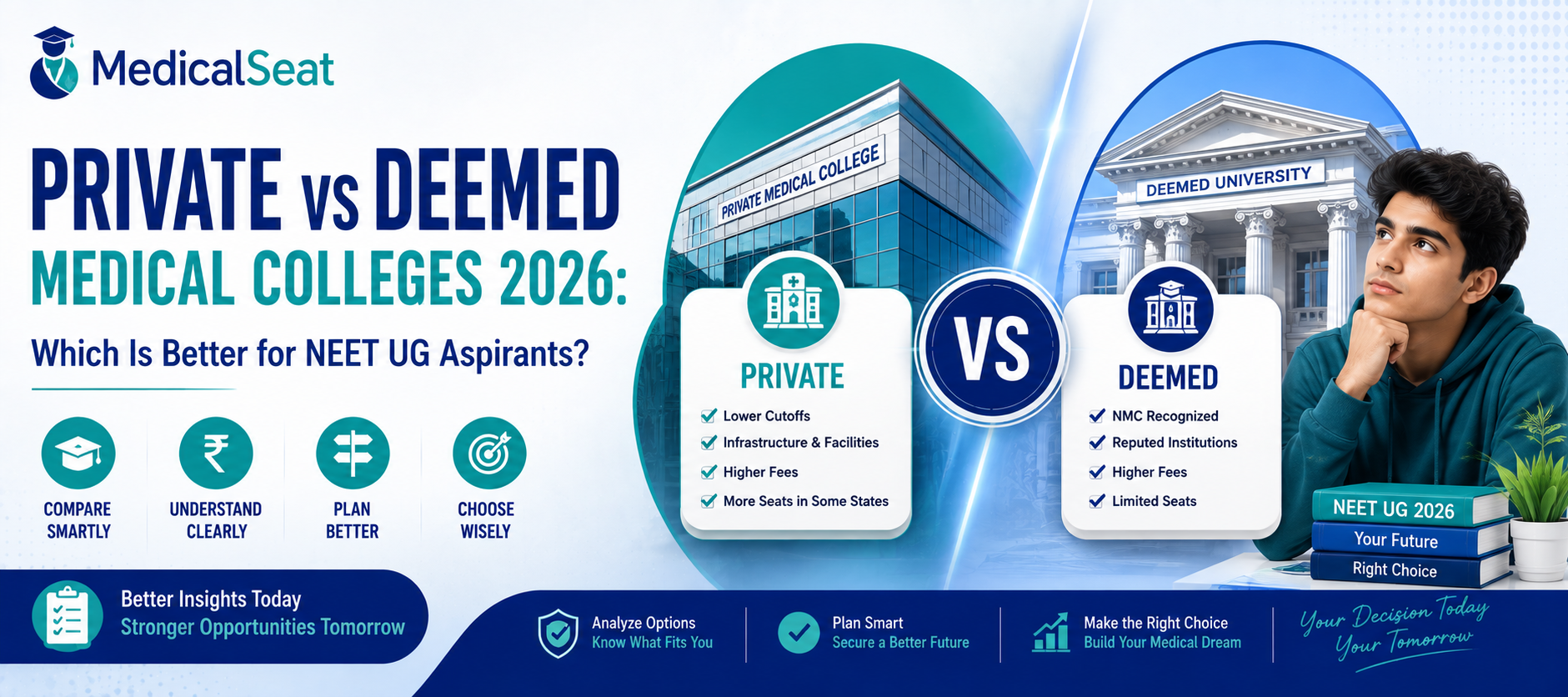
Private vs Deemed Medical Colleges 2026: Which Is Better for NEET UG Aspirants?
Confused between private and deemed medical colleges in 2026? Compare fees, NMC rules, counselling, and career scope before you fill NEET UG choices.
Private vs Deemed Medical Colleges 2026: Which Is Better for NEET UG Aspirants?
Private medical colleges are approved by the state government and NMC, participate in state quota counselling, and follow state-fixed or NMC-linked fees for a portion of seats.
Deemed universities are autonomous institutions recognised under the UGC Act, admit students only through All India Quota-pattern central counselling by MCC, and generally charge higher, institution-set fees.
Deemed universities have no state quota reservation, which can help outstation candidates, but their overall MBBS cost is usually higher than private colleges.
Both categories admit students strictly through NEET UG, and choosing between them depends on your NEET rank, budget, and home state.
With 2026 counselling season underway, verifying a college's recognition status on the NMC and MCC websites before filling choices is non-negotiable.
Introduction
Every year, lakhs of NEET UG qualifiers reach the same fork in the road: a private medical college seat within reach, or a deemed university seat that seems more "prestigious" but costs more. The confusion is genuine, because both categories look similar on paper — both are self-financed, both charge tuition well above government college fees, and both admit through NEET UG.
But the similarities end there. Private vs deemed medical colleges differ sharply in how they are governed, how seats are allotted, what the fee structure actually means for your family's budget, and how counselling rounds work. Getting this wrong at the choice-filling stage can mean paying lakhs more than necessary, or missing a seat you were actually eligible for.
This guide breaks down the real differences — recognition, counselling process, fee regulation, quota structure, top colleges, and career outcomes — so you can make an informed decision during NEET UG 2026 counselling.
Quick Answer: Private vs Deemed Medical Colleges
Private medical colleges are affiliated to a state university, regulated by the state government's fee committee, and fill 85% of seats through state quota counselling and 15% through All India Quota (AIQ). Deemed universities, on the other hand, are self-governing institutions under the UGC Act, 1956, with no state quota — 100% of their seats go through central counselling by MCC, and fees are typically higher since state fee-fixation committees generally do not control them the same way.
Table of Contents
What Are Private Medical Colleges?
What Are Deemed Medical Colleges?
Private vs Deemed Medical Colleges: Key Differences
Eligibility Criteria for NEET UG 2026
Admission Process
NEET UG 2026 Exam Pattern and Latest Updates
Fee Structure Comparison
Counselling Process: State Quota vs Central Counselling
Documents Required
Important Dates for NEET UG 2026 Counselling
Top Private Medical Colleges in India
Top Deemed Medical Universities in India
Pros and Cons
Career Scope and Salary After MBBS
Common Mistakes Aspirants Make
Expert Tips for Choice Filling
Checklist Before Choice Filling
Timeline: From NEET Result to Admission
Conclusion
FAQs
What Are Private Medical Colleges?
Private medical colleges are self-financed institutions established by trusts, societies, or private managements, but they operate under the affiliation of a state university and require approval from the National Medical Commission (NMC).
Key characteristics
Affiliated to a state or central university for degree conferral.
Governed by the respective State Fee Regulatory Authority/Committee for tuition fixation.
85% seats generally go under State Quota, filled by the state counselling authority.
15% seats go under All India Quota, filled by the Medical Counselling Committee (MCC).
Some seats are reserved as NRI/management quota, subject to state rules.
Recognition authority
According to NMC norms, every private medical college must hold valid recognition before admitting students under NEET UG. Aspirants should always cross-check a college's status on the official NMC website before considering it during choice filling.
What Are Deemed Medical Colleges?
A deemed university is an institution granted "deemed-to-be-university" status by the University Grants Commission (UGC) under Section 3 of the UGC Act, 1956, on the recommendation of the Ministry of Education. This status allows the institution to design its own curriculum, set its own fee structure (within NMC's overarching guidelines), and award its own degrees without affiliating to a state university.
Key characteristics
Autonomous body — not affiliated to any state university.
100% of MBBS seats are filled through central counselling conducted by MCC, following an All India Quota-like pattern.
No state quota reservation — any NEET-qualified candidate from any state can apply.
Fee is fixed by the institution, subject to NMC's fee-guideline framework rather than a state fee committee.
Degrees are recognised by NMC, similar to any other MBBS degree, provided the university is officially recognised.
Private vs Deemed Medical Colleges: Key Differences
Parameter | Private Medical College | Deemed Medical University |
Governing Authority | State Fee Regulatory Committee + NMC | UGC + NMC |
Affiliation | Affiliated to a state university | Autonomous, self-affiliating |
Counselling Body | State counselling authority (85%) + MCC (15% AIQ) | 100% through MCC-conducted central counselling |
Quota Structure | State Quota, AIQ, Management/NRI quota | No state quota; all-India merit-based |
Fee Fixation | Regulated by state fee committee | Set by institution under NMC's fee guideline framework |
Domicile Requirement | Often required for state quota | Not required |
Typical MBBS Fee Range | ₹4 lakh – ₹25 lakh per annum (varies by state) | ₹15 lakh – ₹28 lakh+ per annum |
Scholarship/Subsidy | More common under state schemes | Limited, institution-specific |
Counselling Rounds | State rounds + AIQ rounds run separately | Single centralised round structure via MCC |
Fee ranges are indicative and vary by college, state, and academic year. Always verify current fees on the official college website or the NMC fee disclosure portal.
Eligibility Criteria for NEET UG 2026
Both private and deemed medical colleges follow the same NEET UG eligibility framework set by the NTA and NMC:
Candidate must have passed Class 12 with Physics, Chemistry, Biology/Biotechnology, and English as core subjects.
Minimum qualifying percentile: 50th percentile for General category, 40th percentile for SC/ST/OBC, and 45th percentile for General-PwBD (percentiles are notified each year separately by NTA).
Minimum age of 17 years as of December 31 of the admission year.
Must have a valid NEET UG 2026 scorecard with a qualifying rank.
For deemed universities: no domicile restriction — candidates from any state are eligible.
For state quota seats in private colleges: a domicile certificate of the respective state is usually mandatory.
Admission Process
The admission route into either category is identical at the entry point — NEET UG is compulsory, with no direct or management-quota bypass permitted under current NMC and Supreme Court rulings.
Step-by-step process
Qualify NEET UG 2026 by scoring at or above the qualifying percentile.
Register for MCC counselling for AIQ seats (private colleges) or central counselling (deemed universities).
Register separately for state counselling if targeting state quota seats in a private college.
Fill and lock choices based on your rank, preferred colleges, and category.
Seat allotment is released after each round based on rank, category, and choice order.
Report to the allotted college within the stipulated window with original documents for verification.
Pay the admission fee and complete document verification to confirm the seat.
Participate in subsequent rounds (Round 2, Mop-Up, Stray Vacancy) if upgrading or if a seat remains unfilled.
NEET UG 2026 Exam Pattern and Latest Updates
NEET UG 2026 was originally scheduled for May 3, 2026, but the NTA cancelled the exam following paper-leak allegations and conducted a re-examination on June 21, 2026. The NTA declared results on July 16, 2026, with roughly 11.21 lakh candidates qualifying out of the total candidates who appeared.
As per the seat matrix released by the NMC for the 2026 cycle, India now has approximately 1,36,939 MBBS seats, with government medical colleges offering around 63,296 seats and private medical colleges (including deemed universities) offering around 73,643 seats — a notable increase over the previous year.
Exam pattern snapshot
Parameter | Detail |
Mode | Pen-and-paper (OMR-based) |
Duration | 3 hours 20 minutes |
Subjects | Physics, Chemistry, Biology (Botany + Zoology) |
Total Questions | 200 (180 to be attempted) |
Marking Scheme | +4 for correct, −1 for incorrect |
Conducting Body | National Testing Agency (NTA) |
As per the latest MCC updates, the NEET UG 2026 counselling schedule had not been officially released at the time of writing and is expected in the last week of July 2026, with Round 1 registration likely opening shortly after. Aspirants should track mcc.nic.in and their respective state counselling portals for the official notification rather than relying on unofficial sources.
Fee Structure Comparison
Fee is often the single biggest factor separating private colleges from deemed universities.
Private medical colleges
Under NMC's fee guideline framework, 50% of seats in private medical colleges are meant to carry fees on par with government medical colleges in that state, while the remaining 50% are charged at a management/NRI-quota rate fixed by the state fee committee. In practice, implementation varies by state, and some states have faced delays or disputes in enforcing full parity — so it's important to check the current fee notification for your target college rather than assuming automatic parity.
Deemed universities
Deemed universities are not bound by state fee committees in the same way. Their fees are largely institution-determined, though NMC's overarching fee guideline (under Section 10(1)(i) of the NMC Act, 2019) requires transparency, audited cost disclosures, and a ban on capitation fees. In practice, deemed university MBBS fees tend to be significantly higher across the board, since there is no state-quota-equivalent discount tier.
Illustrative annual fee comparison
College Type | Approx. Annual Tuition | Total Course Cost (Approx., 4.5–5 years) |
Government Medical College | ₹10,000 – ₹1.5 lakh | ₹50,000 – ₹7 lakh |
Private College (State Quota) | ₹4 lakh – ₹8 lakh | ₹18 lakh – ₹40 lakh |
Private College (Management/NRI Quota) | ₹12 lakh – ₹25 lakh | ₹55 lakh – ₹1.1 crore |
Deemed University | ₹15 lakh – ₹28 lakh | ₹70 lakh – ₹1.3 crore |
These are broad, illustrative figures compiled from publicly available fee trends and are subject to change every academic year. Always confirm exact fees from the official college prospectus or NMC fee disclosure before counselling.
Counselling Process: State Quota vs Central Counselling
This is where most aspirants get confused, so it's worth separating clearly.
Private colleges
85% State Quota — filled by the respective state's Directorate of Medical Education (DME) or equivalent counselling authority, usually requiring domicile proof.
15% All India Quota (AIQ) — filled centrally by MCC, open to candidates from any state.
Two separate registrations may be required if you want to be considered for both.
Deemed universities
100% seats filled through central counselling conducted by MCC, following the All India Quota admission pattern.
No domicile requirement — any NEET-qualified candidate can apply regardless of home state.
Registration, choice filling, and seat allotment happen on the MCC portal (mcc.nic.in), alongside AIQ and central institute seats.
Documents Required
Keep the following ready, both as originals and self-attested photocopies, for document verification at any counselling stage:
NEET UG 2026 admit card and scorecard
Class 10 and Class 12 mark sheets and certificates
Class 12 passing certificate
Date of birth proof (Class 10 certificate is usually accepted)
Category certificate (SC/ST/OBC-NCL/EWS), if applicable
PwBD certificate, if applicable
Domicile/residence certificate (for state quota only)
Passport-size photographs (as per counselling authority specifications)
Provisional/final allotment letter
Aadhaar card or other government photo ID
Migration certificate (as applicable at admission stage)
Anti-ragging affidavit (student and parent, as per UGC format)
Important Dates for NEET UG 2026 Counselling
Event | Status/Expected Timeline |
NEET UG 2026 Original Exam | May 3, 2026 (cancelled) |
NEET UG 2026 Re-Exam | June 21, 2026 (conducted) |
NEET UG 2026 Result | July 16, 2026 (declared) |
MCC Counselling Schedule | Expected last week of July 2026 |
Round 1 Registration | Expected late July – early August 2026 |
Round 2 and Mop-Up Rounds | Expected through September–October 2026 |
State Counselling Schedules | Vary by state; announced separately |
All 2026 counselling dates beyond the result declaration are provisional and subject to official confirmation by MCC and respective state authorities. Always verify on mcc.nic.in before acting on any date.
Top Private Medical Colleges in India
Kasturba Medical College, Manipal
Christian Medical College, Vellore
St. John's Medical College, Bengaluru
Armed Forces Medical College, Pune
JSS Medical College, Mysuru
Sri Ramachandra Medical College, Chennai
Top Deemed Medical Universities in India
Sri Ramachandra Institute of Higher Education and Research, Chennai
Kasturba Medical College (Manipal Academy of Higher Education), Manipal
SRM Medical College Hospital and Research Centre, Chennai
Amrita School of Medicine, Kochi
Datta Meghe Institute of Higher Education and Research, Wardha
Saveetha Medical College, Chennai
Note: A few institutions (such as Manipal) operate multiple constituent colleges across categories, so always verify the exact admission category — private-affiliated vs deemed — for the specific campus and course you are targeting.
Pros and Cons
Private Medical Colleges
Pros
More affordable through state quota, especially with NMC's 50% fee-parity provision.
Domicile-based reservation improves odds for local candidates.
Wider geographic spread across most states.
Cons
Higher management/NRI quota fees for the remaining 50% of seats.
Cross-state candidates have limited access outside AIQ seats.
Fee implementation inconsistencies across states.
Deemed Universities
Pros
No domicile barrier — open to candidates from any state.
Often better infrastructure, hospital exposure, and research facilities.
Single centralised counselling process, reducing procedural complexity.
Cons
Significantly higher overall fees, with no state-quota-equivalent discount.
Limited scholarship or fee-waiver options compared to state quota.
Higher total cost of the course can strain family finances over 4.5–5 years.
Career Scope and Salary After MBBS
Regardless of whether you graduate from a private college or a deemed university, your MBBS degree carries equal recognition from NMC as long as the institution is properly recognised — the college category does not, by itself, determine your career ceiling.
Career pathways after MBBS
NEET PG for MD/MS specialisation
INI CET for AIIMS, JIPMER, and other institutes of national importance
NEET SS for super-specialisation after postgraduation
FMGE-equivalent recognition is not needed for Indian MBBS graduates, but relevant for those returning after MBBS abroad
Government medical officer roles via state PSC/UPSC exams
Private hospital practice, primary care, or setting up independent practice
Research, public health, and academic medicine roles
Indicative salary range (India)
Role | Approximate Annual Salary Range |
Fresh MBBS Graduate (Government) | ₹6 lakh – ₹9 lakh |
MBBS Graduate (Private Hospital) | ₹5 lakh – ₹10 lakh |
Post-MD/MS Specialist | ₹12 lakh – ₹30 lakh+ |
Super-Specialist (DM/MCh) | ₹20 lakh – ₹50 lakh+ |
Salaries vary widely by specialisation, city, sector, and experience; figures above are broad market indicators, not guarantees.
Common Mistakes Aspirants Make
Assuming deemed universities are always "better" without comparing actual fee and ROI.
Not verifying NMC recognition status of a college before filling it as a choice.
Ignoring domicile requirements and losing a state quota seat due to incomplete documentation.
Filling choices only based on college "brand name" rather than rank-realistic options.
Missing the reporting deadline after seat allotment, resulting in seat cancellation.
Not registering for both AIQ and state counselling when eligible for both.
Overlooking hidden costs — hostel, mess, university/library fees beyond tuition.
Trusting unofficial counselling date announcements instead of the official MCC/state portals.
Expert Tips for Choice Filling
Rank your choices by a realistic combination of rank, budget, and location — not by reputation alone.
Fill a wide range of choices, including a few "safe" options, to avoid an empty allotment.
Cross-check every college's NMC recognition and current academic year approval before locking choices.
Compare the effective 5-year cost, not just the annual tuition, especially for deemed universities.
Keep a document checklist ready in advance — verification windows are short.
If eligible for both state quota and AIQ, register for both to maximise your options.
Track official state medical counselling websites in parallel with MCC, since timelines rarely align exactly.
Checklist Before Choice Filling
NEET UG 2026 scorecard downloaded and rank noted
MCC registration completed
State counselling registration completed (if applicable)
Category and domicile certificates ready
Shortlist of private colleges (state quota-eligible) prepared
Shortlist of deemed universities prepared
Fee comparison sheet for shortlisted colleges ready
Budget discussion completed with family
Document folder (originals + photocopies) organised
Bank arrangements for admission fee/security deposit in place
Timeline: From NEET Result to Admission
Result Declaration — NTA publishes NEET UG scorecard.
Counselling Registration — Candidates register on MCC and/or state portals.
Choice Filling and Locking — Preferences submitted in order of priority.
Seat Allotment (Round 1) — Based on rank, category, and choice order.
Reporting and Verification — Candidate reports to allotted college with documents.
Fee Payment and Admission Confirmation — Seat is secured.
Round 2 / Upgrade — Candidates may upgrade if a better option opens up.
Mop-Up and Stray Vacancy Rounds — Remaining seats filled for candidates still unallotted.
Academic Session Commencement — Classes begin as per NMC's academic calendar.
Conclusion
The private vs deemed medical colleges decision ultimately comes down to three factors: your NEET UG rank, your family's budget, and whether you qualify for state quota benefits. Private colleges offer a more affordable route through state quota, especially with NMC's fee-parity provision, but come with domicile restrictions. Deemed universities remove the domicile barrier and often offer stronger infrastructure, but at a meaningfully higher total cost.
Neither option is universally "better" — the right choice depends on matching your specific rank and financial situation to the realistic seats available to you. Whatever you choose, always verify a college's current NMC recognition, confirm counselling authority (state vs MCC), and calculate the full five-year cost before locking your choices.
If you're finding it difficult to compare colleges, track NMC seat matrices, or plan your NEET UG counselling strategy, MedicalSeat's counselling guidance and college comparison tools can help you make a rank-realistic, budget-aware decision instead of a rushed one.
Explore verified NEET UG college options, compare private and deemed universities side by side, and get personalised counselling support at MedicalSeat.