
 Neet Rank Predictor
 NEET UG Predictor
 MDS Predictor
 INI CET Predictor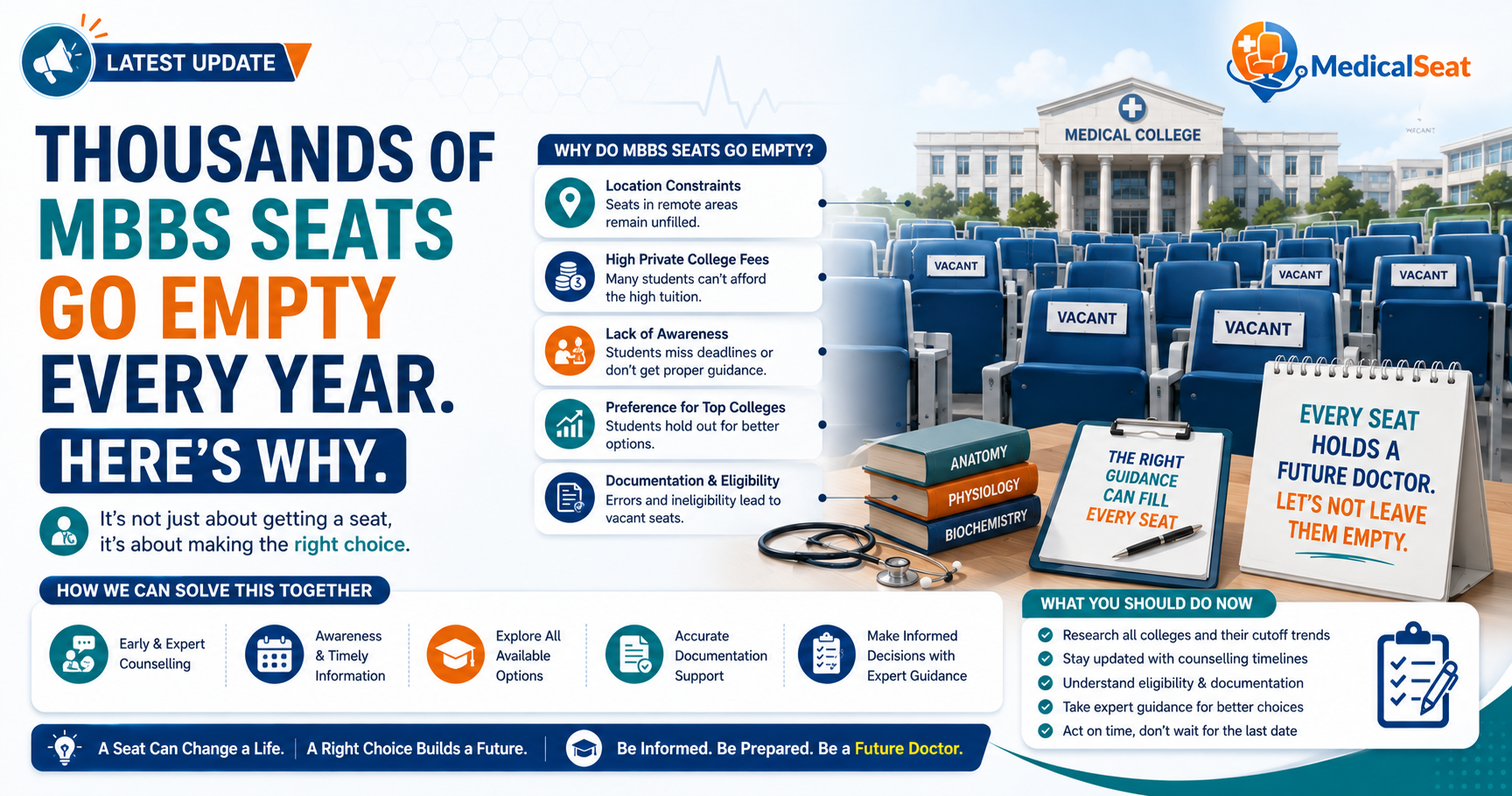
Thousands of MBBS Seats Go Empty Every Year. Here's Why.
It sounds like a contradiction: NEET UG draws over 20 lakh applicants competing for roughly 1.1 lakh MBBS seats, cutoffs climb every year, and yet, by the time the final counselling round closes, thousands of MBBS seats are still sitting empty. Government data placed before Parliament has repeatedly confirmed this — including a figure of more than 2,800 vacant undergraduate medical seats in a recent year, despite a 39% jump in total MBBS seats over the previous few years.
It sounds like a contradiction: NEET UG draws over 20 lakh applicants competing for roughly 1.1 lakh MBBS seats, cutoffs climb every year, and yet, by the time the final counselling round closes, thousands of MBBS seats are still sitting empty. Government data placed before Parliament has repeatedly confirmed this — including a figure of more than 2,800 vacant undergraduate medical seats in a recent year, despite a 39% jump in total MBBS seats over the previous few years.
This isn't a data error or a rare glitch. It's a structural pattern — and understanding why it happens can genuinely help aspirants who are still searching for a seat.
Quick Facts Box
Fact | Detail |
Vacant UG medical seats reported to Parliament (recent year) | 2,800+ |
Total MBBS seats in India (2024–25) | Approximately 1,16,000 (up from ~83,000 in 2020–21) |
Where vacancies concentrate most | Private/deemed colleges, NRI quota, tier-3/rural institutions |
States commonly reporting high vacancies | Maharashtra, Tamil Nadu, Uttar Pradesh, Rajasthan, Punjab, Northeast states |
Final chance to claim a vacant seat | Stray Vacancy Round |
Featured Snippet Answer
Why do thousands of MBBS seats go vacant every year in India despite intense competition? MBBS seats go vacant mainly because of unaffordable private college fees that deter even NEET-qualified candidates, a complex multi-round counselling process that causes last-minute withdrawals, uneven distribution of colleges across states, chronic under-filling of NRI quota seats, and limited candidate awareness of stray vacancy and mop-up rounds where many of these seats eventually surface.
How Big Is the Problem, Really?
This isn't a fringe issue. In one recent stray vacancy round alone, MCC reported over 1,600 vacant MBBS seats nationally under AIQ and central institutions combined, with the North East, East, and Central regions of India most affected. In a separate cycle, the final AIQ stray vacancy seat matrix showed Maharashtra, Tamil Nadu, and Uttar Pradesh carrying the highest numbers of vacant MBBS seats — states that also have some of the largest total seat counts, illustrating that raw seat volume itself contributes to the vacancy pattern.
Did You Know? Even AIIMS and other central institutions have reported unfilled seats in past cycles — proof that this isn't purely a "low-quality private college" problem, but a systemic one touching multiple seat categories, including a portion of NRI quota seats specifically.
Reason 1: Private College Fees Price Out Qualified Candidates
This is consistently cited as the single biggest driver. Private and deemed MBBS programs can cost anywhere from roughly ₹10–25 lakh annually at some institutions, and total program costs at the higher end can run into ₹50 lakh to over ₹1 crore across the full course. For many NEET-qualified families, this simply isn't financeable — even when the candidate has genuinely earned admission through merit or category eligibility.
Comparison Table: Why Fees Cause Vacancies
Scenario | Outcome |
|---|---|
Candidate qualifies but can't arrange fees before deadline | Seat is withdrawn or forfeited, becomes vacant |
Candidate takes a loan but backs out after realizing total cost | Seat opens up again mid-cycle |
Candidate accepts a private seat as backup, then gets a government upgrade | Original private seat becomes vacant |
Expert Tip: If cost is a concern, always calculate the total program cost (tuition, hostel, mess, and any bond/service obligations) before accepting an offer — sticker-shock withdrawals mid-cycle are one of the most common causes of last-minute vacancies.
Reason 2: A Bureaucratic, Multi-Round Counselling Process
India's MBBS admission process runs across multiple sequential rounds — AIQ, State Quota, mop-up, and stray vacancy — each with its own registration, choice-filling, and reporting deadlines. Medical practitioners and policy commentators have repeatedly pointed to this complexity as a driver of avoidable vacancies: candidates lock seats early out of fear of missing out, then withdraw at the last moment upon getting a better offer elsewhere, and inconsistent communication from some private colleges about fees, facilities, and bond conditions pushes other candidates to simply opt out rather than risk an uninformed decision.
Important Update: Because these withdrawals often happen close to reporting deadlines, many resulting vacancies aren't visible until later rounds — which is exactly why serious "vacant seat" figures tend to peak at the mop-up and stray vacancy stage rather than in Round 1.
Reason 3: Regional Imbalance in College Distribution
Medical colleges are not evenly spread across India. States like Tamil Nadu, Karnataka, and Maharashtra host a large share of the country's total capacity, while other regions — particularly parts of the Northeast, East, and Central India — have far fewer seats relative to demand. This mismatch means that even as national seat capacity has grown sharply, certain regions and specific institutions (especially newer or less-established colleges) can struggle to attract enough interested, financially capable candidates.
Did You Know? States such as Rajasthan, Punjab, Himachal Pradesh, and Uttarakhand are frequently flagged in vacancy data — often driven by a mix of high private/NRI quota fees and comparatively lower demand for seats in some of their less-urban colleges.
Reason 4: NRI Quota Seats Are Chronically Hard to Fill
NRI quota seats — typically the most expensive category, aimed at students with NRI sponsorship — are disproportionately represented in vacancy figures year after year. Genuine, eligible NRI-sponsored candidates are a much smaller pool than the number of NRI quota seats available, and eligibility documentation requirements add another layer of friction.
Checklist: Why NRI Quota Seats Often Go Vacant
High fee structure limits the eligible candidate pool
Strict sponsorship and eligibility documentation requirements
Some candidates who qualify choose to study abroad directly instead
Limited awareness among eligible candidates about deadlines and processes
Reason 5: New Colleges With Recognition or Infrastructure Issues
India's rapid MBBS seat expansion — roughly a 35%+ increase in total seats over a few years — has included many newly established colleges. Some of these face genuine growing pains: incomplete infrastructure, insufficient experienced faculty, or pending National Medical Commission (NMC) recognition or accreditation issues, sometimes tied up in court cases or delayed approvals. Understandably, candidates are often reluctant to commit to a seat at an institution with an uncertain recognition status, even if the seat itself is technically available.
Common Mistakes to Avoid:
Accepting a seat at a college without verifying its current NMC recognition status.
Assuming a college is fully accredited just because it appears in the counselling seat matrix.
Ignoring publicly available information about ongoing infrastructure or faculty shortfalls at a specific institution.
Reason 6: Awareness Gaps Around Stray Vacancy Rounds
A significant number of vacant seats are never claimed simply because eligible candidates don't know these later rounds exist, or assume (incorrectly) that only "leftover, undesirable" seats are available by that stage. In reality, stray vacancy and mop-up rounds can include seats at reputed government and private institutions that opened up due to withdrawals, upgrades, or late-stage NRI quota conversions.
Pro Tip: Never assume the counselling process is "over" after Round 1 or Round 2 disappoints you. Registering for mop-up and stray vacancy rounds costs little effort and has repeatedly resulted in candidates securing seats they initially thought were out of reach.
Which States See the Most Vacant Seats?
Comparison Table: States Frequently Reporting High MBBS Vacancies
State/Region | Commonly Cited Driver |
Maharashtra, Tamil Nadu, Uttar Pradesh | High total seat volume; some vacancies are a scale effect |
Rajasthan | High private/NRI quota fees despite demand |
Punjab | Government NRI seats often unfilled after early rounds |
Himachal Pradesh, Uttarakhand | Less-urban colleges struggle to attract candidates |
Northeast states | Lower overall seat density and regional demand-supply mismatch |
Important Update: These patterns can shift year to year based on fee revisions, new college openings, and counselling reforms, so always check the current year's official stray vacancy seat matrix rather than relying on historical patterns alone.
What This Means If You're Still Looking for a Seat
If you haven't secured a seat through the main counselling rounds, the vacancy pattern above is genuinely useful information, not just a statistic:
Stray vacancy rounds are real opportunities, not a last-resort dumping ground — some genuinely reputable seats surface here.
NRI quota conversions sometimes open general-category-eligible seats later in the process, depending on specific state and institutional rules.
Newer colleges may offer seats at lower initial competition — but always verify recognition status before accepting.
Regional flexibility helps — being open to a college outside your immediate preference zone significantly increases your chances of claiming a vacant seat.
Common Mistakes Candidates Make With Vacant Seats
Giving up after Round 2 without registering for mop-up or stray vacancy rounds.
Accepting any available seat without checking NMC recognition status, risking future licensing complications.
Not budgeting realistically before accepting a private seat, leading to a personal withdrawal that then re-creates a vacancy for someone else.
Ignoring NRI-to-general conversion possibilities in later rounds due to unfamiliarity with the process.
Assuming "vacant" means "bad" — many vacant seats result from financial or logistical withdrawal, not institutional quality issues.
Checklist: Evaluating a Stray Vacancy Seat
Confirm the college's current NMC recognition status
Verify the actual, currently notified fee structure for that specific seat/quota
Check whether any service bond or rural posting obligation applies
Research hospital patient load, infrastructure, and faculty strength
Confirm the exact reporting deadline for that specific round
Keep all required original documents ready, since stray rounds often have compressed timelines
Key Takeaways
Vacant MBBS seats are a real, recurring, government-documented issue — not a myth or rare exception.
Unaffordable private college fees remain the single most cited driver of vacancies.
A complex, multi-round counselling process contributes to late-stage withdrawals that create fresh vacancies.
NRI quota seats, newer colleges, and less-urban regions are disproportionately affected.
Stray vacancy and mop-up rounds are genuine opportunities for aspirants still searching for a seat — always register rather than assuming the process has ended.
People Also Ask
Why do private MBBS seats remain vacant despite high demand?
What happens to unfilled MBBS seats after the last counselling round?
Which states have the most vacant MBBS seats in India?
Can NEET-qualified students get a vacant government MBBS seat?
Is it safe to take admission through a stray vacancy round?
Conclusion
The paradox of empty MBBS seats amid record NEET competition isn't really a mystery once you look at the data — it's the predictable result of steep private college fees, a multi-stage counselling process prone to late withdrawals, uneven regional college distribution, and limited awareness of later counselling rounds. For aspirants still searching for a seat, this pattern is actually good news: it means genuine opportunities keep surfacing well past Round 1, provided you stay engaged with the process, verify recognition status carefully, and don't assume the race is over too early.
Track live vacant seat matrices, verify college NMC recognition status, and compare stray vacancy options on MedicalSeat so you don't miss a genuinely available seat.