
 Neet Rank Predictor
 NEET UG Predictor
 MDS Predictor
 INI CET Predictor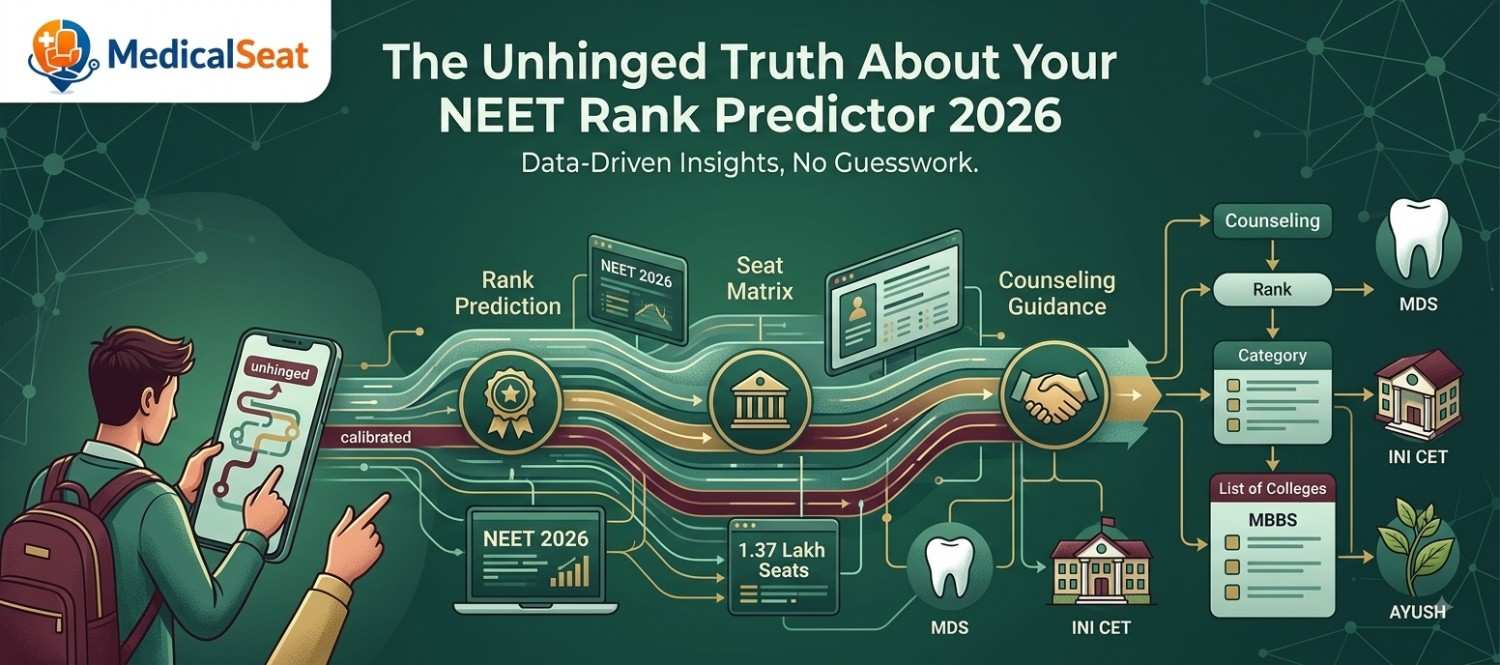
The Unhinged Truth About Your NEET Rank Predictor 2026 That Nobody In Your WhatsApp Group Will Tell You
Guessing your NEET rank and college is the biggest mistake aspirants make every year. Here is how a properly calibrated NEET Rank Predictor 2026 and NEET College Predictor actually work, what the real MBBS seat numbers look like across India, and how to build a counseling shortlist that will not blow up in choice filling.
Every result season, the same scene repeats itself in lakhs of homes across the country. A phone screen lights up, a scorecard opens, and within seconds an entire family has already "decided" which college their child is getting into, based on nothing but a rumor from a neighbor's cousin who "knows someone in counseling." This is, without exaggeration, the biggest lie students hear about NEET Counseling every single year: that you can guess your way into a medical seat. You cannot. Not this year, not with the re NEET 2026 pattern, and definitely not with a rank inflation story as messy as this one.
If you are reading this in the days around the re neet result 2026, you are standing in the most chaotic, highest stakes 72 hour window of your academic life. This piece exists to cut through the noise. We are going to talk, in painfully specific detail, about how a real NEET Rank Predictor 2026 works, why a proper NEET College Predictor is not optional anymore, what the actual total number of MBBS seats in India looks like this year, how NEET Counseling 2026 and NEET UG/PG Counseling 2026 are structured, what MBBS fees in India really cost across government, deemed and private institutions, and why states like Bihar, Tamil Nadu, Jharkhand and Maharashtra deserve their own separate strategy entirely.
The "Biggest Lie" Explained: Why Guessing Kills Your Counseling Chances
Here is the lie in plain words: "Just wait for the result, then figure it out." Students who wait to "figure it out" after the re neet result 2026 date is announced are the ones who end up filling random choices at 2 a.m. on the last day of registration, locking themselves into colleges they never researched, with fee structures they never checked.
The truth is that NEET rank vs college mapping needs to be understood before you even open the choice filling form. A candidate scoring 550 in a normal year and a candidate scoring 550 in a re NEET 2026 re exam year are not guaranteed the same NEET closing ranks, because the exam pattern, difficulty curve and re test dynamics change the percentile distribution completely. This is precisely why tools calibrated for this year's pattern matter so much more than a generic spreadsheet someone shared in a Telegram group two years ago.
If you have not yet checked how registration, appearance and qualification numbers moved this cycle, this breakdown of NEET UG 2026 result statistics, registrations, appearances and qualifiers is worth a slow read before you touch any predictor tool.
What A Real NEET Rank Predictor 2026 Actually Does
A NEET Rank Predictor is not a magic ball. It is a statistical model that takes your marks, your category, your home state and the difficulty level of this year's paper, then compares it against historical NEET closing ranks, this year's expected qualifying percentile, and seat availability trends. A serious NEET UG 2026 Rank Predictor should be able to answer, at minimum, three questions for you.
First, what is your probable All India Rank. Second, what is your probable category rank, whether General, OBC, SC, ST or EWS. Third, and most important, what does that rank actually translate to in terms of a realistic medical college predictor India shortlist, not a fantasy list of AIIMS Delhi for every single score band.
This is where most free tools genuinely fall apart. They are built once and never recalibrated, so they keep spitting out pre pandemic closing ranks even in a year when the exam pattern, seat matrix and re exam mechanics have all shifted. A calibrated NEET Rank Predictor 2026 has to be rebuilt every cycle against fresh data, and the model behind the free NEET rank and college predictor for 2026 is exactly the kind of thing you want open in a second tab the moment your scorecard drops.
Why "650 Marks" Does Not Mean What It Used To
One of the loudest conversations this year has been about rank inflation. A score of 650, which used to comfortably sit inside the top percentile band, is now landing candidates in a completely different rank zone because more students crossed that mark this cycle than in previous years. If your friend group is arguing about whether 650 is "safe," stop guessing and read the actual data behind this year's NEET UG 2026 rank inflation around the 650 score band so you know exactly where you stand before choice filling opens.
From Rank To Reality: Why You Need A NEET College Predictor, Not Just A Rank Number
Knowing your rank without knowing what it buys you is like knowing your bank balance without knowing prices. This is the entire point of a NEET College Predictor. A good medical college predictor India tool takes your predicted rank, cross references it against NEET closing ranks from the last two to three admission cycles, filters by your home state quota, All India Quota eligibility, category reservation and even the type of course, whether MBBS, BDS, MDS, INI CET or AYUSH, and returns a realistic band of colleges you can actually target.
This is the single biggest gap between students who get a seat aligned with their goals and students who end up regretting a choice made in panic. If you want to see how a rank number of 5,000 or thereabouts maps to actual seats, this state and category wise breakdown of NEET rank versus colleges around the 5,000 rank mark is a genuinely useful reality check, and you can run your own exact numbers through the main NEET rank and college predictor tool in under two minutes.
It Is Not Just MBBS Anymore
A huge mistake students make is treating NEET Counseling as a single track process. It is not. If your goal includes postgraduate dental seats, you need a dedicated MDS predictor that accounts for a completely different seat matrix and competition pool. If you are eyeing the Institutes of National Importance, the INI CET predictor uses a separate scoring and merit logic entirely. Lumping all of this into one generic "NEET predictor" search is how students waste their most valuable resource this season, time.
Total Medical Seats In India: The Numbers Nobody Explains Clearly
Let us talk numbers, because most articles either skip this or bury it in jargon. As per the most recent National Medical Commission seat matrix released for the 2026 27 academic session, India's total number of medical seats in India for MBBS has been revised upward to close to 1.37 lakh, up from roughly 1.18 lakh in the previous cycle, following a fresh round of seat approvals across the country. These numbers do shift as colleges submit final compliance documents, so always cross check against the official notification before you finalize choices.
Breaking this down further, the total number of government medical seats in India sits at roughly 63,000 to 64,000 seats spread across more than 450 government medical colleges, including AIIMS and other central institutions. The total number of private medical seats in India makes up the remaining chunk, now estimated at anywhere between 65,000 and 74,000 seats depending on how deemed universities are counted, spread across roughly 350 to 370 private and deemed institutions.
This matters enormously for your NEET rank vs college planning because government seats are dramatically more competitive per seat than private seats, but private seats come with a fee structure that can be ten to twenty times higher. Understanding this trade off before counseling starts, not during it, is what separates a calm choice filling session from a panicked one. For a state wise look at how new seats are being added this year, the list of upcoming medical colleges is worth bookmarking.
Government Versus Private Versus Deemed: What Actually Separates Them
Government & private medical colleges differ in three practical ways that every aspirant should internalize. Fees is the obvious one, government MBBS programs typically cost anywhere from a few thousand rupees to about two lakh rupees for the full course, while private and all deemed and private college seats can range from twenty lakhs to over a crore for the same five and a half year program.
Ownership and governance is the second difference. Government colleges are run by state or central governments and follow fixed fee regulations, while private and deemed universities set their own fee structures within regulatory caps, which is why fee variation across similar ranked private colleges can be enormous.
Infrastructure and hospital exposure is the third, and often underestimated, factor. Older government colleges frequently offer higher patient volume for clinical exposure, while many newer private and deemed institutions have invested heavily in modern infrastructure to compete. Neither is universally "better," which is exactly why a NEET counseling guide built on your specific rank, budget and career goals matters more than generic rankings you find online.
If budget is a genuine constraint for your family, this practical guide on medical college options within a realistic budget breaks down where MBBS is actually achievable without crossing into unsustainable debt territory.
MBBS Fees In India: The Number That Changes Everything
Talking about MBBS fees India without specifics is almost useless, so let us be direct. Government medical colleges generally charge between roughly ten thousand rupees and two lakh rupees for the entire course, varying by state. Private medical colleges typically range from twenty lakhs to sixty lakhs for the full program, while a subset of premium deemed universities can cross eighty lakhs to well over a crore, particularly for management quota seats.
This is precisely why understanding medical colleges in India by fee bracket, not just by rank cutoff, has become such a critical part of counseling strategy this year. A student with a rank that technically qualifies for a private seat still needs to ask whether that seat is financially realistic for their family across five and a half years, plus a mandatory internship year, plus potential postgraduate study afterward.
State Spotlight: Bihar, Tamil Nadu, Jharkhand And Maharashtra
Every state runs its own state quota counseling alongside the central All India Quota process, and the dynamics are genuinely different from one state to another.
Bihar has been steadily expanding its government medical seat capacity over the last few cycles, but competition within the state quota remains intense because a large aspirant pool competes for a comparatively smaller seat base relative to states like Maharashtra or Tamil Nadu. Domicile based reservation rules here can meaningfully shift your effective rank compared to the All India merit list.
Tamil Nadu runs one of the most structured and transparent state counseling systems in the country, with a strong government college network and a well documented NEET closing ranks history that makes year on year prediction relatively reliable, provided you account for the state's own internal reservation categories correctly.
Jharkhand, being a comparatively newer and smaller state in terms of medical infrastructure, has fewer government seats overall, which pushes many aspirants toward private and deemed options within or outside the state. This makes cross state strategy, not just in state focus, especially important for Jharkhand domiciled candidates.
Maharashtra consistently has one of the largest total medical seat counts in India, spanning a huge network of government, municipal, private and deemed institutions. The sheer scale means NEET rank vs college mapping here needs granular, region specific data rather than broad state level averages, since a rank that is competitive in Mumbai's colleges may open completely different options in Nagpur or Aurangabad.
Across all four states, and honestly across the country, the common thread is this: generic "national average" cutoffs are close to useless for state quota planning. You need state calibrated data, which is exactly what a properly built medical college predictor India tool should be giving you.
How NEET Counseling 2026 Actually Works, Step By Step
NEET UG/PG Counseling 2026 is administered through two broad layers. At the top sits the Medical Counseling Committee, which manages the All India Quota seats, deemed university seats, central institutions and the INI CET process for postgraduate seats at institutions like AIIMS and JIPMER. Below that sit individual state counseling authorities, which manage state quota seats, state government college admissions and, in most states, private and deemed college seats located within that state.
The practical sequence looks like this. Registration opens shortly after the re neet result 2026 or the standard result, depending on which cycle you belong to. Choice filling follows, where you rank colleges and courses in order of preference. Seat allotment rounds happen next, typically across two to three main rounds plus a mop up and sometimes a stray vacancy round. Reporting and document verification at the allotted institute locks in your seat.
The single most common mistake in this entire sequence is choice filling without a data backed shortlist. Filling fifty random preferences because "more options equals safer" almost always backfires, because it dilutes your genuine, well researched choices among colleges you would never actually want to join. A disciplined shortlist built from a real NEET College Predictor, cross checked against your MBBS admission guidance priorities of location, fees and infrastructure, consistently outperforms a scattergun approach.
AYUSH, MDS And INI CET: The Tracks People Forget
NEET Counselling India is often discussed as if MBBS is the only outcome, but three other major tracks run in parallel. AYUSH counseling covers BAMS, BHMS, BUMS and related programs, with its own separate seat matrix and merit list. MDS counseling for postgraduate dental seats runs through a distinct process with far fewer seats than MBBS, making preparation and shortlisting even more critical. INI CET governs postgraduate admission to Institutes of National Importance and has one of the steepest competition curves in the entire system. If any of these tracks are part of your plan, treat them as separate research projects, not an afterthought bolted onto your MBBS strategy.
Building Your Own NEET Counseling Guide: A Practical Checklist
A workable NEET counseling guide does not need to be complicated, it needs to be sequenced correctly. Start by confirming your exact marks against the final answer key, not the provisional one, since objection outcomes can shift your score. Run those marks through a NEET Rank Predictor 2026 calibrated for this year's pattern to get a realistic All India and category rank. Cross reference that rank against a NEET College Predictor filtered by your home state, target course and budget ceiling. Shortlist colleges in three tiers, ambitious, realistic and safe, so your choice list has genuine depth rather than fifty near identical entries. Finally, lock your fee comfort zone before counseling begins, not after you have already emotionally attached yourself to a particular college.
This sequence sounds simple, but skipping any single step is how thousands of qualified students end up with seats that do not match their actual capacity or goals every single year.
You Do Not Have To Do This Guesswork Alone
If there is one thing this entire admission cycle has proven, it is that the gap between a random guess and a calibrated prediction can cost you an entire academic year. Every choice you fill without real data is effectively a coin toss with your career on the line, and this year's re NEET 2026 pattern has made those coin tosses even riskier than usual.
Before you fill a single preference, run your actual score through a medical college predictor India tool that has been rebuilt specifically for this year's exam pattern, covering MBBS, MDS, INI CET and AYUSH seats in one place at MedicalSeat.com. If you would rather talk through your specific rank, budget and state quota situation with an actual person instead of a spreadsheet, a counseling expert is a call away at 8448997528 or an email away at support@medicalseat.com, and getting started costs you nothing.