
 Neet Rank Predictor
 NEET UG Predictor
 MDS Predictor
 INI CET Predictor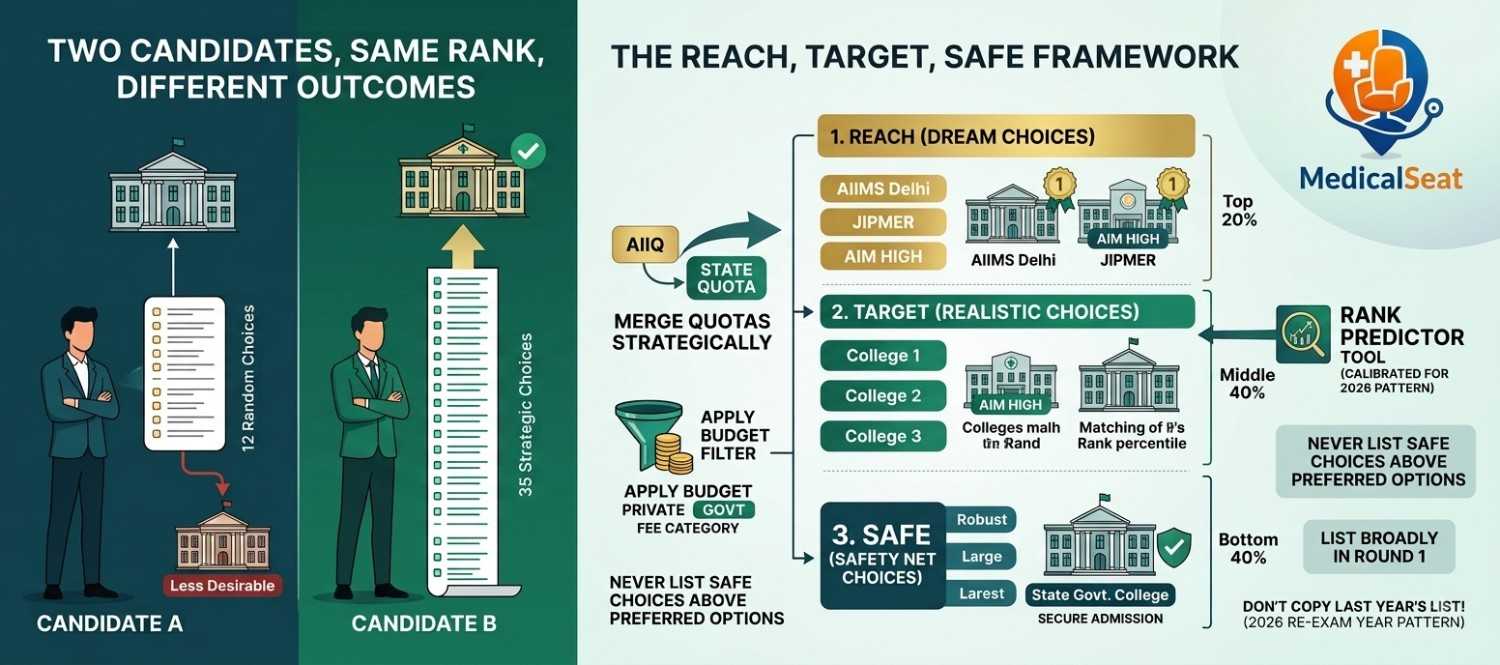
Your Rank Got You Here. A Bad Choice List Will Send You Home: The Truth About NEET Counselling Strategy
Your NEET rank is only half the battle - the right choice list can determine where you actually end up. Learn how to build a smart reach, target, and safe college list, factor in rank, category, quota, budget, and state-specific rules, and avoid common choice-filling mistakes that can cost you a better MBBS seat.
Two students can walk into counselling with the exact same NEET UG rank and walk out with wildly different outcomes. One ends up in a college that matches everything they wanted. The other ends up in stray vacancy, scrambling for whatever's left, wondering what went wrong. The uncomfortable truth is that it usually wasn't the rank. It was the list.
NEET counseling is often talked about as if the score is the only variable that matters, but the seat allotment algorithm doesn't reward the highest rank in the room. It rewards the candidate whose choice list was built correctly. This is the part of MBBS admission guidance that gets the least attention and causes the most regret, so it's worth understanding properly before you ever open a choice filling screen.
How the Allotment Algorithm Actually Works
Here's the mechanical truth that almost nobody explains clearly: the algorithm checks your locked preference list in order, one position at a time, and asks a single question at each position, does your All India Rank qualify for this specific college and course, given the seats available and your category. The moment it finds a "yes," it stops and allots you that seat. It never looks ahead to see if something further down your list might have been a better fit by some external measure. It also never looks back to give you a higher preference you skipped over.
This has a consequence most students don't fully internalise: where you place a college on your list has zero effect on your odds of getting it. Listing a college at position 3 versus position 30 doesn't make it more or less likely you'll be allotted that seat, it only changes when the algorithm checks it. What actually determines your outcome is whether you listed it at all, and whether your rank clears the threshold for it in that specific round.
This single fact demolishes one of the most common pieces of bad advice floating around NEET forums: "put your safe colleges first to guarantee something." Doing this can actively cost you a better outcome. If your safe college sits above a realistic target college you'd genuinely prefer, and your rank qualifies for both, the algorithm allots you the safe one first and never checks the target college at all. Order should reflect genuine preference, not perceived safety.
The Reach, Target, Safe Framework
The most reliable structural approach, echoed by counselling experts across the board, is to build your list in three bands:
Reach or dream choices (roughly the top 20 percent of your list): colleges you'd love to attend even if your rank is a stretch. There's no cost to aiming high here, since the algorithm simply won't allot you a seat your rank doesn't clear.
Target or realistic choices (the middle 40 percent): colleges where your rank sits comfortably within recent closing rank bands for your category. This is where most successful allotments actually land.
Safe choices (the bottom 40 percent): colleges you're confident your rank clears with real margin, ones you'd still be glad to attend even if everything above them doesn't work out.
This isn't a rigid formula, it's a mental model. The point is balance: aim high without abandoning the middle ground, and protect the bottom of your list so you never end up with zero options because you only listed aspirational colleges.
Fill Broadly, Especially in Round 1
There is no upper limit on how many colleges you can list, and there's no penalty for listing more. Every college you leave off your list is a possibility you've silently removed for yourself, not a risk you've avoided. In Round 1 specifically, where most counselling systems offer a free exit if you're allotted something you don't want, there's essentially no reason to list narrowly. A longer, honest list only increases your chances of landing somewhere good; it never decreases them.
This changes slightly in later rounds. Once exit rules tighten and joining becomes closer to binding, only list colleges you'd genuinely be willing to attend. Getting allotted a college you don't want in Round 3 creates a real dilemma between accepting a seat you don't want or forfeiting your security deposit, so round-specific caution matters as the process progresses.
Where Rank vs College Comparisons Get Complicated
NEET rank vs college planning isn't a single flat comparison, because you're often navigating multiple overlapping systems at once. Your list needs to separately account for:
AIQ eligibility: 15% of government seats nationally, plus deemed universities, central universities, AIIMS, JIPMER, ESIC colleges, and AFMC, all with no domicile requirement
State quota eligibility: the remaining 85% of government seats plus nearly all government & private medical colleges in your home state, almost always domicile restricted
Category classification, which can genuinely differ between the AIQ list and your state's own reservation rules
A well-built list treats these as separate sub-lists that get merged strategically, not as one undifferentiated pile of colleges ranked by vague preference. Missing this distinction is one of the more common ways students under-list realistic options simply because they didn't realise a specific college fell into a different quota track than they assumed.
Layer Your Budget Into the List, Not Just Your Rank
MBBS fees India figures vary enormously, sometimes by a factor of ten or more between a government seat and a private management quota seat for the exact same course. A choice list built purely on rank without a budget filter risks landing you a seat that's technically a great result on paper and a genuine financial strain in practice. Decide your ceiling before you build the list, not after you're staring at an allotment result with a deadline ticking.
If affordability is a real constraint, running your list through a filter that accounts for cost directly, rather than rank alone, changes which colleges belong in your target and safe bands. MedicalSeat's budget focused resource is built specifically for this kind of filtering, letting you see realistic options within a defined spend rather than discovering the fee structure only after allotment.
State Specific Quirks You Need to Know Before You Lock
Not every state counselling system behaves identically. Some states allow you to keep modifying your choice list across multiple rounds; others restrict adding new colleges after Round 1 entirely. Some allow a genuinely free float between rounds; others tie floating to stricter conditions. If your shortlist spans bihar, tamilnadu, jharkhand, maharastra, or any combination of states, read that specific state's counselling brochure for its exact rules on list modification, rather than assuming the mechanics you've read about MCC or one other state apply everywhere.
Don't Copy Last Year's List. This Is a Re-Exam Year.
NEET closing ranks from 2024 or 2025 are a rough starting map at best this cycle, not a reliable benchmark. This year's re-conducted exam has genuinely shifted how scores distribute across the candidate pool, which means a rank that comfortably cleared a specific college last year isn't a guaranteed comparison point today. Copying a choice list from a forum, a coaching center handout, or even your own senior from a prior year without adjusting for this year's actual pattern is a fast way to under-list or over-list your realistic bands incorrectly.
MedicalSeat's breakdown of the NEET UG 2026 result statistics and their analysis of rank inflation around the 650 score band both explain exactly why this year's rank to score mapping needs fresh context rather than an inherited assumption.
Two Candidates, Same Rank, Different Outcomes
Picture two students with an identical All India Rank in the general category. Candidate A builds a list of twelve colleges, all clustered around their perceived "safe" band, worried that aiming higher would waste a slot. Candidate B builds a list of thirty five colleges spanning genuine reach options at the top, a wide realistic middle, and a deep safety net at the bottom, using a NEET UG 2026 rank predictor to calibrate each band against this year's actual pattern rather than guessing.
Candidate A's outcome is capped by their own caution; even if their rank could have cleared a stronger college somewhere in the reach band, they never gave the algorithm the chance to check. Candidate B's outcome reflects their true potential, because every realistic possibility their rank could reach was actually on the list. Same rank. Very different results. This is the entire argument behind the idea that rank isn't everything, the list is where the outcome actually gets decided.
Where a Predictor Genuinely Improves Your List
A NEET rank predictor doesn't fill your list for you, and no legitimate tool claims it does. What it does is translate your expected score into a realistic band of colleges for your category and quota, which is exactly the input you need to correctly populate your reach, target, and safe sections instead of guessing where those boundaries sit.
MedicalSeat.com's predictor is calibrated for this year's re-exam pattern and covers MBBS, MDS, INI CET, and AYUSH counselling in one place, functioning as a combined NEET rank predictor and NEET college predictor. If postgraduate seats are also part of your planning, there's a dedicated MDS predictor and INI CET predictor as well. Their explainer on how a free rank and college predictor actually works is worth reading before you lean on any tool's output for something as consequential as your final list.
For a broader reference point beyond a single predictor's output, MedicalSeat's rank to college resource across roughly 5,000 institutions is a useful cross check when you're deciding how deep your safe band needs to go, and their list of upcoming medical colleges is worth a glance too, since a newly approved college entering the matrix mid-cycle can quietly expand your realistic options in a way a static list wouldn't capture.
Building the List in Practice: A Step by Step Approach
Start with your realistic band, not your dream list. Use a medical college predictor India tool calibrated for this year's pattern to identify where your rank genuinely sits for your category and quota.
Add reach choices above that band without hesitation. There's no cost to aiming high, since the algorithm simply won't allot something your rank doesn't clear.
Build a genuinely deep safe band below it. This is your protection against a worse than expected round, not an afterthought.
Split by quota track. Keep a mental (or literal) separation between your AIQ eligible colleges and your state quota eligible colleges, since they're governed by different systems entirely.
Apply your budget filter across all three bands, not just at the bottom. A reach college that's financially impossible for your family shouldn't occupy a slot that a genuinely reachable, affordable target college could use instead.
Order strictly by true preference within each band. Never move a "safe" choice above a genuinely preferred option out of anxiety, doing so can cost you the better outcome entirely.
List broadly in Round 1, where exit is typically free, and narrow your willingness to join as later rounds tighten the exit rules.
Re-check your list before every subsequent round. The seat matrix shifts after each round as candidates join, float, or withdraw, and your realistic bands should shift with it.
How Category and Quota Change Your Bands
A reach, target, and safe framework built for a general category candidate looks structurally different from one built for an OBC, SC, ST, or EWS candidate, even at the exact same numerical rank, because closing ranks for reserved categories sit at different points in the same seat matrix. This is where a NEET UG 2026 rank predictor that lets you filter by category specifically becomes genuinely useful, rather than a generic tool that only accounts for a flat All India Rank.
The same logic applies across quota types within a single college. A private college's state quota seat, management quota seat, and NRI quota seat can carry three different effective cutoffs and three different MBBS fees India figures, even though they're technically the same course at the same institution. Treating "college X" as one entry on your list, without specifying which quota you're targeting within it, is a subtle but genuinely costly simplification. A well-built list separates these explicitly, especially for private colleges that offer more than one quota track.
This also affects how you should read any predictor output. A NEET college predictor result that shows you a single flat probability for a college without breaking it down by your specific category and quota is giving you an incomplete picture. Push for category-specific and quota-specific detail wherever you can get it, since that's the level of precision your actual choice list needs to operate at.
The Myth That "Filling More Choices Wastes Time"
Some students hesitate to build a long list because it feels inefficient, as if fewer, more "curated" choices reflect better decision-making. This gets the incentive structure backwards. Since the algorithm only ever allots you the highest choice your rank clears, and never anything you didn't list, a shorter list can only ever remove options, it can never sharpen your outcome. The only real cost of a longer list is the time it takes to research and order it properly, which is a one-time investment against a decision that shapes the next five or more years of your education. Spending an extra evening expanding your safe band from ten colleges to twenty five is one of the highest-value uses of your time in the entire NEET UG/PG Counseling 2026 calendar, undergraduate or postgraduate.
Treat your list the way you'd treat an insurance policy: the goal isn't to predict exactly which college you'll land in, it's to make sure that whichever round actually plays out, you've already accounted for it. NEET Counselling India, across every state and every track, rewards exactly this kind of preparation far more consistently than it rewards a marginally higher rank alone.
Why This Matters More for the National Numbers Involved
India's medical seat landscape has grown quickly this cycle. The NMC's latest 2026-27 seat matrix puts total MBBS capacity at roughly 1,36,939 seats across 823 colleges, made up of about 63,296 government seats and 73,643 private seats. With that many medical colleges in India genuinely in play, a narrow choice list isn't just cautious, it's leaving a meaningful share of your realistic options completely unexplored. The scale of the system itself is an argument for listing broadly, not narrowly.
The Bottom Line
Your rank sets a ceiling on what's possible. Your choice list determines how much of that ceiling you actually reach. Two candidates with identical scores can end up in genuinely different tiers of outcome purely based on how carefully, how broadly, and how honestly they built their list, and whether they adjusted it for this specific year's shifted NEET closing ranks rather than inherited assumptions from a normal cycle. This is the single piece of MBBS admission guidance worth internalising above every other tip in this article: your NEET rank vs college outcome is a function of two variables, not one, and the second one is entirely within your control.
Across every state, every quota, and every one of the roughly 823 medical colleges in India currently active, the students who treat their choice list with the same seriousness they treated their exam preparation consistently outperform their raw rank. A medical college predictor India tool helps you find the boundaries of your bands, but building and ordering the list itself is work only you can do properly.
Every guess in this process costs you a round, and a round that's closed doesn't come back. Run your score through MedicalSeat.com's predictor calibrated for this year's actual pattern before you build your list, or talk directly to a counselling expert at +91 97517 95765 or support@medicalseat.com if you'd rather build your reach, target, and safe bands with a person who can walk through your specific rank and category with you.