
 Neet Rank Predictor
 NEET UG Predictor
 MDS Predictor
 INI CET Predictor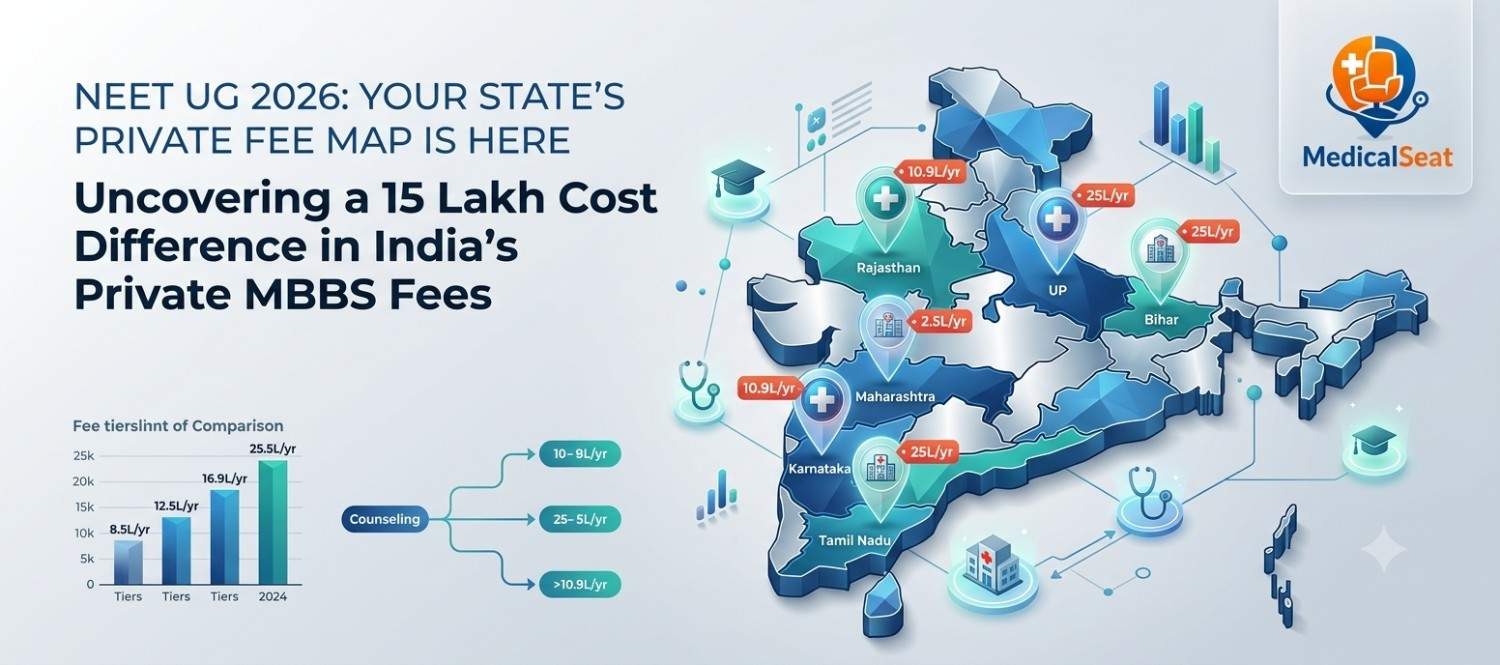
Your State Could Be Costing You 15 Lakhs More Than It Should, Here Is the NEET UG 2026 Private Fee Map That Actually Proves It
Compare NEET UG 2026 private medical college fees state wise across Karnataka, Maharashtra, Tamil Nadu, Bihar and more with a free NEET rank predictor.
Every year the same conversation repeats itself in NEET aspirant WhatsApp groups. Someone posts a screenshot of a private college fee structure, panic spreads, and half the group assumes every state charges the same brutal number. It does not. Private MBBS fees in India swing from roughly 7 lakhs a year in one state to over 25 lakhs a year in another, for the exact same degree, the exact same NEET UG exam, and often a comparable quality of clinical training. This guide lays out the real MBBS fees India picture, state by state, so your NEET UG/PG Counseling 2026 choice list is built on numbers instead of rumours.
If you have not already checked where you stand this year, run your score through a proper NEET rank predictor and NEET college predictor before you read a single fee table below, because the smartest fee comparison in the world is useless without knowing which of these states are even realistically in reach for your NEET UG 2026 rank predictor output.
Why State Matters More Than Almost Anything Else in Your Fee Planning
Medical education in India runs on a split system. The National Medical Commission sets broad fee regulation principles, but the actual rupee figure for every private college gets fixed by state level fee committees, university affiliations, or dedicated bodies like the Karnataka Examinations Authority, Maharashtra's DMER, or the counselling boards of Bihar and Jharkhand. That means two private colleges with near identical infrastructure, one in Madhya Pradesh and one in Karnataka, can carry annual tuition figures that differ by 3 lakhs to 5 lakhs simply because of which state fixed the number.
This is exactly why any serious NEET counseling guide has to be built state first, not college first. Once you know which two or three states fit your budget and your NEET rank vs college reality, narrowing down to individual colleges becomes far easier. The NEET rank and college predictor, calibrated for this year's re exam pattern across MBBS, MDS, INI CET, and AYUSH, is the fastest way to see which states are genuinely open to your score before you spend hours reading fee PDFs.
The National Picture First: Total Medical Seats in India for 2026
Before comparing states against each other, it helps to see the full scale of what you are competing for. The total number of medical seats in India for the 2026 admission cycle stands at approximately 1,36,939 MBBS seats spread across 823 NMC approved colleges nationwide. Of that figure, the total number of government medical seats in India comes to roughly 63,296, while the total number of private medical seats in India accounts for the remaining 73,643, a figure that includes both standalone private colleges and deemed universities.
That private seat share, just over half the country's total total number of MBBS seats in India, is exactly why fee comparison matters so much. More than half of every year's MBBS class ends up paying private tuition somewhere, and where that somewhere happens to be can change a family's total five year cost by a factor of two or three. For a fuller sense of how many candidates are actually chasing this national seat pool this year, the NEET UG 2026 result statistics on registered, appeared, and qualified candidates is worth a read alongside this guide.
Karnataka: The Regulated Benchmark Everyone Compares Against
Karnataka runs one of the most transparent private fee systems in the country through the Karnataka Examinations Authority. Karnataka MBBS fees at most private colleges under state quota are standardised at approximately 10.92 lakhs per year, a figure fixed centrally rather than left to individual colleges to decide, which makes Karnataka private medical college fees one of the more predictable entries in any medical college predictor India comparison. Outside state candidates without Karnataka domicile can still access management and NRI quota seats without domicile restriction, though those Karnataka NEET UG 2026 fees tiers climb considerably higher, often reaching 20 lakhs to 25 lakhs a year or more at premium institutions. Karnataka's counselling runs through KEA for state seats and joins the central MCC process for its deemed university seats, so candidates need to track two separate timelines if they are considering both routes for their Karnataka medical college fees planning.
Maharashtra: High Reward, Higher Price Tag
Maharashtra carries some of the steepest Maharashtra MBBS fees in the country, particularly at its deemed universities. State quota admission in maharastra remains domicile restricted, meaning only Maharashtra resident candidates can compete for the standard Maharashtra private medical college fees tuition band. NRI quota seats at several Maharashtra institutions push the total Maharashtra NEET UG 2026 fees course cost as high as 2,60,000 US dollars across the 5.5 year MBBS program, among the highest anywhere in India. For a non domicile aspirant, Maharashtra generally only becomes viable through deemed university seats or NRI quota, both of which sit well above the national average for MBBS fees India. Candidates weighing Maharashtra medical college fees against more affordable states should factor this domicile restriction into their NEET counseling guide planning very early, since it eliminates the standard state quota route entirely for outside state applicants.
Tamil Nadu: The Government College Bargain With a Private Sting
Tamilnadu presents one of the sharpest contrasts anywhere in the country when it comes to Tamil Nadu MBBS fees. Its government medical colleges charge among the lowest tuition in India, often around 11,000 rupees a year, making the state an outstanding target for candidates whose NEET UG 2026 rank predictor output lands them a government seat. Private colleges tell a completely different story. Tamil Nadu private medical college fees under management quota at self financing colleges typically fall in the 12 lakh to 13.5 lakh per year range, and the state's deemed universities, including some of the country's most recognised names, sit meaningfully higher still on the Tamil Nadu NEET UG 2026 fees scale. Tamil Nadu state quota seats also carry domicile restrictions, so outside state candidates chasing an affordable Tamil Nadu government seat will find the door largely closed, while the private and deemed routes remain open on merit for tamilnadu aspirants nationwide.
Bihar: A Genuinely Affordable Private Route
Bihar has quietly become one of the more budget friendly Bihar MBBS fees destinations in the country. Government colleges charge next to nothing, roughly 9,000 rupees a year in several institutions, while Bihar private medical college fees generally fall between 9.6 lakhs and 16.5 lakhs a year depending on the specific college and quota, with some outlier colleges stretching closer to 20 lakhs to 22 lakhs under premium or NRI tiers. Unlike Maharashtra or Tamil Nadu, bihar private colleges are genuinely open to every NEET UG qualified candidate nationwide, with no domicile requirement for the private route, and an NRI quota available separately for eligible applicants at roughly 25,000 to 30,000 US dollars per year under the Bihar NEET UG 2026 fees structure. Counselling runs through BCECEB under the UGMAC system, and the state's growing number of newer private colleges means later counselling rounds often carry accessible closing ranks for candidates whose NEET rank vs college position sits in the moderate band.
Jharkhand: Small Private Pool, Notified Fees
Jharkhand's private medical college count remains limited compared to its larger neighbours, with only a small handful of trust run private institutions offering MBBS through the Jharkhand Combined Entrance Competitive Examination Board. Where Jharkhand MBBS fees are officially notified, year one tuition at the state's jharkhand private colleges runs around 16 lakhs, with state, management, and NRI quota tiers published separately by each college under the Jharkhand private medical college fees structure. Jharkhand's government colleges, including RIMS Ranchi and MGM Jamshedpur, sit entirely outside this Jharkhand NEET UG 2026 fees conversation, admitting through JCECEB state quota and the central MCC all India quota instead. For candidates who cannot clear Jharkhand's tighter government cutoffs, the private route here is worth checking, though the limited number of seats means demand regularly outpaces availability even at the private tier.
Madhya Pradesh: The Quiet Mid Range Option
Madhya Pradesh continues to sit in a genuinely useful middle ground for Madhya Pradesh MBBS fees planning. The state runs 14 private medical colleges offering roughly 2,700 MBBS seats altogether, with Madhya Pradesh private medical college fees under general category typically falling between 7.5 lakhs and 10 lakhs a year, among the more restrained figures in this entire comparison. Outside state candidates become eligible for Madhya Pradesh private seats from the later counselling rounds onward, and unlike Tamil Nadu or Maharashtra, there are currently no deemed medical universities in the state, meaning every Madhya Pradesh NEET UG 2026 fees private seat runs through the same state DME counselling process rather than splitting across all deemed and private college systems. For a full breakdown of Madhya Pradesh specific colleges and closing rank patterns, it is worth reading the dedicated guide once your predictor output confirms the state is within reach.
Uttar Pradesh: Cheap Government, Genuinely Mixed Private
Uttar Pradesh runs one of the cheapest government MBBS systems in the country, with Uttar Pradesh MBBS fees at most state and autonomous government colleges sitting between 36,000 and 54,600 rupees a year. Its private sector tells a more layered story than most states in this guide. UP carries one of the largest raw counts of private medical colleges in India, and that scale produces a genuinely wide Uttar Pradesh private medical college fees spread, with several regulated private colleges offering state quota seats in the 5 lakh to 10 lakh a year range, while a handful of premium or deemed institutions in the state push well beyond that on the Uttar Pradesh NEET UG 2026 fees scale. UP is also one of the states, alongside Karnataka, Kerala, and Rajasthan, that keeps its private management quota open to candidates without state domicile, which is why it shows up so often in medical college predictor India searches from outside state families.
Rajasthan: One of the Costliest Private Routes in the Country
Rajasthan sits at the expensive end of this entire Rajasthan MBBS fees comparison. Its government colleges remain genuinely affordable at around 70,340 rupees a year for a straight government seat, but the management quota tier inside those same government colleges jumps to roughly 9.57 lakhs a year, and the NRI tier climbs further to around 23.93 lakhs under the Rajasthan NEET UG 2026 fees structure. Rajasthan private medical college fees are steeper still, with general category private seats starting near 18.9 lakhs a year and management quota private seats beginning around 26.75 lakhs, figures that regularly stretch toward 35 lakhs annually at the top end. Rajasthan does allow non domicile candidates into its private quota, so the state remains technically open nationwide, but families should treat it as a premium option rather than a budget one within this NEET UG/PG Counseling 2026 comparison.
Gujarat: A Regulated Middle Ground, Closed to Outside Domicile
Gujarat MBBS fees at government colleges stay low, around 25,000 rupees a year, with the state's semi government GMERS colleges charging roughly 3.75 lakhs a year under the government quota. Gujarat private medical college fees under the government quota route generally fall between 9 lakhs and 12.5 lakhs a year, with management quota seats priced higher depending on the individual college, pushing the Gujarat NEET UG 2026 fees range further up for outside applicants. The catch for outside state aspirants is that Gujarat is one of the closed states in this guide, meaning its state quota private and government seats are restricted to Gujarat domicile holders, similar to Maharashtra and Tamil Nadu. Deemed university seats within Gujarat remain the one route open to all India candidates regardless of domicile.
Haryana: Delhi NCR Pricing Without the Delhi NCR Reputation
Haryana MBBS fees typically fall between 12 lakhs and 17 lakhs a year, with SGT Medical College in Gurgaon sitting at the top of the Haryana private medical college fees band near 21 lakhs a year, largely a reflection of its Delhi NCR proximity and infrastructure investment. Haryana is also one of only five states, alongside Rajasthan, Punjab, Himachal Pradesh, and Puducherry, that offers a genuine NRI quota within government medical colleges rather than restricting NRI seats to the private and deemed sector alone, pushing the Haryana NEET UG 2026 fees range wider than most, which makes it worth a second look for NRI category families comparing this NEET counseling guide against other options.
Punjab: Consistently Named Among the More Affordable Northern States
Punjab appears repeatedly in NEET counseling research as one of the more affordable northern states for Punjab MBBS fees, generally priced below the Haryana and Rajasthan bands for comparable college tiers. Punjab private medical college fees stay moderate compared to its neighbours, and like Haryana, Punjab is one of the five states offering an NRI quota inside its government colleges under the Punjab NEET UG 2026 fees structure, giving NRI category families a genuine government college option here that most other states simply do not provide. Punjab's overall private college count remains smaller than UP or Karnataka, so seat availability tightens faster once counselling rounds progress.
Andhra Pradesh: A Sharp Three Tier Fee Ladder
Andhra Pradesh MBBS fees run one of the most clearly tiered systems in this entire comparison. Government seats cost approximately 15,000 rupees a year for the general category, jumping to roughly 12 lakhs a year for Category B self financing seats and around 20 lakhs a year for Category C NRI seats, all within the same government colleges. Andhra Pradesh private medical college fees follow a similar ladder, with Category B management quota fees near 13.2 lakhs a year and Category C NRI fees reaching as high as 39.6 lakhs a year at some institutions under the Andhra Pradesh NEET UG 2026 fees structure, among the steepest NRI figures anywhere in this guide.
Telangana: The Southern Cousin of Karnataka's Regulated System
Telangana MBBS fees are regulated through KNRUHS in a manner broadly similar to Karnataka's KEA model, and the state consistently appears alongside Karnataka and Kerala in lists of comparatively affordable government quota options within Telangana private medical college fees. Management and NRI tiers at Telangana's private and deemed institutions climb considerably above the government quota figure under the Telangana NEET UG 2026 fees ladder, following the same pattern seen across most of southern India.
Kerala: Consistently the Value Pick of the South
Kerala MBBS fees show up again and again in this research as one of the most consistently affordable private destinations in the country, with Kerala private medical college fees at several institutions reported in the 5 lakh to 10 lakh a year range, comparable to Uttar Pradesh's more affordable private tier. Kerala also offers a government NRI quota route similar to Haryana and Punjab, adding another budget conscious option for NRI category applicants under the Kerala NEET UG 2026 fees structure. The state's private quota does carry domicile preference in places, though its overall reputation for cost discipline keeps it a recurring recommendation in almost every NEET counseling guide covering budget conscious southern options.
West Bengal: A Regulated System With a Smaller Private Footprint
West Bengal MBBS fees run through the state's Department of Health and Family Welfare with a comparatively transparent, government college heavy system. The state's West Bengal private medical college fees count remains smaller than counterparts like Karnataka, Maharashtra, or Uttar Pradesh, which keeps competition for the available private seats intense even though the regulated West Bengal NEET UG 2026 fees structure itself stays broadly in line with the national mid range band once government, ESIC, and private tiers are compared side by side.
Chhattisgarh, Odisha, Uttarakhand and Himachal Pradesh: The Smaller Markets Worth Checking
A cluster of smaller states rounds out this national picture, each worth a look depending on your NEET rank vs college position. Chhattisgarh MBBS fees consistently appear alongside Punjab and Uttar Pradesh in lists of the more affordable Chhattisgarh private medical college fees states, making it a reasonable budget conscious backup for candidates who miss the bigger state cutoffs. Odisha MBBS fees run a smaller private college count with Odisha private medical college fees generally in the national mid range once government, private, and NRI tiers are compared. Uttarakhand MBBS fees and Himachal Pradesh MBBS fees both carry limited private seat counts, and Himachal Pradesh is notably one of the five states offering an NRI quota inside its government colleges under the Himachal Pradesh NEET UG 2026 fees structure, alongside Haryana, Punjab, Rajasthan, and Puducherry, which is worth knowing if NRI category planning is part of your family's strategy.
Delhi, Northeast States and Union Territories: Mostly a Government Story
Delhi MBBS fees and the wider Delhi medical education landscape are overwhelmingly a government and central institution story, with colleges like AIIMS Delhi and the university run colleges dominating the seat count and very limited Delhi private medical college fees capacity within the territory itself. The northeastern states, including Assam, Manipur, Meghalaya, and their neighbours, similarly run almost entirely on government and state quota seats with minimal private MBBS presence, meaning aspirants from this region who want a private option typically look toward Bihar, Jharkhand, West Bengal, or Karnataka rather than staying within their home state. Puducherry MBBS fees stand out among the smaller union territories, offering an NRI quota within its government colleges under Puducherry NEET UG 2026 fees, like Haryana, Punjab, Rajasthan, and Himachal Pradesh, making it a genuine option for NRI category families despite its small overall seat count.
A Quick Side by Side Snapshot Before You Dive Deeper
If you only remember one section from this entire guide, make it this one. Karnataka's state quota holds steady near 10.92 lakhs a year with management and NRI tiers reaching 20 lakhs to 25 lakhs. Maharashtra's domicile restricted state quota keeps outside state candidates locked out of the cheaper tier entirely, pushing them toward NRI seats that can cross 2,60,000 US dollars for the full course. Tamil Nadu swings hardest of all, from an almost symbolic 11,000 rupees a year in government colleges to 12 lakhs to 13.5 lakhs in private management seats. Bihar's private band of 9.6 lakhs to 16.5 lakhs a year remains genuinely open to every domicile nationwide. Jharkhand's limited private pool notifies fees near 16 lakhs for its flagship private option. Madhya Pradesh holds one of the most restrained private bands in this entire comparison at 7.5 lakhs to 10 lakhs a year.
Beyond these six, Uttar Pradesh and Kerala both offer a genuinely affordable private tier around 5 lakhs to 10 lakhs a year for candidates without domicile restrictions standing in the way. Rajasthan sits at the opposite extreme, with private seats starting near 18.9 lakhs and management quota crossing 26.75 lakhs. Gujarat stays moderate at 9 lakhs to 12.5 lakhs a year but keeps its state quota closed to outside domicile, just like Maharashtra and Tamil Nadu. Haryana runs 12 lakhs to 17 lakhs, Andhra Pradesh's management tier sits near 13.2 lakhs with NRI fees reaching a steep 39.6 lakhs, and Punjab, Telangana, Chhattisgarh, and Odisha all sit in a comparatively moderate mid range band. Keep this full snapshot next to your predictor output as you start narrowing down your actual choice list across every state in the country.
Why NRI and Management Quota Numbers Get Misunderstood So Often
A recurring confusion in NEET counseling forums is treating management and NRI quota fees as a single interchangeable number, when in practice they behave completely differently depending on the state. In Karnataka, management and NRI tiers at the same college often sit within a few lakhs of each other. In Maharashtra, the gap between a state quota seat and an NRI seat at the very same institution can be enormous, since NRI fees are frequently quoted in US dollars and converted at the point of payment, which means currency movement alone can shift your effective rupee cost by several lakhs between the day you plan your budget and the day you actually pay. Families exploring the NRI route anywhere in this comparison should always request the current academic year's dollar figure in writing from the college directly, rather than relying on a rupee estimate calculated months earlier.
Government Versus Private Quota: The Number That Actually Decides Your Budget
Across every state covered here, the single biggest swing factor in your final MBBS cost is not the state itself, it is whether you land a government seat, a state quota private seat, a management quota seat, or an NRI quota seat. Government seats, wherever they exist across the government & private medical colleges landscape, remain the cheapest route by a wide margin, often under 1 lakh a year even at the costlier end of government fee structures. State quota private seats sit in the middle, generally 7 lakhs to 13 lakhs a year depending on the state. Management and NRI quota seats occupy the top end, frequently crossing 20 lakhs a year and, in Maharashtra's case, running into tens of lakhs annually once the full course is converted from dollar denominated fees.
This is precisely why a strong NEET college predictor matters more than a strong fee spreadsheet. Knowing your realistic quota, not just your realistic state, is what actually determines whether your family is planning around a 10 lakh total course cost or a 60 lakh one. The rank to college mapping tool lets you see exactly which quota tier your predicted rank realistically lands in across every state covered in this guide.
How This Year's Rank Inflation Changes the Fee Conversation
A detail candidates consistently underweight is that fee planning and rank prediction are not separate exercises this year. This year's exam pattern has shifted how marks translate to all India rank in ways that differ from last year's numbers, which means a score that comfortably secured a government or budget private seat last cycle may not do the same in 2026. Before locking a state purely on the strength of its fee reputation, it is worth checking the detailed breakdown in this year's rank inflation analysis at the 650 score mark, since a rank shift of even a few thousand places can push a candidate out of a state quota tier and into a considerably more expensive management or NRI tier in states like Karnataka or Maharashtra.
Budgeting the Full Five Year Cost, Not Just Year One
Every fee figure discussed so far covers annual tuition, and annual tuition alone is not the number that should drive your final decision. Hostel charges, mess fees, security deposits, uniform and clinical consumable costs, and university or affiliation charges typically add another 1 lakh to 2.5 lakhs per year on top of tuition across most private colleges nationwide, regardless of state. Multiply any state's headline annual figure by five, then add these recurring extras across the full MBBS duration, and the real gap between an affordable state like Bihar or Madhya Pradesh and an expensive one like Maharashtra or a Tamil Nadu deemed university can stretch well past 50 lakhs over the full course. Before counselling opens, it is genuinely worth running your shortlist through a structured education budgeting resource to see the true five year cost side by side rather than comparing single year tuition figures in isolation.
Do Not Forget Dental and INI CET Options While Fee Planning
Fee comparison discipline should not stop at MBBS. Candidates weighing a dental seat as a parallel option alongside their MBBS choice list should run the same state by state exercise using the MDS predictor, since BDS and dental postgraduate fee patterns follow a similar, though generally lower, state by state spread. Candidates with a strong enough NEET UG 2026 rank predictor output should also check the INI CET predictor before committing fully to a private route, because a genuine INI seat almost always beats even the most affordable private state on total cost.
Newer Colleges Can Quietly Undercut the Established Fee Bands
One pattern worth watching across nearly every state in this guide is that newer private colleges, still building their reputation and patient volume, frequently price their first few admission cycles below the established fee band in their own state purely to fill seats. This applies just as much in Karnataka and Maharashtra as it does in Bihar, Jharkhand, and Madhya Pradesh. Checking the list of upcoming medical colleges opening seats this cycle is a genuinely useful step for budget conscious candidates willing to trade a slightly newer campus for a meaningfully lower five year cost.
Building Your Own State Shortlist the Right Way
Do not build a state shortlist around reputation alone. Start with your predicted rank from a properly calibrated NEET rank predictor, filter that against your family's actual budget ceiling using the state figures above, then check quota eligibility, since domicile restrictions in Maharashtra and Tamil Nadu can eliminate an entire state from contention regardless of how attractive its fee band looks on paper. Only after clearing those three filters should college specific reputation and closing rank history enter the decision. This order, budget and eligibility before brand name, is the single biggest difference between families who end counselling calm and families who end it in a scramble for a mop up round seat they never planned for.
Talk to Someone Before You Commit to a State
A fee table can tell you what a state charges. It cannot tell you whether your specific NEET rank vs college position makes that state's government route realistic, whether a management quota seat is worth the premium over a comparable state quota option elsewhere, or whether an NRI quota seat in Maharashtra genuinely beats a state quota seat in Bihar for your family's situation. That conversation needs an actual counsellor who has watched this year's specific pattern play out across states. Reach the MedicalSeat.com counselling desk directly at support@medicalseat.com or call +91 97517 95765, and walk into counselling with a state shortlist that matches both your rank and your real budget, not just a fee table you found online.
Conclusion
The gap between the cheapest and most expensive private MBBS routes in India is not small, it can be the difference between a 40 lakh total course cost and a 100 lakh one, and almost all of that gap comes down to which state and which quota a candidate ends up in. Karnataka offers regulated predictability, Maharashtra commands a premium that only makes sense through deemed or NRI routes for outside state candidates, Tamil Nadu splits sharply between near free government seats and costly private ones, and Bihar, Jharkhand, and Madhya Pradesh remain the more genuinely accessible private options for candidates without in state domicile. Run your numbers through a proper NEET college predictor, check domicile eligibility before falling in love with any single state, and budget for the full five year cost rather than a single year's tuition figure. Get that sequence right, and your NEET UG/PG Counseling 2026 experience becomes a planned decision instead of a last minute scramble.