
 Neet Rank Predictor
 NEET UG Predictor
 MDS Predictor
 INI CET Predictor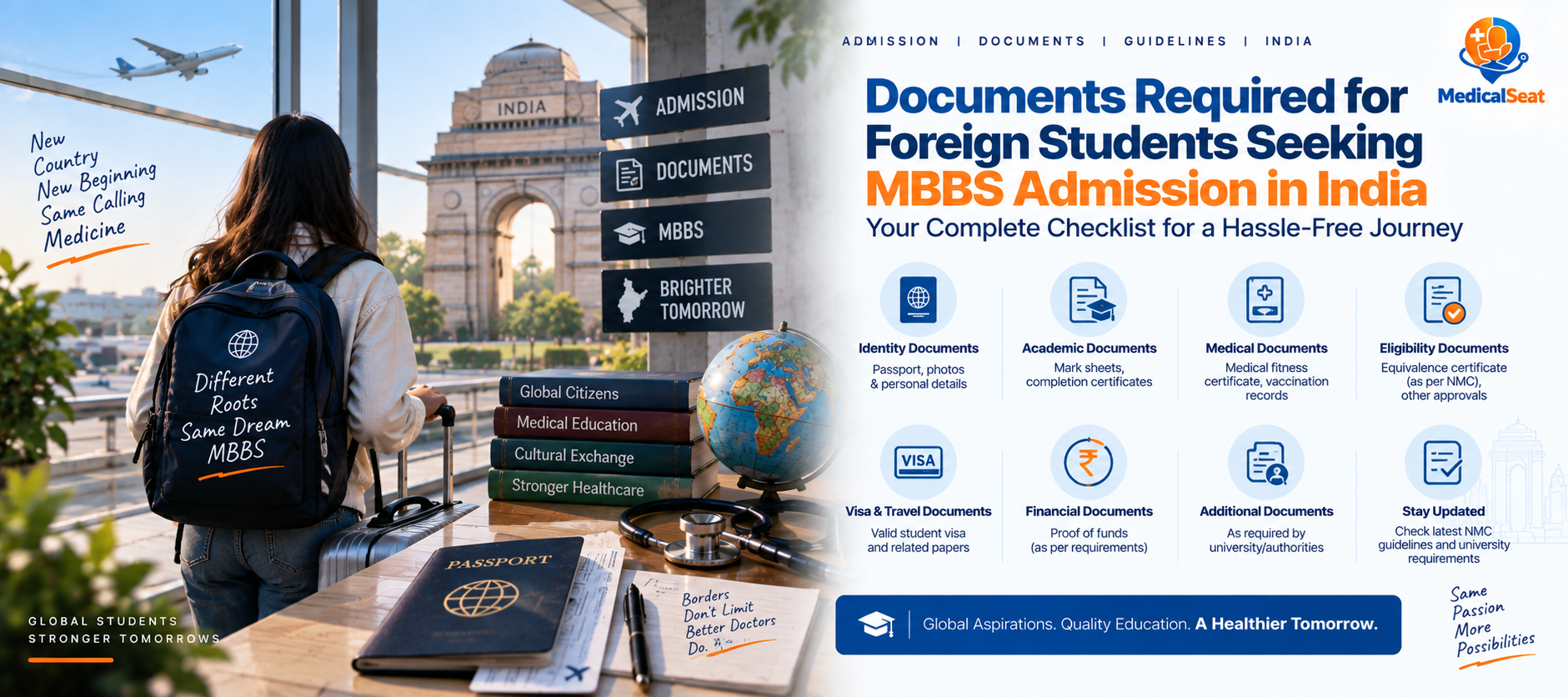
Documents Required for Foreign Students Seeking MBBS Admission in India
For foreign students pursuing MBBS in India, the biggest obstacle is rarely NEET rank — it's paperwork. A single missing AIU equivalence certificate, a name spelled inconsistently across a passport and a marksheet, or an FRRO registration completed a day too late can stall or derail an admission that was otherwise fully earned. This guide organizes every document a foreign student typically needs, stage by stage, from academic equivalence checks all the way through to post-arrival compliance in India.
Introduction
For foreign students pursuing MBBS in India, the biggest obstacle is rarely NEET rank — it's paperwork. A single missing AIU equivalence certificate, a name spelled inconsistently across a passport and a marksheet, or an FRRO registration completed a day too late can stall or derail an admission that was otherwise fully earned.
This guide organizes every document a foreign student typically needs, stage by stage, from academic equivalence checks all the way through to post-arrival compliance in India.
Quick Facts Box
Document | Required For | Where to Obtain |
AIU Equivalence Certificate | Foreign Class 12 (or equivalent) qualifications | |
NEET UG Scorecard | All candidates, no exceptions | NTA (National Testing Agency) |
Embassy/Diplomatic Mission Certificate | NRI/OCI/foreign national candidates | Indian Embassy/Consulate in country of residence |
Student Visa (S-Visa) | Foreign nationals studying in India | Indian Embassy/Consulate abroad |
FRRO Registration | Visa holders staying over 180 days | e-FRRO portal, within 14 days of arrival |
Featured Snippet Answer
What documents does a foreign student need for MBBS admission in India? Foreign students need an AIU Equivalence Certificate for their foreign academic qualifications, a NEET UG scorecard, a valid passport and student visa, an Indian Diplomatic Mission certificate, sponsorship documents if applying under the NRI category, and post-arrival FRRO registration completed within 14 days of entering India. Additional medical fitness and vaccination documents are typically required by the admitting institution.
Stage 1: Academic Documents and the AIU Equivalence Certificate
Before anything else, a foreign student's prior academic qualifications need to be formally recognized as equivalent to Indian standards.
What's required:
Original Class 10 and Class 12 (or equivalent) certificates and transcripts from the foreign board or institution
An AIU Equivalence Certificate from the Association of Indian Universities, confirming the foreign qualification is recognized as equivalent to Indian Class 12
How the AIU process works:
Check that your foreign school board or institution appears on AIU's accredited list — if it doesn't, the application won't move forward until this is resolved.
Apply online through evaluation.aiu.ac.in (applications are accepted online only; physical files aren't processed).
Create an account, enter your full education history, and upload the required documents.
Processing typically takes several weeks, so this should be one of the very first steps taken, not something left for later.
Important Update: Submission of the AIU Equivalence Certificate is mandatory for foreign nationals seeking admission where eligibility relies on a qualification from outside the recognized Indian board list. Skipping this step, or applying too late, is one of the most common reasons foreign applications get rejected at the registration stage — before document verification has even begun.
Stage 2: Identity, Citizenship, and Relationship Documents
Checklist: Identity Documents
Valid passport (with sufficient validity remaining for the admission period)
Birth certificate
OCI card (if applicable) or proof of foreign citizenship
Passport-size photographs meeting the specific format required by the admitting institution or embassy
Did You Know? If a candidate's name appears differently across documents — for example, a slightly different spelling on the passport versus the Class 12 marksheet — a notarized Name Correction Affidavit is typically required and should be carried alongside every document set, since counselling authorities generally won't accept two different spellings without this reconciliation.
Stage 3: NEET UG Registration Documents
Every foreign student, regardless of category, must qualify NEET UG to be considered for MBBS admission in India. Registration itself requires:
Checklist: NEET UG Registration
Valid passport as the primary identity document (in place of Aadhaar, which applies to Indian citizens)
Class 10 and Class 12 mark sheets/certificates (with AIU equivalence, if applicable)
Recent passport-size photograph meeting NTA's specifications
Category declaration (Indian citizen, NRI, OCI, or foreign national) made accurately at the time of registration
Important Update: MCC does not allow candidates to switch their registered category — for example, from "Indian" to "NRI" — after the first counselling round. This makes accurate category selection at NEET registration genuinely consequential, not just an administrative formality.
Stage 4: Sponsorship Documents (NRI and Foreign National Category)
If applying under the NRI quota (required for foreign nationals without OCI status, and optional-but-common for NRI/OCI candidates), sponsorship documentation becomes central to the application.
Checklist: Sponsorship Document Set
Sponsor's passport and visa, showing current NRI/overseas residency status
Documented proof of the specific blood relationship between sponsor and candidate
Notarized affidavit from the sponsor committing to fund the candidate's entire course fee
Certificate from the Indian Diplomatic Mission (Embassy or Consulate) in the sponsor's country of residence — this must come specifically from the Diplomatic Mission; certificates from a local notary, Indian lawyer, accountant, or HR department are not accepted
Expert Tip: Start the Diplomatic Mission certificate process early — appointment availability at Indian embassies and consulates varies significantly by country, and this document alone can become a bottleneck if requested close to a registration deadline.
Stage 5: Counselling and Admission Documents
Once NEET UG is qualified, counselling-stage documentation comes into play — this is where MCC's NRI Document Verification Team (for NRI/OCI/foreign national candidates) reviews everything submitted so far.
Checklist: Counselling-Stage Documents
NEET UG scorecard and admit card
All academic documents plus AIU equivalence certificate
Complete sponsorship document set (if applicable)
Category confirmation as registered with NTA
Any additional state- or institution-specific documents (for example, proof of a minimum years-abroad study requirement at certain colleges)
Pro Tip: Submit every document as a complete set at once rather than piecemeal — partial submissions are a common cause of processing delays, since verification teams typically won't begin scrutiny until the full required set has been received.
Stage 6: Visa and Immigration Documents
Once admission is confirmed, a foreign student needs the correct visa category to legally study in India.
Checklist: Visa Documents
Valid passport
Admission/offer letter from the Indian medical institution
Completed Student Visa (S-Visa) application, submitted through the Indian Embassy or Consulate in the student's country of residence
Supporting financial documents demonstrating ability to fund the course and stay in India
Any additional documents specified by the particular embassy or consulate handling the application
Important Update: A Student Visa (S-Visa) is generally required for foreign nationals studying in India for an extended period; visa requirements and processing times can vary by country, so applications should begin as soon as an admission offer is confirmed, not after arrival planning has already begun.
Stage 7: Post-Arrival Compliance — FRRO Registration
Getting admitted and obtaining a visa isn't the final step. Foreign students holding a Student Visa valid for more than 180 days must register with the Foreigners Regional Registration Office (FRRO) within 14 days of arrival in India.
How FRRO registration works:
Complete the online application through the e-FRRO portal (the Ministry of Home Affairs' digital platform for foreign national registration).
Select "Student Visa" as the visa type and provide visa, admission, and intended-stay details.
Submit any additional documents required based on the student's specific location or visa type.
Checklist: FRRO Registration Documents
Valid passport with Student Visa
Admission letter from the Indian institution
Proof of local address/accommodation in India
Passport-size photographs
Important Update: This is both a legal obligation and a practical safety net — FRRO registration ensures the student is officially accounted for during their stay and can access administrative support if needed. Missing the 14-day window can create avoidable legal complications, so this should be scheduled immediately after arrival, not left until classes begin.
Stage 8: Medical and Health Documents
Most institutions require proof of medical fitness before allowing a foreign student to formally join, given the extended residential nature of an MBBS program.
Checklist: Medical and Health Documents
Medical fitness certificate issued by a registered medical practitioner, often on a specific prescribed format
Vaccination records or an International Certificate of Vaccination, typically covering measles, mumps, rubella (MMR), tetanus, diphtheria, polio, and hepatitis B
Health insurance coverage valid for the full duration of study
Did You Know? Specific vaccination and medical fitness requirements can vary by institution and by the student's country of origin, so it's worth confirming the exact prescribed format and required tests directly with the admitting college well before travel.
Attestation, Apostille, and Notarization — Getting the Paperwork Legally Recognized
Foreign academic and civil documents (birth certificates, academic transcripts, and similar records) often need formal legal recognition before Indian authorities will accept them.
Comparison Table: Notarization vs Apostille vs Attestation
Process | What It Does | When It Applies |
Notarization | A registered advocate verifies and certifies a copy of the original document | Often the first step for supporting documents |
Apostille | A single certificate verifying a document's authenticity for use in another country | Used between countries that are both signatories to the Hague Apostille Convention |
Embassy Legalization/Attestation | A multi-step verification process involving relevant government and embassy authorities | Used when the destination country is not a Hague Convention signatory |
Important Update: A foreign-issued document (such as a foreign Class 12 certificate) is authenticated in the country that issued it, not by India's Ministry of External Affairs — the AIU Equivalence Certificate process described in Stage 1 is the correct route for bringing a foreign qualification into recognized use within India, rather than an Indian apostille process.
Complete Document Checklist (All Stages)
Class 10 and Class 12 (or equivalent) certificates and transcripts
AIU Equivalence Certificate (mandatory for foreign qualifications)
Valid passport
Birth certificate
OCI card (if applicable)
Passport-size photographs meeting required specifications
NEET UG admit card and scorecard
Category declaration confirmation (as registered with NTA)
Sponsor's passport/visa and relationship proof (NRI/foreign national category)
Notarized sponsorship affidavit
Certificate from the Indian Diplomatic Mission in the sponsor's country of residence
Name Correction Affidavit (if name spelling varies across documents)
Admission/offer letter from the Indian institution
Student Visa (S-Visa)
Proof of financial capacity
FRRO registration (post-arrival, within 14 days)
Medical fitness certificate
Vaccination records/International Certificate of Vaccination
Health insurance valid for the full study duration
Common Mistakes That Delay or Derail Applications
Applying for the AIU Equivalence Certificate too late, not accounting for the multi-week processing time.
Submitting a certificate from the wrong authority — only the Indian Diplomatic Mission's certificate is accepted for sponsorship purposes, not a notary, lawyer, accountant, or HR department.
Inconsistent name spelling across passport, academic documents, and visa paperwork, without a Name Correction Affidavit to reconcile it.
Registering under the wrong NEET category, then attempting to switch after Round 1 — which MCC does not permit.
Missing the 14-day FRRO registration window after arriving in India.
Delaying the Student Visa application until close to the intended travel date, rather than starting immediately after admission confirmation.
Assuming all embassies/consulates have identical document requirements — specifications (like photo background color) can vary and should be confirmed directly with the relevant office.
Key Takeaways
The AIU Equivalence Certificate is a mandatory, often underestimated first step for any foreign student with academic qualifications from outside India — start this early.
NEET UG qualification and accurate category declaration at registration are non-negotiable — category cannot be changed after the first counselling round.
Sponsorship documentation for NRI/foreign national candidates must come from the correct authority — specifically the Indian Diplomatic Mission, not any local certifying body.
Post-arrival FRRO registration within 14 days is a legal requirement, not an optional formality, for visa holders staying more than 180 days.
Medical fitness and vaccination documentation requirements vary by institution — confirm the exact format directly with the admitting college before travel.
People Also Ask
What is an AIU Equivalence Certificate and who needs one?
How long does FRRO registration take for foreign students in India?
What visa do international students need for MBBS in India?
Can NRI candidates switch categories after NEET registration?
What medical documents are required for foreign MBBS admission in India?
Conclusion
For foreign students, a strong NEET UG score is only half the battle — the other half is a document trail that has to be complete, correctly authorized, and submitted on time at every single stage, from AIU equivalence certification all the way through post-arrival FRRO registration. None of these requirements are designed to be obstacles; they exist to formally establish eligibility, sponsorship legitimacy, and legal status in India. Treated as a structured checklist rather than a last-minute scramble, they're entirely manageable.
Track document requirements, AIU equivalence timelines, and college-specific admission checklists for foreign students on MedicalSeat to keep your MBBS application on schedule.