
 Neet Rank Predictor
 NEET UG Predictor
 MDS Predictor
 INI CET Predictor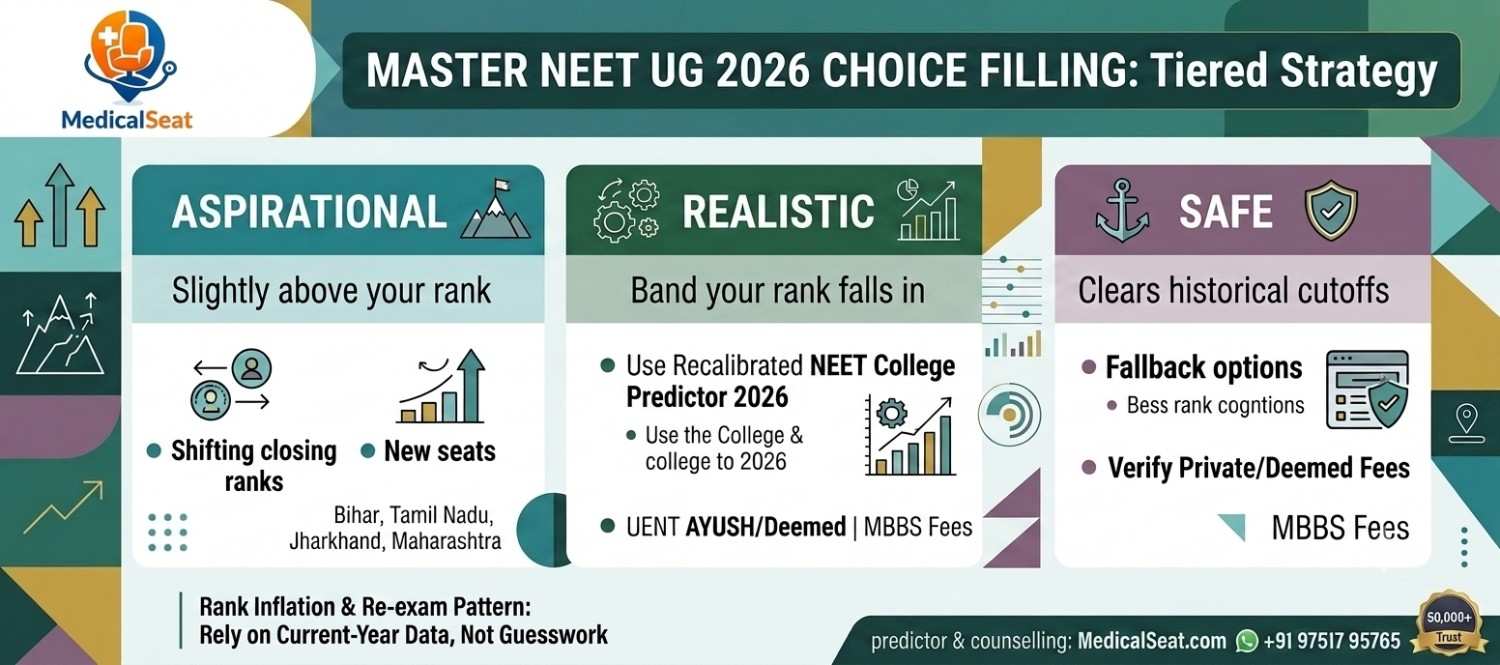
NEET UG 2026 Choice Filling Strategy: Aspirational, Realistic & Safe Choices Explained
Master NEET UG 2026 choice filling with aspirational, realistic, and safe college choices — backed by rank predictors, cutoffs, and state-wise data.
NEET UG 2026 Choice Filling Strategy: Aspirational, Realistic & Safe Choices Explained
Every year, thousands of NEET UG aspirants lose a round of counselling not because their rank was bad, but because their choice filling was badly ordered. They either aimed too high and wasted rounds chasing a medical seat that was never realistically in reach, or they played it too safe and locked into a college far below what their rank could have fetched. In a year shaped by the re-exam pattern, this mistake is even easier to make — and even more costly.
This guide breaks down exactly how to structure your NEET UG/PG Counseling 2026 choice list using the three-tier method that every serious counselling expert recommends: aspirational, realistic, and safe choices. We'll also walk through NEET rank vs college data, NEET closing ranks, state-specific targets like Bihar, Tamil Nadu, Jharkhand, and Maharashtra, and how to use a reliable NEET rank predictor and NEET college predictor before you touch the choice-filling screen.
Why Choice Filling Strategy Matters More in 2026
This year's NEET Counseling 2026 cycle comes with an added layer of complexity. The re-neet rank predictor 2026 search trend spike itself tells the story — aspirants are unsure how the re-exam has shifted NEET closing ranks compared to previous years. Historical cutoff data, which used to be a safe reference point, is far less dependable in a year where the score-to-rank curve has genuinely changed.
This means two things for your choice filling strategy:
You cannot rely purely on last year's NEET closing ranks to predict this year's outcomes.
You need a medical college predictor India trusts — one that's been recalibrated for the actual re-exam rank distribution, not the old pattern.
This is exactly the gap a proper NEET rank predictor 2026 and NEET college predictor are built to close. Before filling a single choice, run your score through the NEET rank predictor and cross-check your standing with the NEET UG 2026 rank predictor tool so your entire choice list is built on this year's real numbers, not assumptions.
The Three-Tier Choice Filling Framework
MBBS admission guidance counsellors across India generally agree on one structure for building a NEET UG 2026 choice list: split your choices into three tiers — Aspirational, Realistic, and Safe. Each tier plays a different role in your counselling strategy, and skipping any one of them is where most students go wrong.
1. Aspirational Choices
These are colleges slightly above what your current rank would normally get you — the ones you'd take if a NEET closing rank shifts favorably in your category this year, or if seat matrix increases (which have genuinely happened this cycle) open up an unexpected opportunity. Aspirational choices should sit at the top of your list, but they shouldn't dominate it. A good rule: no more than 15–20% of your total choices should be aspirational.
To identify realistic aspirational targets, don't guess — compare your NEET rank vs college standing against actual historical closing-rank bands. If your rank is close to the 10,000 mark, study the rank 10,000 college data closely; if you're near 15,000, the rank 15,000 breakdown shows which government and private medical colleges have historically closed in that range.
2. Realistic Choices
This is the backbone of your list — colleges where your rank falls comfortably within the typical admission band based on recent trends. This is where the majority of your choice filling (roughly 50–60%) should be concentrated. For aspirants in the 25,000 rank zone, the rank 25,000 resource is a useful reference for realistic government and private medical colleges, while those closer to 75,000 should check the rank 75,000 data to see where private and deemed college options open up.
3. Safe Choices
These are colleges where your rank comfortably clears the historical cutoff — your guaranteed fallback if higher tiers don't work out. Every serious NEET counseling guide stresses that skipping safe choices is the single biggest reason students end up with zero seats after multiple rounds. If your rank sits closer to the 300,000 mark, don't assume there's nothing available — the rank 300,000 resource shows there are still medical colleges in India, largely among private and deemed institutions, worth including as safe anchors.
Understanding NEET Rank vs College: Why the Gap Is Confusing This Year
The NEET rank vs college relationship is not linear, and this year it's been further complicated by what many are calling rank inflation — a pattern where a similar raw score corresponds to a different, often higher, rank than in previous years because of the re-exam's altered difficulty curve. If you scored around 650 marks and are unsure what that actually means for your All India Rank this cycle, this detailed breakdown of the 2026 rank inflation trend at a 650 score is essential reading before you even start choice filling.
Also worth checking: aspirants around the 5,000 rank mark are seeing meaningfully different outcomes this year compared to prior cycles. The rank 5,000 college data lays out exactly what's changed.
State-Wise Choice Filling: Bihar, Tamil Nadu, Jharkhand, Maharashtra
Choice filling isn't just about rank — it's about matching rank to state quota realities. Here's what to keep in mind for a few high-demand states:
Bihar has a relatively smaller pool of government medical colleges compared to its aspirant base, which pushes many students toward private and deemed colleges both within the state and through the All India Quota.
Tamil Nadu runs one of the most structured state counselling systems in the country, with a strong mix of government and private medical colleges — but domicile and language-medium rules matter, so cross-check eligibility before ranking your choices.
Jharkhand has a smaller total seat count, meaning realistic and safe choices here often need to extend into neighboring-state private options or deemed universities.
Maharashtra has one of the largest medical seat pools in India across both government and private medical colleges, giving aspirants more room to build a genuinely tiered list without over-relying on aspirational picks.
Whatever state you're targeting, the underlying principle is the same: verify current-year seat counts and NEET closing ranks for that state specifically, rather than applying a national average to a state-specific decision.
Don't Forget Private, Deemed, and AYUSH Options
A complete MBBS admission guidance strategy doesn't stop at MBBS. If your rank places you outside comfortable MBBS territory, AYUSH courses (BAMS, BHMS, BUMS) through deemed and private colleges are a serious, often underused, safe-tier option. Run your score through the AYUSH college predictor to see exactly where you stand for BAMS, BHMS, and other AYUSH programs before ruling them out of your list entirely.
Similarly, MBBS fees India-wise vary enormously between government, private, and deemed medical colleges — often by several lakhs per year. Don't add a private or deemed college to your safe-choice tier without first checking its fee structure; a "safe" choice that's financially out of reach isn't actually safe.
How Many Total Choices Should You Fill?
NEET UG 2026 counselling allows a large number of choices to be filled, and conventional wisdom among NEET counseling experts is simple: fill as many as your patience allows, correctly tiered. A short list built only on "top picks" is the fastest way to end up with no allotment. Use the full three-tier structure — aspirational, realistic, safe — across every eligible government and private medical college, deemed university, and, where relevant, AYUSH option, all mapped against verified NEET closing ranks for this year specifically.
Conclusion
NEET UG 2026 choice filling isn't a one-shot guess — it's a structured decision built on real, current-year data. Aspirational choices give you upside, realistic choices form your core strategy, and safe choices protect you from losing a round entirely. Layer in state-specific targets like Bihar, Tamil Nadu, Jharkhand, and Maharashtra, factor in private, deemed, and AYUSH pathways, and check your numbers against this year's actual NEET rank vs college trends — not last year's.
Get Your Real Rank and College Match Before Counselling Opens
Every guess costs you a round. Head to MedicalSeat.com and run your score through a rank and college predictor that's actually calibrated for this year's re-exam pattern — MBBS, MDS, INI CET, and AYUSH, all in one place.
Talk to a counselling expert directly: 📞 +91 97517 95765 📧 support@medicalseat.com
Free to start · Trusted by 50,000+ NEET aspirants
Frequently Asked Questions
1. What is the difference between aspirational, realistic, and safe choices in NEET UG 2026 choice filling? Aspirational choices are colleges slightly above your expected reach based on your NEET rank, realistic choices match your rank to typical closing-rank bands, and safe choices are colleges where your rank comfortably clears historical cutoffs. A balanced NEET UG 2026 list needs all three tiers — leaning only on aspirational or only on safe choices increases your risk of an unfavorable outcome.
2. How accurate is a NEET rank predictor for the 2026 re-exam pattern? A NEET rank predictor 2026 is only as reliable as the data it's calibrated on. Because the re-exam pattern has shifted score-to-rank distribution this year, using a predictor recalibrated specifically for re-neet 2026 — like the one on MedicalSeat.com — gives a far more accurate picture than relying on older, unadjusted models or last year's cutoffs.
3. Should I include private and deemed medical colleges in my safe-choice list? Yes — private and deemed medical colleges are often essential safe-tier anchors, especially for aspirants whose rank doesn't fall within comfortable government medical college cutoffs. Just make sure to verify MBBS fees India-wise for each institution before including it, since affordability is as important as admission probability when a college is meant to be your fallback.
4. What if my NEET UG rank doesn't fit MBBS anywhere — are there other options? Yes. If your rank places you outside realistic MBBS range, AYUSH courses like BAMS and BHMS through recognized deemed and private colleges are a strong alternative worth including in your choice list. You can check exactly where you stand using the AYUSH college predictor before finalizing your strategy.