 Neet Rank Predictor
 NEET UG Predictor
 MDS Predictor
 INI CET Predictor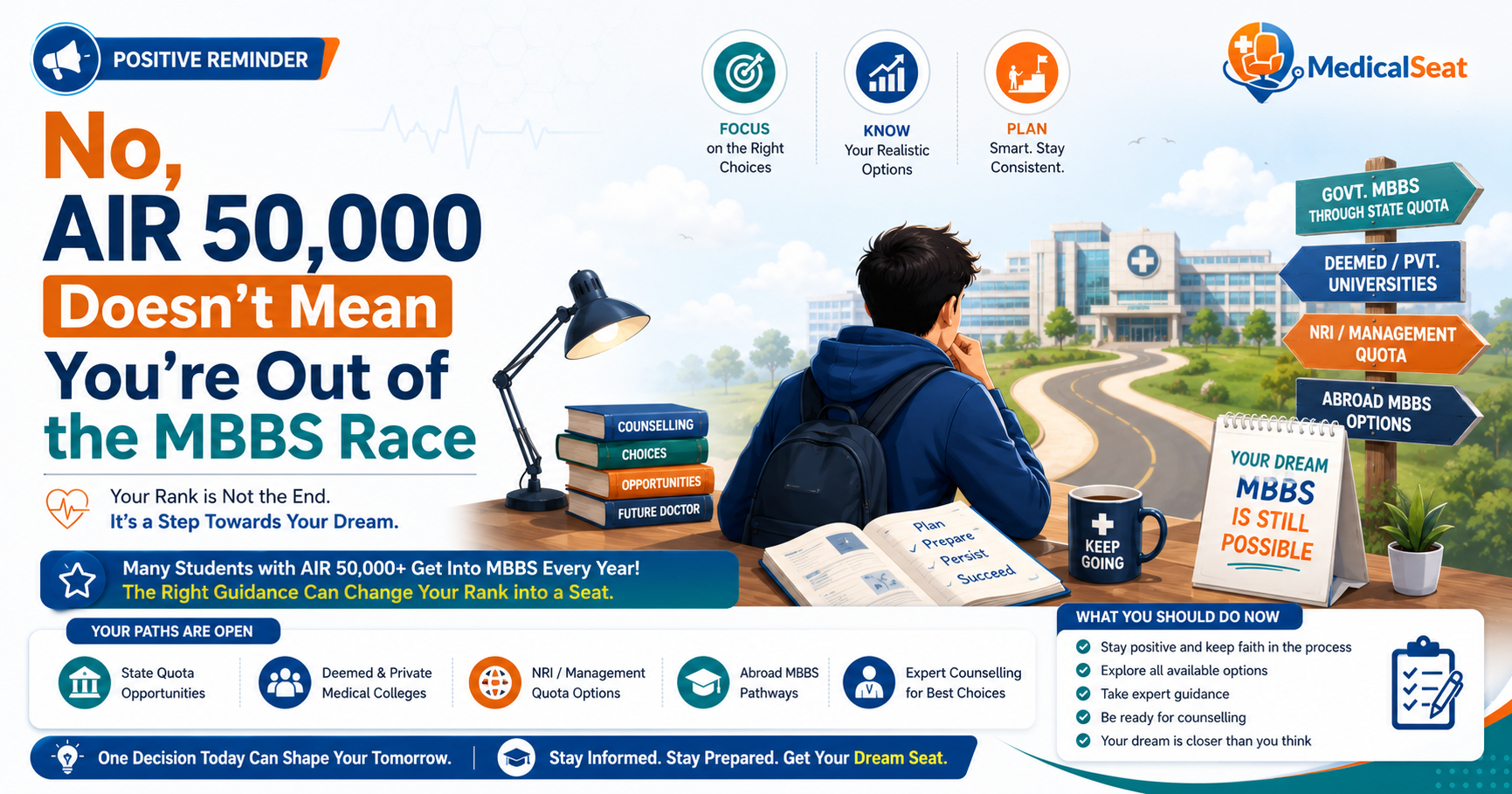
No, AIR 50,000 Doesn't Mean You're Out of the MBBS Race
If your NEET UG rank landed around AIR 50,000, you've probably already heard some version of "that's basically out of the MBBS race." It isn't true — and repeating it to yourself (or hearing it from well-meaning relatives) does more harm than good. AIR 50,000 is a real inflection point, not a dead end. It changes which pathway is realistic, not whether a medical career is possible. This guide lays out exactly what options exist at this rank, honestly, with no false hope and no unnecessary despair.
If your NEET UG rank landed around AIR 50,000, you've probably already heard some version of "that's basically out of the MBBS race." It isn't true — and repeating it to yourself (or hearing it from well-meaning relatives) does more harm than good.
AIR 50,000 is a real inflection point, not a dead end. It changes which pathway is realistic, not whether a medical career is possible. This guide lays out exactly what options exist at this rank, honestly, with no false hope and no unnecessary despair.
Quick Facts Box
Pathway | Realistic at AIR ~50,000? |
AIQ government MBBS (15% quota) | Very difficult, rank-dependent by category |
State Quota government MBBS | Realistic in several states, especially for reserved categories |
Private/Deemed MBBS | Realistic, fee-dependent |
Government BDS | Often realistic at this rank |
Government AYUSH (BAMS/BHMS) | Very realistic, low or zero fees |
MBBS abroad | Realistic, lower cost than Indian private MBBS in many cases |
Structured repeat attempt | A legitimate option, not a failure |
Featured Snippet Answer
Can I get an MBBS seat with AIR 50,000 in NEET UG? Yes. While AIR 50,000 makes AIQ government seats very competitive, candidates in this range regularly secure MBBS seats through State Quota counselling (especially in reserved categories or less-competitive states), private and deemed medical colleges, or pursue government BDS and AYUSH courses as strong alternative paths. It also remains a reasonable rank to consider a focused, well-planned repeat attempt.
Why AIR 50,000 Feels Like the End (It Isn't)
AIR 50,000 has become something of a psychological line in NEET counselling conversations — treated as the point where "government college" starts sounding impossible and "private college" starts sounding inevitable. Career counsellors describe it as an important milestone precisely because it's the range where the picture genuinely shifts from mostly AIQ options to mostly state-quota and private options — not because opportunities disappear.
Did You Know? Out of India's total MBBS, BDS, and AYUSH seat pool — well over 2 lakh seats combined across MBBS, BDS, AYUSH, and other health science courses — the vast majority are filled through State Quota, private, deemed, and AYUSH counselling, not just the 15% AIQ pool most students fixate on.
Pathway 1: State Quota Government Colleges
This is the single most underused strategy at this rank range. State Quota counselling (85% of government MBBS seats) is handled separately by each state and, for domicile-holding candidates, frequently opens government college doors that look closed under AIQ.
Comparison Table: AIQ vs State Quota at AIR ~50,000
Factor | AIQ (15%) | State Quota (85%) |
Domicile requirement | Not required | Usually required |
Competitiveness at AIR 50,000 | Very high | Meaningfully lower in many states |
Fee structure | Government-subsidized | Government-subsidized |
Category advantage | Central reservation applies | Often larger reserved-category advantage |
Expert Tip: A candidate with domicile in a less exam-saturated state can sometimes access a government college through State Quota at a rank where the same category, applying only through AIQ, would have no realistic chance. Always run your State Quota numbers separately — never assume your AIQ prospects define your full picture.
Pathway 2: Deemed and Private Medical Colleges
At AIR 50,000, private and deemed university MBBS seats become genuinely realistic — this is, in fact, considered a strong rank range for accessing well-established private and deemed institutions.
The Money Reality: Private MBBS total program costs vary widely, often running from several tens of lakhs to over a crore of rupees across the full course, depending on the state, city, and specific institution — a significant difference from government college costs, and a decision that needs an honest, family-level financial conversation (see our related guide on choosing between government and private MBBS).
Checklist: Before Committing to a Private/Deemed Seat
Confirm current NMC recognition status of the college
Verify the actual, currently notified fee structure (not last year's numbers)
Check hospital patient load and clinical infrastructure
Review the college's historical NEET PG outcomes
Pathway 3: BDS in Government Dental Colleges
Government BDS seats use the same NEET UG rank and typically carry a considerably lower cutoff than MBBS at the same college or state. For AIR 50,000 candidates unwilling to pay private MBBS fees, government BDS is often a realistic, low-cost route into a health sciences career — with the option to pursue MDS specialization later.
Did You Know? BDS graduates who pursue MDS specialization in fields like orthodontics, oral surgery, or prosthodontics can build strong, well-respected clinical careers — dentistry is a legitimate primary path, not just a fallback.
Pathway 4: AYUSH Courses (BAMS, BHMS)
Government AYUSH colleges (BAMS – Ayurveda, BHMS – Homeopathy, and related courses) have significantly lower cutoffs than MBBS or BDS, and government AYUSH seats often come at little to no fee.
Pro Tip: If your priority is a recognized medical/healthcare degree at minimal financial burden, and you're open to AYUSH systems of medicine, this is one of the most underrated realistic pathways at this rank — not a last resort, but a genuine professional track with its own registration, practice rights, and specialization options.
Pathway 5: MBBS Abroad
MBBS programs at recognized universities in countries like Russia, the Philippines, Georgia, and Kazakhstan are a realistic option at this rank, often at a lower total cost than an Indian private MBBS seat.
Important Update: If considering this route, thoroughly research the university's FMGE (Foreign Medical Graduate Examination) pass rates before committing — the ability to practice in India after graduating abroad depends on clearing this licensing exam, and pass rates vary significantly between universities.
Checklist: MBBS Abroad Due Diligence
University recognized by India's National Medical Commission for the purpose of practicing in India
Verified, university-specific FMGE pass rate data (not agent claims)
Clarity on medium of instruction and clinical exposure quality
Full cost breakdown including living expenses, not just tuition
Pathway 6: A Structured Repeat Attempt
If your target was genuinely close and preparation gaps are identifiable and fixable, a focused, time-bound repeat attempt for the next NEET UG cycle remains a legitimate choice — not a sign of failure.
Common Mistakes to Avoid:
Deciding to repeat purely out of family or peer pressure, without an honest assessment of realistic rank improvement.
Repeating without a structured plan — same routine, same gaps, expecting a different result.
Treating a repeat attempt as the only respectable option, when several of the pathways above are equally valid career starts.
Comparing All Six Pathways Side by Side
Comparison Table: Pathway Trade-Offs at AIR ~50,000
Pathway | Cost | Time to Start | Best For |
State Quota government MBBS | Low | Immediate | Domicile candidates in less-saturated states/categories |
Private/Deemed MBBS | High | Immediate | Families with financial capacity, wanting to start now |
Government BDS | Low | Immediate | Candidates open to dentistry as a primary career |
Government AYUSH | Very low/zero | Immediate | Candidates prioritizing minimal fees and AYUSH interest |
MBBS abroad | Moderate | Immediate | Candidates comfortable relocating, willing to plan FMGE prep |
Structured repeat attempt | Time cost (1 year) | Delayed | Candidates with a clear, fixable preparation gap |
Common Mistakes AIR 50,000 Candidates Make
Only checking AIQ cutoffs and concluding "no government college is possible" without ever running State Quota numbers.
Assuming private MBBS is unaffordable without actually checking current fee structures across different states and colleges.
Dismissing BDS or AYUSH as failures rather than legitimate, respected healthcare career paths.
Choosing an unrecognized or poorly vetted foreign university based on agent pressure rather than verified FMGE outcome data.
Deciding to repeat emotionally, without a structured plan or honest rank-improvement assessment.
A Decision Checklist for This Rank Range
Have you checked your State Quota cutoff trend separately from AIQ?
Do you know your family's real financial ceiling for a private/deemed seat?
Have you seriously considered government BDS or AYUSH as primary options, not just fallbacks?
If considering MBBS abroad, have you verified the specific university's FMGE pass rate?
If considering a repeat attempt, do you have a concrete, structured preparation plan, not just intention?
Key Takeaways
AIR 50,000 does not end your MBBS or healthcare career possibilities — it shifts which pathway is realistic.
State Quota counselling is the most underused lever at this rank; always evaluate it separately from AIQ.
Private and deemed MBBS colleges become genuinely realistic at this rank, provided the family's finances can support it.
Government BDS and AYUSH courses are legitimate, respected primary career paths at this rank — not consolation prizes.
MBBS abroad and a structured repeat attempt are both valid choices when approached with real due diligence and planning, not desperation or pressure.
People Also Ask
What is a good NEET rank for government MBBS through State Quota?
Can AIR 50,000 get a seat in a deemed university?
Is BDS better than private MBBS for a NEET rank around 50,000?
Which countries are best for MBBS abroad after NEET?
Is it worth repeating NEET UG at AIR 50,000?
Conclusion
AIR 50,000 is a real turning point in NEET counselling — but it's a fork in the road, not a wall. Candidates in this range regularly build strong, respected healthcare careers through State Quota government colleges, private and deemed institutions, government BDS and AYUSH courses, MBBS abroad, or a focused repeat attempt. The mistake isn't landing at this rank — it's assuming it closes doors that are, in fact, still open.
Compare State Quota cutoffs, private college fee structures, and BDS/AYUSH options for your exact rank range on MedicalSeat to find the pathway that actually fits your situation.