
 Neet Rank Predictor
 NEET UG Predictor
 MDS Predictor
 INI CET Predictor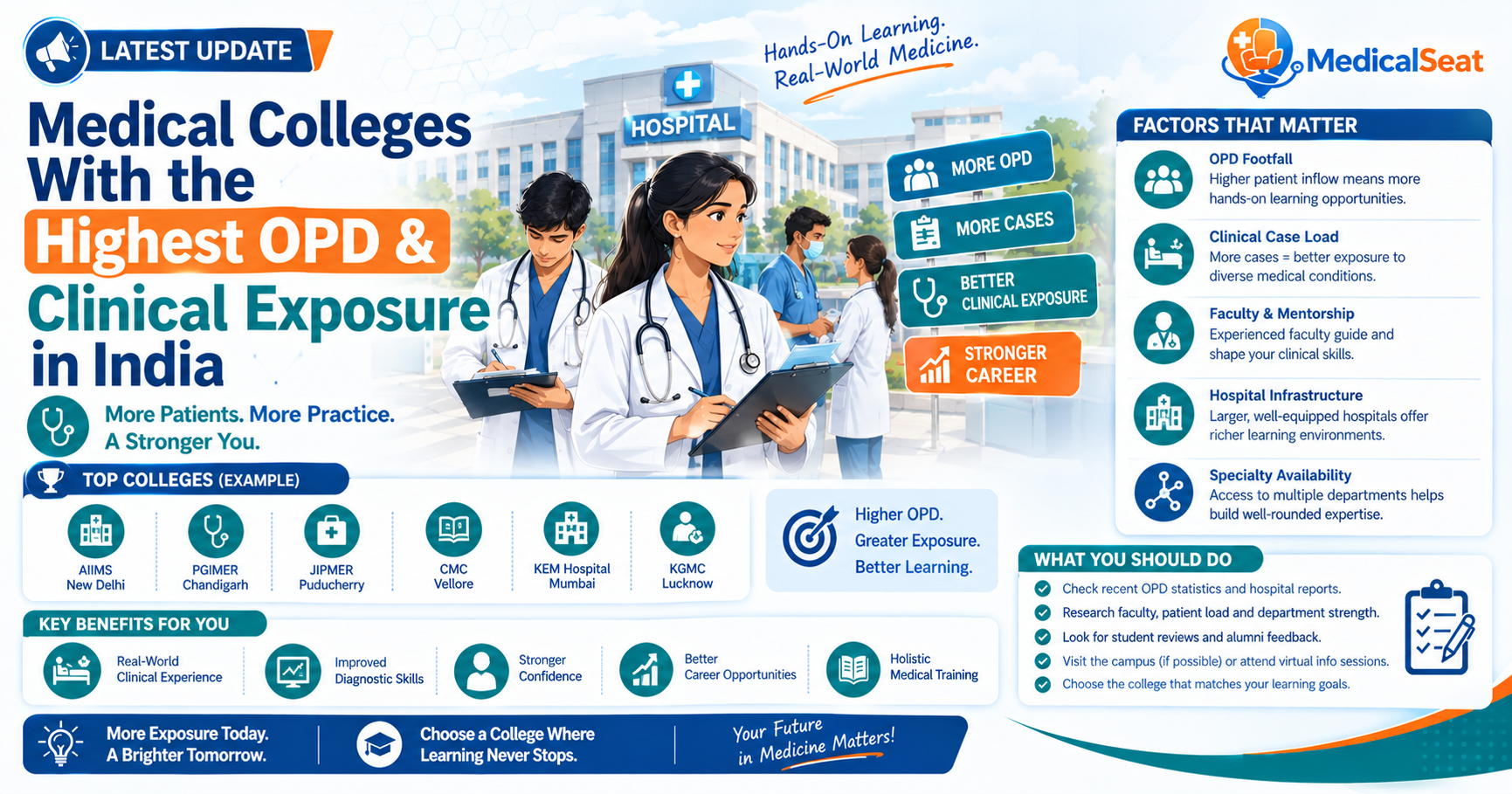
Medical Colleges With the Highest OPD & Clinical Exposure in India
Ask any senior doctor which factor shaped their clinical confidence most during MBBS, and very few will say "my college's NIRF rank." Most will point to something else entirely: how many real patients they examined, how varied the cases were, and how much hands-on responsibility they were trusted with early on.
Ask any senior doctor which factor shaped their clinical confidence most during MBBS, and very few will say "my college's NIRF rank." Most will point to something else entirely: how many real patients they examined, how varied the cases were, and how much hands-on responsibility they were trusted with early on.
This guide looks specifically at OPD volume and clinical exposure across some of India's most prominent central institutes and private medical colleges — a distinct lens from state-run government college patient load, which we've covered separately. If you're weighing AIIMS, JIPMER, CMC Vellore, or BHU against each other (or against a strong state government college), this is the comparison that actually matters for your training years.
Quick Facts Box
Institution | Type | Reported Patient Volume |
AIIMS, New Delhi | Central Institute | Around 4,500 OPD patients daily (as reported) |
JIPMER, Puducherry | Central Institute | Over 1.8 million outpatient visits annually |
CMC Vellore | Private (Christian minority-aided) | Over 8,000 patients daily (as reported) |
IMS-BHU, Varanasi | Central University | Around 2,500+ patients daily at Sir Sunderlal Hospital |
Featured Snippet Answer
Which medical colleges in India have the highest OPD and clinical exposure? AIIMS New Delhi, JIPMER Puducherry, CMC Vellore, and IMS-BHU Varanasi are consistently cited for very high daily patient volumes and strong clinical exposure, alongside major state government teaching hospitals like Safdarjung, Madras Medical College, and PGIMER. Reported figures vary by source and year, so always verify current numbers directly with the institution before making a decision.
AIIMS, New Delhi
India's top-ranked medical institute isn't just an academic powerhouse — its hospital reportedly handles around 4,500 OPD patients daily, alongside more than 100 research departments and regular collaboration with international health bodies like the WHO. The scale and complexity of cases referred to AIIMS from across the country give students exposure to conditions rarely seen at smaller institutions.
Did You Know? AIIMS's referral status means it doesn't just see high volume — it sees a disproportionately high share of complex, difficult-to-diagnose cases sent from smaller hospitals nationwide, adding a unique dimension to clinical exposure beyond raw numbers.
JIPMER, Puducherry
JIPMER is frequently described as having one of the largest OPDs in India, with hospital records showing over 1.8 million outpatient visits annually — averaging out to nearly 5,000 patients a day. As an autonomous central institute combining academics, research, and clinical service, JIPMER offers students real-time exposure to a high volume of cases across general and specialty departments.
Expert Tip: JIPMER's structure as a combined teaching-research-service institute means clinical exposure here often comes paired with strong exposure to structured academic case discussions — useful if you're weighing hands-on volume against academic depth.
Christian Medical College, Vellore
CMC Vellore, established in 1900, is reported to treat over 8,000 patients daily, blending rigorous academics with a strong community healthcare and service-oriented mission. Despite being a private, minority-aided institution, its fees remain comparatively low (historically cited around ₹85,000/year), and it consistently ranks among India's top few institutions in NIRF's medical category — with many practitioners specifically citing its clinical training quality as best-in-class.
Comparison Table: What Makes CMC's Exposure Distinct
Feature | Why It Matters |
High daily patient volume | Broad, varied case exposure similar to top government institutes |
Service-oriented mission | Strong emphasis on ethics, community health, and patient-first training culture |
Long institutional history (est. 1900) | Deep, established clinical protocols and mentorship culture |
Comparatively affordable fees for a private college | Reduces the usual private-college affordability trade-off |
Institute of Medical Sciences (IMS), BHU, Varanasi
The Sir Sunderlal Hospital at BHU is reported to see over 2,500 patients daily, offering strong clinical training within one of India's oldest and most respected central universities. While its OPD volume is comparatively lower than AIIMS, JIPMER, or CMC Vellore, it remains a well-regarded option combining solid clinical exposure with a historic academic environment and highly competitive admission.
Government State Colleges Worth Checking Separately
Several state-run government medical colleges also report extremely high OPD volumes and deserve equal consideration alongside the central institutes and CMC above — we've profiled these in detail separately since the data and context differ meaningfully by state:
Safdarjung Hospital / VMMC, Delhi — one of the largest hospitals under the Ministry of Health and Family Welfare
Madras Medical College & Rajiv Gandhi Government General Hospital, Chennai — India's oldest hospital, historically reporting around 12,000 outpatients daily
PGIMER, Chandigarh — a major northern-India tertiary referral center with OPD footfall reported surpassing 10,000 daily
King George's Medical University, Lucknow — a high-demand state institution serving Uttar Pradesh and neighboring regions
Important Update: See our dedicated guide on government medical colleges by hospital patient load for a full breakdown of these institutions, including bed strength and department-specific highlights.
Central Institutes vs State Government Colleges vs Private: A Clinical Exposure Lens
Comparison Table: Three Institution Types, Compared on Clinical Exposure
Factor | Central Institutes (AIIMS, JIPMER) | State Government Colleges (Safdarjung, MMC) | Top Private (CMC Vellore) |
Referral complexity | Very high — draws complex cases nationally | High — draws regionally, especially in metro cities | High, with strong ethics/service focus |
Fee structure | Very low | Very low | Low for a private institution, but higher than government |
NEET rank required | Extremely competitive | Highly competitive, varies by state | Extremely competitive |
Research emphasis | Very strong | Varies by institution | Strong, service-integrated |
Key Takeaways Box
Central institutes tend to combine high volume with high case complexity due to their national referral role.
Large state government hospitals often match or exceed central institutes in raw daily volume, particularly in metro areas.
Strong private institutions like CMC Vellore show that high patient volume and quality training aren't exclusive to government-run institutions.
What "High OPD" Doesn't Guarantee
Common Mistakes to Avoid:
Assuming high OPD automatically means more student involvement — at extremely high-referral institutes, complex cases are sometimes primarily managed by senior residents and specialists, with undergraduate involvement varying by department and rotation.
Ignoring department-specific variation — a college's overall OPD number doesn't tell you whether your specific area of interest (say, dermatology or psychiatry) gets proportionate exposure.
Overlooking teaching quality and faculty engagement, which shapes how much of that patient volume translates into genuine learning versus passive observation.
Assuming a single reported figure is current — OPD numbers shift with hospital expansions, referral pattern changes, and population growth.
How to Independently Verify OPD and Clinical Exposure Data
Checklist: Verifying Clinical Exposure Claims
Check the hospital's own annual report or official website for OPD/IPD statistics
Look for recent (not decade-old) news coverage or government data releases
Ask current students specifically about ward responsibilities and hands-on involvement, not just OPD numbers
Ask about department-specific patient volume if you have a specialty interest
Cross-check claims across at least two independent sources, since figures often vary by source and year
Common Mistakes When Comparing Colleges on This Basis
Comparing an annual figure to a daily figure without converting them to the same basis.
Treating "high OPD" as interchangeable with "high ranking" — they measure different things.
Choosing based on outdated statistics found on unofficial aggregator sites.
Not weighing case complexity alongside volume — a referral center's cases differ meaningfully from a general OPD's typical case mix.
Ignoring first-hand student accounts, which often reveal more about actual day-to-day exposure than any published number.
Checklist: Evaluating Clinical Exposure Before You Choose
Confirm recent OPD and IPD volume figures directly from the institution
Understand whether the hospital functions as a general community hospital or a complex-case referral center
Check department-specific exposure if you already have a specialty interest
Talk to at least two current students about actual hands-on responsibility, not just numbers
Weigh clinical exposure alongside faculty engagement, infrastructure, and NEET PG outcomes — not in isolation
Key Takeaways
AIIMS Delhi, JIPMER Puducherry, CMC Vellore, and IMS-BHU are consistently cited among India's highest-volume institutions for OPD and clinical exposure, alongside major state government hospitals covered separately.
CMC Vellore proves that top-tier clinical training isn't exclusive to government institutions — it combines high patient volume with a strong service-oriented, affordable model despite being private.
Central institutes tend to see more complex, referral-heavy cases, while large state hospitals often match or exceed them in raw volume, especially in metro cities.
High OPD numbers don't automatically mean high student involvement — department-specific exposure and faculty engagement matter just as much.
Always verify current data independently rather than relying on a single, possibly outdated statistic.
People Also Ask
What is JIPMER's annual OPD patient volume?
Is CMC Vellore better than AIIMS for clinical training?
How many patients does AIIMS Delhi see daily?
Which is better for MBBS clinical exposure — government or private colleges?
What is the OPD footfall at BHU's Sir Sunderlal Hospital?
Conclusion
When it comes to clinical exposure, India's central institutes, top state government hospitals, and leading private colleges like CMC Vellore all have genuinely strong cases to make — each with a slightly different flavor of exposure, from AIIMS and JIPMER's complex referral caseloads to CMC's service-oriented volume and BHU's historic academic environment. The right fit depends less on chasing the single highest number and more on matching your priorities — case complexity, hands-on involvement, department-specific strength, and affordability — to what each institution genuinely offers.
Compare OPD volume, clinical exposure data, and NEET cutoffs across central institutes, government colleges, and top private colleges on MedicalSeat to find your best fit.