
 Neet Rank Predictor
 NEET UG Predictor
 MDS Predictor
 INI CET Predictor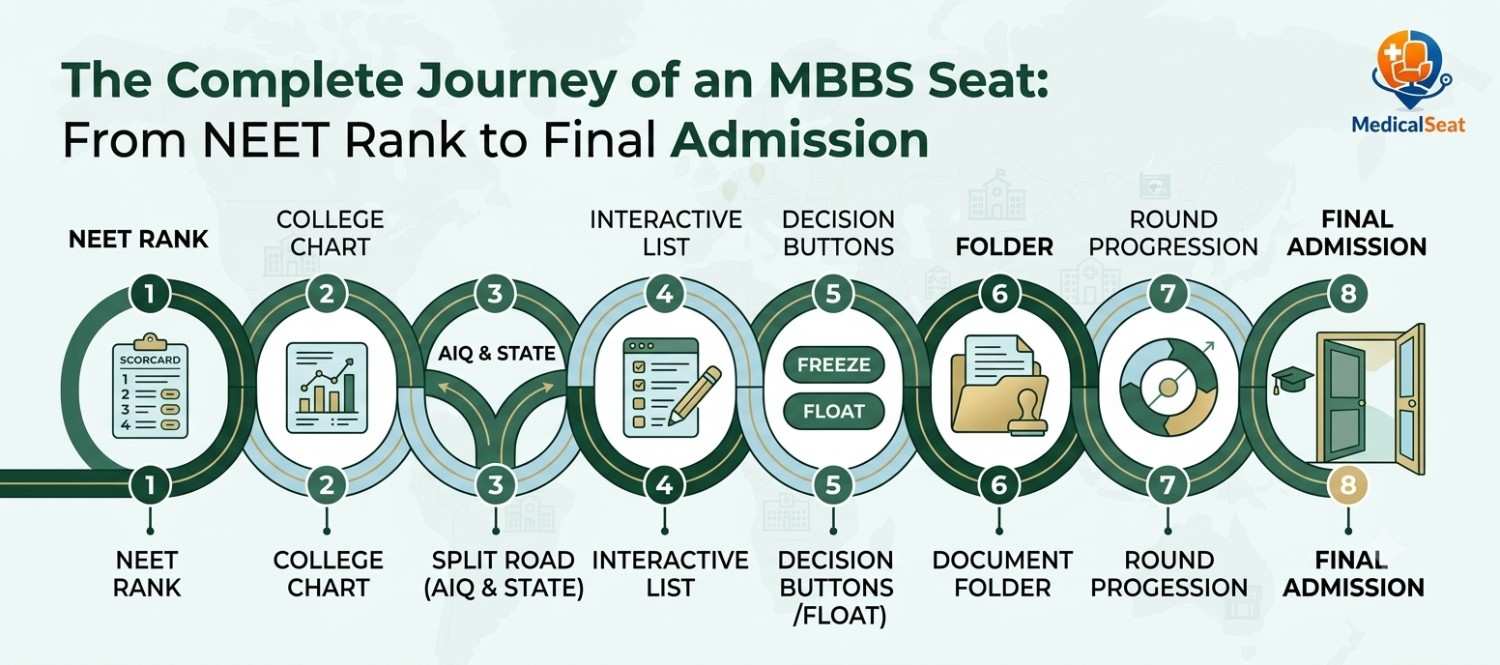
The Complete Journey of an MBBS Seat: From NEET Rank to Final Admission
The complete NEET UG counselling journey explained — from rank and predictor to choice filling, freeze/float/slide, and final MBBS admission.
Clearing NEET UG feels like the finish line. It isn't. It's the starting gun for a second, longer process that decides which of India's medical colleges you actually end up sitting in a classroom at. That process, NEET counseling, has more moving parts than most aspirants expect, and understanding the full sequence before it starts is the single best thing you can do for yourself right now.
This is the complete path a rank travels, from the moment your scorecard lands to the day you walk into your college for document verification, with the specific decision points where most students either gain an edge or lose one.
Step 1: The Result Becomes a Rank
Your NEET UG scorecard gives you raw marks, a percentile, and an All India Rank. In a re-exam year like this one, this step matters more than usual: your score to rank mapping this year does not track cleanly onto 2024 or 2025 data, because the re-conducted exam has shifted how scores distribute across the candidate pool. If you're relying on last year's NEET closing ranks as a benchmark, treat that number as a rough starting point, not a fixed reference.
MedicalSeat's breakdown of the NEET UG 2026 result statistics and their analysis of rank inflation around the 650 score band are both worth reading at this stage, before you build any expectations around a specific college.
Step 2: Rank Becomes a Shortlist
This is where a NEET rank predictor actually does useful work. Not by promising you an exact seat, no legitimate tool can do that, but by translating your marks and category into a realistic band of colleges out of the roughly 823 medical institutions currently operating across India. A predictor built for a normal year quietly assumes normal-year score distributions; this year, you specifically want one calibrated for the re-exam pattern.
MedicalSeat.com's predictor is built around exactly that, and covers MBBS, MDS, INI CET, and AYUSH counselling in a single tool. If you're also weighing postgraduate options, there's a dedicated MDS predictor and an INI CET predictor for AIIMS and JIPMER PG seats. Their explainer on how a free rank and college predictor actually works is a good five-minute read if you want to understand what's happening under the hood before you trust any output, from any provider.
Step 3: Two Parallel Registrations, Not One
Here's the part that trips up almost every first-time aspirant. There is no single counselling process. There are two, running simultaneously:
MCC (All India Quota): covers 15% of every government college's seats, plus 100% of deemed universities, central universities, AIIMS, JIPMER, ESIC and AFMC seats, open to any candidate nationally with no domicile requirement
Your state counselling authority: covers the remaining 85% of government seats (usually domicile restricted) plus almost all private and management quota seats in medical colleges in India specific to that state
Registering for one does not affect your eligibility for the other, and most successful candidates register on both portals immediately after result declaration rather than waiting to see how Round 1 goes.
Step 4: Choice Filling Is Strategy, Not Wish-Listing
Once registered, you fill an ordered list of colleges and courses, typically 20 to 30-plus choices across MCC and your state portal combined. This step decides more of your outcome than people realise, because the allotment algorithm works strictly down your list in order against your rank; it will never skip past a lower preference to give you a college you ranked higher unless you actively upgrade later.
A medical college predictor India tool helps here by giving you a realistic base to build the list around, rather than filling 30 choices based on name recognition alone. A shortlist built purely off reputation, without checking realistic closing ranks for your category, is one of the most common ways students waste their higher-preference slots on colleges that were never within reach.
Step 5: Allotment, and the Freeze, Float, Slide Decision
After each round, seats are allotted based on rank and choice order. At this point you get a decision to make:
Freeze: you're satisfied with this seat and want to lock it in, no further participation in later rounds
Float: you accept the seat for now but stay in the running for something better in the next round
Slide: available in some state systems, letting you move to a different course or lower-fee seat within the same college without losing your place entirely
This decision has real consequences. Floating keeps your options open but comes with risk of losing your current seat if you don't respond correctly in the next round; freezing gives certainty but ends your chances of moving up. Read your specific counselling authority's rules carefully here, because the exact freeze and float mechanics differ slightly between MCC and individual state boards.
Step 6: Document Verification and Reporting
Once you accept a seat, you report physically (or in some rounds, online followed by physical verification) to the allotted college with original documents: NEET scorecard, admit card, Class 10 and 12 certificates, identity proof, category certificate if applicable, and a domicile certificate for state quota seats. This step is where a paperwork gap, not a rank gap, most often costs students their seat. Keep originals plus several photocopies ready well before your allotment result is out, not after.
Step 7: The Rounds Keep Going
Most years run through Round 1, Round 2, a Mop-Up round, and a final Stray Vacancy round, each opening up seats vacated by students who withdrew, upgraded, or never reported. Seats left vacant in the AIQ deemed or central university pool after Round 2 typically move into a mop-up round, while the very last unfilled seats go to a stray vacancy round, often run directly at the college level with compressed timelines and stricter exit rules; in most systems, you cannot withdraw once allotted a stray vacancy seat.
This is also the stage where NEET UG/PG Counseling 2026 timelines start overlapping for students eyeing both undergraduate and postgraduate pathways down the line, so keeping a calendar of every round's deadline across every portal you registered on genuinely matters.
Step 8: Fee Payment and Final Admission
Once document verification clears, you pay the applicable tuition and complete the college's own admission formalities. Most counselling authorities also collect a refundable security deposit at registration, returned to you if you follow the round's rules correctly, so keeping track of what's refundable and what isn't is worth doing before, not after.
Where Private and Deemed Colleges Change the Sequence
Not every college in this journey follows an identical path. A private medical college that is structured as a deemed university skips the state process entirely and runs fully through MCC on a slightly different rounds calendar, often with distinct fee tiers for state quota style seats versus management or NRI seats. A non-deemed private college, by contrast, runs through your state's counselling authority alongside its government colleges. Knowing which of your government & private medical colleges shortlist items falls into which category before choice filling prevents you from missing a registration window on the wrong portal.
Why the National Numbers Matter to Your Personal Journey
As of the NMC's latest 2026-27 seat matrix, India has roughly 1,36,939 total MBBS seats across 823 medical colleges, made up of about 63,296 government MBBS seats and 73,643 private MBBS seats, a jump of nearly 9,911 seats over the prior cycle. Private colleges accounted for close to four-fifths of this year's new capacity. Knowing this split matters because it tells you how much of the competition ahead of you is genuinely national, the AIQ and deemed pool, versus how much is local to your own state's 85% quota and its private colleges.
If your rank sits anywhere near a marginal cutoff, it's also worth tracking newly approved medical colleges, since a fresh college entering the matrix mid-cycle can shift closing ranks by a meaningful margin. For a wider reference on how ranks have historically mapped across roughly 5,000 institutions nationally, MedicalSeat's rank to college resource is a useful cross check, and if budget rather than rank is your binding constraint, their budget focused guide filters options accordingly.
A Practical Checklist for the Journey Ahead
Register on both the MCC portal and your home state's portal as soon as counselling opens
Run your projected score through a predictor built for this year's re-exam pattern before you build your choice list
Order your choices by realistic closing rank for your category, not by name recognition
Understand your counselling authority's exact freeze, float, and slide rules before your first allotment
Keep every document, original and photocopied, ready before results are out, not after
Track deadlines across every portal you registered on, since MCC and state timelines rarely align exactly
Every guess in this process costs you a round, and rounds don't come back once they've closed. Run your score through MedicalSeat.com's predictor built for this year's actual pattern, or talk directly to a counselling expert at +91 97517 95765 or support@medicalseat.com if you'd rather walk through your specific choice list with a person before you lock it.