
 Neet Rank Predictor
 NEET UG Predictor
 MDS Predictor
 INI CET Predictor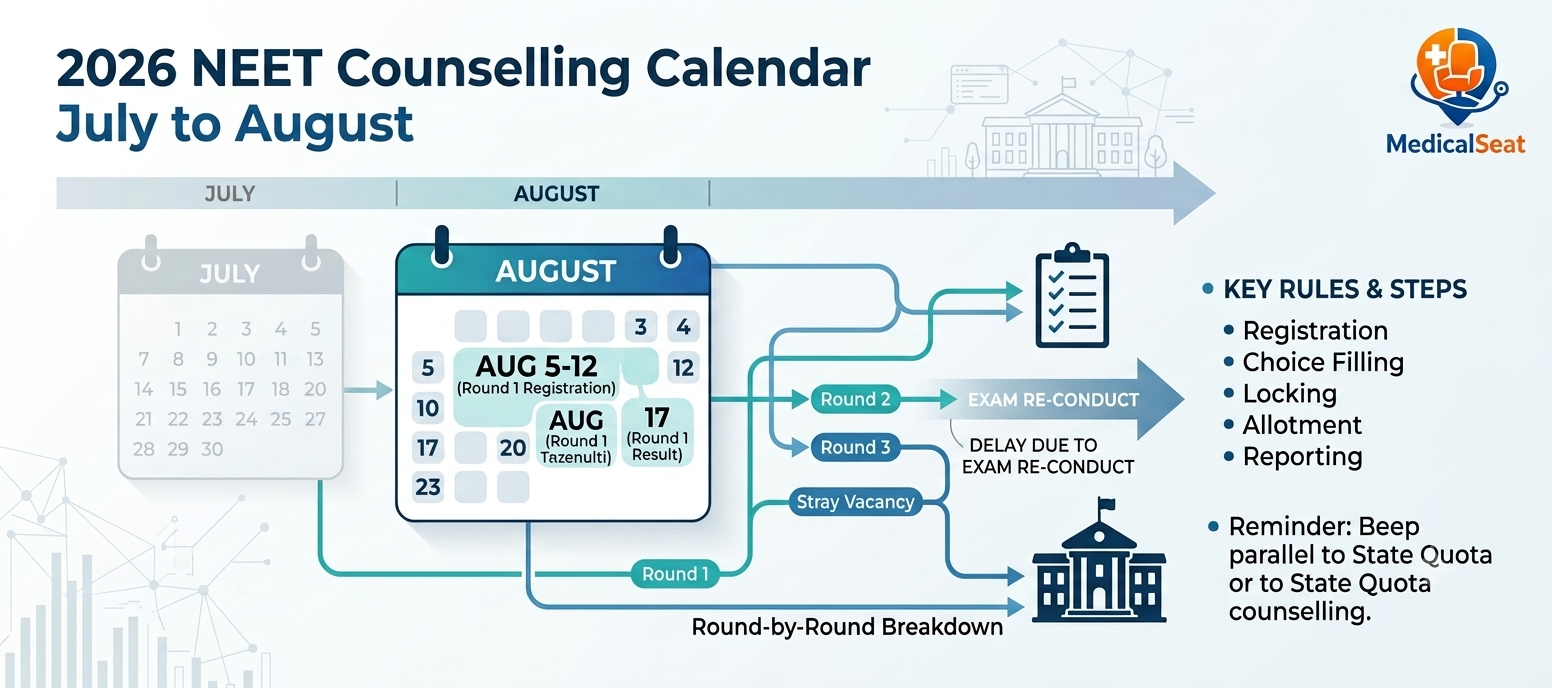
From July to August: How the 2026 NEET Counselling Calendar Got Pushed Back, and What Comes Next
The complete story of NEET UG 2026 counselling — how the calendar compares to 2023-2025, this year's full schedule, and what happens after October.
From July to August: How the 2026 NEET Counselling Calendar Got Pushed Back, and What Comes Next
Every year, one document quietly becomes the most important piece of paper in a NEET aspirant's life: the counselling schedule. Not the result, not the answer key, the schedule. It's the document that turns a rank into a real deadline. This year, the Medical Counselling Committee (MCC) has released that schedule for NEET Counseling 2026, and understanding it properly means understanding not just what's happening this August, but how this year's calendar compares to every cycle before it, and what it sets up for the months ahead.
This is the complete story: where MCC counselling comes from, how this year's schedule was built, exactly what each round involves, why the calendar shifted later than usual, and what happens once the last stray vacancy seat is filled. Treat it as the NEET counseling guide section that ties your NEET rank vs college planning to the actual dates on the calendar, not just the general concept.
Where MCC Counselling Comes From
Before getting into 2026 specifically, it's worth understanding why a centralised body runs any of this at all. All India Quota counselling exists because of a Supreme Court directive from the mid 1980s, which established that a fixed share of government medical college seats nationally should be filled purely on merit, open to candidates from any state, rather than restricted entirely to local domicile pools. That share settled at 15% of government seats, which is why AIQ is still referred to as the "15% quota" today. Over time, MCC's role expanded well beyond that original 15% slice: it now also runs 100% of admissions for Deemed Universities, Central Universities like Delhi University, BHU, and AMU, every AIIMS campus, JIPMER Puducherry and Karaikal, and ESIC medical colleges. NEET Counselling India, in its modern form, is really this dual structure: one national track run by MCC, and 85% of government seats plus most private colleges run separately by each state.
How the Calendar Has Moved Year to Year
Looking at MCC's schedule history tells you a lot about why timing matters so much in a given cycle:
2023: Round 1 registration ran from July 20 to July 25, with results out by July 29, one of the earliest starts in recent years.
2024: The calendar was pushed to mid-August, with counselling only beginning around August 14, largely because that year's own NEET UG exam controversy and a grace-marks re-exam for over 1,500 candidates delayed the final result and score normalisation process.
2025: Round 1 registration began around July 21, closer to the earlier 2023 pattern, with a seat matrix of 775 colleges and roughly 1,14,550 seats across AIQ, Central Institutions, AIIMS, and JIPMER specifically.
2026: Round 1 registration opens August 5, again later than the 2023 and 2025 pattern, and again for a familiar underlying reason, this year's NEET UG exam included its own re-conducted component, which delayed final results and pushed the entire NEET UG/PG Counseling 2026 calendar back by roughly two to three weeks compared to a normal year.
The pattern across all four years tells you something useful: MCC's counselling start date isn't fixed on the calendar, it's anchored to when the exam's final, fully reconciled result is ready. Anything that disrupts a clean single-sitting exam, whether that's a grace-marks dispute in 2024 or a re-exam in 2026, pushes the whole downstream calendar later.
The Full 2026 Schedule, Round by Round
MCC's newly released schedule covers the 15% AIQ track along with 100% of Deemed University, Central University, AIIMS, and JIPMER seats for MBBS, BDS, and B.Sc Nursing admissions for the 2026-27 academic year.
Round 1
Seat matrix verification by institutes: August 4, 2026
Registration and payment: August 5 to August 12, up to 3:00 PM server time (payment accepted until 6:00 PM)
Choice filling: August 6 to August 13, up to 11:00 AM server time
Choice locking: from 4:00 PM on August 12 to 11:00 AM on August 13
Seat allotment processing: August 13 to August 16
Result: August 17
Reporting and joining: August 18 to August 22
Verification of joined candidates by institutes: August 23
Round 2
Registration and payment: August 25 to August 29
Choice filling and locking: August 25 to August 30
Seat allotment processing: August 31 to September 1
Result: September 2
Reporting and joining: September 3 to September 8
Verification of joined candidates: September 9
Round 3
Registration and payment: September 11 to September 15
Choice filling and locking: September 11 to September 16
Seat allotment processing: September 16 to September 17
Result: September 18
Reporting: September 19 to September 26
Verification of joined candidates: September 27
Online Stray Vacancy Round
Registration: September 28 to September 30
Choice filling and locking: September 28 to September 30
Seat allotment processing: October 1 to October 2
Result: October 3
Reporting: October 4 to October 10
Laid end to end, this year's AIQ and deemed university counselling runs from early August through mid-October, roughly ten weeks from Round 1 registration to the final stray vacancy reporting deadline.
What Actually Happens Inside Each Round
For anyone going through this for the first time, it helps to understand what each stage actually involves, not just the dates:
Registration and payment is where you create your MCC account, confirm your NEET UG credentials, and pay the counselling fee plus a refundable security deposit.
Choice filling is where you build an ordered list of colleges and courses you're eligible for. There's no upper limit on how many you can list, and the order should reflect genuine preference, since the algorithm allots the highest choice on your list that your rank clears, it never skips a lower preference to give you something you ranked higher.
Choice locking finalises that list. Once locked, it typically can't be edited for that round.
Seat allotment processing is the internal computation window where MCC's system matches ranks against available seats.
Result is when your specific allotment, if any, is published.
Reporting and joining is when you physically present yourself at the allotted institute with original documents to confirm admission.
Verification is MCC's own internal check that institutes have accurately reported who actually joined, which feeds directly into calculating vacancies for the next round.
Understanding this sequence matters because the rules around exiting a seat change meaningfully as you move from Round 1 to the Stray Vacancy Round. Round 1 typically allows a free exit if you don't want your allotted seat. By Round 3, resignation is generally not permitted for AIQ, Deemed, and Central University seats. By the Stray Vacancy Round, joining is usually mandatory once allotted, with essentially no exit option at all. This is a core piece of MBBS Admission Guidance that every candidate needs internalised before locking a single choice, not just read about after an allotment surprises them.
Why This Year Is Genuinely Different: The Re-Exam Effect
NEET closing ranks from 2024 or 2025 are only a rough guide this cycle, because this year's re-conducted exam has shifted how scores distribute across the candidate pool compared to a normal single-sitting year. This is the same underlying dynamic that pushed 2024's calendar back after its grace-marks dispute, playing out again in a different form in 2026. The practical consequence is twofold: the calendar itself starts later, and the score-to-rank mapping candidates use to build their choice lists needs fresh calibration rather than an inherited assumption from a normal year. Any solid piece of MBBS Admission Guidance for this cycle has to start from this point, since building a list on last year's NEET closing ranks without adjustment is one of the most common and avoidable mistakes this specific year.
MedicalSeat's breakdown of the NEET UG 2026 result statistics and their analysis of rank inflation around the 650 score band both go into why this year's numbers specifically need this kind of fresh context rather than a copied benchmark.
What This Means for Choice List Planning Right Now
A confirmed schedule turns vague preparation into a countdown. With choice filling opening August 6 and closing just seven days later, the actual research and list-building work needs to happen now, in the days before registration opens, not during the window itself. This is exactly where a NEET UG 2026 Rank Predictor earns its keep: instead of building a list from memory of last year's cutoffs, running your expected score through a predictor calibrated for this year's specific pattern gives you a realistic shortlist ready to refine the moment the portal opens.
MedicalSeat.com's predictor is built around this year's re-exam pattern and covers MBBS, MDS, INI CET, and AYUSH counselling together, functioning as both a NEET Rank Predictor and a NEET College Predictor in one tool. Running your own NEET rank vs college comparison through it, rather than eyeballing last year's cutoffs, is the single fastest way to turn a raw score into a usable shortlist. There's a dedicated MDS predictor for dental postgraduates and an INI CET predictor for AIIMS and JIPMER PG aspirants tracking a parallel calendar. A second pass with a fresh NEET Rank Predictor run after Round 1 results are out is also worth doing, since your realistic NEET College Predictor shortlist for Round 2 will look different once the vacancy list updates. Their explainer on how a free rank and college predictor actually works is worth reading before you commit to any single tool's output for something this consequential.
Where State Counselling Fits Into This Same Calendar
This MCC schedule covers only the AIQ track and MCC-exclusive institutions. It says nothing about the remaining 85% of government seats or the vast majority of government & private medical colleges in each state, which follow their own, separately announced calendars. If your shortlist spans states like bihar, tamilnadu, jharkhand, or maharastra, you'll need to track that state's own counselling authority's schedule in parallel, since the two calendars rarely align exactly and registering for one has no bearing on your eligibility for the other. This dual-track structure is one of the most under-explained parts of any NEET counseling guide, and it's exactly why treating this MCC schedule as the entire picture is a mistake, whether you're comparing medical colleges in India broadly or narrowing your search to one state's government & private medical colleges list specifically.
Running the same rank through a medical college predictor India tool for both your AIQ shortlist and your state quota shortlist separately is the only way to see the full picture this NEET UG/PG Counseling 2026 cycle actually offers you. This dual-track awareness is the core of any genuine NEET Counselling India strategy this year, not a footnote to it.
What Happens After: The Path to the Classroom
Once the Stray Vacancy Round concludes in early October, institutes finalise their joined candidate lists, and the 2026-27 academic session begins shortly after, typically within days of the final reporting deadline. From this point forward, any seats that remain genuinely vacant, which does happen occasionally at newer or less sought-after institutions, may be handled through additional rounds at the institutional level rather than through MCC's centralised system, though this varies year to year and isn't guaranteed.
For candidates who don't get an AIQ or deemed seat they're satisfied with, the parallel state counselling process, still running through its own rounds during this same window, remains the primary path to a medical colleges in India seat through the 85% state quota and private college tracks. Understanding both calendars together, not just the MCC one, is what determines whether a candidate ends up satisfied by mid-October or still searching.
Budget and National Context Worth Knowing
MBBS fees India figures vary enormously across this landscape, from a nominal few thousand rupees a year at a government AIQ seat to double-digit lakhs annually at a private management or NRI quota seat, sometimes for the exact same course. Setting a fee ceiling before you build your choice list, not after an allotment result, is one of the more overlooked pieces of preparation, whether your comparison spans bihar, tamilnadu, jharkhand, maharastra, or the national MBBS fees India picture as a whole. MedicalSeat's budget focused resource filters options by affordability directly, and their rank to college reference across roughly 5,000 institutions is a useful cross check across states.
It's also worth tracking MedicalSeat's list of upcoming medical colleges, since new institutions entering the matrix mid-cycle can shift what's realistic in later rounds, particularly by Round 3 and the Stray Vacancy Round when the seat pool looks meaningfully different from where it started in Round 1.
A Practical Checklist Between Now and August 5
Build a realistic rank band using a medical college predictor India tool calibrated for this year's actual pattern, not last year's cutoffs
Gather every document, admit card, Class 10 and 12 certificates, category certificate, and identity proof, well before the reporting window opens
Register separately on your state counselling portal if you're eligible for state quota, since this MCC schedule doesn't cover it
Set a firm fee ceiling before choice filling begins
Understand the exit rules for each round in advance, since Round 1's free exit becomes progressively stricter by Round 3 and disappears almost entirely by the Stray Vacancy Round
Recheck your shortlist after every round, since the seat matrix shifts meaningfully between Round 1 and the Stray Vacancy Round
The Bottom Line
This year's calendar arrived roughly two to three weeks later than the 2023 and 2025 pattern, for the same underlying reason 2024's calendar shifted: a disrupted exam cycle delaying the final, reconciled result. What hasn't changed is the structure itself, four rounds, tightening exit rules, a dual national and state system running in parallel, and a hard deadline for every stage that doesn't extend for anyone who wasn't ready. Every guess in this process costs you a round, and a round that's closed doesn't come back.
Run your score through MedicalSeat.com's predictor, a genuine NEET UG 2026 Rank Predictor built for this year's actual pattern, before Round 1 opens on August 5, or talk directly to a counselling expert at +91 97517 95765 or support@medicalseat.com to map out your specific timeline, both MCC and state, before the clock starts running.