
 Neet Rank Predictor
 NEET UG Predictor
 MDS Predictor
 INI CET Predictor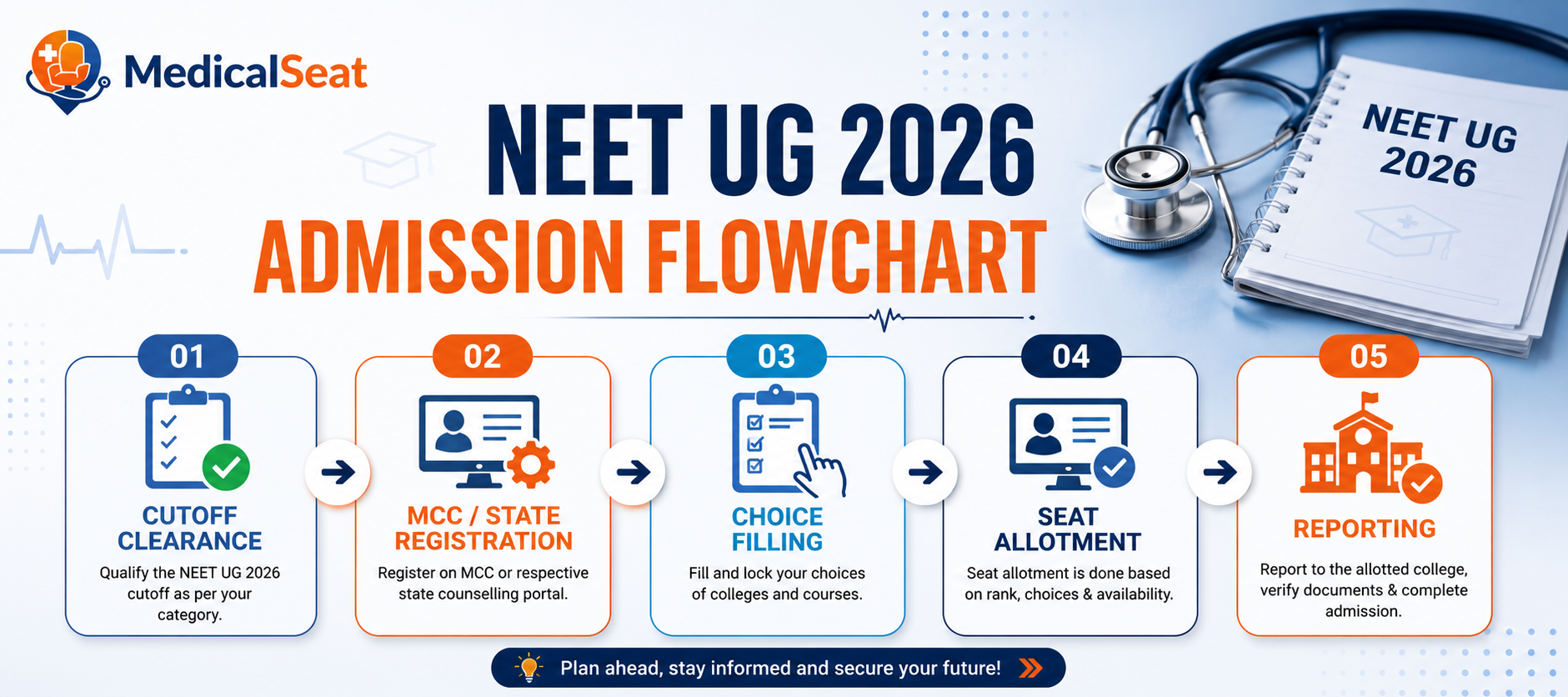
NEET UG 2026 Cutoff: Category-wise Marks & Percentile
NEET UG 2026 cutoff is out! Check category-wise qualifying marks, percentile, topper details, and what your score means for MBBS counselling.
The NEET UG 2026 cutoff for General/EWS is 213–715 marks (50th percentile), while OBC/SC/ST candidates need 177–212 marks (40th percentile) to qualify. The National Testing Agency released these marks with the Re-NEET result on July 16, 2026, alongside category-wise PwBD cutoffs.
NTA declared NEET UG 2026 results and cutoffs on July 16, 2026
General/EWS qualifying range: 213–715 marks (50th percentile)
OBC/SC/ST qualifying range: 177–212 marks (40th percentile)
11.21 lakh candidates qualified out of nearly 20 lakh who appeared
Aryan Gupta (Punjab) and Panshul Bansal (Haryana) share AIR 1 with 715/720
MCC counselling for 15% AIQ seats is expected to begin around July 21, 2026
Qualifying cutoff ≠ admission cutoff — clearing it only makes you eligible for counselling
Introduction
If you sat for NEET UG this year, you already know 2026 wasn't a routine admission cycle. The original exam scheduled for May 3, 2026, was cancelled following paper leak allegations, and lakhs of aspirants waited anxiously for the Re-NEET, held on June 21, 2026. That wait ended on July 16, 2026, when the National Testing Agency released results along with the category-wise qualifying cutoffs.
At MedicalSeat, we work with NEET aspirants every counselling season, and one thing never changes: the first question every student asks is "did I clear the cutoff?" This guide breaks down the NEET UG 2026 cutoff for every category, explains how it compares to last year, and tells you exactly what to do next — whether you're eyeing a government medical college seat or exploring MBBS abroad as a backup plan.
Table of Contents
What is the NEET UG Cutoff
Why is the NEET Cutoff Important
Eligibility Criteria
NEET UG 2026 Category-wise Cutoff
Admission Process After Cutoff
Required Documents
NEET UG 2026 Topper List
Cutoff Trend: 2026 vs 2025 vs 2024
Preparation Tips for Next Attempt
Fee Structure Overview
Career Opportunities After MBBS
MBBS India vs MBBS Abroad
Common Mistakes Students Make
Expert Tips from MedicalSeat Counsellors
FAQs
Conclusion
What is NEET UG Cutoff?
The NEET UG cutoff is the minimum percentile-based score a candidate must achieve to qualify for the exam and become eligible for medical counselling. It is not a fixed number — it is a percentile that NTA converts into actual marks each year based on how the exam went overall.
There are two cutoffs students often confuse:
Qualifying Cutoff: The minimum percentile (fixed) that determines whether you pass NEET UG at all.
Admission/Closing Cutoff: The rank at which a specific college or course stops offering seats during counselling, decided by MCC or state authorities after each round.
Clearing the qualifying cutoff only makes you eligible to register for counselling. It does not guarantee a seat anywhere — that depends on your rank, category, domicile, and seat availability.
Why is the NEET Cutoff Important?
The cutoff decides three things for every aspirant:
Whether you can register for MCC/state counselling at all
Which round and category of colleges realistically fall within your reach
Whether you need to plan for a repeat attempt, a different course (BDS/AYUSH), or MBBS abroad
According to the National Medical Commission (NMC), only candidates who clear the prescribed percentile are considered for admission to MBBS, BDS, and allied medical courses across India. Missing the cutoff by even a few marks can mean sitting out an entire academic year, which is why understanding where you stand — immediately — matters.
NEET UG 2026 Eligibility Criteria
Criteria | Requirement |
Nationality | Indian citizen, OCI, NRI, or foreign national |
Age | Minimum 17 years as of December 31 of the admission year |
Qualifying Exam | 10+2 with Physics, Chemistry, Biology/Biotechnology, and English |
Minimum Marks in 10+2 | 50% for General, 40% for SC/ST/OBC, 45% for General-PwBD |
Qualifying Cutoff | 50th percentile (General/EWS), 40th percentile (OBC/SC/ST) |
NEET UG 2026 Cutoff: Category-wise Qualifying Marks
According to the National Testing Agency (NTA), the category-wise qualifying cutoffs for NEET UG 2026 have risen across every category compared to 2025, even though the qualifying percentiles themselves stayed the same.
NEET UG 2026 Official Cutoff Table
Category | Qualifying Percentile | Cutoff Marks Range (out of 720) |
UR / General / EWS | 50th | 213 – 715 |
UR/EWS – PwBD | 45th | 194 – 212 |
OBC / SC / ST | 40th | 177 – 212 |
OBC – PwBD / SC – PwBD | 40th | 177 – 193 |
ST – PwBD | 40th | 178 – 191 |
How Many Candidates Qualified in Each Category
UR/EWS: 9,96,935 candidates
OBC: 81,111 candidates
SC: 29,947 candidates
ST: 12,452 candidates
Total qualified: 11.21 lakh out of nearly 20 lakh who appeared
Notably, more than 58% of the qualified candidates this year are women, and the exam was conducted in 13 languages across 5,440 centres in 551 Indian cities and 14 cities abroad.
Admission Process After Clearing the Cutoff
Clearing the cutoff is only step one. Here's the sequence every qualified candidate follows:
Download your NEET UG 2026 scorecard from neet.nta.nic.in
Register for MCC counselling (for 15% All India Quota seats) at mcc. nic.in
Register separately for state counselling (for 85% state quota seats) through your respective state authority
Fill and lock your choices based on expected rank and category
Wait for seat allotment in each round
Complete document verification and reporting at the allotted institute
Pay admission fees and confirm your seat
MCC counselling for the current cycle is expected to open around July 21, 2026, with the process likely running in four rounds through October 2026. These dates remain tentative until officially confirmed by MCC, so always cross-check with mcc. nic.in before making plans.
Required Documents for NEET Counselling
NEET UG 2026 admit card and scorecard
Class 10 and 12 mark sheets and certificates
Date of birth proof
Category certificate (SC/ST/OBC/EWS), if applicable
PwBD certificate, if applicable
Domicile/residence certificate (for state counselling)
Passport-size photographs (same as used in application)
Aadhaar card or other government ID
Migration certificate (where required)
NEET UG 2026 Topper List
This year's Re-NEET produced a joint AIR 1: Aryan Gupta from Punjab and Panshul Bansal from Haryana, both scoring 715 out of 720. Unlike some previous years, no candidate secured a perfect 720/720 score in 2026. NTA data shows 19 candidates scored above 700 marks, reflecting a fairly balanced difficulty level in this year's Re-NEET paper.
NEET Cutoff Trend: 2026 vs 2025 vs 2024
Recent admission trends indicate that cutoff marks fluctuate with paper difficulty even though the percentile requirement never changes.
Year | General/EWS Cutoff Range | OBC/SC/ST Cutoff Range |
2024 | Up to 720 min. 162 | Min. 127 |
2025 | 686 – 144 | 143 – 113 |
2026 | 715 – 213 | 212 – 177 |
The jump in minimum qualifying marks from 144 (2025) to 213 (2026) for General/EWS suggests this year's Re-NEET paper was comparatively easier or that candidate performance improved overall. Medical education experts recommend comparing your expected rank against last year's closing ranks, not just the qualifying cutoff, to realistically judge your government college chances.
Top 10 Preparation Tips (For Repeaters and Future Aspirants)
Build an NCERT-first strategy — over 80% of NEET Biology and Chemistry questions trace back to NCERT concepts
Attempt full-length mock tests under real exam timing every week
Maintain a formula and reaction-mechanism notebook for quick revision
Focus on high-weightage chapters in Biology (Genetics, Ecology, Human Physiology)
Solve at least 10 years of previous NEET papers
Track your percentile in mocks, not just raw scores
Revise Physics numericals daily instead of only theory
Join a structured repeater batch if your first attempt fell short
Take care of sleep and stress — exam-day performance depends on it
Keep an error log and revisit mistakes weekly instead of only solving new questions
Fee Structure Overview
Medical education fees vary significantly by college type, state, and quota, so we recommend verifying the exact figures directly with each institution or the relevant counselling authority rather than relying on generalised numbers.
College Type | General Fee Range Pattern |
Government Medical College | Lowest fees; heavily subsidised |
Private Medical College | Significantly higher; varies by state and NRI/management quota |
Deemed University | Typically higher than government, regulated by NMC fee guidelines |
MBBS Abroad | Varies widely by country and university |
According to the Ministry of Health and Family Welfare (MoHFW), India had approximately 1,18,190 MBBS seats available as of 2025, with the majority being government-college seats. Always confirm current fee structures through official college prospectuses or your state counselling authority before making financial decisions.
Career Opportunities After MBBS
An MBBS degree opens multiple pathways:
Clinical Practice: General physician or specialist after PG (MD/MS)
Postgraduate Specialisation: MD, MS, DNB, followed by DM/MCh super-specialisation
Public Health: Roles with WHO, MoHFW, or state health departments
Research: Clinical and biomedical research roles
Global Practice: Licensing exams like USMLE (USA), PLAB (UK), and other country-specific routes for international practice
Academics: Teaching positions in medical colleges after relevant PG qualifications
MBBS India vs MBBS Abroad: Which is Right for You?
Factor | MBBS in India | MBBS Abroad |
Entrance Requirement | NEET UG qualifying cutoff | NEET UG qualifying cutoff (mandatory for Indian students) |
Seat Availability | Highly competitive, limited seats | Comparatively easier admission |
Recognition | NMC-recognised automatically | Must be NMC/WHO-listed; requires clearing FMGE/NExT to practice in India |
Cost Pattern | Low (govt.) to high (private) | Varies widely by country |
Language of Instruction | Mostly English/regional | English (verify per university) |
Summary: There's no universal "winner" — government colleges in India remain the most cost-effective and widely recognised option if your rank allows it. MBBS abroad can be a viable route for students who don't clear the required rank for Indian colleges, provided the university is NMC-approved and the student is prepared for the FMGE/NExT licensing exam required to practice in India.
Common Mistakes Students Make
Assuming the qualifying cutoff guarantees a seat
Not registering for both MCC and state counselling
Missing document verification deadlines
Choosing colleges without checking previous years' closing ranks
Ignoring AYUSH and BDS options as viable backups
Not verifying a foreign university's NMC/WHO recognition before enrolling
Overlooking the mandatory FMGE/NExT requirement for MBBS-abroad graduates
Panic-withdrawing from counselling rounds without understanding exit rules
Relying on unverified sources for counselling updates
Delaying the category or domicile certificate preparation
Expert Tips from MedicalSeat Counsellors
Current counselling guidelines suggest that students who research seat matrices and previous-year closing ranks before choice-filling make significantly more informed decisions than those who fill choices reactively, round by round. Our counselling experience shows that keeping backup options — across AIQ, state quota, and NMC-approved abroad universities — reduces last-minute panic considerably. Always verify every update through official NTA and MCC channels; fraudulent "seat guarantee" calls are common during this period, and NTA itself has cautioned candidates against them.
Conclusion
The NEET UG 2026 cutoff release finally gives lakhs of aspirants clarity after a disrupted exam cycle. Whether you've cleared the cutoff comfortably or you're right at the edge, the real work — choosing the right colleges, understanding quota rules, and filing counselling choices strategically — starts now.
Need help mapping your NEET UG 2026 rank to realistic college options, whether in India or abroad? MedicalSeat's counselling experts can guide you through AIQ counselling, state counselling, and NMC-approved MBBS-abroad options so you make an informed decision instead of a rushed one. Connect with MedicalSeat's admission guidance team today.