
 Neet Rank Predictor
 NEET UG Predictor
 MDS Predictor
 INI CET Predictor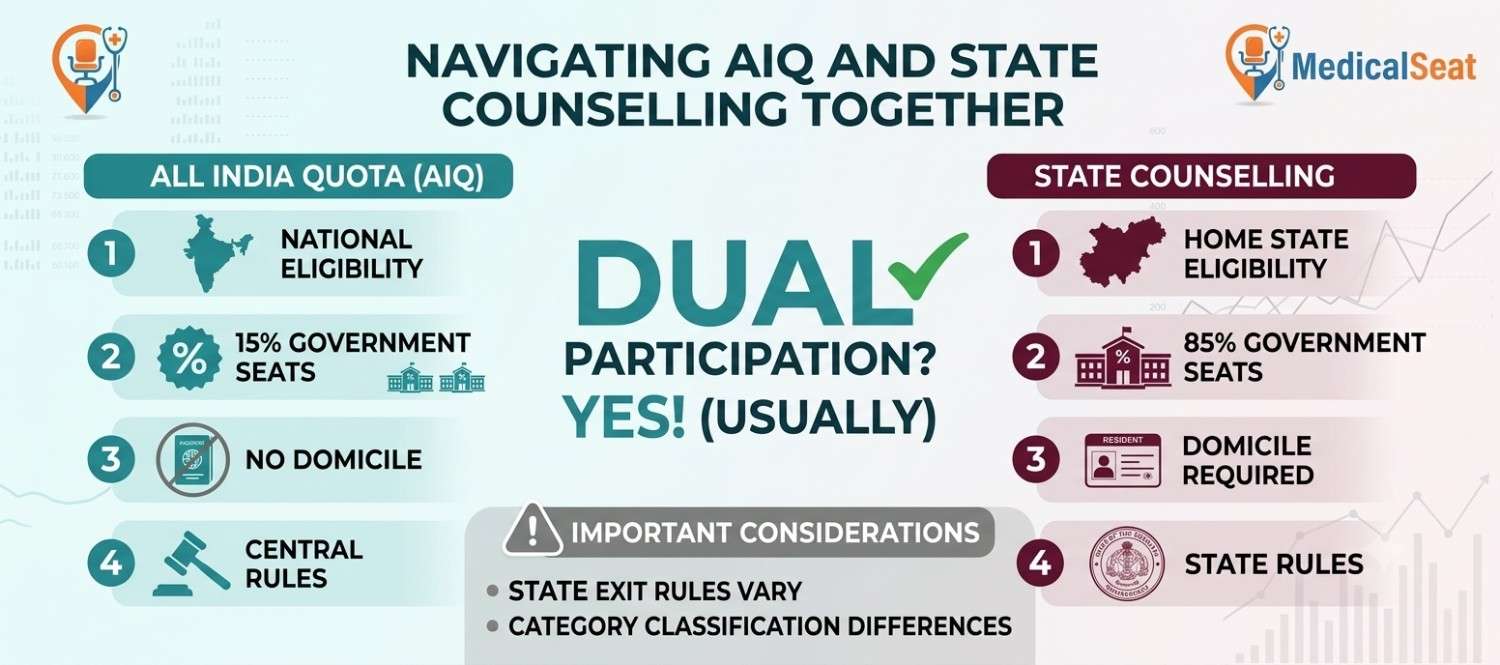
Can You Participate in AIQ and State Counselling Together? The Answer Is Yes (Usually)
Can you do AIQ and state counselling together for NEET UG? Yes, with key exceptions on joining, category rules, and seat-leaving penalties explained.
This is one of the most searched questions in every NEET counseling guide, and the short answer genuinely is yes. You can, and generally should, register for both All India Quota (AIQ) counselling and your state's counselling at the same time. But "usually" is doing real work in that sentence, and the exceptions are exactly the kind of detail that costs candidates a seat when they assume the answer is a flat, unconditional yes.
This piece walks through when dual participation works cleanly, where it gets conditional, and the specific decision points where you actually have to choose one path over the other.
The Straightforward Part: Registration
AIQ, run by the Medical Counselling Committee (MCC), covers 15% of every government medical college's seats nationally, plus 100 percent of deemed universities, central universities, AIIMS, JIPMER, ESIC colleges, and AFMC. It's open to any NEET-qualified candidate regardless of home state, with no domicile requirement.
State counselling, run separately by each state's own authority, covers the remaining 85% of government seats, almost always domicile restricted, plus nearly all private and management quota medical colleges in India within that state.
Registering for both at the start of counselling is completely standard practice, and most successful candidates do exactly that. This is where the "yes" in the title holds without any real caveat. Doing both simultaneously widens your realistic shortlist considerably, which is exactly what a NEET college predictor should be helping you plan around from day one, not something you figure out mid-counselling under time pressure.
Where "Usually" Starts to Matter
The complications don't show up at registration. They show up once you're actually offered a seat in one track and have to decide what to do about the other.
1. Accepting and Joining Changes Your Standing
If you're allotted a seat in AIQ Round 1 and simply lock your choice without paying fees or reporting, you can generally still appear in your State Round 1 without issue. The moment you accept the seat, pay the first-year fee, and physically join the college, though, the situation changes. To continue in later state rounds, you typically need to formally withdraw or surrender the AIQ seat before a specific cutoff date, and several states impose a real financial penalty for leaving a joined seat, sometimes in the range of one to two lakh rupees. The reverse applies too: joining a state quota seat can restrict your ability to keep participating in AIQ rounds afterward.
This is the practical core of "usually." Registering for both is unconditionally fine. Holding both seats simultaneously past the joining stage generally is not, and the exit costs are real enough to plan around rather than discover after the fact.
2. Your Category Isn't Guaranteed to Match Across the Two Lists
AIQ works off a central reservation list. Your home state applies its own category and reservation rules. It's entirely possible for a candidate's classification to differ between the two systems, which affects both eligibility and your realistic NEET rank vs college expectations in each track separately. Treating one category tag as automatically valid in both counselling systems is a common and avoidable mistake.
3. J&K and Ladakh Have Had a Genuinely Different Rule
Historically, candidates domiciled in Jammu & Kashmir and Ladakh needed to specifically opt in to be considered for AIQ, rather than being automatically included the way every other state's candidates are. Policy in this specific area has been shifting, with more recent guidance suggesting broader default AIQ eligibility for J&K and Ladakh candidates from 2026 onward unless they choose to opt out. If you or someone you're advising falls into this category, this is exactly the kind of detail to verify directly against the current year's official MCC information bulletin rather than assume from a general rule, since it's one of the few genuinely state-specific exceptions to the "everyone can register for AIQ" default.
4. Deemed Universities Don't Have a State Alternative
If a private college is structured as a deemed university, there's no domicile-based state pathway into it at all, since it runs entirely through MCC. This isn't really a dual-participation exception so much as a reminder that not every college on your shortlist has two doors; some only have one, and it's the national one.
Why Most Aspirants Should Still Do Both
Despite the caveats above, participating in both tracks remains the right default strategy for the overwhelming majority of candidates, for one simple reason: state quota competition is typically far lower than AIQ competition for your own home state's colleges, because it excludes every out-of-state candidate. A NEET UG 2026 rank predictor applied separately to both tracks will usually show a meaningfully better state quota outlook than an AIQ one for the same rank, which is exactly why skipping state counselling to focus only on AIQ is one of the more expensive mistakes a domiciled candidate can make.
A Practical Sequence to Avoid the Trap
Register for both AIQ and your state counselling immediately once counselling opens; there's no downside to registering for both
Choice-fill both lists independently, using realistic NEET closing ranks for your category in each system rather than assuming the same number applies to both
If allotted a seat in either track, check whether you've only locked a choice or actually accepted and paid; the consequences differ sharply between these two states
Read your specific state's exit rules before joining anything, since seat-leaving penalties and formal withdrawal deadlines vary by state and by round
Don't freeze early out of anxiety; floating keeps both doors open longer, provided you understand your counselling authority's specific float mechanics for that round
Where a Predictor Actually Helps With This Decision
The reason a medical college predictor India tool is useful here isn't just producing a list of names. A predictor calibrated for this year's re-exam pattern can show you, side by side, a realistic AIQ outcome and a realistic state quota outcome for the same rank, which is precisely the comparison you need before deciding whether to freeze an early AIQ offer or hold out for a likely stronger state quota allotment a round or two later.
MedicalSeat.com's predictor is built around this year's pattern and covers MBBS, MDS, INI CET, and AYUSH in one place, so you can run the comparison across every track you're eligible for rather than piecing it together from separate tools. If postgraduate seats are also on your radar, there's a dedicated MDS predictor and INI CET predictor as well, and their explainer on how a free rank and college predictor actually works is worth reading before you lean on any tool's output for a decision this consequential.
Given that this is a re-exam year, your AIQ and state comparisons both need a fresh baseline rather than last year's numbers. MedicalSeat's breakdown of NEET UG 2026 result statistics and their piece on rank inflation around the 650 score band both explain why. If budget is part of your freeze-or-float decision, MedicalSeat's budget focused resource and their rank to college reference across roughly 5,000 institutions are useful cross checks, and it's also worth tracking their list of upcoming medical colleges since a newly approved college can shift closing ranks in either track mid-cycle.
The National Context
India's medical seat matrix has grown quickly this cycle; the NMC's latest 2026-27 seat matrix puts total MBBS capacity at roughly 1,36,939 seats across 823 colleges, made up of about 63,296 government seats and 73,643 private seats. AIQ draws from a meaningful slice of that government total nationally, while your state quota draws from the rest plus nearly all of that state's private capacity. Understanding which pool you're realistically competing in for a given college, before you decide whether to freeze an early offer, is the single most useful habit this whole process rewards.
Every guess here costs you a round, and once a round closes, it's closed. Run your score through MedicalSeat.com's predictor calibrated for this year's actual pattern, or talk directly to their counselling desk at +91 97517 95765 or support@medicalseat.com if you want to walk through a specific freeze-versus-float decision with a person before you commit to it.