 Neet Rank Predictor
 NEET UG Predictor
 MDS Predictor
 INI CET Predictor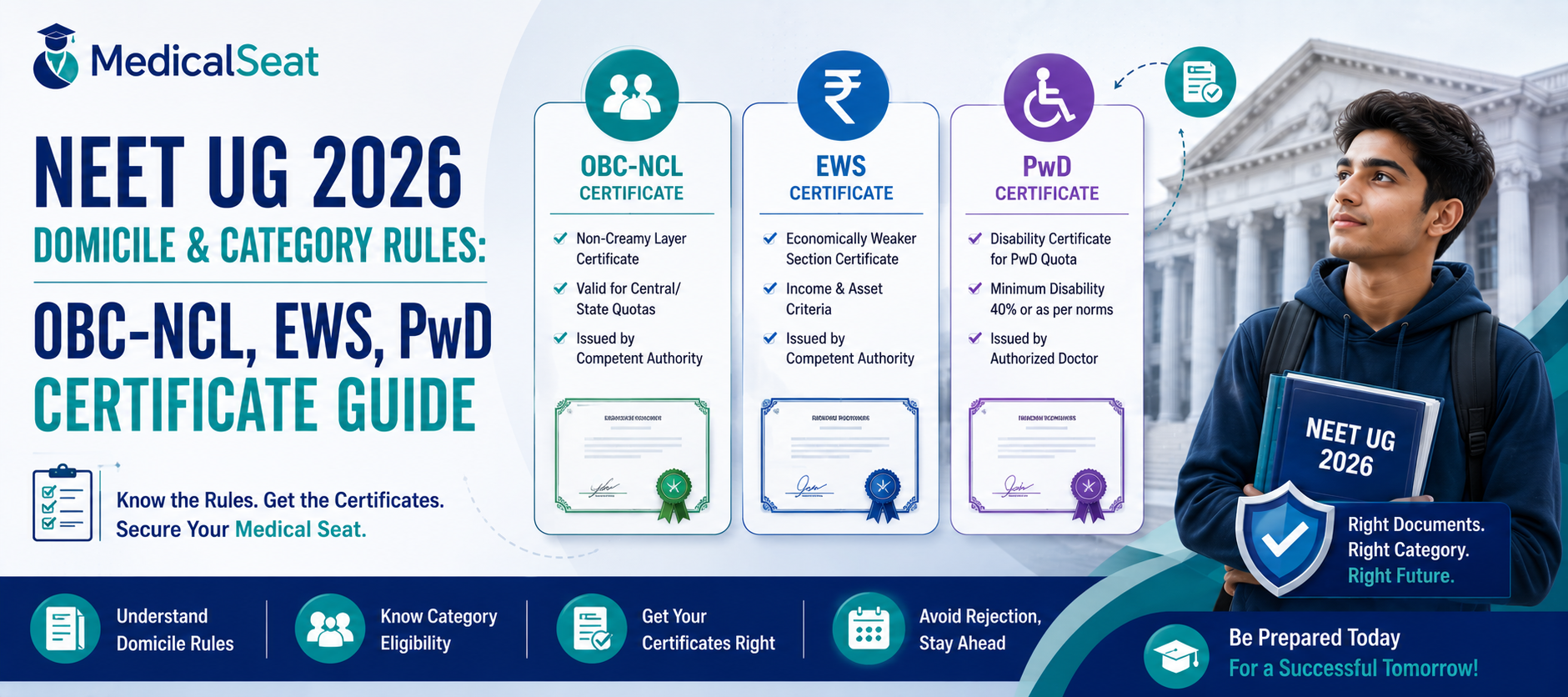
NEET UG 2026 Domicile & Category Rules: OBC-NCL, EWS, PwD Certificate Guide
NEET UG 2026 domicile and category rules explained — OBC-NCL, EWS and PwD certificate formats, validity dates and common rejection mistakes to avoid.
NEET UG 2026 Domicile & Category Rules: OBC-NCL, EWS, PwD Certificate Guide
OBC-NCL and EWS certificates must be fresh — issued on or after April 1, 2025, and in the central government format for AIQ seats. State-format certificates work only for State Quota.
SC/ST certificates generally carry lifetime validity, so no annual renewal is needed.
PwD/PwBD candidates need a minimum 40% benchmark disability, certified by an authorised medical board, with a valid UDID card, to claim the 5% horizontal reservation.
Domicile rules for State Quota vary by state — years of residence, schooling history, or a parent's government posting can all count as proof, so check your target state's brochure directly.
The single biggest cause of seats being cancelled during verification isn't a low rank — it's an expired, wrongly formatted, or mismatched certificate.
Introduction
A strong NEET UG 2026 rank can be undone by a single line on a certificate. Every counselling cycle, candidates who cleared the exam comfortably lose their reserved-category seat during document verification — not because they weren't eligible, but because their OBC-NCL certificate was a year too old, their EWS certificate used a state format instead of the central one, or their PwD certificate wasn't issued by an MCC-recognised medical board.
This guide walks through NEET UG 2026 domicile and category rules for OBC-NCL, EWS and PwD candidates — what counts as a valid certificate, exact validity windows, common formatting mistakes, and how domicile requirements differ between AIQ and State Quota counselling.
Direct Answer
For NEET UG 2026, OBC-NCL and EWS certificates must be issued on or after April 1, 2025, in the central government format to be valid for AIQ counselling; state-format certificates apply only to State Quota. SC and ST certificates typically don't expire. PwD candidates need a minimum 40% benchmark disability certified by an authorised medical board and a valid UDID card. Domicile proof for State Quota varies by state and must be arranged separately from your category certificate.
Table of Contents
Why Certificate Rules Matter More Than Your Rank
OBC-NCL Certificate: Format, Validity and Rules
EWS Certificate: Eligibility and Format
SC/ST Certificate Rules
PwD/PwBD Certificate: Eligibility and Process
Domicile Rules for State Quota
AIQ vs State Quota: Certificate Format Differences
Step-by-Step: How to Get Your Certificate Ready
Important Dates for NEET UG 2026 Certificate Submission
Documents Checklist
Common Mistakes That Get Certificates Rejected
Comparison Table: Category Certificate Rules at a Glance
Pros and Cons of Each Category Route
Expert Tips to Avoid Rejection
Career Impact of Getting This Right
Conclusion
FAQs
H2: Why Certificate Rules Matter More Than Your Rank
NEET UG 2026 counselling, run through MCC for AIQ and state authorities for State Quota, treats category and domicile certificates as legal proof, not formality. Verification teams check the issuing authority, format, date and even name spelling against your Class 10 marksheet. If anything fails, your seat allotment under that category is cancelled and you're either moved to the general category pool or lose the seat entirely, depending on the counselling stage.
This is why understanding NEET UG 2026 domicile and category rules early — well before Round 1 opens — is as important as your exam preparation itself.
H2: OBC-NCL Certificate: Format, Validity and Rules
The OBC-NCL (Non-Creamy Layer) certificate confirms both your caste category and that your family income falls below the non-creamy layer threshold.
Validity: Must be fresh for the current financial year — for NEET UG 2026, this means issued on or after April 1, 2025
Format: Must follow the central government format listed in the NTA information bulletin to be valid for AIQ seats
Caste listing: Your specific caste must appear in the Central List of the NCBC — a state OBC list alone is not sufficient for AIQ
State Quota exception: A state-format OBC certificate is accepted only for that state's own State Quota seats, not for AIQ
H3: Why "Fresh" Matters
Because non-creamy layer status is income-linked, an old certificate can no longer confirm your family's current financial standing. Counselling authorities treat certificates issued before the cut-off date as expired, even if your caste category itself hasn't changed.
H2: EWS Certificate: Eligibility and Format
The Economically Weaker Section (EWS) certificate applies to General category candidates who don't benefit from SC/ST/OBC reservation but meet specific income and asset limits.
Eligibility criteria:
Gross annual family income below ₹8,00,000
Family does not own 5 acres or more of agricultural land
Family does not own a residential flat of 1,000 sq. ft. or above (with additional limits on residential plot size in notified municipalities/areas)
Certificate rules:
Must be fresh for the current financial year, ideally issued on or after April 1, 2025
Must be issued by a competent authority in the prescribed central format for AIQ
Old, expired or state-specific EWS certificates are liable to be rejected during MCC verification
H2: SC/ST Certificate Rules
SC and ST reservation certificates are treated differently from OBC-NCL and EWS, since caste status itself doesn't expire.
Validity: SC/ST certificates generally have lifetime validity — no annual renewal is required
Issuing authority: Must be issued by a competent authority such as a Tehsildar, District Magistrate, or higher-ranking revenue official
Format: For MCC/AIQ counselling, the certificate must align with the central format specified in the NTA information bulletin
ST state variation: State-level ST reservation percentages can differ significantly from the central 7.5% — notably higher in several Northeastern states and Jharkhand — so always check your specific state's notified percentage for State Quota
H2: PwD/PwBD Certificate: Eligibility and Process
Persons with Benchmark Disabilities (PwBD) candidates are entitled to a 5% horizontal reservation, extra exam time, and scribe assistance where applicable.
H3: Eligibility Criteria
Minimum 40% benchmark disability, as defined under the Rights of Persons with Disabilities (RPwD) Act, 2016
Disability certified by a recognised government medical authority or MCC-designated centre
A valid UDID (Unique Disability ID) card, issued by the Department of Empowerment of Persons with Disabilities (DEPwD), rated Yellow or above
Candidate must otherwise meet standard NEET UG academic eligibility
H3: Step-by-Step Process to Get a Valid PwBD Certificate
Apply for a UDID card at swavlambancard.gov.in if you don't already have one
Visit one of the MCC-designated disability assessment centres for AIQ purposes (state disability boards are accepted for State Quota)
Undergo assessment; the medical board issues a certificate stating disability type and percentage
Ensure the certificate clearly states the benchmark percentage and disability category recognised under the RPwD Act
Fill and submit the self-certified affidavit in the prescribed NTA/MCC format alongside the certificate
Upload the certificate during registration, and carry the original for physical verification during counselling
H2: Domicile Rules for State Quota
Domicile requirements sit apart from category certificates and apply specifically to State Quota counselling. Because each state authority sets its own rules, requirements vary:
Minimum years of residence in the state
A specified number of years of schooling (Class 9-12, or similar) completed within the state
Parent's posting or service record with the state government, in some states
A domicile certificate issued by the state's Revenue Department or equivalent authority
Some Union Territories without their own medical colleges apply relaxed or different domicile norms, and a handful of states allow domicile through either the candidate's or a parent's long-term residence. Because these rules genuinely differ, the only reliable step is checking your target state's official counselling brochure directly rather than assuming a neighbouring state's rule applies.
H2: AIQ vs State Quota: Certificate Format Differences
Certificate | Required for AIQ | Required for State Quota |
OBC-NCL | Central format, Central List caste, issued after April 1, 2025 | State format accepted; state OBC list applies |
EWS | Central format, current financial year | State format accepted where applicable |
SC/ST | Central format for MCC verification | State format accepted; state reservation % may differ |
PwD/PwBD | MCC-designated centre certificate mandatory | State disability board certificate accepted |
Domicile | Not applicable | Mandatory, state-specific proof required |
H2: Step-by-Step: How to Get Your Certificate Ready
Identify which category you're claiming — OBC-NCL, EWS, SC, ST, or PwD
Confirm whether you need it in central format (for AIQ), state format (for State Quota), or both
Visit the correct issuing authority — Tehsildar/SDM office for caste certificates, competent authority for EWS, MCC-designated centre or state disability board for PwD
Cross-check every detail — name spelling, date of birth, category name — against your Class 10 marksheet and NEET application
Keep both a scanned copy (for online upload, in the specified format and size) and the physical original (for counselling verification)
Re-verify the issue date meets the "fresh" requirement before submission
H2: Important Dates for NEET UG 2026 Certificate Submission
Event | Detail |
OBC-NCL / EWS certificate validity start | On or after April 1, 2025 |
NEET UG 2026 Re-Examination | June 21, 2026 |
NTA qualifying cut-off declared | July 16, 2026 |
AIQ/State counselling document upload window | Opens with each round's registration — check mcc.nic.in and your state portal |
Physical document verification | At college reporting, after each round's seat allotment |
If your OBC-NCL or EWS certificate isn't ready by the application deadline, a self-declaration/undertaking in the prescribed NTA format can be submitted temporarily — but the actual certificate must still be produced at counselling and admission verification, or the reservation benefit is withdrawn.
H2: Documents Checklist
NEET UG 2026 admit card and scorecard
Class 10 and Class 12 marksheets and certificates
OBC-NCL/EWS certificate (central format, issued after April 1, 2025) — if applicable
SC/ST certificate (central format) — if applicable
PwBD certificate from an MCC-designated centre, plus UDID card — if applicable
Domicile certificate for your target state — for State Quota only
Photo ID, passport-size photos matching application specifications
Self-declaration/undertaking, if the final certificate wasn't ready at registration
H2: Common Mistakes That Get Certificates Rejected
Submitting a state-format OBC-NCL certificate for AIQ seats, where only the central format is accepted
Using an OBC-NCL or EWS certificate issued before April 1, 2025, for the 2026 cycle
Name mismatch between the certificate, Class 10 marksheet and NEET application — no nicknames or shortened names
Submitting a PwD certificate from a clinic or hospital that isn't an MCC-designated centre for AIQ purposes
Uploading a laminated or poor-quality scanned certificate, making the watermark or seal unverifiable
Assuming an old SC/ST certificate needs renewal — it generally doesn't, but format still needs checking for AIQ
H2: Comparison Table: Category Certificate Rules at a Glance
Category | Validity | Reservation (AIQ) | Key Requirement |
OBC-NCL | 1 financial year (fresh, post-April 1, 2025) | 27% | Central List caste + non-creamy layer proof |
EWS | 1 financial year (fresh) | 10% | Income below ₹8,00,000/year + asset limits |
SC | Lifetime | 15% | Competent authority certificate |
ST | Lifetime | 7.5% | Competent authority certificate |
PwD/PwBD | 5 years typically (reassessment if older) | 5% (horizontal) | 40%+ benchmark disability + UDID card |
H2: Pros and Cons of Each Category Route
H3: OBC-NCL / EWS
Pros: Meaningful reservation share (27% and 10% respectively); widely available issuing authorities. Cons: Annual renewal burden; strict format rules that trip up first-time applicants
H3: SC / ST
Pros: Lifetime certificate validity removes annual renewal hassle. Cons: State reservation percentages can differ sharply from central norms, requiring separate research per state
H3: PwD/PwBD
Pros: Horizontal reservation plus exam-day accommodations like extra time and scribe assistance. Cons: Mandatory MCC-designated centre certification for AIQ adds an extra procedural step beyond a standard disability certificate
H2: Expert Tips to Avoid Rejection
Start certificate paperwork the moment you finish your NEET UG 2026 exam — don't wait for results
Keep two versions ready if you're eligible and planning to use both AIQ and State Quota — central format and your state's format
Photocopy and double-check every certificate against your Class 10 marksheet before uploading anything
For PwBD candidates, book your MCC-designated centre appointment early, since these centres see heavy demand right after results are declared
If your certificate isn't ready in time for registration, use the self-declaration option rather than leaving the category field blank, but treat it strictly as a placeholder — the real certificate is still mandatory later
H2: Career Impact of Getting This Right
A verified, correctly formatted certificate protects the seat you've earned through your NEET UG 2026 rank, whether you're heading into NEET UG counselling now or planning ahead for NEET PG, INI CET, or NEET SS later — since category documentation requirements resurface at every stage of medical education, including counselling for MBBS Abroad and Global Medical Education pathways where equivalent home-country documentation is often required.
H2: Conclusion
NEET UG 2026 domicile and category rules aren't complicated once broken down by category — OBC-NCL and EWS need fresh, correctly formatted certificates every year; SC/ST certificates carry lifetime validity but still need format checks for AIQ; PwD/PwBD candidates need a 40%+ benchmark disability certificate from an authorised source; and domicile proof for State Quota depends entirely on your target state's own rules. Sorting these out well before counselling begins is the simplest way to protect the rank you worked hard for.
MedicalSeat CTA: Need help verifying your category or domicile documents before NEET UG 2026 counselling? Get personalised guidance on MedicalSeat for NEET UG, NEET PG, Counselling, and Medical Colleges across India.