
 Neet Rank Predictor
 NEET UG Predictor
 MDS Predictor
 INI CET Predictor
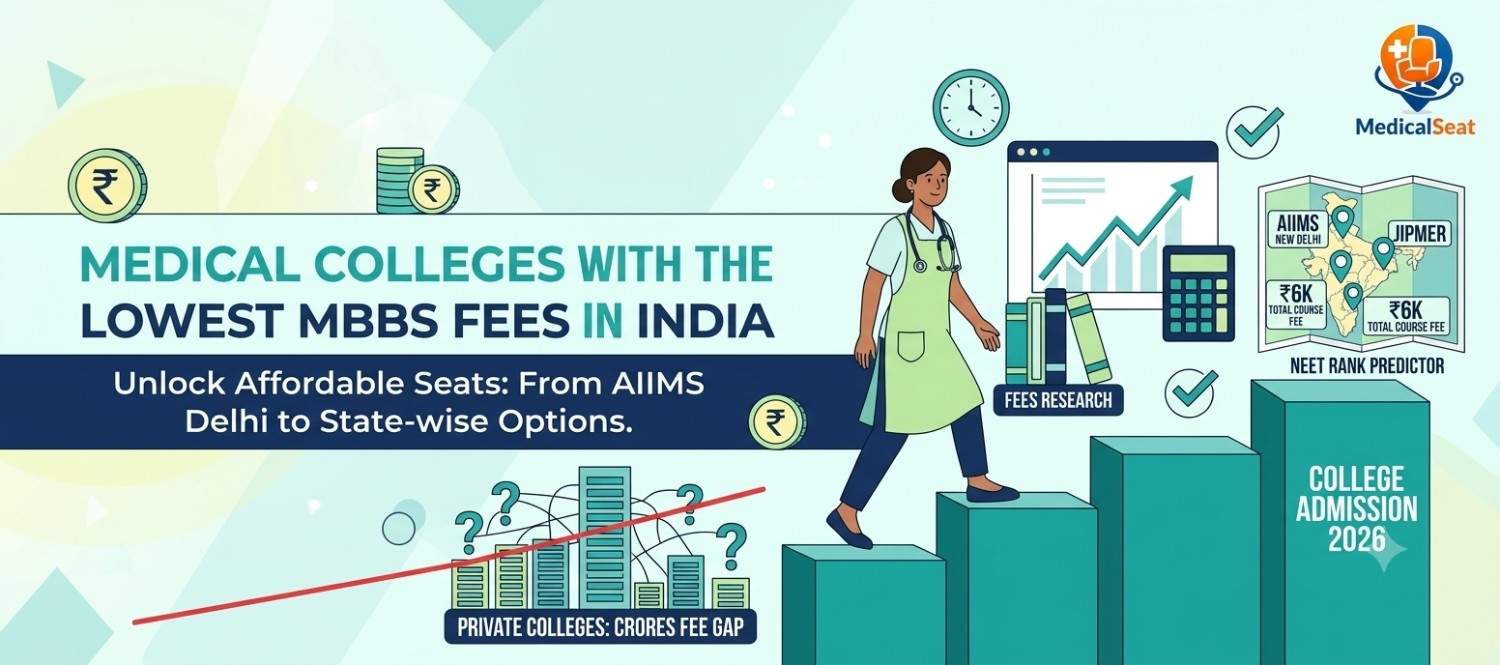
Medical Colleges With The Lowest MBBS Fees In India
The gap between the cheapest and most expensive MBBS seats in India can run into crores, and most of that gap comes down to research, not rank. Here is a real look at the medical colleges in India offering the lowest MBBS fees, from AIIMS Delhi's near zero total cost to JIPMER's low annual fees, and how to use a genuine NEET Rank Predictor 2026 and NEET College Predictor to find an option your family can actually afford.
Somewhere in India right now, a family is running the same terrifying math. Five and a half years of MBBS, plus internship, plus hostel and mess, plus books and equipment, multiplied against a private college fee structure that could easily cross a crore. And somewhere else, a family with an equally qualified child is paying less for the entire course than a single semester of school tuition, simply because they knew exactly which government colleges to target. This gap is not random. It is knowable, plannable, and directly tied to how well you use a real NEET College Predictor during NEET UG/PG Counseling 2026.
If MBBS fees India wide feel like the biggest unknown in your family's admission planning right now, this is the piece that puts real numbers next to real colleges.
Just How Big Is The Fee Gap, Really
The scale of this gap is genuinely hard to grasp until you see it side by side. Government medical colleges typically charge somewhere between five thousand rupees and roughly six lakh rupees for the entire MBBS course, depending heavily on the state and institution, while private medical college fees typically run between forty lakh rupees and two crore rupees for the same five and a half year program. That is not a small difference in convenience, it is the difference between a manageable family expense and a decision that can define a household's finances for a decade.
This is exactly why medical colleges in India should never be evaluated purely on NEET rank vs college logic without fees sitting right alongside it. A rank that technically qualifies you for a seat does not automatically mean that seat is the right financial decision for your family.
The Genuinely Cheapest Options In The Country
At the very bottom of the fee scale sits AIIMS New Delhi, widely regarded as the single most affordable medical college in the entire country. The total course fee across all five and a half years, including basic hostel accommodation, typically comes in somewhere around six to seven thousand rupees for the complete program. This is not a typo, and it is precisely why AIIMS ranks are among the most fiercely contested in the country, since the combination of prestige and near zero fees creates an almost unmatched value proposition.
Maulana Azad Medical College, Delhi, offers something even more specific and worth knowing about. Its All India Quota annual fee has been reported at roughly two hundred and forty rupees per year, making it, on a strict annual basis, one of the lowest fee government MBBS seats anywhere in the country, even though the closing rank required to secure it remains extremely high.
JIPMER, spread across its Puducherry and Karaikal campuses, keeps its annual course fee in the range of roughly eleven to twelve thousand rupees, with hostel charges adding a further fourteen thousand rupees a year, still an extraordinarily affordable total for the quality of clinical training on offer, and a genuinely strong option for medical college predictor India searches focused on both fees and training quality together.
Dr. Ram Manohar Lohia Institute of Medical Sciences in Uttar Pradesh is frequently cited as having among the lowest tuition fees within the state system, reported at roughly eighteen thousand rupees, positioned well below several other government colleges in the same state whose fees run noticeably higher for comparable seats.
Mahatma Gandhi Institute of Medical Sciences, Wardha, deserves a specific mention for aspirants exploring all deemed and private college options, since it offers fees comparable to government colleges despite operating outside the strict state government fee structure, though this typically comes attached to a rural service bond that candidates should read carefully before choice filling.
Why This Data Matters More Than Rank Alone
Knowing these specific numbers is only useful once you can confirm which of these low fee institutions are genuinely reachable for your actual rank, category and state. A properly built NEET College Predictor should be surfacing exactly this combination, affordability alongside admission probability, rather than leaving fee research as a separate, disconnected task. Running your real score through the NEET rank and college predictor gives you a shortlist that already accounts for both dimensions together.
This is especially important this year given how the re NEET 2026 re exam pattern has shifted score distributions compared to a standard cycle. A NEET Rank Predictor 2026 that has not been recalibrated for this specific pattern risks pointing you toward fee sensitive colleges that are not actually realistic for your true standing, wasting time you should be spending confirming category specific fee concessions and scholarship eligibility instead. If you want to see exactly how this year's pattern has reshaped a specific score band, this breakdown of NEET UG 2026 rank inflation around the 650 score band is worth reading before you build your final list.
Government Versus Private: The Real Fee Story
Government & private medical colleges are often compared purely on prestige, but the fee gap between them is arguably the more consequential difference for most families. Government colleges are heavily subsidised, which is why total course fees can sit anywhere from a few thousand rupees to roughly six lakh rupees depending on the state, while private and deemed institutions routinely charge forty lakh rupees to well over a crore for the identical degree. Category based fee concessions add another layer worth understanding fully, since SC, ST, OBC and EWS candidates are typically eligible for additional fee reductions at many government institutions, on top of the already subsidised base rate.
For families genuinely weighing whether a private seat is worth the additional cost, this comparison should never happen in isolation from your actual NEET closing ranks research. A private seat that costs sixty lakh rupees might be entirely justified if it is the difference between studying medicine and not studying it at all, but it is a very different decision if a comparable government seat is genuinely within reach for the same rank. This is where a disciplined NEET counseling guide approach, built around both fees and realistic rank data together, saves families from decisions made purely on panic or prestige.
Total Medical Seats In India: Understanding The Fee Landscape At Scale
Understanding the low fee options above requires seeing them against the full national picture. As per the latest National Medical Commission seat matrix for the 2026 27 session, the total number of medical seats in India for MBBS now stands at approximately 1.37 lakh, following a fresh round of seat approvals, up from roughly 1.18 lakh in the previous cycle. Within that, the total number of government medical seats in India sits at roughly 63,000 to 64,000 across more than 450 institutions, almost all of which fall within the low fee range described above, while the total number of private medical seats in India, spanning all deemed and private college options, makes up the remainder, estimated between 65,000 and 74,000 seats, where fees climb sharply. For a running view of newer institutions entering the system, and their likely fee positioning, the list of upcoming medical colleges is worth checking as part of your fee research.
If budget realism is a genuine constraint for your family, and for most families it is, this practical guide on medical college options within a realistic budget is specifically built around finding the overlap between reachable ranks and sustainable fees, rather than treating those as two separate research projects.
State Spotlight: Fee Variation Across Bihar, Tamil Nadu, Jharkhand And Maharashtra
Bihar government colleges generally sit toward the lower end of the national fee range, making state quota government seats an especially strong value proposition for domiciled candidates, provided the rank requirement is met.
Tamil Nadu offers a particularly deep bench of low fee government colleges beyond the most famous names, giving in state candidates a genuinely wide set of affordable options across multiple cities, not just the state capital.
Jharkhand, with a smaller government college network overall, has fewer low fee in state options relative to its aspirant pool, which is exactly why cross state research becomes financially important, not just academically important, for Jharkhand domiciled candidates.
Maharashtra, given its scale, has a wide range of fee structures even within its government college network, so region specific fee research matters more here than in smaller states, since costs can vary meaningfully even among colleges of similar rank difficulty.
Building A Fee Aware NEET Counseling Guide
A complete NEET counseling guide for this cycle should treat fee research as a standing filter, applied to every single choice before it goes on your final list, not a factor you consider only after an allotment already feels shaky. Confirm your realistic rank using a NEET Rank Predictor 2026 recalibrated for this year's pattern. Generate your reachable list through a proper NEET College Predictor. Then confirm the actual total course fee, not just the headline annual figure, for every serious option, including hostel, mess and any applicable bond terms. If your rank sits near the widely searched five thousand mark, this breakdown of how a rank near 5,000 maps to actual colleges is a useful way to see how many genuinely low fee options exist at that specific level.
This Applies Beyond MBBS Too
Fee variation is just as significant for MDS, INI CET and AYUSH aspirants, since postgraduate and AYUSH programs carry their own distinct fee structures that differ meaningfully from standard MBBS fee patterns. Dedicated tools such as the MDS predictor and the INI CET predictor help you build a fee aware shortlist specific to those tracks, rather than assuming MBBS fee logic applies uniformly across every course.
Do Not Let Fees Catch Your Family By Surprise
Every guess costs you a round, and discovering a college's real total fee after you have already reported is one of the most stressful, most avoidable surprises in the entire counseling process. Before you finalise your choice list, run your real score through a rank and college predictor genuinely calibrated for this year's pattern, covering MBBS, MDS, INI CET and AYUSH all in one place, at MedicalSeat.com. If you want to talk through which low fee colleges genuinely fit your rank and category with an actual counseling expert, call 8448997528 or email support@medicalseat.com. It is free to start, and already trusted by over 50,000 NEET aspirants planning their admission around real numbers instead of guesswork.