
 Neet Rank Predictor
 NEET UG Predictor
 MDS Predictor
 INI CET Predictor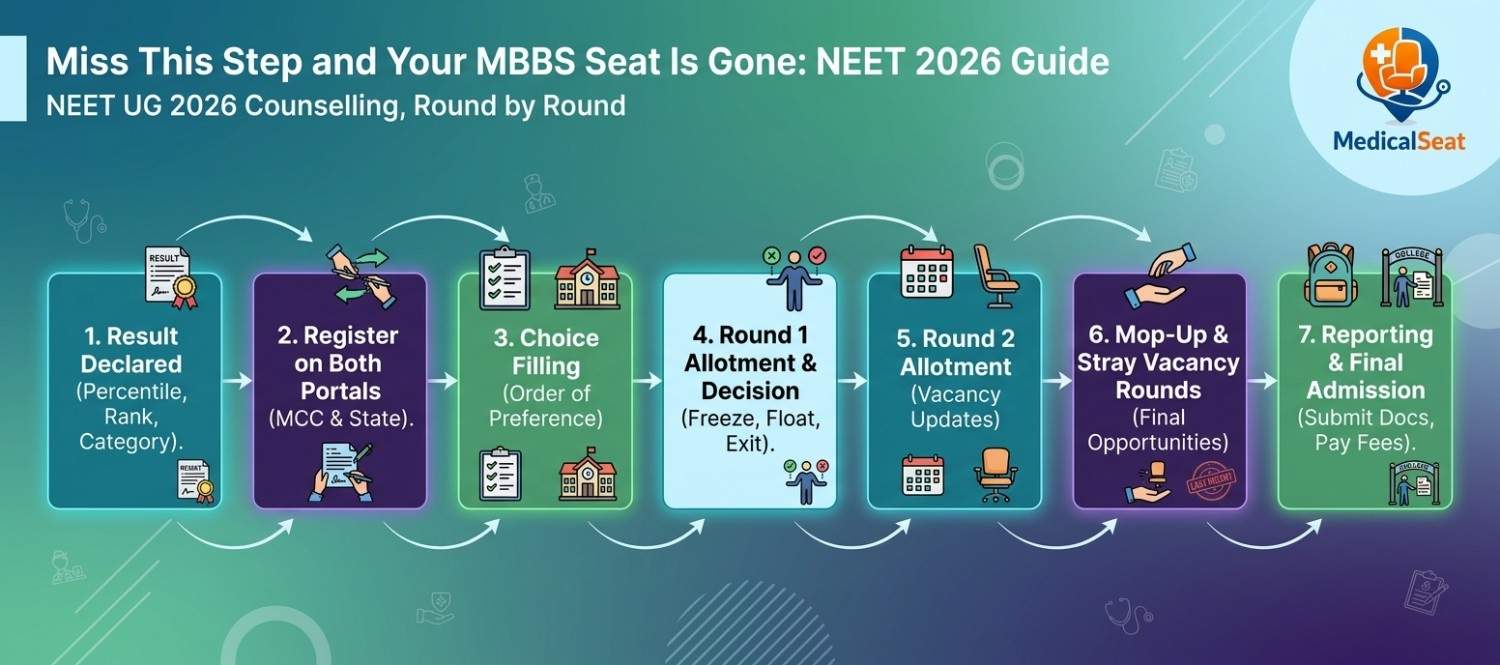
Miss One Box In This Flowchart and Your MBBS Seat Is Gone: NEET UG 2026 Counselling, Round by Round
NEET UG 2026 counselling explained round by round, registration, choice filling, freeze float exit, mop up, and stray vacancy, so no step costs your seat.
The diagram above is the whole process compressed into seven boxes. This is the same journey with everything the boxes leave out, the part that actually determines whether you end up in the college you wanted or scrambling through a stray vacancy round in October.
NEET counseling looks intimidating mostly because nobody lays out the full sequence in one place before it starts. Once you can see the shape of it end to end, each individual round stops feeling like a fresh emergency and starts feeling like a step you already know is coming. Think of this as the NEET counseling guide you wish someone had handed you the morning your result came out.
Step 1: Result Declared
Your NEET UG scorecard gives you a percentile, a category rank, and an All India Rank. In a re-exam year, this number needs handling with extra care. This year's re-conducted exam has shifted how scores map to ranks compared to a normal cycle, so NEET closing ranks from 2024 or 2025 are a rough starting point at best, not a reliable benchmark.
MedicalSeat's breakdown of the NEET UG 2026 result statistics and their analysis of rank inflation around the 650 score band are both worth reading right after your result, before you build expectations around any specific college.
Step 2: Register on Both Portals
This is the step most first-timers get wrong, not by doing it incorrectly, but by not realising there are two separate registrations to do. MCC handles All India Quota (15% of government seats, plus 100% of deemed universities, central universities, AIIMS, JIPMER, ESIC colleges and AFMC). Your state's own counselling authority handles the remaining 85% of government seats, almost always domicile restricted, plus nearly every private college in that state.
Registering for both immediately, rather than waiting to see how MCC's Round 1 goes, is standard practice among successful candidates. It costs nothing and it's the only way to access the full range of government & private medical colleges you're actually eligible for.
Step 3: Choice Filling
You build an ordered list of colleges and courses, usually 20 to 30-plus choices across both portals combined. The allotment algorithm works strictly down your list against your rank, it will never skip a lower preference to hand you something you ranked higher unless you actively upgrade in a later round. This makes choice order a real strategic decision, not a wish list, and it's the single step where good MBBS admission guidance pays off most.
This is exactly where a NEET college predictor earns its place in the process. Rather than filling your 30 choices off name recognition or last year's cutoffs, running your expected score through a NEET rank predictor calibrated for this year's re-exam pattern gives you a realistic base to build the list around, and cross-checking that against a broader medical college predictor India view helps you sanity-check the whole list before you submit it. MedicalSeat.com's predictor covers MBBS, MDS, INI CET, and AYUSH counselling in one place, and their explainer on how a free rank and college predictor actually works is a useful five minutes before you trust any tool's output for something this consequential.
Step 4: Round 1 Allotment, and the Freeze, Float, Exit Decision
After Round 1 results, you get a decision to make on any seat you're allotted:
Freeze: lock the seat in, exit further rounds
Float: keep the seat provisionally while staying eligible for something better in Round 2
Exit or withdraw: step out of that particular track, sometimes with a financial penalty depending on the round and the authority
This is also the point where the interaction between AIQ and state counselling gets real. If you accept and join an AIQ seat, continuing in later state rounds generally requires a formal withdrawal before a cutoff date, and several states charge a genuine seat-leaving penalty for candidates who joined and later left. Read your specific counselling authority's exact rules here before you commit to anything, since freeze and float mechanics differ slightly between MCC and individual state boards.
Step 5: Round 2 Allotment
Floated candidates get re-ranked against remaining seats, and new vacancies from Round 1 no-shows or withdrawals enter the pool. This round is usually where NEET rank vs college outcomes shift the most, since the seat matrix has changed shape from Round 1 based on who joined, who floated, and who dropped out entirely. It's worth re-running a NEET rank predictor at this stage rather than relying purely on your Round 1 assumptions, since a NEET college predictor rebuilt on the current vacancy list can look meaningfully different from your original shortlist.
Step 6: Mop-Up and Stray Vacancy Rounds
Once Round 2 closes, unfilled seats move into a Mop-Up round, generally open to both floated candidates and, depending on the pool, some fresh registrants for deemed university seats specifically. Whatever remains after that funnels into a final Stray Vacancy round, often run with compressed timelines directly at the college level and stricter exit rules; in most systems you cannot withdraw once allotted a stray vacancy seat, so this round is genuinely a last resort rather than a backup plan to lean on casually.
If your rank sits near a marginal cutoff, tracking newly approved medical colleges matters here specifically, since a fresh college entering the matrix mid-cycle can open up seats in these later rounds that weren't in the picture during Round 1. Any medical college predictor India tool worth trusting refreshes its data at exactly this point, because the pool of medical colleges in India with genuinely open seats looks very different in the mop-up round than it did on result day.
This is also where MBBS fees India comparisons matter most in practice, since a mop-up or stray vacancy seat can land you a very different fee tier than your original Round 1 target, whether you're looking at colleges in bihar, tamilnadu, jharkhand, or maharastra.
Step 7: Reporting and Final Admission
Once you accept a seat you intend to keep, you report to the college with original documents, NEET scorecard, admit card, Class 10 and 12 certificates, identity proof, category certificate if applicable, and a domicile certificate for state quota seats, then complete fee payment. This is where a missing photocopy, not a missing rank, most often costs a student their seat. Have every document ready before results are out, not after.
Why the Sequence Matters More Than Any Single Round
Every round in this flowchart depends on decisions made in the round before it. A choice list built without checking realistic NEET closing ranks front-loads bad decisions into Round 1 that no amount of floating can fully undo, and the resulting NEET rank vs college mismatch is exactly what pushes otherwise well-prepared candidates into the stray vacancy round. Treating NEET counseling and MBBS admission guidance as one continuous sequence, not a single event, is what separates candidates who end up satisfied with their outcome from those scrambling with three colleges left on a list of thirty.
If budget is a factor in how far down your list you're willing to go, especially given how wide the MBBS fees India range runs between government and private seats, MedicalSeat's budget focused resource filters options by affordability rather than rank alone, and their rank to college reference across roughly 5,000 institutions is a useful sanity check when you're comparing medical colleges in India across states like bihar, tamilnadu, jharkhand, maharastra, or any other state on your list.
Every guess in this process costs you a round, and once a round closes, it doesn't come back. Run your score through MedicalSeat.com's predictor built for this year's actual re-exam pattern, or talk to a counselling expert directly at +91 97517 95765 or support@medicalseat.com if you'd rather map out your specific round-by-round strategy with a person.