
 Neet Rank Predictor
 NEET UG Predictor
 MDS Predictor
 INI CET Predictor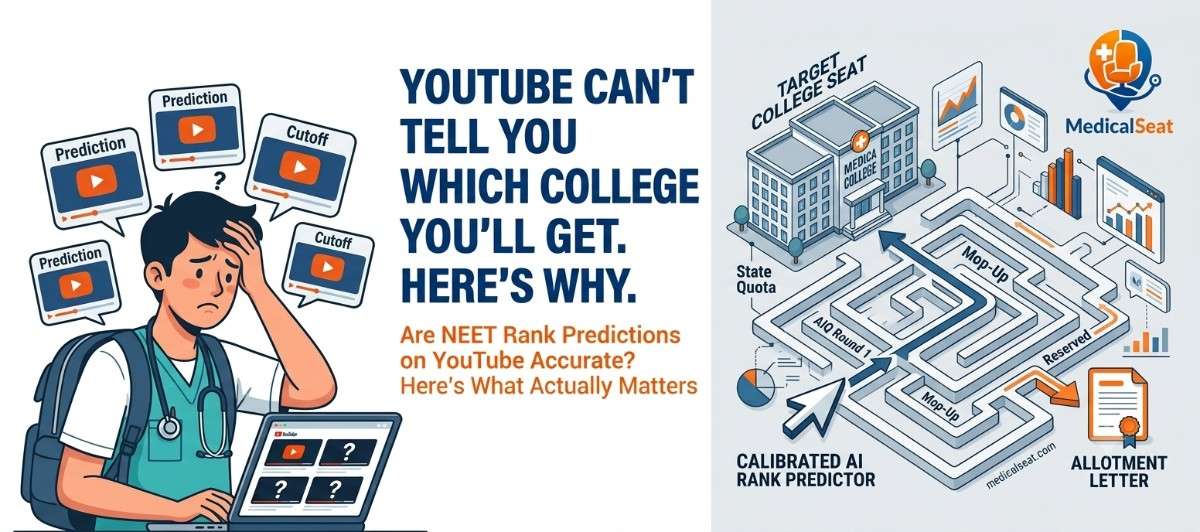
YouTube Can't Tell You Which Medical College You'll Get. Here's Why.
Are YouTube NEET rank predictions actually reliable? Before you plan your MBBS future around a video, read what actually determines your AIR - and how to estimate it accurately.
Are NEET Rank Predictions on YouTube Accurate? Here's What Actually Matters
Every year, in the weeks following NEET, something entirely predictable occurs across the Indian internet. Thousands of coaching institute channels, self-appointed analysts, and well-meaning educators flood YouTube with videos bearing titles of unmistakable urgency: "Expected NEET Rank 2026 — Score-wise Breakdown!" and "NEET Cutoff Prediction: Which College Will You Get?"
Students — exhausted, anxious, and desperately seeking clarity — watch these videos in the millions.
And then they make planning decisions based on them.
This is doubly true in 2026, where the shadow of ReNEET has made an already anxious process considerably more volatile. Students who appeared for the re-examination are now navigating not just the ordinary uncertainty of NEET rank prediction but the amplified uncertainty of a disrupted cycle — one where ReNEET rank prediction carries additional layers of complexity that most YouTube channels are wholly unequipped to address.
This blog is about why YouTube is a profoundly unreliable instrument for estimating your expected NEET rank, what the actual science of NEET rank prediction involves, and how a well-designed AI NEET rank predictor provides a meaningfully more accurate and honest answer than any video ever can.
The Seductive Certainty of a YouTube Cutoff Prediction
There is nothing inherently dishonest about most NEET analysis channels on YouTube. Many are run by genuine educators and counsellors who offer useful perspectives on the broader admission landscape. The problem is not intent. The problem is methodology — or more accurately, the structural impossibility of what these videos claim to deliver.
A YouTube rank prediction is, at its irreducible core, an educated guess delivered with the production values of authority. The presenter has historical data, perhaps years of counselling experience, and a serviceable understanding of how NEET works. They examine previous years' rank-to-score relationships and make projections. This is not worthless. But it is also not what most students believe it to be when they note down a predicted AIR and begin shortlisting colleges around it.
Here is what a YouTube video cannot account for, no matter how experienced its creator:
What YouTube Rank Predictions Cannot Factor In
1. The Actual Difficulty of This Year's Paper
NEET rank prediction depends fundamentally on the distribution of scores across the candidate pool. That distribution is shaped, more than anything else, by the difficulty of the specific paper sat in a specific year. A seemingly small shift in paper difficulty — even a single biology section that proved unexpectedly demanding — can compress or expand the score distribution dramatically.
When a YouTube analyst films their cutoff prediction video, the paper has been sat but the score distribution has not been computed. They are working from historical difficulty comparisons and anecdotal reports from students. This is conjecture, however informed.
2. The Total Number of Candidates Who Actually Appeared
NEET marks vs rank is not a fixed formula. The relationship between a score and an All India Rank is a function of how many candidates scored above that mark in that particular year. In 2024 alone, over 23 lakh candidates registered. The number who actually appeared, and their aggregate scoring patterns, directly governs what AIR prediction a given score produces.
No YouTube presenter has this data at the time of filming. They are extrapolating from previous years' registered-to-appeared ratios, which themselves vary. The expected AIR calculator embedded in a YouTube video is therefore working with an estimated denominator, not a real one.
3. Normalisation and the ReNEET Problem
NEET is conducted in a single shift format, but when re-examinations, supplementary tests, or paper leakage controversies arise — as they did with conspicuous severity in 2024 and as the ReNEET situation has demonstrated again — the situation becomes considerably more complex. Normalisation methodologies applied post-examination can shift individual scores in ways that no pre-result NEET analysis can anticipate.
This is where ReNEET rank prediction becomes an especially treacherous domain for YouTube. A ReNEET analysis video filmed immediately after the re-examination has no visibility into how NTA will reconcile scores across the original examination and the re-test cohort, whether normalisation will be applied to one or both groups, or what the resulting ReNEET expected rank distribution will look like. Students relying on YouTube for their ReNEET AIR prediction are navigating with a map drawn for an entirely different terrain.
For a detailed breakdown of what the ReNEET cutoff 2026 is expected to look like based on historical data and current trends, read MedicalSeat's dedicated analysis: ReNEET Cutoff 2026 — What to Expect and How to Plan.
The predicted AIR calculator in a YouTube video assumes the raw score is the final score. In a ReNEET cycle, it frequently is not.
4. Category-wise Seat Availability Changes
NEET rank prediction for a specific candidate is not simply about their overall AIR. It is about their category rank — General, OBC-NCL, SC, ST, EWS, PwD — and about the specific seat availability within that category across the colleges they are considering. YouTube rank prediction analyses are predominantly framed around General category trends. Students from reserved categories watching these videos and applying the predicted ranks to their own situations are making a categorically different calculation with the wrong inputs.
5. State Quota Versus AIQ Dynamics
The NEET rank predictor that a YouTube channel uses is almost invariably calibrated against All India Quota closing ranks, which represent 15 percent of government college seats. A student targeting the remaining 85 percent through state quota counselling is operating in an entirely different competitive environment — one that is governed by the state merit list rather than the AIR, and by domicile-based competition rather than the national pool.
A score of 480 may produce a challenging AIR in the national pool but a comfortable position in the state merit list of a smaller-population state with fewer qualified candidates. Or the reverse. Consider, for instance, that Tamil Nadu alone accounts for the largest share of government MBBS seats among all Indian states — a fact that dramatically shapes the competitive dynamics for students targeting that state's quota. Read more about how Tamil Nadu's government seat matrix affects your NEET strategy here.
YouTube rank predictions that treat the AIR as the sole determinant of admission outcome are, at minimum, incomplete in their NEET analysis.
Why Do Different Rank Predictors Show Different AIR?
This is among the most frequently asked questions on NEET forums, and it deserves a methodologically precise answer. Are NEET rank predictors accurate? The honest answer begins with understanding why they diverge.
Every NEET rank prediction — whether from a YouTube channel, a coaching institute website, or an online tool — is computed through some version of the same underlying exercise: take the candidate's score, compare it to historical score distributions, and project where that score would have ranked in previous years. The divergence in outputs arises from the following sources.
Different historical datasets. A predictor calibrated on 2022 and 2023 data will produce a different output than one calibrated on 2020 through 2025 data. The more years included, and the more precisely the normalisation and difficulty adjustments are applied, the more stable the NEET rank predictor accuracy tends to be.
Different normalisation assumptions. Some predictors apply difficulty-band adjustments to their historical baselines. Others do not. The ones that do will produce different, and generally more reliable, results for years where the paper's difficulty deviated significantly from the historical average — including years affected by ReNEET, where ReNEET marks vs rank relationships are not directly comparable to standard NEET cycles.
Different candidate pool projections. The total appeared-candidate figure is unknown until NTA publishes it. Predictors that use more conservative projections will show better ranks (lower AIR numbers) for the same score. Predictors using aggressive projections will show worse ranks. The spread between the two can be tens of thousands of AIR positions for the same score.
Rounding and binning methodology. Many predictors present ranges rather than point estimates. How that range is constructed — the statistical confidence interval applied, the percentile bands used — varies between tools and produces different outputs even from identical underlying data.
How accurate is NEET rank prediction in practice? No predictor is accurate in the sense of producing the exact final rank before the result. The best NEET rank predictor is one that is transparent about its methodology, draws on the largest and most recent dataset of actual NEET score-rank relationships, applies category-wise and state-wise calibrations, and presents results as a range rather than a spurious point estimate. Accuracy in prediction is a matter of calibration and honest uncertainty quantification, not the confident display of a specific number.
How to Estimate Your NEET Rank: The Right Approach
The question of how to estimate your NEET rank — or your ReNEET expected rank if you appeared for the re-examination — should be approached in stages, each of which narrows the uncertainty progressively.
Stage one: Score calculation from the official answer key. Your starting point must be the answer key published by NTA, not the keys from coaching institutes, not WhatsApp compilations, not recalled answers. Apply the official marking scheme — four marks for each correct response, negative one mark for each incorrect response, zero for unattempted questions — and compute your raw score. This is the only number worth entering into any rank prediction tool.
Stage two: Enter your score into a calibrated rank predictor. A free NEET rank predictor by marks that draws on multiple years of actual NEET score-rank data and applies category-wise calibration will produce a more reliable output than any manual YouTube rank prediction. The output should be treated as a range, not a precise rank. If the tool tells you your expected NEET rank is between 45,000 and 65,000, use both ends of that range in your college research — do not anchor to the optimistic end.
Stage three: Apply your category rank. Your AIR and your category rank are different numbers and both matter. For state counselling, the state merit list position within your category — not your AIR — determines the outcome. A good predicted AIR calculator should give you both.
Stage four: Use a college predictor to map that rank range to realistic college options. This is where the analysis becomes actionable. An AI NEET rank predictor that integrates your estimated rank, your category, your state domicile, and the historical closing ranks of colleges across AIQ and state quota will tell you far more than any YouTube video about which institutions fall within your realistic range and which do not.
The Case for an AI NEET Rank Predictor Over YouTube Analysis
Should I trust YouTube cutoff prediction videos to plan my admission strategy? The distinction between a properly engineered AI NEET rank predictor and a YouTube rank prediction is not merely one of presentation. It is one of computational depth, data volume, and epistemological honesty.
A well-constructed AI NEET rank predictor ingests years of actual NEET score-rank relationship data, applies category-wise regression models, accounts for year-on-year difficulty variation, and outputs a confidence-adjusted rank range that is specific to the candidate's score and category. In a year complicated by ReNEET, a proper ReNEET rank predictor additionally accounts for the specific score distribution characteristics of a re-examination cohort — something no YouTube channel's NEET analysis can replicate.
A YouTube video, by contrast, must compress an inherently probabilistic calculation into a digestible narrative. The presenter must choose a number or a narrow range, because ambiguity makes poor viewing. The incentive structure of the platform rewards confident AIR prediction over calibrated uncertainty. The result is that students receive a specific expected NEET rank estimate with artificial precision, filed in their memory as reliable information, and act upon it.
This is not an indictment of YouTube education as a category. It is a structural observation about what the medium incentivises and what it therefore consistently delivers when applied to a fundamentally probabilistic question like NEET rank prediction accuracy.
What Actually Matters More Than Your Predicted Rank
Amid all the preoccupation with NEET rank prediction, there are several factors that determine admission outcomes far more reliably than any rank estimate, and which receive comparatively little attention in YouTube rank predictions.
Choice filling strategy. The most consequential decision in the NEET counselling process is not the rank. It is the order in which colleges are listed during choice filling. Students who fill choices based on careful, category-aware, state-aware research consistently secure better seats than students with comparable ranks who fill choices on the fly. This is empirically demonstrable from counselling records year after year.
Dual registration for AIQ and state counselling. Many students target one counselling route and miss the other. Registering for both MCC AIQ counselling and state quota counselling simultaneously, with properly constructed choice lists for each, maximises the probability of securing the best available seat for a given rank.
Document preparedness. Category certificates, domicile certificates, and other documents with expiry conditions cause students to lose confirmed seats every year after allotment. The NEET rank prediction was accurate. The counselling strategy was sound. The seat was lost at the document verification stage. No cutoff prediction video will remind you to renew your OBC-NCL certificate before counselling opens.
Knowledge of the mop-up round. Many strong college options become available in the mop-up round as candidates upgrade or withdraw. Students who have not registered — under the impression that their rank makes mop-up round participation unnecessary — frequently lose opportunities that their rank would have secured had they participated.
Stop Guessing. Start Planning.
The weeks between the NEET examination and the result announcement are not a period of passive waiting. They are the most valuable planning window in the entire MBBS admission cycle — a window that closes the moment counselling registration opens and the pressure of deadlines begins. For ReNEET candidates, that window is even shorter.
MedicalSeat's free NEET rank predictor and College Predictor give you a calibrated, category-aware expected NEET rank estimate and a personalized college shortlist — built on real data, not a YouTube presenter's projection. No login required. No cost. Just an honest, data-driven starting point for the most consequential decision of your medical career.
For students who want more than a tool — who want a personal mentor, choice filling support, documentation guidance, MBBS admission strategy, and WhatsApp consultation through every round of counselling — MedicalSeat's Premium Counselling is built exactly for that.
Try the Free AI Rank Predictor → medicalseat.com
Email: support@medicalseat.com
Phone: +91 97517 95765