
 Neet Rank Predictor
 NEET UG Predictor
 MDS Predictor
 INI CET Predictor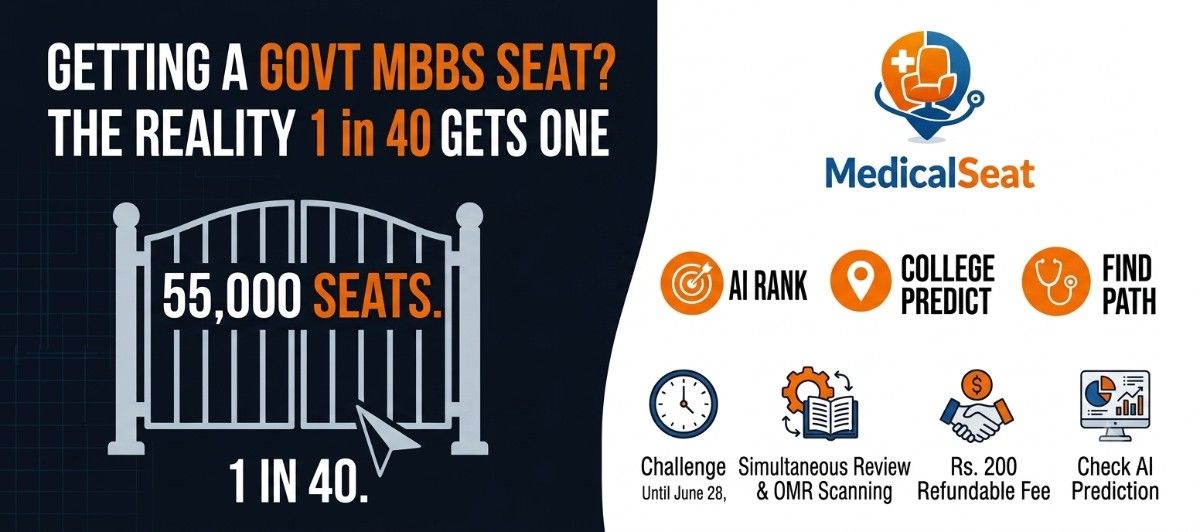
1 in 40 NEET Candidates Gets a Government MBBS Seat. Before Anything Else Today, Read This!
India has 55,000 government MBBS seats for 23 lakh NEET candidates. Know the numbers, understand the odds, and build a smarter counselling strategy for 2026.
The Total Number of Government MBBS Seats in India and What That Means For You
There is a number that quietly governs the ambitions of over two million families in India every single year. It is not the NEET cutoff. It is not the All India Rank. It is something more foundational, more brutal in its finality, and yet almost never spoken about plainly enough. That number is the total number of government MBBS seats available in the country, and understanding it with clarity, not optimism, is the single most important piece of strategic preparation any NEET 2026 aspirant can carry into the counselling season.
Let us talk about it honestly, systematically, and with the kind of detail that actually helps you plan.
The Actual Numbers: Government MBBS Seats in India Today
India currently has approximately 706 medical colleges recognised by the National Medical Commission, and the total MBBS seats across all of them, government and private combined, now stands at approximately 1,12,112 seats as of the most recently approved seat matrix. Of these, government medical colleges account for roughly 55,000 to 57,000 MBBS seats across approximately 340 government institutions.
That sounds substantial until you measure it against the number of candidates who appear for NEET every year, which now exceeds 23 lakh. The arithmetic is unsparing: fewer than 1 in 40 NEET candidates will secure a government MBBS seat in India. And within that narrow channel, the All India Quota, which is the 15% of government seats managed by the Medical Counselling Committee through MCC AIQ Counselling at mcc.nic.in, accounts for only around 8,000 to 9,000 seats nationally. The remaining 85% of government seats are distributed through state quota counselling, each state running its own process with its own domicile requirements, reservation structures, and closing rank patterns.
This distinction between the AIQ seats and state quota seats is not a technicality. It is the structural reality within which every NEET College Predictor 2026, every NEET Rank Predictor 2026, and every MBBS College Predictor India must be understood.
How Government Seats Are Distributed: A State by State Perspective
Government MBBS seats are not spread evenly across India. Historically, the southern states, particularly Tamil Nadu, Karnataka, Andhra Pradesh, and Telangana, have had a disproportionately large share of both government and private MBBS infrastructure relative to their population. The northern and eastern states, Bihar, Uttar Pradesh, Rajasthan, Madhya Pradesh, and Odisha among them, have been catching up in recent years through new AIIMS campuses and state medical college expansions, but the gap remains significant.
The table below gives an indicative picture of government MBBS seat distribution and the corresponding counselling authority across major states.
State | Approximate Government MBBS Seats | State Quota Counselling Authority | AIQ Seats (15%) Counselling |
Tamil Nadu | 4,800+ | TNMGRMU / DOTE | MCC |
Karnataka | 3,500+ | KEA | MCC |
Maharashtra | 3,800+ | DMER Maharashtra | MCC |
Andhra Pradesh | 2,800+ | NTRUHS | MCC |
Telangana | 2,200+ | TSNMC / Kaloji NTR UHS | MCC |
Uttar Pradesh | 3,200+ | DGME UP | MCC |
Rajasthan | 2,400+ | RUHS | MCC |
Madhya Pradesh | 2,000+ | DMET MP | MCC |
Bihar | 1,400+ | BCECEB | MCC |
Kerala | 1,600+ | Commissioner for Entrance Examinations | MCC |
West Bengal | 2,000+ | WBMCC | MCC |
Gujarat | 2,200+ | ACPC Gujarat | MCC |
These figures are indicative and drawn from recent NMC approved seat matrices. Seat counts shift each year as new colleges receive recognition and existing institutions expand intake, so candidates should always verify from the official state counselling authority website and the MCC information bulletin before finalising their strategy.
What this table underscores is something important for any aspirant using a Government Medical College Predictor or a State Quota MBBS College Predictor: your domicile state is not just a logistical detail. It is a strategic variable. A candidate from Bihar competing for Bihar state quota seats faces a very different competitive environment from the same candidate attempting to access Tamil Nadu's government colleges through AIQ, where domicile carries no weight but rank competition is fierce from across the country.
The All India Quota: Fiercely Competitive, Genuinely Open
The 15% All India Quota seats in government medical colleges are administered centrally by the Medical Counselling Committee and represent the only route through which candidates from any state can access government college seats in another state. MCC AIQ Counselling runs through four rounds, Round 1, Round 2, Mop Up, and Stray Vacancy, and the AIQ MBBS College Predictor must be used separately from the state quota predictor because the competitive dynamics are meaningfully different.
AIQ closing ranks for top government colleges are among the most discussed data points in NEET preparation, and they reveal just how concentrated the competition is at the apex. AIIMS New Delhi, which technically operates outside standard MCC AIQ Counselling but anchors the aspirational landscape, sees closing ranks in the single digits. The top government colleges in Tamil Nadu, Karnataka, Maharashtra, and UP close through AIQ within ranks of 2,000 to 20,000 for the General category, depending on year, specialisation, and the specific college. The NEET 2026 Expected Cutoff for top AIQ government seats, based on 2024 and 2025 patterns, would require a NEET Safe Score 2026 of at least 600 to 640 for a realistic shot at the most sought after institutions.
This is precisely why the AIQ MBBS College Predictor and the Government Medical College Predictor must be used together, cross referencing your NEET Expected Rank 2026 against both pools simultaneously, because a candidate who misses their top AIQ choice in Round 1 may still find a strong government seat available through state quota in their home state, or through the Mop Up round.
ReNEET 2026 and What It Changes for Government Seat Access
The introduction of ReNEET 2026 adds a dimension to this year's counselling season that did not exist in most previous cycles, and it affects the government seat landscape in ways that candidates need to think through carefully.
ReNEET 2026 is being conducted for candidates who meet the specified eligibility criteria for a re examination, and the scores and ranks generated by ReNEET 2026 feed into the same counselling pool as the main NEET UG 2026 results. This means the ReNEET 2026 Answer Key, once released, should be used immediately to calculate your NEET Expected Rank 2026 using a reliable NEET Score Calculator 2026 or an AI Powered NEET Rank Predictor, because the rank is what determines your position in every queue, whether that queue is for an AIQ government seat, a state quota seat, or a management quota seat in a private college.
The ReNEET 2026 Result feeds into all counselling streams simultaneously. MCC AIQ Counselling, NTRUHS in Andhra Pradesh, KEA in Karnataka, TNMGRMU in Tamil Nadu, DMER in Maharashtra, and every other state authority will use the consolidated merit list that includes both NEET UG 2026 and ReNEET 2026 scores. The NEET 2026 Official Answer Key and the ReNEET 2026 Answer Key should therefore both be used as soon as they are published to run your NEET Score vs Rank 2026 calculation, because every hour of clarity you gain before counselling registration opens is an hour you can spend building a smarter preference list.
Candidates who appeared for ReNEET 2026 should also note that the total applicant pool for 2026 may be somewhat different from 2024 and 2025, which means the NEET 2026 Expected Cutoff at specific government colleges could shift in either direction. Use an AI Powered NEET Rank Predictor that accounts for the current year's difficulty distribution rather than relying solely on historical patterns.
NEET Score vs Rank vs Government Seat: The Honest Translation
One of the most persistent sources of anxiety among NEET aspirants is the translation problem: you have a score in your hand, but what you actually need is a rank, and what you need after that is a realistic read on which government seats that rank can reach. Let us walk through that translation honestly.
The relationship between NEET score and All India Rank shifts every year depending on paper difficulty, total number of candidates, and the score distribution across the cohort. A score of 600 that placed a candidate at rank 18,000 in one year might place the same candidate at rank 12,000 or 24,000 in another year. This is why a NEET Score vs Rank 2026 tool calibrated to this specific year's paper is more reliable than historical tables, and why an AI NEET College Predictor that adjusts for this year's distribution gives sharper output than a static cutoff chart.
The second table below maps approximate score bands to their expected government seat access across quota types, using recent cycle patterns as the reference point.
NEET Score Band | Approximate AIR (General) | Government College Access |
650 and above | Under 1,000 | AIIMS campuses, top JIPMER, top government colleges in Tamil Nadu, Karnataka, Maharashtra through AIQ |
600 to 650 | 1,000 to 15,000 | Strong AIQ access to government colleges across all major states, top state quota seats accessible |
550 to 600 | 15,000 to 60,000 | AIQ government seats in mid tier colleges, strong state quota access in most states for domicile candidates |
500 to 550 | 60,000 to 1,50,000 | State quota government seats in many states for domicile candidates, AIQ access narrows significantly |
450 to 500 | 1,50,000 to 3,00,000 | Government seats largely unavailable through AIQ, limited state quota access in lower demand states |
Below 450 | 3,00,000 and beyond | Government seats become very difficult to access through any route; private and deemed college strategy becomes primary |
The NEET General Category College Predictor, NEET OBC College Predictor, NEET EWS College Predictor, NEET SC College Predictor, and NEET ST College Predictor each produce meaningfully different outputs for the same raw score, because reservation categories carry lower closing ranks at government colleges across every state. A General category candidate at rank 80,000 may find government seats effectively unavailable through AIQ, while an SC or ST category candidate at the same rank may still have viable options in state quota counselling. This is not a footnote; it is a core input into every MBBS Admission Chances Calculator exercise.
State Quota Government Seats: Where Domicile Becomes Strategy
The 85% state quota seats in government colleges are, for most candidates, the more accessible and more realistic government seat pathway. But accessible is a relative word, and it requires context.
In states with large government seat counts and strong local demand, such as Tamil Nadu, Maharashtra, and Karnataka, the state quota closing ranks for General category candidates at top government colleges can be as competitive as or more competitive than some AIQ seats elsewhere. Tamil Nadu MBBS Cutoff 2026 and Karnataka MBBS Cutoff 2026 for government colleges will likely continue the pattern of recent years, where top state government colleges close within ranks of 5,000 to 25,000 for the General category.
In states where government infrastructure is still expanding, the closing ranks tend to be wider, offering a more realistic window for candidates in the middle rank bands. Candidates whose home states are Bihar, Chhattisgarh, Odisha, Jharkhand, or the northeastern states may find that their state quota closing ranks are meaningfully more accessible than what the national averages suggest.
This is why the MBBS College Predictor India function in any serious college predictor tool must allow filtering by both state quota and AIQ separately. A candidate from Andhra Pradesh planning their 2026 counselling strategy needs to run the NTRUHS state counselling filter for Andhra Pradesh MBBS Cutoff 2026 in parallel with the MCC AIQ filter, and should also keep Telangana MBBS Cutoff 2026, Tamil Nadu MBBS Cutoff 2026, and Karnataka MBBS Cutoff 2026 in view, since AIQ opens government seats in all of those states to candidates regardless of their domicile.
The Role of AIIMS, JIPMER, and Centrally Administered Institutions
Any discussion of government MBBS seats in India would be incomplete without acknowledging the centrally administered institutions that sit outside the standard MCC AIQ process and yet absorb a large share of aspirant attention.
AIIMS New Delhi, along with the 15 newer AIIMS campuses established under the Pradhan Mantri Swasthya Suraksha Yojana at Bhopal, Patna, Jodhpur, Bhubaneswar, Rishikesh, Raipur, Nagpur, Mangalagiri, Bathinda, Deoghar, Bibinagar, Gorakhpur, Kalyani, Rajkot, and Awantipora, collectively offer approximately 1,725 MBBS seats. JIPMER in Puducherry adds another 200 seats. These institutions admit through their own counselling processes using NEET scores, but closing ranks at AIIMS New Delhi and a handful of other premium campuses remain in the single digits to low hundreds for General category candidates, which means they are realistic targets only for a very small subset of the overall NEET cohort.
Candidates who are genuinely in contention for AIIMS and JIPMER seats will know it from their NEET Score vs Rank 2026 calculation. For the vast majority of the 23 lakh candidates who appear each year, the practical government seat landscape is defined by the approximately 55,000 seats spread across state government colleges and the AIQ system, not by the AIIMS network.
Building Your Strategy Around the Government Seat Reality
The hard truth about government MBBS seats is that 55,000 seats divided by 23 lakh candidates leaves most aspirants in a position where private college strategy is not the fallback plan. It is the main plan, and it should be built with the same rigour and seriousness as the government seat plan.
This does not mean abandoning the government seat pursuit. It means running both tracks simultaneously, with a clear understanding of where your NEET Expected Rank 2026 places you in each track. Use a NEET College Predictor 2026 that separates government and private college outputs clearly. Use an AI Powered NEET Rank Predictor to sharpen your rank estimate as soon as the NEET 2026 Official Answer Key or ReNEET 2026 Answer Key is published. Then use a Medical College Predictor by Rank and a Medical College Predictor by Marks to build separate lists for government college choices and private college choices, rather than treating them as a single undifferentiated pool.
For government seats, the choice filling strategy in MCC AIQ Counselling and in state quota counselling should always be built around the accept and upgrade philosophy in states where it is available: lock the best seat you can get in Round 1, while retaining eligibility to move up in Round 2, the Mop Up round, and the Stray Vacancy round. Missing a response window in MCC counselling is one of the most common and most avoidable reasons candidates lose secured seats, so the round by round calendar deserves as much attention as the cutoff data itself.
For candidates whose rank places them outside the government seat zone, the Private College Predictor and Deemed University Predictor become the primary instruments. Karnataka MBBS Cutoff 2026 for deemed universities, Andhra Pradesh MBBS Cutoff 2026 for private colleges under NTRUHS, Maharashtra MBBS Cutoff 2026 for state management quota, Uttar Pradesh MBBS Cutoff 2026, Rajasthan MBBS Cutoff 2026, Madhya Pradesh MBBS Cutoff 2026, Gujarat MBBS Cutoff 2026, Punjab MBBS Cutoff 2026, Haryana MBBS Cutoff 2026, West Bengal MBBS Cutoff 2026, and the full set of state cutoffs should be mapped against your rank using a comprehensive MBBS College Predictor India view.
A NEET OBC College Predictor, NEET EWS College Predictor, NEET SC College Predictor, or NEET ST College Predictor must be used for reserved category candidates rather than the general predictor, because the closing rank differential for reserved categories at both government and private colleges is substantial enough to change which institutions are realistically within reach.
The Seat Count Is Growing, But Not Fast Enough
It would be misleading to paint an entirely static picture. The government MBBS seat count in India has grown meaningfully over the past decade, driven by new AIIMS campuses, upgradation of district hospitals into teaching hospitals, and NMC's push to increase intake at existing government colleges. The total MBBS seat count nationally, including private and deemed, has grown from approximately 54,000 in 2014 to over 1,12,000 today.
But the candidate pool has grown at least as fast, if not faster. NEET 2026 Applicants are expected to exceed 23 to 24 lakh, and the proportion of genuinely competitive scores, those above 500 marks, has grown as coaching quality and awareness have improved across Tier 2 and Tier 3 cities. The net effect is that a government seat in 2026 is not meaningfully easier to access than it was five years ago, even though there are more of them in absolute terms.
This is the structural context within which every NEET Rank Predictor 2026, every NEET Safe Score 2026 estimate, and every MBBS Admission Chances Calculator must be understood. The numbers are larger, but so is the competition. The only thing that genuinely shifts the odds in your favour is knowing exactly where you stand, building your preference list with precision rather than hope, and executing the counselling process without missing a single deadline.
What You Should Do Right Now
The moment the NEET 2026 Official Answer Key is published, or the ReNEET 2026 Answer Key if you appeared for the re examination, run your marks through a NEET Score Calculator 2026 and get your NEET Expected Rank 2026 on paper. Do not wait for the official result. Do not rely on memory or vague estimates. Use an AI Powered NEET Rank Predictor calibrated to this year's difficulty and cohort size, because the difference between rank 15,000 and rank 25,000 can be the difference between a government seat and a private college.
Once you have your estimated rank, open a NEET College Predictor 2026 or a Private Medical College Predictor and run your number through both the government and private filters simultaneously, for your category, for your domicile state's quota, and for the AIQ pool. Build your government college list and your private college list as parallel documents, not sequential ones. Treat them both with the same seriousness.
Then register on time, verify your documents before the window closes, fill your choices with deliberation rather than panic, and respond to every round of allotment within the stated deadline. The counselling process rewards preparation and punishes delay more consistently than any other variable in the MBBS admission journey.
Government MBBS seats in India number roughly 55,000 in a country of 140 crore people. That is the reality. What you do with that reality, how intelligently you plan, how comprehensively you use the tools available, and how precisely you execute the process, is the part entirely within your control.
For a free AI Powered NEET Rank Predictor, NEET College Predictor 2026, and state by state MBBS cutoff comparison across government, private, and deemed colleges, visit MedicalSeat. No login required. Instant results.
Email: support@medicalseat.com
Phone: +91 9751795765